
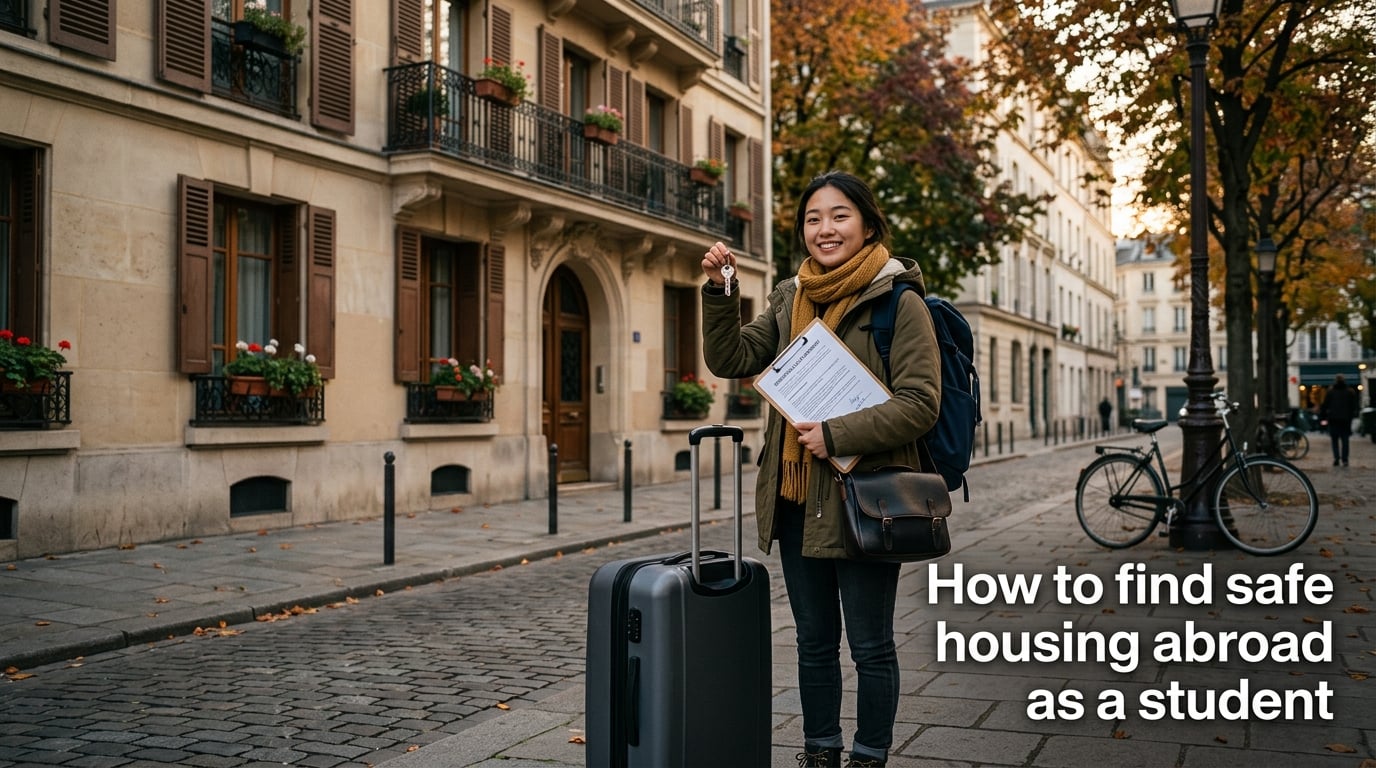
Finding safe housing abroad as a student starts with one rule: never sign or pay anything until you have verified the listing, the landlord, and the contract. This guide walks you through every step, from types of accommodation to scam red flags to country-specific platforms, so you can secure a safe place before your plane lands.
Where you live during a study abroad semester directly affects your academic focus, mental health, and personal safety. Unsafe or poorly chosen accommodation is the number one avoidable risk reported by international students, and a common reason for early program withdrawal. We built this guide using real student experiences from Reddit, Quora, and expat forums, combined with university housing office recommendations and current platform data.
Table of Contents
Types of Student Housing Abroad
Before you start searching, you need to understand the main housing types available to international students. Each comes with different trade-offs in cost, safety, privacy, and social integration.
University Dormitories and Residence Halls
On-campus dorms are the easiest option for first-time study abroad students. The university handles contracts, utilities, and security. You get proximity to campus, built-in social life, and usually 24-hour front desk support.
The downside is limited availability. Many universities prioritize incoming freshmen over exchange students, and waitlists at popular schools can stretch one to three semesters. Dorms also tend to have strict rules about guests, quiet hours, and move-out dates.
Homestays with a Host Family
Living with a local family gives you cultural immersion, language practice, and a built-in support system. Homestays often include meals and utilities in the price. They work especially well for younger students or those studying in countries where they do not speak the local language.
Privacy is the trade-off. You are living in someone else’s home with their rules. If independence matters to you, a homestay may feel restrictive after the first few weeks.
Shared Apartments and House Shares
Sharing an apartment with other students is the most common housing type for international students in Europe. You split rent and utilities, get more space than a dorm, and choose your own location.
The risk is compatibility. Cleaning schedules, noise levels, and guest policies become daily negotiations. Vet your roommates the same way you would vet a landlord: ask direct questions before signing anything together.
Private Apartments
A private apartment gives you full independence and control over your space. You pick the neighborhood, set your own rules, and do not depend on roommates for cleanliness or quiet.
This is also the most expensive and riskiest option for first-time international renters. You handle the entire lease yourself, including deposits, utility contracts, and landlord communication in a foreign language. Students without a local guarantor or credit history may face extra hurdles.
Private Student Residence Halls
Companies like Resa in Spain or private operators in the UK and Netherlands run student-only buildings with furnished rooms, shared kitchens, and organized social events. They sit between a dorm and an apartment in both price and independence.
Quality varies widely. Some are well-managed with proper security and maintenance. Others are overpriced for what they offer. Read Google and Trustpilot reviews before committing.
How to Find Safe Housing Abroad as a Student: Step-by-Step
This is the core process for finding safe student housing abroad. Follow this timeline and you will have a confirmed, verified place before you board your flight.
6 Months Before Arrival: Research and Apply to University Housing
Contact your university’s housing office or international student services department. Ask what housing options they guarantee or recommend for exchange and international students. Many schools have dedicated portals with pre-vetted listings.
If your university offers on-campus housing, apply immediately. These spots fill fast, especially for fall semester start dates. At the same time, research the city’s housing market. Look at average rents, popular student neighborhoods, and which platforms locals use.
4 to 3 Months Before: Search Verified Platforms
Use established student housing platforms that verify their listings. The most trusted options include Student.com, Uniplaces, Study Abroad Apartments, and Erasmus Play. These sites work directly with landlords and property managers, which significantly reduces scam risk.
Avoid starting your search on Facebook Marketplace or Craigslist. While legitimate listings do exist on social media, these platforms also carry the highest concentration of rental scams targeting international students.
3 to 2 Months Before: Tour and Verify
Request a live video tour of any property you are seriously considering. A live video call with the landlord or current tenant walking through the space is the minimum standard. Pre-recorded videos can be faked or stolen from other listings.
During the video tour, ask to see: every room including bathroom and kitchen, the building entrance and any security features, the street outside, and any damage or maintenance issues. If the landlord refuses a live video tour, walk away.
2 to 1 Month Before: Sign and Pay Securely
Read the entire lease or rental contract. If it is in a language you do not fully understand, have someone translate it before signing. Your study abroad advisor or university international office can often help with this.
Pay deposits only through traceable methods. Bank transfers and credit card payments create a paper trail. Never send cash, cryptocurrency, or wire transfers to individuals you have not met in person. Legitimate landlords accept standard payment methods and provide receipts.
Arrival Week: Inspect and Document
When you arrive, inspect the property before unpacking. Take photos and video of every room, including any existing damage. Send these to the landlord with a timestamp. This protects your deposit when you move out.
Test all locks, windows, smoke detectors, and appliances. Report anything broken immediately in writing (email or text message), not just verbally. A documented record protects you if the landlord later claims the damage was yours.
Safety Checklist: What to Look For in Student Accommodation
Use this checklist when evaluating any housing option, whether online or in person. A safe place meets most of these standards, not necessarily all of them, but missing several is a red flag.
Building and Unit Safety
Check that all exterior doors have working locks, ideally deadbolts. Windows should lock securely, especially on ground-floor units. Look for smoke detectors in every room and a fire extinguisher in common areas or the kitchen.
Verify that the building has at least two emergency exits and that hallways and stairwells are clear of obstructions. Elevators should have inspection certificates posted inside. If the building has security cameras or a front desk, that is a plus.
Neighborhood Safety
Research the neighborhood using Google Maps Street View, local crime statistics websites, and student forums for that city. Look for well-lit streets, active businesses, and proximity to public transportation. A 15-minute walk to campus is ideal for balancing cost and convenience.
Avoid ground-floor apartments in high-crime areas. If you are unfamiliar with the city, ask your study abroad advisor or alumni network which neighborhoods they recommend and which to avoid.
Lease and Contract Terms
A proper lease should include your full name, the property address, monthly rent amount, deposit amount, lease duration, notice period for termination, and the landlord’s full legal name and contact information. Verbal agreements are not enough.
Confirm what utilities are included in rent and which you pay separately. Ask about the deposit return process: when it gets returned, what deductions are allowed, and whether the deposit is held in a protected scheme. Many European countries require landlords to keep deposits in separate protected accounts.
How to Spot and Avoid Housing Scams
Housing scams are the single biggest risk international students face during the accommodation search. Real students report these patterns repeatedly on Reddit and expat forums. Knowing what to look for is your best defense.
Common Scam Red Flags
The listing price is significantly below market rate for the area. If a furnished apartment in central Barcelona costs half what comparable places charge, it is almost certainly a scam. Scammers use low prices to generate urgency and prevent you from thinking critically.
The landlord says they are abroad and cannot show the apartment in person. This is the most common scam pattern reported by Erasmus students in Spain. The fake landlord asks for a deposit to “hold” the apartment, then disappears.
You are pressured to decide within hours or days. Legitimate landlords give you reasonable time to consider. Scammers create artificial urgency to stop you from verifying anything.
The listing uses photos that appear on multiple other listings. Do a reverse image search on Google. If the same photos show up under different addresses or landlords, the listing is fake.
The landlord asks for payment via Western Union, cryptocurrency, gift cards, or wire transfer before you have signed a contract. No legitimate landlord requires untraceable payment methods.
What to Do If You Are Scammed
Contact the platform where you found the listing and report the scam immediately. File a report with local police in the city where the property is supposedly located. If you are already abroad, visit the nearest police station with all evidence: screenshots, emails, payment receipts.
Notify your university’s international student office. They may have emergency housing resources or can connect you with student legal services. In the EU, you can also contact the European Consumer Centre for cross-border disputes.
Country-Specific Housing Platforms and Tips
Each country has its own housing ecosystem. Using the right platforms for your destination saves time and reduces scam exposure.
Germany
Apply to Studierendenwerk in your city as early as possible. These are public student services organizations that manage subsidized dorms. Waitlists are long, but the rooms are safe, affordable, and contract-protected. For private housing, WG-Gesucht is the dominant platform for shared apartments (WGs). ImmobilienScout24 covers full apartments.
In Germany, landlords must provide a written lease and cannot charge more than two months’ rent as a deposit. The Mieterschutzbund (tenant protection association) offers free or low-cost contract reviews for students.
Spain
Idealista and Fotocasa are the two largest rental platforms in Spain. Both allow you to filter for furnished apartments and contact landlords directly. Resa.es operates a chain of student housing facilities in major university cities.
Scam risk in Spain is notably high for Erasmus students. Multiple students report arriving to find apartments that do not exist or are already rented. Always verify the listing through a live video tour and pay only after signing a contract.
Netherlands
The Dutch housing market is extremely competitive, especially in Amsterdam, Utrecht, and Delft. Kamernet is the main platform for student rooms. SSH and other housing corporations manage student-specific buildings with waiting lists.
Facebook groups for international students in the Netherlands are widely used, but also carry significant scam risk. Meet any potential landlord in person before agreeing to anything. Dutch law requires landlords to register deposits with a protection scheme.
United Kingdom
SpareRoom and Rightmove are the primary platforms for student housing in the UK. Many universities also have their own accommodation portals with vetted private landlords. Purpose-built student accommodation (PBSA) from companies like Unite Students or iQ provides furnished rooms with included bills and security.
In England and Wales, landlords must protect your deposit in a government-approved scheme within 30 days of receiving it. Scotland and Northern Ireland have their own deposit protection rules. Always ask which scheme your deposit is registered with.
United States
Zillow, Trulia, and Apartments.com are the largest general rental platforms. Your university’s off-campus housing office is the best starting point. Many schools maintain listings of verified landlords who have rented to students before.
In the US, you typically need a Social Security Number or Individual Taxpayer Identification Number for a credit check. International students without these can sometimes use a guarantor service or pay several months of rent upfront.
Australia
Domain and realestate.au are the main rental platforms. Universities often have dedicated international student accommodation services. Purpose-built student housing near major campuses provides furnished options with included utilities.
Australian tenancy laws are strong. Your bond (deposit) must be lodged with a government tenancy authority, not held by the landlord. Each state has its own tenancy tribunal for disputes.
Temporary Housing While You Search
Many experienced international students recommend booking temporary accommodation for your first one to two weeks and searching for permanent housing in person once you arrive. This approach dramatically reduces scam risk because you can physically visit properties and meet landlords.
Good temporary options include Airbnb (look for monthly discounts), hostels with private rooms, university guest housing, and budget hotels near campus. Some universities offer emergency or transitional housing specifically for arriving international students. Ask your international student services office if this exists at your school.
Do not sign a long-term lease from abroad just because you are anxious about not having a place. The first two weeks in temporary housing is a worthwhile investment for the safety and certainty of seeing a place in person.
Budgeting for Student Housing Abroad
Budget accurately by accounting for more than just monthly rent. Your total housing cost includes the security deposit, first month’s rent, utilities if not included, renter’s insurance where applicable, and furnishing costs if the apartment is unfurnished.
Sample monthly costs for a shared apartment in popular student cities (approximate, 2026): Berlin runs 400 to 600 euros, Barcelona 350 to 550 euros, Amsterdam 500 to 800 euros, London 600 to 900 pounds, Melbourne 500 to 750 Australian dollars, and New York 800 to 1,200 US dollars. These ranges shift based on neighborhood, apartment size, and whether utilities are included.
Always keep a buffer of at least one extra month’s rent in your bank account. Unexpected costs come up: a broken appliance, a rent increase, or needing to move earlier than planned. Financial stress makes every other problem worse.
Frequently Asked Questions
How to find housing when studying abroad?
Start by contacting your university’s housing office or international student services. They often have vetted listings and can recommend trusted platforms. Search on established student housing sites like Student.com, Uniplaces, or Study Abroad Apartments. Always request a live video tour, verify the landlord’s identity, and read the full contract before paying any deposit.
Where is the safest place to study abroad?
Countries with strong tenant protection laws and low crime rates are generally the safest for student housing. Denmark, Switzerland, Japan, New Zealand, and the Netherlands consistently rank high for overall safety. However, safety depends more on the specific city and neighborhood than the country. Research the area where your university is located and talk to current students about their experiences.
What is the best website for student housing abroad?
Student.com, Uniplaces, and Study Abroad Apartments are the most widely used verified platforms for international student housing. Each verifies listings and works directly with landlords, which reduces scam risk. For country-specific searches, use WG-Gesucht in Germany, Idealista in Spain, Kamernet in the Netherlands, and SpareRoom in the UK.
How to avoid student housing scams?
Never pay a deposit before signing a written contract and seeing the property via a live video tour. Do a reverse image search on listing photos. Avoid landlords who claim they are abroad and cannot show the apartment. Pay only through traceable methods like bank transfer. If the price is far below market rate or you are pressured to decide immediately, walk away.
Does Erasmus help with housing?
The Erasmus program itself does not directly provide housing, but your home and host universities may offer support. Many European universities have partnerships with student housing providers and can recommend verified platforms. The Erasmus Play platform lets you compare student accommodation options across European cities. Contact your host university’s Erasmus office for housing guidance specific to your destination.
How much does student housing cost abroad?
Costs vary significantly by city and housing type. A shared apartment room ranges from 350 to 600 euros per month in most European cities, 600 to 900 pounds in London, and 800 to 1,200 US dollars in New York. University dorms are usually cheaper than private rentals. Budget for the security deposit, first month’s rent, and utilities separately from monthly rent.
Final Thoughts
Knowing how to find safe housing abroad as a student comes down to three habits: start early, verify everything, and never pay before you have a signed contract. Use verified platforms, request live video tours, research neighborhoods, and trust your instincts when something feels off. The extra time you spend vetting a place is nothing compared to the stress of a bad rental or a scam.
Your university’s international student services office is your single most valuable resource. They have seen every housing problem before and know the local market better than any online guide. Reach out to them first, and use this guide as your roadmap for everything that comes after.