
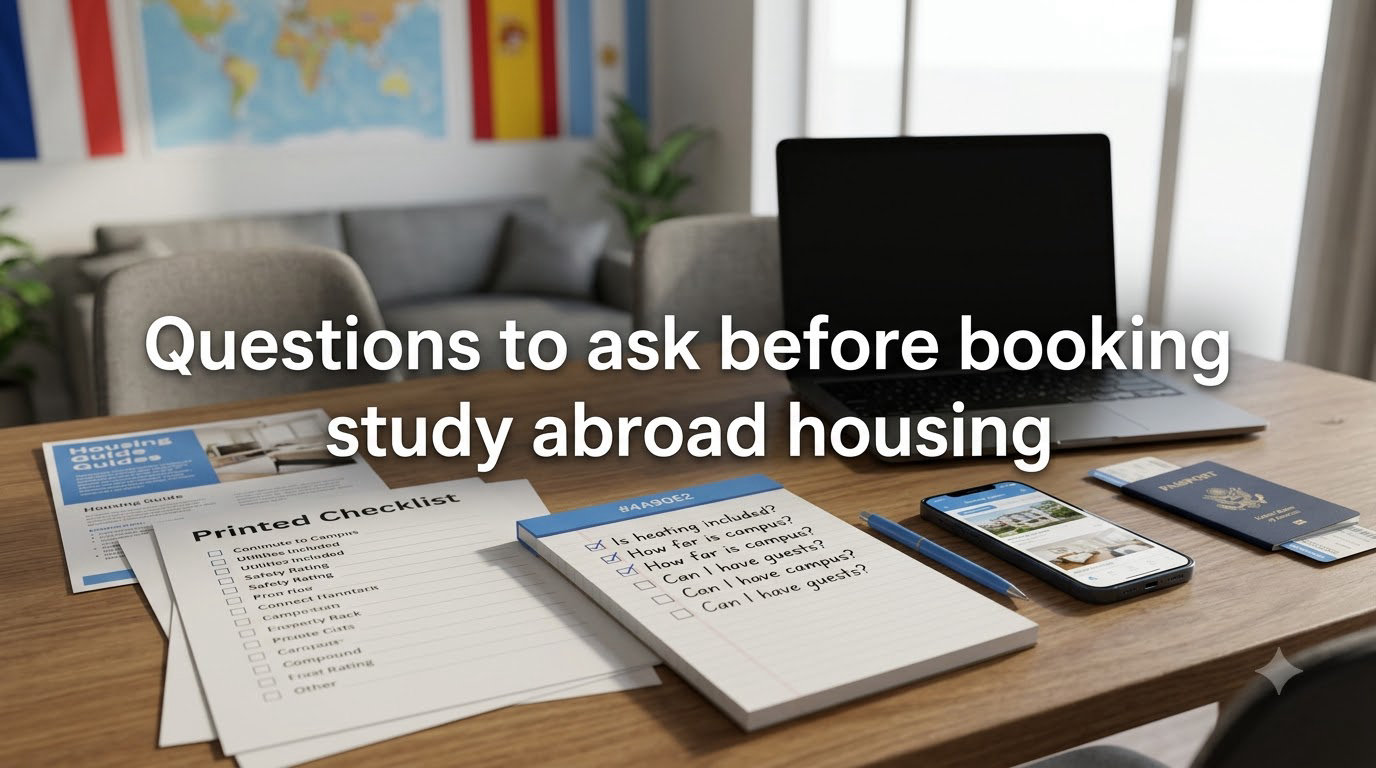
Booking study abroad housing is one of the most stressful decisions international students face. You are committing to months of rent, often in a country you have never visited, based on photos and a video call. The right questions to ask before booking study abroad housing can save you from hidden charges, unsafe buildings, broken leases, and outright scams.
Our team has helped hundreds of international students prepare for study abroad moves since 2026. In this guide we share the full checklist we use with our own students, organised by category so you can work through it before you sign anything or send a deposit.
You will find sections on cost and budget, contract terms, what’s included, safety, maintenance, roommates, study abroad-specific concerns, remote viewing, red flags, and a university-versus-private comparison. We finish with a FAQ answering the most common questions students search for.
Table of Contents
Cost and Budget Questions to Ask Before Booking Study Abroad Housing
Money problems are the single biggest reason study abroad housing goes wrong. A “cheap” room becomes expensive once deposits, utilities, admin fees, and currency conversion are added. These questions reveal the real total cost of your stay.
- What is the total monthly rent, and is it per person or per room?
- Are utilities included (electricity, water, gas, internet, contents insurance)?
- How much is the deposit, and is it protected in a government scheme?
- Are there application, admin, or agency fees on top of the deposit?
- In which currency can I pay, and which payment methods do you accept?
- Will the rent increase during my tenancy, and by how much?
If the landlord cannot give you a written breakdown of monthly and upfront costs, walk away. Reviewers on student housing forums consistently report that hidden fees are the most common surprise in study abroad accommodation.
Contract and Lease Terms Every International Student Should Ask About
A study abroad lease is a legal contract in a foreign country. Before you sign it, you need to understand the rules, the exit options, and who is on the hook if something goes wrong.
- What is the minimum contract length, and does it match my study period?
- Can I terminate the lease early if I leave the program or transfer universities?
- Do you require a local guarantor or a UK-based guarantor?
- Is subletting allowed during semester breaks or summer holidays?
- What is the renewal process, and what notice do I need to give?
- What happens to my deposit at the end of the lease?
If you cannot get a copy of the contract to review before paying any money, that is itself a red flag. Every legitimate landlord will email you a draft agreement.
What Is Included in the Accommodation
“Furnished” means different things to different landlords. A room listed as furnished may still leave you sleeping on a bare mattress and cooking with one saucepan. Ask exactly what is in the room before you book.
- Is the bedroom fully furnished (bed, mattress, desk, chair, wardrobe, storage)?
- Is kitchen equipment, cutlery, and bedding provided?
- Is high-speed Wi-Fi included, and what is the typical download speed?
- Are laundry facilities on-site, and what does each load cost?
- Is parking available, and is it included or charged separately?
- Is cleaning of communal areas included in the rent?
Knowing what is included helps you budget for the items you will need to buy on arrival, which can easily run into four figures.
Security and Safety Questions for International Students
Safety is the top concern for parents and the top question on every international student’s mind. Ask about both the physical security of the building and the safety of the surrounding neighbourhood.
- What security features are in place (CCTV, key fob entry, secure letterboxes, intercom)?
- Is there on-site staff or a 24-hour reception?
- What are the fire safety procedures, and are smoke alarms tested regularly?
- How safe is the surrounding neighbourhood, and how close is the nearest police station?
- Is contents insurance included or available as an add-on?
If you cannot visit in person, ask the landlord or agent for the exact street and walk the area on Google Street View at different times of day. Night-time footage is often more revealing than daylight photos.
Maintenance and Repairs Process Explained
A broken boiler in winter or a leaking roof can ruin a semester. Before booking, you need to know how problems get reported and how fast they are fixed.
- How do I report maintenance issues, and what is the typical response time?
- Who pays for repairs caused by normal wear and tear?
- Is there an out-hours emergency contact for urgent problems?
- Are contractors vetted, and will you give notice before entering the property?
Properties managed by an agency usually have a formal maintenance system. Private landlords vary widely, so ask for evidence of how quickly past issues were resolved.
Roommate and Living Arrangement Questions
Your roommate can make or break your study abroad experience. Before you move in, you want to understand who you will live with, what the house rules are, and how disputes are handled.
- How are roommates selected, and can I request a specific gender, course, or nationality mix?
- What is the guest policy, and are overnight stays allowed?
- What are the quiet hours and house rules?
- Are pets allowed, and if not, can I have visiting friends with pets?
- What is the process if I have a serious conflict with a roommate?
For first-time international students, purpose-built student accommodation with a managed roommate matching service is usually the safer choice. Private shared flats require more self-reliance.
Study Abroad Specific Questions Most Guides Miss
This is the section that separates a real study abroad housing checklist from a generic rental checklist. Booking housing from thousands of miles away adds risks that ordinary renters never face.
- Can the landlord or provider provide proof of accommodation for my visa application?
- How do I verify the listing is real before paying any deposit from abroad?
- Are there cultural norms or house rules specific to this country that I should know about?
- Is there language support if I do not yet speak the local language fluently?
- What happens to my belongings if I travel home between semesters?
- Will the landlord accept scanned or digital copies of my passport and student visa for ID verification?
Most embassies and consulates require a formal proof-of-address letter from the landlord as part of the visa application. Get this commitment in writing before you pay a deposit, because the wrong letter format can delay your visa by weeks.
How to Book Study Abroad Housing Remotely Without Getting Scammed
When you cannot visit in person, remote viewing and verification become your only protection. These are the questions and checks we walk our students through when they cannot fly out first.
- Can I do a live video walk-through, not a pre-recorded tour, before signing anything?
- Can I verify the landlord or letting agent’s identity (business registration, company number, address)?
- Should I pay through the platform, a protected payment scheme, or directly to the landlord?
- What documents should I request before paying any money (ID, proof of ownership, recent utility bill at the address)?
- Does the university or a recognised student housing provider endorse this listing?
Students in the r/expats and r/StudyInTheNetherlands communities consistently warn against paying large deposits to private landlords without verified identification. University-affiliated housing providers and well-known purpose-built student accommodation brands are the safest remote options.
Red Flags and Scams to Avoid When Booking Study Abroad Housing
These are the warning signs we tell every student to treat as immediate walk-away signals. If you spot any of these, do not pay a single cent.
- The landlord asks you to pay the full deposit or several months’ rent before signing any contract.
- The price is far below market rate for the area, especially for a “furnished” room.
- The landlord refuses a video call, or cancels repeatedly.
- The landlord wants payment in cryptocurrency, gift cards, or a wire transfer to a personal account.
- The landlord pressures you to decide within hours, claiming “many other students are interested”.
- Photos and descriptions do not match between the listing, the contract, and the video tour.
- There is no physical address, or the address does not exist on Google Maps.
- The landlord is overseas and cannot show ID tied to the property ownership.
Forum discussions among international students consistently show that pressure to pay fast and requests for unusual payment methods are the two strongest signals of a scam.
University Housing vs Private Rental: Which Is Right for You?
University halls and purpose-built student accommodation are usually easier to book, safer to pay, and designed for students who arrive without local knowledge. They tend to be more expensive per week, but the all-inclusive pricing means fewer surprises.
Private rentals through local letting agents are often cheaper and give you more independence, a wider choice of locations, and the chance to live with friends. The trade-off is more paperwork, the need for a guarantor in many cases, and a longer application process.
For first-year international students who have never lived abroad, university-affiliated housing is almost always the lower-risk option. For second- and third-year students who know the city, private rentals usually offer better value and more flexibility.
Frequently Asked Questions
What are some good questions to ask when applying for a study abroad program?
Ask about housing options and how to secure accommodation before arrival, the level of on-campus welfare support, what proof of address the landlord can provide for your visa, the typical total cost of living including rent and utilities, and how the university helps international students who book housing remotely.
What are some important questions to ask about student housing?
Ask about total monthly rent and what is included, deposit amount and protection scheme, contract length and break clause, security features, maintenance response times, contents insurance, guest and overnight policies, and whether the provider can issue a proof-of-accommodation letter for visa purposes.
What are some common questions people ask about studying abroad?
Common questions include how to find housing in another country, whether to book before or after arrival, how to avoid rental scams, what support is available for international students, how to budget for total living costs, and how the local culture affects daily life and housing norms.
How to find housing when studying abroad?
Start with the host university’s official accommodation office, then check recognised purpose-built student accommodation providers in the city, then look at local letting agents with verified reviews. Use student forums for honest feedback, book a live video tour before paying any money, and always use a protected payment method until you have a signed contract.
Final Thoughts on Questions to Ask Before Booking Study Abroad Housing
The questions to ask before booking study abroad housing fall into a few clear buckets: money, contract, what’s included, safety, maintenance, and the study-abroad-specific risks that come with booking from another country. Run through the full checklist for every property you consider, not just your favourite one.
If a landlord refuses to answer any of these questions, refuses a live video tour, or pressures you to pay before signing a contract, treat that as the answer it really is. The right accommodation is the one that gives you clear answers and a written agreement before you part with a single pound, dollar, euro, or other currency.