
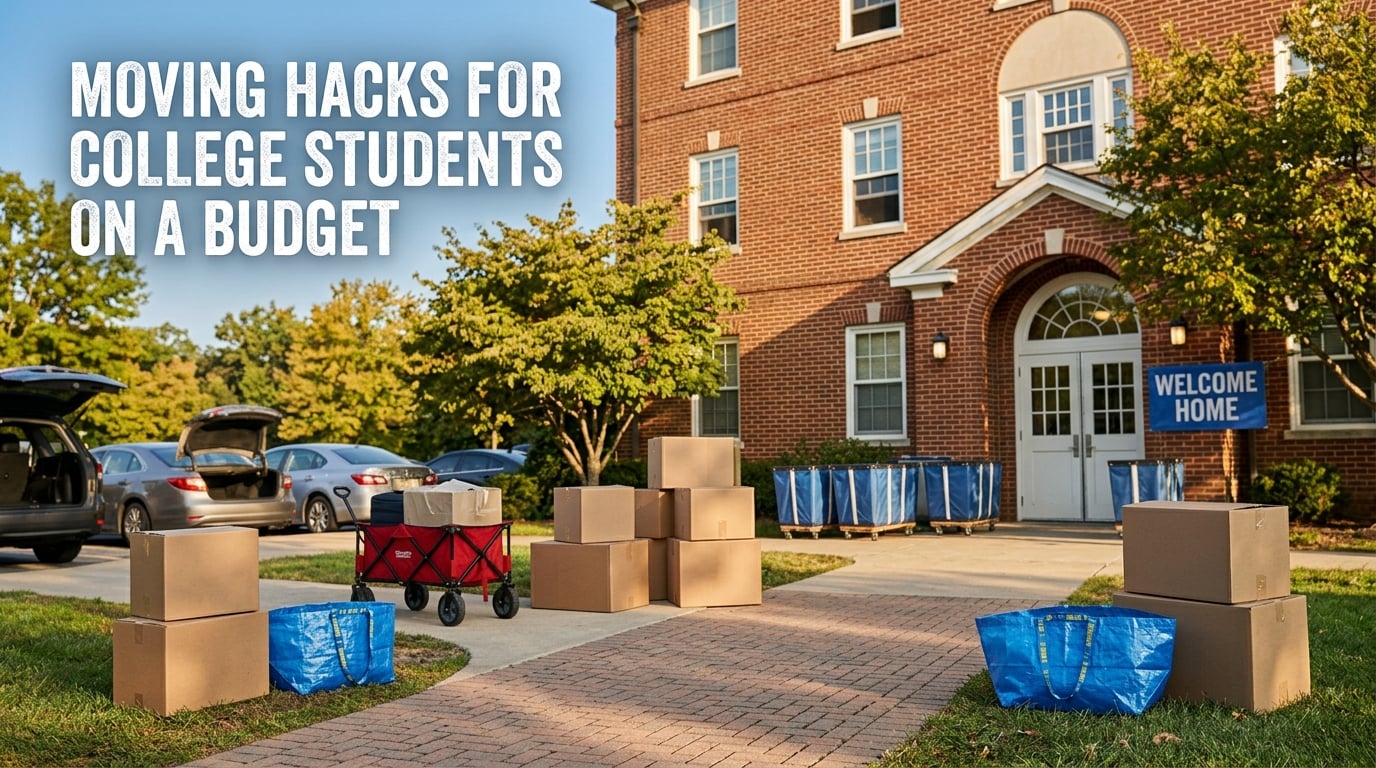
Moving into a college dorm can cost anywhere from $200 to $500 in unexpected expenses if you don’t plan ahead. Between shipping boxes, buying supplies, renting equipment, and covering first-week essentials, the bills add up fast. The good news: a handful of smart moving hacks for college students on a budget can cut those costs by 30 to 60 percent and save you hours of back-and-forth hauling.
This guide walks you through everything from sourcing free packing supplies to nailing move-in day logistics, so you can show up prepared without draining your bank account. We pulled advice from real students on Reddit, college forums, and our own experience helping hundreds of students settle into campus housing.
Table of Contents
Quick Hacks: Move Into College on a Budget
Build a moving budget before you buy anything. Write down every expected cost—supplies, equipment, transport, first-week food—so nothing catches you off guard.
Grab free boxes from grocery stores and liquor shops. Call ahead; most managers set aside sturdy boxes if you ask.
Roll clothes instead of folding them. Rolled garments take up 30 percent less suitcase space and arrive wrinkle-free.
Use IKEA Frakta zipper bags as duffel alternatives. They hold an entire closet’s worth of clothes and zip shut for rain protection.
Trash-bag your hanging clothes. Poke hangers through a drawstring bag opening, cinch it shut, and carry a full wardrobe in one trip.
Sell what you don’t need on Facebook Marketplace before the move. A weekend purge can fund your entire packing-supply budget.
Book the earliest move-in time slot available. You’ll beat the heat, grab equipment first, and have loading-zone access before it fills up.
Bring a folding dolly or collapsible wagon. Schools run out of loaners fast, and carrying boxes by hand across campus is miserable.
Ship heavy items ahead if you’re flying. Ground shipping costs less than a second checked bag and arrives at your dorm door.
Label every box with your name, room number, and contents. Suitemates mix up identical boxes every single year.
Plan Ahead and Build a Moving Budget
Start with a simple spreadsheet or a notes app list. Break your moving expenses into four categories: packing supplies, transport, dorm essentials, and first-week food. A realistic breakdown for a budget dorm move looks like this:
Packing supplies: $0 to $30 if you source free boxes and use towels as padding. Transport: $0 (personal car) to $75 (one-way truck rental) to $200+ (full-service). Dorm essentials: $100 to $300 depending on what your school provides. First-week food: $50 to $100 until your meal plan starts.
If you follow the 50-30-20 rule that financial advisors recommend for students—50 percent on needs, 30 percent on wants, 20 percent on savings—your moving costs fall squarely in the “needs” bucket. Knowing your total number before you shop prevents impulse buys at the campus bookstore, where markups run 20 to 40 percent above retail.
Pro tip: Check whether your school charges an early move-in fee. Many campuses offer free early arrival for RAs and athletes but charge $25 to $50 for other students. Booking that slot early can still save money if it means one trip instead of two.
Compare Your Transport Options
One content gap we noticed across every college-moving guide is a real cost comparison of your transport options. Here’s a side-by-side look at what each method actually costs for a typical local move (under 50 miles):
DIY with your own car: $0 in transport costs, but limited trunk space means multiple trips. Best for students who live within 30 minutes of campus and have a sedan or SUV. Expect 2 to 3 round trips for a full dorm load.
One-way truck rental: $20 to $75 for a local move with a cargo van or small truck. Companies like U-Haul and Budget offer student discounts mid-week. This is the sweet spot for most students—one trip, everything fits, and you don’t owe anyone a favor.
Full-service movers: $200 to $500 for a studio-sized load. You pay for the convenience of not lifting anything. Worth it only if you’re moving long-distance, have heavy furniture, or have a physical limitation.
Ship-ahead via ground: $15 to $30 per 20-pound box through USPS or UPS ground. Ideal for students flying to campus or attending school across the country. Ship a week early so boxes arrive before you do.
Borrow a friend’s truck or SUV: $0 plus a pizza and gas money. The classic college move. Coordinate with friends who have larger vehicles and offer to return the favor at the end of the year.
Find Free or Cheap Packing Supplies
Cardboard boxes are the single biggest hidden moving cost. Retail stores throw away hundreds of clean, sturdy boxes every week. Here’s where to find them for free:
Grocery stores: Banana and produce boxes are heavy-duty and already broken down. Ask the stock manager mid-morning when shipments arrive.
Liquor stores: Divided boxes are perfect for glasses, mugs, and toiletries—no bubble wrap needed.
Facebook “Buy Nothing” groups: Post a request two to three weeks before move-in. Families clearing out after graduation often give away boxes, tape, and even plastic bins.
Campus residence halls: Returning students drop off flattened boxes at recycling dumpsters after spring move-out. Grab them in May and store them.
For reusable alternatives, heavy-duty plastic bins from Home Depot or Walmart double as under-bed storage once you’re unpacked. IKEA Frakta bags (the big blue ones) hold an entire semester’s worth of clothes and cost less than a fast-food meal. As one Reddit user on r/lifehacks put it: “These big heavy-duty storage bins from Home Depot are the best way to move.”
Aim for 8 to 12 boxes total for a standard dorm room. You need fewer than you think—most students over-pack boxes and end up hauling half-empty containers. If you’re buying tape, go for a 2-inch wide packing tape rather than masking tape. It holds under weight and humidity, and one roll seals 15 to 20 boxes.
Declutter Before You Pack
The single most repeated piece of advice from r/dormrooms users is simple: try not to bring too much. Most students regret overpacking within the first week. Before you tape a single box, sort every item into four piles: keep, sell, donate, and trash.
Sell to fund your move. Facebook Marketplace, Poshmark, and Depop are your best friends here. List clothes, old textbooks, and electronics you haven’t touched in six months. A weekend selling spree can easily net $100 to $300—enough to cover your entire packing-supply budget and then some.
Donate responsibly. Goodwill and local shelters accept clothes, bedding, and small appliances. Schedule a pickup if you don’t have a car. Some schools host pre-move-in donation drives where you can drop items at a campus collection point.
Trash the rest. If it’s broken, stained, or hasn’t been used in a year, let it go. You’ll thank yourself when you’re carrying fewer boxes up three flights of stairs on a 90-degree day.
One angle most guides skip: digital declutter. Cancel subscriptions you won’t use at school (your parents’ streaming account might not work on campus WiFi). Return or sell textbooks from last semester. Unlink old accounts from devices you’re bringing. Free up cloud storage so you can back up your laptop before the move.
Smart Packing Techniques That Save Space and Money
How you pack matters as much as what you pack. These techniques cut your load by 20 to 40 percent, which means fewer boxes, fewer trips, and less stress on move-in day.
Roll, don’t fold. Rolled clothes compress tighter and resist wrinkling. Start with bulkier items like jeans and sweaters at the bottom of your suitcase, then layer rolled t-shirts and underwear on top. This one hack alone saves enough space to eliminate an entire box.
Use vacuum bags for bedding and pillows. A single jumbo vacuum bag shrinks a comforter and two pillows to the size of a laptop bag. You can buy a pack of six bags for under $10 at most discount stores. They’re reusable year after year, making them one of the best dorm investments you can make.
Try the trash-bag clothes hack. Group 8 to 10 hanging garments together, slide a large drawstring trash bag over them from the bottom up, and poke the hangers through the bag’s drawstring opening. Cinch it shut. You just moved an entire closet section in one waterproof bundle. Alicia Wood Lifestyle readers swear by this one—it’s the most-shared dorm hack on Pinterest.
Pack in reverse order. Load items you’ll need first—bedding, shower caddy, phone charger, a change of clothes—last into your car so they come out first. The Reddit community calls this the “essentials bag” approach, and it saves you from tearing through every box on night one.
Label aggressively. Use a thick Sharpie and write on at least two sides of every box. Include your name, room number, and a three-word contents description (“BATHROOM toiletries towels”). This matters more than you think: suitemates grab the wrong boxes constantly, and campus move-in crews dump unlabeled boxes in a common pile.
Wrap fragile items in clothes and towels. Skip bubble wrap entirely. Your socks, t-shirts, and dish towels provide the same cushioning for free—and they’re coming with you anyway. Wrap electronics in a hoodie, nest mugs inside socks, and slide picture frames between folded towels.
Nail Move-In Day Like a Pro
Move-in day is chaotic by design. Hundreds of students arrive at once, parking is limited, elevators are packed, and tempers run short in the heat. Preparation turns that chaos into a smooth two-hour process.
Book the earliest time slot. Most colleges open sign-ups in July. The first available slot means cooler morning temperatures, fewer crowds, and full availability of moving equipment like dollies and carts. By noon, every loaner is gone and the loading zones are gridlocked. If your school offers an early-move-in program for a small fee, it often pays for itself in time saved.
Bring a crew of two to three helpers. Parents, siblings, or friends each carry one load while you direct traffic in the room. Recruit people who can handle stairs—most dorms don’t have freight elevators open to students. Feed your crew well; a cooler full of cold drinks and sandwiches keeps morale high.
Wear comfortable, closed-toe shoes and light clothes. Flip-flops and hardwood dorm floors are a blister waiting to happen. You’ll be bending, lifting, and walking concrete hallways for hours. Bring a pair of work gloves if you’re handling rough cardboard all day.
Pack a cooler with water, snacks, and sandwiches. Campus dining halls might not open until the evening of move-in day. Dehydration and hunger turn a fun day into a miserable one fast. Granola bars, fruit, and a case of water go a long way. One Reddit user said their cooler was “the best thing I brought on move-in day.”
Bring your own folding dolly or collapsible wagon. Schools stock a handful of flatbed carts and dollies, but they disappear within the first hour. A personal folding dolly costs $20 to $40 and folds flat in your trunk. Forum users across r/college and r/dormrooms unanimously recommend this one. If you can’t buy one, check your local hardware store’s rental program or ask a neighbor.
Scout parking before you arrive. Download your campus parking map and identify the closest 15-minute unloading zone. Some schools assign specific lots by building. Arriving early means you grab the closest spot instead of circling for 20 minutes. Have your helpers unload at the curb while you park the car in the designated long-term lot.
Check in before you unload. Get your room key, student ID, and any move-in paperwork sorted first. Hauling boxes to the wrong building or floor wastes time and energy you don’t have. Verify your room assignment at the front desk even if you already know it—rooms occasionally change over the summer.
Set Up Your Dorm Before You Unpack
Clean the room before you bring a single box inside. Dorm rooms sit empty all summer collecting dust, and previous occupants leave behind everything from gum wrappers to mystery stains on closet shelves. A quick wipe-down takes 15 minutes and saves you from unpacking into a dirty space.
Clean top to bottom: Start with shelves and window sills, then wipe the desk and dresser, and finish with the floor. Bring disinfecting wipes and a small broom—your dorm probably doesn’t provide either. A roll of paper towels and a bottle of all-purpose cleaner fit easily in your essentials bag.
Plan your furniture layout before moving anything heavy. Most dorm rooms have a standard bed-desk-dresser arrangement, but lofting or bunking beds opens up critical floor space. If your school allows bed risers, those 6 to 8 inches of extra under-bed clearance fit plastic bins, shoes, and out-of-season clothes perfectly.
Use command strips instead of nails or tape. Most residence halls fine students for wall damage. Command strips hold picture frames, fairy lights, and small shelves without leaving marks. Buy a variety pack before move-in so you have hooks, strips, and poster mounts ready. Your RA will thank you at the end-of-year room inspection.
Maximize vertical space. Stack bins, use over-door shoe organizers, and add wall-mounted hooks for bags and jackets. Your dorm floor space is roughly 100 to 130 square feet—every vertical inch counts. Over-the-door organizers work on closet doors, bathroom doors, and even the back of your desk chair.
Coordinate With Your Roommate to Split Costs
Reach out to your roommate two to four weeks before move-in. A short group chat conversation saves both of you from showing up with duplicate fridges, microwaves, and vacuum cleaners.
Split shared items: Decide who brings the mini-fridge, who brings the microwave, and who brings the vacuum. If you’re at the same school, coordinate arrival times so one person can hold the room while the other checks in. A shared Google Doc or spreadsheet keeps everything organized without a dozen text messages.
Share a moving crew. If both sets of parents are coming, team up: four adults moving two rooms is faster than two adults moving one room twice. Take turns carrying loads and watching the hallway pile.
Agree on shared supplies before the trip: Trash bags, cleaning wipes, hand soap, and paper towels are boring purchases nobody wants to double-buy. Venmo each other the split afterward. Even something as small as splitting a $6 pack of trash bags prevents that annoying moment when you both show up with one.
Talk about boundaries early. It’s awkward, but discussing quiet hours, guest policies, and cleaning schedules before move-in prevents bigger conflicts later. The r/college community says this is the single most skipped step that causes roommate problems in the first semester.
Storage Hacks for Between Semesters
Winter and summer breaks create a storage puzzle, especially for out-of-state students who can’t drive everything home. Here are your main options:
Campus storage programs: Some universities offer free or low-cost storage rooms in residence halls over summer. Spaces fill fast—sign up the day registration opens.
Ship it home via ground shipping. USPS and UPS ground rates for a 20-pound box run $15 to $30 depending on distance. Way cheaper than a second plane ticket with checked bags.
Split a storage unit with friends. A 5×5 unit near campus costs $30 to $60 per month. Four students splitting that cost pay under $15 each per month.
Leave bins with local friends or family. If you have relatives near school, ask to stash a few plastic bins in their garage. Most are happy to help.
Whatever you choose, pack storage items in sealed plastic bins, not cardboard. Garages and storage units attract moisture, and cardboard boxes collapse and mildew over a humid summer. Label each bin with your name and a contents list so you can grab what you need without opening everything when you return.
What NOT to Bring: The Anti-Packing List
Every year, students haul items to campus that end up stuffed under the bed or sent home by Thanksgiving. Save yourself the trouble and leave these behind:
Your entire book collection. Dorm shelf space is measured in inches, not feet. Bring five favorites and use the campus library for the rest.
Full-size appliances. Most dorms ban anything with an exposed heating element. Check your school’s prohibited-items list before packing a toaster or space heater.
Seasonal clothes you won’t wear for months. If you’re moving in during August, winter coats and boots just waste closet space. Ship them home or swap them during break.
Sentimental items you’d be devastated to lose. Dorm rooms are high-traffic, high-clutter environments. Leave irreplaceable heirlooms at home.
More than two weeks’ worth of toiletries. There’s a store near campus. Stocking up on a year’s supply of shampoo takes up valuable space and often expires before you finish it.
The r/dormrooms community calls this the “less is more” rule. The students who settle in fastest are the ones who brought the fewest boxes. Pack smart, not heavy.
Frequently Asked Questions
What is the 50-30-20 rule for college students?
The 50-30-20 rule is a budgeting guideline that divides your after-tax income into three buckets: 50 percent for needs like rent, food, and moving costs; 30 percent for wants like dining out and entertainment; and 20 percent for savings or debt repayment. For college students, this framework helps you prioritize essentials like dorm supplies before spending on non-essentials.
What is the cheapest method of moving into a college dorm?
The cheapest method is driving your own car (or borrowing one), packing items in free boxes from grocery and liquor stores, and loading everything yourself with two or three helpers. This approach costs $0 to $30 in supplies. If you do not have a car, a one-way truck rental starts around $20 to $50 for local moves. Shipping heavy items via USPS or UPS ground is often cheaper than a second checked bag on a flight.
What are some moving hacks for college students?
The most effective hacks include rolling clothes instead of folding to save 30 percent space, using the trash-bag hanging-clothes trick, sourcing free boxes from grocery stores, bringing your own folding dolly, packing an essentials bag that comes out of the car first, and booking the earliest move-in time slot to beat crowds and grab equipment.
What to pack when moving into a college dorm?
Pack bedding (twin XL sheets, comforter, pillow), toiletries for the first two weeks, a shower caddy with flip-flops, an essentials bag (phone charger, medications, documents, one change of clothes), laundry supplies, a desk lamp, and basic school supplies. Coordinate large items like a mini-fridge and microwave with your roommate beforehand to avoid duplicates.
How many boxes do you need for a college dorm move-in?
Most students need 8 to 12 boxes total for a standard dorm room. This covers clothes, bedding, toiletries, school supplies, and small electronics. Use a mix of medium-sized moving boxes for heavy items like books and larger boxes for lightweight items like pillows and bedding. You need fewer boxes than you think, since overpacking is the number-one regret on move-in day.
What dorm essentials are often forgotten?
Commonly forgotten items include a power strip with a long cord (outlets are scarce and poorly placed), a small toolkit with a screwdriver and scissors, a shower caddy, flip-flops for the bathroom, a mini first-aid kit, a stain remover pen, command strips for wall mounting, and a laundry bag with detergent pods. A doorstop is also surprisingly useful for move-in day when you are hauling boxes in and out.
How to make money as a college student to cover moving costs?
Sell items you no longer need on Facebook Marketplace, Poshmark, or Depop before the move. Most students can earn $100 to $300 in a single weekend. On campus, look for work-study positions, tutoring gigs, food delivery, or campus ambassador programs. Many schools also offer paid orientation leader or resident advisor positions that include free housing.
What not to forget when packing for college?
Do not forget your government-issued ID, health insurance card, any prescription medications, your school required immunization records, and a small folder for important documents. Pack your phone charger and laptop in your personal bag, not a moving box, since you will need both immediately when you arrive. Also bring a basic cleaning kit so you can wipe down the room before unpacking.
Conclusion
Moving into a college dorm on a budget comes down to three things: plan early, pack light, and use free resources whenever possible. The students who arrive stress-free are the ones who started their moving checklist a month in advance, sold what they didn’t need, sourced free boxes, and coordinated with their roommate before packing a single bag.
Use the quick-hacks list at the top of this guide as your starting point, build a budget that accounts for every dollar, and don’t be afraid to leave things behind. Your dorm room is small by design—every item you bring needs to earn its spot. Good luck with move-in day.