
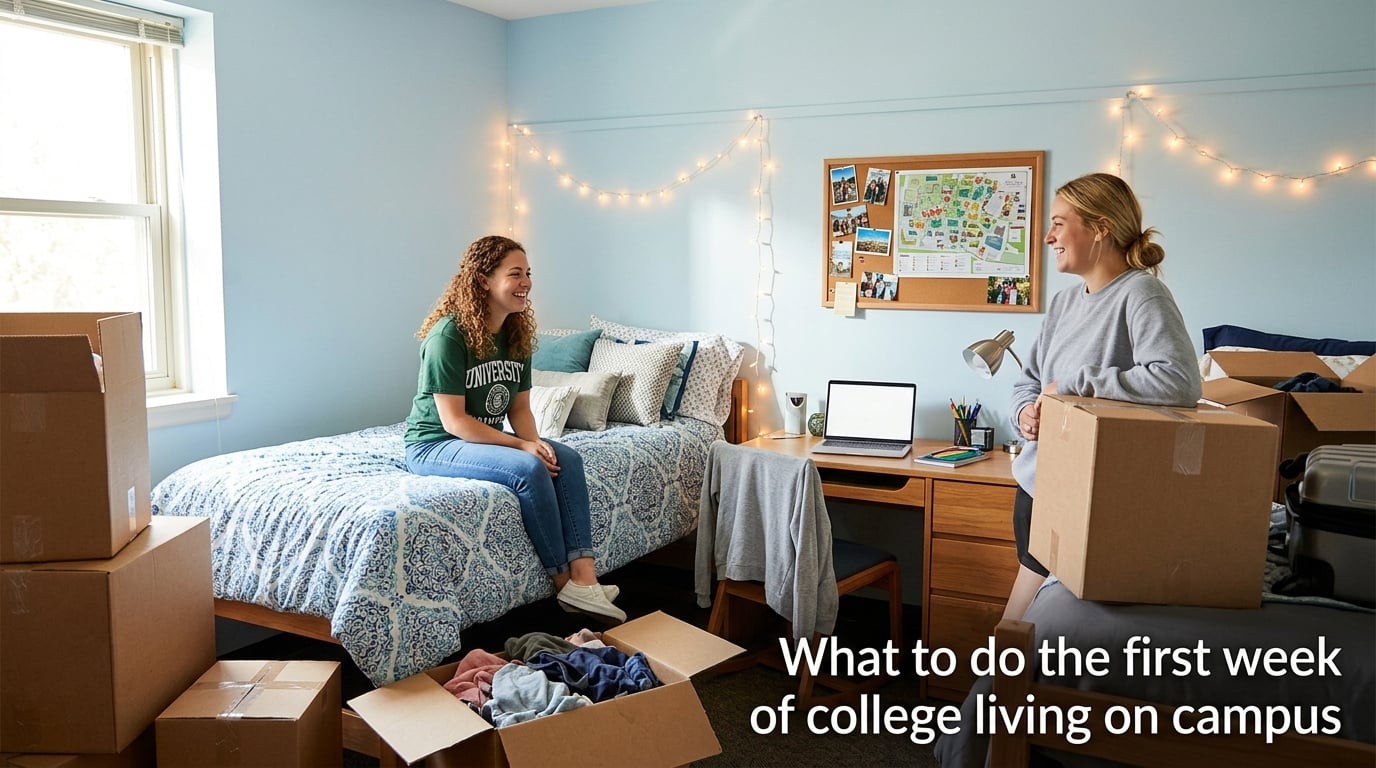
The first week of college living on campus is the 5 to 10 day stretch when new students move into residence halls, attend orientation, find their classrooms, meet their roommate and professors, and start building the routines that shape the rest of the year. Our team has pulled together the practical steps we wish every incoming freshman had on day one, so you can walk in with a plan instead of a panic.
Whether you are an international student moving to a new country, a first-generation student navigating campus for the first time, or a local commuter adjusting to dorm life, this guide walks you through a clear first-week roadmap. Expect logistics, social tips, academic foundations, and a few honest notes on homesickness.
Table of Contents
Your First 7 Days on Campus: A Day-by-Day Checklist
Here is the scannable week-one timeline we recommend. Bookmark it on your phone and tick items off as you go.
Day 1 (Move-in day): Unpack the essentials only. Make the bed, set up your desk lamp, charge your laptop, and locate the bathroom and laundry. Eat at the dining hall and introduce yourself to anyone you meet in the hallway.
Day 2: Attend the residence hall floor meeting. Walk to one of your classrooms during a free hour so you know the route and travel time. Pick up your student ID and campus card if not already issued.
Day 3: Attend the first orientation sessions. These usually cover academic expectations, campus safety, and student support services. Bring a notebook and write down anything you want to remember.
Day 4: Sit in on your first classes, even if it is syllabus week. Introduce yourself to at least one classmate in each class. Reply to that classmate’s social media handle if they share one.
Day 5: Email or visit one professor during office hours. Even a quick “Hi, I’m looking forward to your class” message builds a connection that helps when you need a recommendation later.
Day 6: Visit the student organisations fair or activities night. Pick up flyers from two or three clubs that genuinely interest you. Do not overcommit yet.
Day 7: Check in with family. Locate the counselling centre, public safety office, and health services on a single walk. Block out your first full study session in your planner.
How to Settle Into Your Dorm Room in the First Week
Most competitors skip unpacking strategy, yet this is the task that eats the most time on move-in day. We have seen students waste entire afternoons because they unpacked in random order and ended up repacking.
Unpack by zone, not by box. Start with the bed so you have somewhere to collapse. Then move to the desk, then storage, then decor. This keeps momentum and gives you a usable room within the first two hours.
Test every outlet and light switch the moment you arrive. Pack a small lamp and a power strip with surge protection because most dorms do not have enough outlets for laptops, phones, alarm clocks, and hair tools.
Storage is the biggest space problem in most residence halls. Under-bed bins, over-the-door organisers, and stackable crates triple your usable space without taking floor area. Leave your closet half-empty for the first two weeks so you actually use the storage you brought.
Decorate after you meet your roommate. We know you want string lights up on day one, but a quick 15-minute conversation about colours, posters, and shared surfaces prevents the awkward “can you take that down” talk in week three.
Dorm Move-In Essentials Checklist
Print this list or save it in your notes app. These are the items students most often forget:
- Bedding: two sets of sheets, a comforter, pillow, mattress protector
- Power: surge protector, extension cord, phone charger, laptop charger
- Bath: shower caddy, flip flops, towel set, toiletries
- Study: notebooks, pens, sticky notes, desk lamp, dry-erase board
- Laundry: detergent pods, drying rack, mesh bag for delicates
- Health: basic first aid kit, prescriptions, water bottle, hand sanitiser
- Extras: command hooks, batteries, reusable bags, snacks for late nights
Meeting Your Roommate and Dorm Neighbours
The roommate relationship sets the tone for the whole year. Most roommate conflicts we see on student forums come from assumptions that were never spoken out loud in week one.
Have a 20-minute ground rules conversation within the first 48 hours. Cover sleep schedules (when lights go off, when alarms are okay), cleanliness standards (how often trash goes out, dishes in the sink), guest policy (overnight visitors, partners, study guests), and shared items (food, toiletries, electronics).
Frame it as a partnership, not a contract. We recommend saying something like: “I want to make sure we both feel comfortable here. What does your morning routine look like?” That question alone prevents most early friction.
For neighbours, leave your door open during the first week whenever you are in the room. A short “hey, I’m [name], I’m in 314” to people passing by is enough to start a friendship. Invite dorm mates to events even if you do not know them well. People going through the same transition appreciate the gesture even when they say no.
Exploring Campus: Key Locations to Find in Week One
Large campuses are disorienting in the first week. The goal is not to memorise every hallway but to know where the services you will actually need live.
Walk your class route before classes start. A useful trick from students on Reddit: classroom numbers usually start with the floor. A room labelled 214 is on the second floor. That single fact has saved countless freshmen a panicked sprint on the first day.
Make a “service walk” on day two or three. In one loop, locate the dining hall, library, student centre, public safety office, health services, counselling centre, and the academic advising office. Snap a photo of each entrance so you can show someone else later if needed.
Learn the campus shuttle or bus loop even if you think you will not need it. Weather, illness, or a late-night library session will make you grateful you knew the pickup points. Check the schedule and save it to your phone.
Locate at least two study spots beyond your room. The library, a quiet café, an empty classroom, or a study lounge gives you options when your roommate is sleeping or you need a change of scenery.
Academic Foundations: Classes, Syllabi, and Office Hours
Syllabus week is when you set up your entire semester. Every professor hands out a document that tells you exactly what is coming: readings, assignments, grading weights, and policies. Read every syllabus on the day you receive it.
Use a planner or digital calendar from day one. Block out every class, study session, and recurring commitment before week one ends. Students who skip this step are the ones who show up to the wrong room on day three.
Email or visit at least one professor during office hours in the first week. You do not need a question. A short introduction and a sentence about why you took the course is plenty. Faculty notice the students who show up early, and that visibility matters when you need an extension, a recommendation, or advice.
Meet your academic adviser during orientation if possible. Walk in with three questions: “What does my major require?”, “What campus resources should I know about?”, and “How do I sign up for tutoring if I need it?”. That single meeting sets up the entire year.
Buy textbooks after the first class for each course. A student on r/college pointed out that you will often discover the book is optional, available as an older edition, or accessible through the library. Buying before the first class is the fastest way to overspend on books you never open.
Student ID, Meal Plan, and Admin Setup
No competitor article we reviewed covered this cluster, yet these are the tasks that quietly pile up. Knock them out in one focused afternoon.
Pick up your student ID and campus card. Your ID is your meal card, your building access, your library card, and sometimes your bus pass. Without it, you cannot eat, swipe into your dorm after hours, or print in the library.
Activate your meal plan and try at least two dining locations in week one. Most meal plans work on points or swipes, and the smartest move is to divide your total points by the number of weeks in the semester (roughly 14) to find your weekly budget.
Set up your student email, learning portal, and any required accounts on day one. Forward your student email to your personal address so you never miss an announcement. Save every confirmation email in a folder called “College admin” for the first month.
Register for campus safety alerts and download the official campus app. Most schools now push safety notifications, shuttle tracking, and event listings through one app. Install it before you need it.
Social Life: Clubs, Activities, and Making Friends
The first week is socially intense because everyone is looking for connection at the same time. Use that energy without burning out.
Attend the student organisations fair even if you are not sure what you want to join. Pick up flyers from two or three groups that match your interests and visit one meeting during the first two weeks. Joining too many clubs at once is the fastest path to dropping all of them.
Say yes to invitations the first week. Going to the dorm movie night, the late-night diner run, or the orientation game is how friendships actually start. You can always say no later, but you cannot replay week one.
Do not panic if your first friendships fade. A common pattern on r/college is that the people you click with on day two may not be your people by week three. Give every friendship at least a month before deciding. The students who settle in fastest are the ones who keep showing up without forcing it.
Sit toward the front of class when possible. Students who sit in the front rows report fewer distractions, more eye contact with professors, and easier participation. It is a small choice with a noticeable payoff.
Homesickness, Mental Health, and Calling Home
Homesickness is not a sign of weakness. It is the normal response to a total life change, and it tends to peak around day three or four when the novelty wears off and the routine has not yet formed.
Schedule a regular check-in with family. A short Tuesday night call and a Sunday text keeps everyone grounded without making you feel monitored. Parents on r/college consistently say that the students who call home tend to do better, not worse, academically.
Locate the counselling centre early, even if you do not think you need it. Walk in during week one, pick up a brochure, and save the after-hours number in your phone. Knowing where help lives makes it ten times easier to reach out if you ever need to.
Recognise the signs of “dorm sickness”: trouble sleeping, low motivation, isolation, irritability, or a sense that nothing feels like yours yet. Most campuses offer free short-term counselling, peer support groups, and 24-hour hotlines. Use them early.
Build a routine that feels like yours. Pick a study spot, a morning coffee order, a weekly laundry schedule, and a Friday ritual. Routine is the antidote to homesickness because it gives your nervous system something familiar to hold onto.
Frequently Asked Questions
Is the first week of college hard?
The first week of college is intense but rarely as scary as it feels in advance. Most students describe it as overwhelming in a positive way because everything is new, social, and full of orientation events. Expect long days, lots of walking, and the occasional emotional dip around day three or four as the novelty fades. Going in with a plan, a full phone charger, and a willingness to say yes to invitations makes the week much smoother.
What should I pack for my first-year college dorm?
Pack the essentials first: bedding, towels, a power strip with surge protection, toiletries, basic school supplies, laundry detergent, and a small first aid kit. Add a laptop, a desk lamp, command hooks, under-bed storage bins, and a reusable water bottle. Save decorative items and extras for a second trip so your car or suitcase does not overwhelm you on move-in day.
What are some tips for first-year college students?
The biggest tips for first-year college students are to attend orientation, read every syllabus, meet your professors early, use a planner from day one, and say yes to social invitations the first week. Locate the dining hall, library, health services, and counselling centre before you actually need them. Balance social energy with a regular sleep schedule because exhaustion makes everything else harder.
What are common dorm essentials people forget to bring?
Students most often forget a power strip with surge protection because dorms have very few outlets. Other commonly missed items include command hooks, a small desk lamp, an extra-long ethernet or phone cable, laundry detergent, flip flops for the shower, and a basic first aid kit. A reusable water bottle and a small snack stash also tend to be overlooked until you need them at midnight.
How do I meet people in the first week of college?
The fastest way to meet people in the first week of college is to be physically present and approachable. Leave your dorm door open, sit near the front of class, attend the activities fair, and accept invitations even when you are tired. Joining one or two clubs that match a genuine interest, volunteering for orientation events, and studying in common areas all create repeated contact, which is how real friendships form.
How do I cope with homesickness in the first week of college?
Homesickness usually peaks around day three or four and fades once a routine forms. Schedule a regular check-in with family so the contact is predictable rather than panicked. Build small rituals like a Friday coffee order, a study spot you return to, and a weekly laundry schedule. If feelings of isolation, sadness, or anxiety persist for more than two weeks, visit your campus counselling centre because most schools offer free short-term support.
What should I expect during my first week of college?
Expect a mix of orientation sessions, residence hall events, your first classes (often syllabus week), and the student organisations fair. You will meet hundreds of new people, walk more than usual, and spend time setting up your room, your student ID, your meal plan, and your campus accounts. The week is busy but structured, so the main task is simply showing up to everything and using the support services around you.
Final Thoughts on Your First Week of College Living on Campus
The first week of college living on campus is less about getting everything perfect and more about putting yourself in the rooms where good things tend to happen. Attend orientation, read your syllabi, meet your roommate and your professors, locate the support services, and build a routine you can actually sustain.
Give yourself permission to feel overwhelmed for a few days. Almost every student we have spoken to felt that way in week one and settled in by week three. Use this guide as a checklist, lean on the people around you, and trust that the routines you build now will carry you through the rest of the year.