
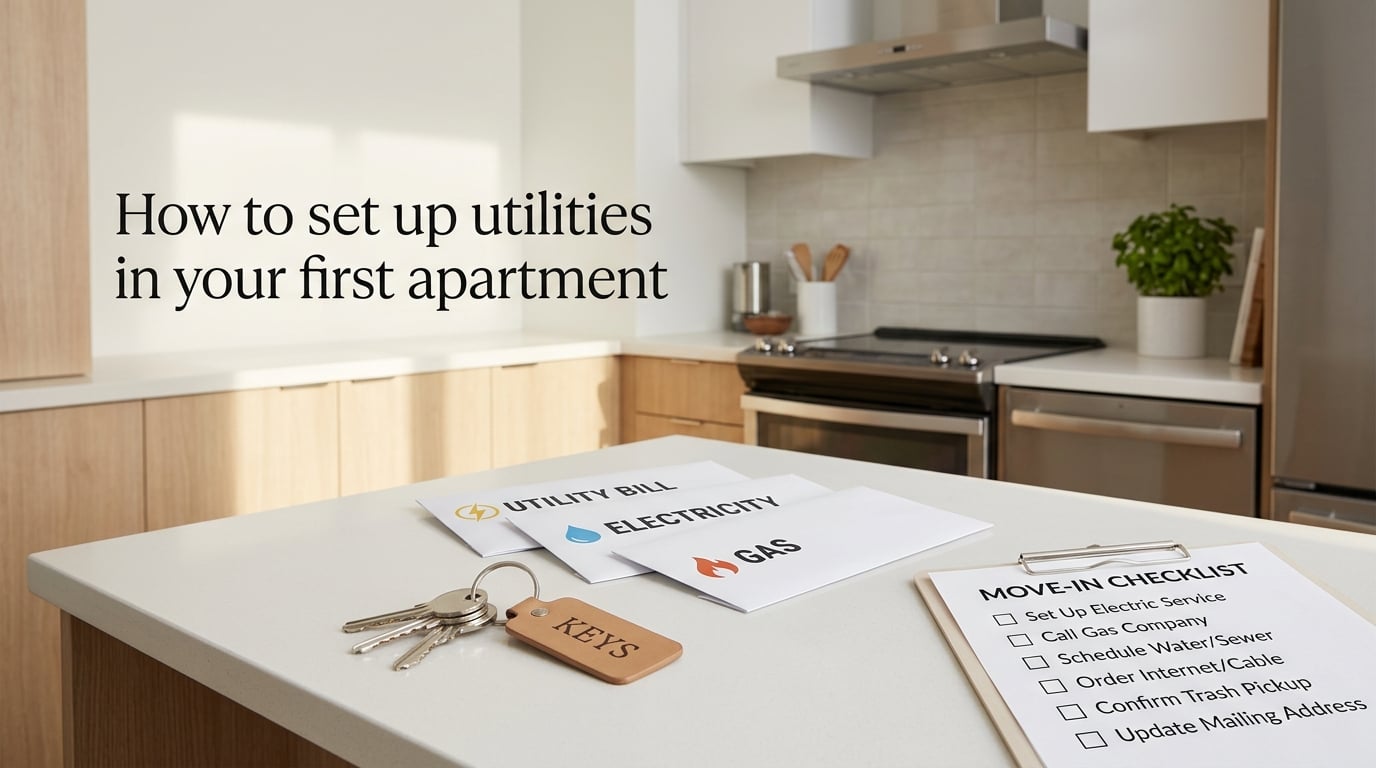
Setting up utilities in your first apartment means opening accounts in your name for essential services—electricity, water, gas, internet, and trash—so that power, running water, heating, and connectivity work the day you move in. If you’ve never done this before, the process can feel overwhelming. But here’s the good news: utility companies deal with first-time customers every single day, and the process is more straightforward than you might think.
In this guide, I’ll walk you through everything you need to know about how to set up utilities in your first apartment. We’ll cover which utilities you need, when to start the process, what documents to gather, and how to avoid common pitfalls that trip up first-time renters.
Table of Contents
What Utilities Do You Need in an Apartment?
Before diving into setup steps, let’s clarify what counts as a utility. Most apartments require you to arrange some combination of these services:
- Electricity – Powers lights, appliances, outlets, and air conditioning
- Water and sewer – Provides running water and handles wastewater
- Natural gas – Fuels heating, hot water, stoves, and dryers (not all apartments use gas)
- Internet/broadband – Connects you to Wi-Fi and streaming services
- Trash and recycling – Collection services for waste disposal
- Renter’s insurance – Protects your belongings (technically optional but strongly recommended)
Your lease agreement will specify which utilities are included in rent and which you must set up yourself. Many apartment buildings cover water, sewer, and trash as part of the rent, while tenants typically handle electricity, gas, and internet. Some landlords offer “all-bills-paid” apartments where every utility is bundled into your monthly payment—these can simplify life but may cost slightly more overall.
Always check your lease first. If it’s unclear, ask your landlord or property manager exactly which utilities you’re responsible for before signing anything.
Your 4-Week Utility Setup Timeline
Timing matters when setting up utilities. Starting too late means moving into a dark apartment with no hot water. Here’s a proven timeline that ensures everything is ready on move-in day:
4 weeks before move-in:
- Review your lease to identify which utilities you need to set up
- Research utility providers in your area (electricity, gas, internet)
- Check if your building has preferred providers or exclusive contracts
3 weeks before move-in:
- Open accounts with your electricity and gas providers
- Schedule any required technician visits (gas connections often need 2–4 weeks lead time)
- Order internet service and book installation if a technician visit is required
2 weeks before move-in:
- Confirm all account openings and service start dates
- Set up water and sewer service (contact the city or county if not landlord-handled)
- Arrange trash and recycling collection if not included in rent
1 week before move-in:
- Confirm technician appointment times for gas and internet
- Set up online accounts and autopay for each provider
- Gather all documents (ID, lease, deposit payment) in one folder
Move-in day:
- Test every utility—turn on lights, run faucets, check hot water, test the stove
- Read and photograph all meter readings
- Report any issues immediately to the provider and your landlord
Following this timeline prevents the stress of scrambling at the last minute. As forum users on r/Adulting frequently point out, most first-time renters underestimate how far in advance they need to start—especially for gas and internet, which often require a technician visit.
How to Set Up Electricity in Your First Apartment
Electricity is typically the first utility you’ll set up because you need it for everything else. Here’s how the process works:
Step 1: Find your electricity provider. In deregulated markets (like Texas, parts of the UK, and many US states), you can choose from multiple providers. In regulated areas, there’s usually one local utility company. Your landlord or leasing office can tell you who services your building.
Step 2: Open an account. Most providers let you open an account online in about 10–15 minutes. You’ll need your new address, move-in date, a government-issued ID, and often your Social Security number (or equivalent for international students). Some providers run a soft credit check.
Step 3: Pay any deposit. First-time customers without a credit history may be asked for a security deposit, typically ranging from $100 to $250. This is usually refundable after 12 months of on-time payments.
Step 4: Schedule activation. Request service to start at least one day before your move-in date. Most electricity providers can activate service remotely—no technician visit needed in most cases.
Electricity typically activates within 1–3 business days, though some providers offer same-day activation for an extra fee. If you’re moving into a unit where the previous tenant’s service is still active, the provider will transfer the account to your name on your requested start date.
How to Set Up Water and Sewer Service
Water and sewer service works differently from other utilities because it’s usually managed by the city or county rather than a private company. Here’s what to do:
Check your lease first. In many apartment buildings—especially larger complexes—water and sewer are included in rent. If that’s the case, you don’t need to do anything.
If you’re responsible for water, contact your local water department (search “[your city] water service” online). You’ll typically need to provide your address, move-in date, lease, and ID. Some municipalities require you to visit in person to set up an account; others allow online registration.
Water deposits tend to be smaller than electricity deposits, often $50–$100. Service usually activates within a few business days. Unlike electricity, water rarely needs a technician visit—once the account is open, water flows through the existing pipes.
How to Set Up Gas Service in a New Apartment
Not every apartment uses natural gas, but if yours does—for heating, hot water, a gas stove, or a dryer—you’ll need to set this up early. Gas setup requires more lead time than other utilities.
Contact the gas provider 3–4 weeks before move-in. In most areas, there’s one main gas utility company. You can find yours by searching “[your city] natural gas provider.”
Expect a technician visit. Unlike electricity, gas service often requires a technician to physically turn on the gas at your meter and check for leaks. During peak moving season (May–September), technician appointments can book up 2–4 weeks in advance. Don’t wait until the last minute.
Safety first. Never attempt to turn on gas service yourself. The technician will check connections, ensure appliances are working properly, and verify there are no gas leaks. This visit is a safety requirement, not a formality.
Gas deposits are similar to electricity deposits—typically $100–$200 for first-time customers. Some providers waive the deposit if you set up automatic payments or have a co-signer with established credit.
How to Set Up Internet for Your Apartment
Internet is the utility that surprises most first-time renters with its setup timeline. Here’s what you need to know:
Check for existing infrastructure. Some apartment buildings have exclusive contracts with specific internet providers, limiting your options. Ask your landlord which providers service the building before shopping around.
Compare plans carefully. Internet speeds and prices vary significantly. For a single person in a studio apartment, a 100 Mbps plan may be plenty. For a shared apartment with multiple people streaming and working from home, look for 300 Mbps or higher. Fiber-optic connections offer the best speeds where available.
Book installation early. If your apartment needs a new connection or technician setup, book at least 2 weeks in advance. First-time renters are often surprised that “setting up internet” doesn’t mean instant Wi-Fi—it can mean waiting for a technician to visit and install equipment.
Consider bundling. Some providers offer discounts when you bundle internet with mobile phone service or streaming packages. This can save money over the course of a year, but read the contract terms carefully—promotional rates often increase after 12 months.
If you need internet immediately and can’t wait for a technician, mobile hotspot devices or tethering from your phone can bridge the gap for a few days.
Documents You’ll Need to Set Up Utilities
Having the right documents ready prevents delays. Gather these before you start contacting providers:
- Government-issued photo ID – Driver’s license, passport, or state/national ID card
- Social Security number (or equivalent) – Used for credit checks; international students may need a guarantor or alternative documentation
- Signed lease agreement – Proves you’re authorized to set up service at the address
- Proof of address – Your lease usually covers this, but some providers want a separate document
- Payment method – Bank account or card for deposits and first payments
- Move-in date – Providers need this to schedule service activation
For international students or renters without a Social Security number, some providers accept a passport plus a letter from your university or employer. You may need a co-signer with established credit, or you might pay a larger deposit. Don’t let this discourage you—providers work with international customers regularly.
Average Monthly Utility Costs: What to Expect
Budgeting for utilities is one of the biggest unknowns for first-time renters. Here are typical monthly ranges based on apartment size and occupancy:
| Apartment Type | Electricity | Gas | Water/Sewer | Internet | Total Estimate |
|---|---|---|---|---|---|
| Studio (1 person) | $40–$80 | $20–$50 | $20–$40 | $40–$70 | $120–$240 |
| 1-Bedroom (1–2 people) | $60–$120 | $30–$70 | $30–$50 | $50–$80 | $170–$320 |
| Shared Apartment (3+ people) | $80–$150 | $40–$90 | $40–$60 | $50–$80 | $210–$380 |
These figures vary by region. Students on r/UWMadison report budgeting around $120 per month total for a shared apartment in Madison, while r/Moving2SanDiego users estimate $150–$200 per month for gas and electric alone in Southern California. Climate is a major factor—expect higher heating bills in winter and higher cooling bills in summer.
A useful rule of thumb: budget 10–15% of your monthly rent for utilities if they’re not included. This gives you a realistic starting point until you see your actual bills.
Splitting Utility Bills with Flatmates or Roommates
Sharing an apartment means sharing utility costs. The most common approach is to put one person’s name on each bill and split costs equally. Here are strategies that work:
Equal split: Divide the total utility bill by the number of roommates. This works well for apartments where everyone uses similar amounts of energy and water. It’s the simplest method and avoids arguments about who used more hot water.
Per-bedroom split: In apartments where bedroom sizes differ, some roommates prefer splitting by room. The person in the larger bedroom (or with the ensuite bathroom) pays a slightly larger share. This accounts for differences in heating/cooling needs.
One person manages all bills: Designate one roommate to have utilities in their name. Others reimburse their share each month. Use a payment app to track who has paid. This keeps things organized but requires trust and consistency.
Important: Whoever’s name is on the bill is legally responsible for the full amount. If a roommate doesn’t pay their share, the account holder is still liable. Establish clear expectations about payment deadlines before move-in day to avoid disputes later.
Tips for Students and International Renters
Students and international renters face unique challenges when setting up utilities. Here’s how to navigate them:
No credit history? Many first-time renters have no credit history, which can trigger deposit requirements. Some providers offer alternatives: you can provide a co-signer (often a parent), pay a larger deposit, or enroll in a deposit waiver program where you pay a small monthly fee instead of a lump sum upfront.
International students without a Social Security number should bring their passport, visa documentation, and a letter from their university confirming enrollment. Some utility providers accept an Individual Taxpayer Identification Number (ITIN) in place of an SSN. Call providers ahead of time to ask what documentation they accept for international customers.
Timing around the academic year: If you’re moving in around August or September, expect longer wait times for technician appointments—this is peak moving season for students. Book gas and internet installations as early as possible, ideally 4 weeks before your move-in date.
Bills-included accommodation: Some student housing and shared houses include utilities in the rent. This eliminates setup hassle but may mean less control over energy usage and costs. If you’re in a bills-included arrangement, confirm with your landlord exactly which utilities are covered—internet is sometimes excluded.
What to Do on Move-In Day
Move-in day is when all your preparation pays off. Follow this checklist to make sure everything works:
Test every utility immediately. Turn on lights in every room, run all faucets (check both hot and cold water), test the stove and heating, and connect to the internet. Do this before unpacking—it’s much easier to report problems while your apartment is still empty.
Read and photograph all meters. Find your electricity, gas, and water meters and take photos with timestamps. This documents your starting readings and protects you from being billed for the previous tenant’s usage. If you can’t locate meters, ask your landlord.
Check for issues from the previous tenant. Sometimes the previous tenant didn’t cancel their service, which can cause confusion. If a utility isn’t working, call the provider directly—they can usually transfer service to your name the same day. This is a common issue mentioned on r/Adulting, where users recommend calling the provider rather than waiting for automatic transfer.
Document everything. Take photos of any issues—leaky faucets, non-functioning outlets, flickering lights—and send them to your landlord in writing. This creates a paper trail and ensures you won’t be blamed for pre-existing problems when you move out.
Your First Utility Bill: What to Expect
Your first utility bills may look different from what you expect. Here’s why:
Prorated charges: If you move in mid-month, your first bill will be prorated—covering only the days you actually lived there. This means the first bill will be smaller than subsequent full-month bills. Don’t let the low first bill fool you into thinking utilities are cheap.
Deposits on the first bill: Many providers add the security deposit to your first bill or charge it separately. This can make your first electricity or gas bill surprisingly high. As forum users consistently warn, first-time renters often underestimate total first-month costs because they forget about deposits.
Budget billing option: Many electricity and gas providers offer budget billing (also called equal payment plans). This averages your annual usage into equal monthly payments, smoothing out seasonal spikes. As one r/Frugal user recommends: “Sign up for budget billing—it flattens seasonal spikes so you don’t get a $300 summer AC bill.”
Setting up autopay: Most providers offer discounts for enrolling in autopay and paperless billing. This saves money and ensures you never miss a payment, which is especially important for building credit history as a first-time renter.
Frequently Asked Questions
How do I set up utilities for the first time?
Start by checking your lease to see which utilities you’re responsible for, then contact each provider (electricity, gas, water, internet) at least 2–4 weeks before your move-in date. You’ll need your address, move-in date, ID, and payment method. Most accounts can be opened online in 10–15 minutes.
How far in advance should I set up utilities for an apartment?
Begin researching providers 4 weeks before move-in. Open electricity and gas accounts 3 weeks ahead, and schedule any technician visits (especially for gas and internet) at least 2 weeks in advance. Water and trash can often be set up 1–2 weeks before.
What utilities do I need to set up for an apartment?
The essential utilities are electricity, water and sewer, gas (if applicable), internet, and trash collection. Check your lease to see which are included in rent—many buildings cover water, sewer, and trash.
How long does it take to get electricity turned on in an apartment?
Electricity usually activates within 1–3 business days after opening an account. Some providers offer same-day activation for an additional fee. In most cases, no technician visit is needed—service is activated remotely at the meter.
What documents do I need to set up utilities?
You’ll need a government-issued photo ID, Social Security number (or equivalent), signed lease agreement, proof of address, and a payment method for deposits. International students may need a passport, visa, and university letter instead of an SSN.
Can I set up utilities with no credit history?
Yes. Most providers will require a security deposit (typically $100–$250) instead of denying service. Alternatives include providing a co-signer, paying a larger deposit, or enrolling in deposit waiver programs. Some providers waive deposits for customers who set up autopay.
How do I split utility bills with roommates?
The simplest method is to put one person’s name on each bill and split the total equally among all roommates. Use a payment app to track reimbursements. Establish payment deadlines before move-in to avoid disputes. Whoever’s name is on the bill is legally responsible for the full amount.
What if the previous tenant didn’t cancel their utilities?
Call the utility provider directly on move-in day. They can transfer service to your name immediately in most cases. This is a common situation—providers handle it routinely. Take photos of meter readings to document your starting usage.
Final Thoughts
Learning how to set up utilities in your first apartment doesn’t have to be stressful. Start early—ideally 4 weeks before your move-in date—gather your documents in advance, and follow the timeline in this guide. Most utility companies are accustomed to helping first-time customers, and the entire process can usually be completed online in a single afternoon.
Remember: the biggest mistake first-time renters make is waiting too long. Gas and internet installations need technician visits that book up weeks in advance, especially during peak moving season. By starting early and following this checklist, you’ll walk into your new apartment on move-in day with lights, hot water, heating, and Wi-Fi already working.