
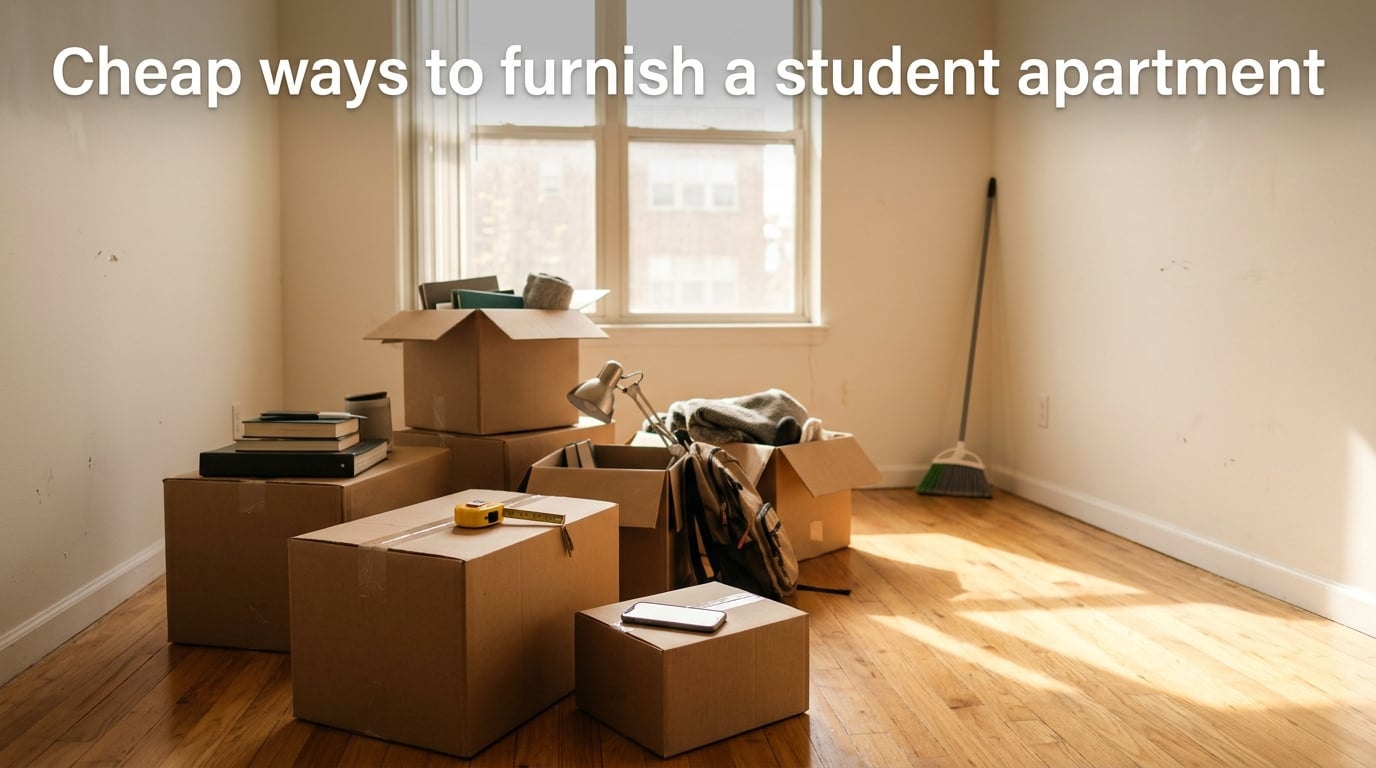
Moving into your first student apartment is exciting — until you realize how much furniture actually costs. Between tuition, textbooks, and groceries, the last thing you need is a four-figure bill just to have somewhere to sit and sleep. The good news? You can furnish a comfortable, stylish apartment without draining your bank account.
After helping dozens of friends move into off-campus apartments and spending years scouring thrift stores, Facebook Marketplace, and IKEA showrooms, I’ve figured out exactly what works. These are the strategies that real students use — not theoretical advice, but proven methods that save hundreds of dollars.
In this guide, I’ll walk you through the cheapest ways to furnish a student apartment, from sourcing furniture for free to decorating without damaging your walls. Whether you have $500 or $2,000 to work with, these tips will help you create a space that feels like home.
Table of Contents
Quick Answer: How to Furnish a Student Apartment on a Budget
Here are the seven most effective strategies for furnishing cheaply:
- Shop secondhand stores like Goodwill, Habitat ReStore, and Salvation Army
- Browse Facebook Marketplace, Craigslist, and student buy/sell groups for deals
- Buy basics at IKEA, Walmart, and Target during sales
- Choose multifunctional furniture — futons, storage ottomans, and foldable tables
- Decorate with removable, renter-friendly items like Command strips and peel-and-stick wallpaper
- Buy in phases, starting with bedroom essentials, then living room, then extras
- Use student discounts and split costs with roommates
Now let’s break down each strategy so you can start saving money today.
Shop Secondhand and Thrift Stores
Thrift stores are the single best place to find affordable furniture as a student. Goodwill, Salvation Army, and local charity shops regularly carry sofas, bookshelves, desks, and dining sets at a fraction of retail prices. You can often find solid wood furniture that outlasts anything from a budget retailer.
Habitat for Humanity ReStore is another goldmine. These stores sell donated furniture, appliances, and home goods, with proceeds funding housing programs. Prices run 50–80% below retail, and you’ll find everything from coffee tables to bed frames.
Don’t overlook flea markets, estate sales, and yard sales, especially at the end of the semester. Many graduating students sell or give away furniture rather than move it. Arrive early for the best selection, and bring cash — most sellers prefer it.
Pro tip: Visit thrift stores in wealthier neighborhoods. The furniture quality tends to be higher, and prices stay the same across all locations in a chain.
Use Online Marketplaces and Free Groups
Facebook Marketplace is the go-to platform for secondhand furniture deals. You can filter by location, price, and category, making it easy to find exactly what you need. Search for “college furniture,” “apartment furniture,” or specific items like “IKEA KALLAX” to surface relevant listings.
Student buy/sell groups on Facebook are even better. Search for your school name plus “buy sell” or “free and for sale” — nearly every university has one. These groups feature students selling furniture at student-friendly prices because they know the audience.
Craigslist’s “free” section is worth checking daily. People give away furniture when they’re moving and need it gone fast. The catch? You usually need to pick it up within 24 hours and have a vehicle that can handle it.
A word about safety: When meeting Marketplace sellers, always verify their profile, meet in a public or well-lit area during daytime, bring a friend, and inspect the item thoroughly before paying. Never send money in advance for furniture you haven’t seen in person.
Curbside Finds and Move-Out Day Freebies
In college towns, the weeks around lease turnover dates (often late August and early September) produce a phenomenon sometimes called “Allston Christmas” — named after the Boston neighborhood famous for streets lined with abandoned furniture. Students moving out leave behind perfectly usable couches, desks, and shelves on the curb.
Check local regulations, as some cities restrict curbside pickup. Where it’s allowed, this is the ultimate free furniture hack. Inspect items carefully for bedbugs, stains, and structural damage before bringing anything inside.
Buy Nothing Groups and Community Boards
Buy Nothing groups on Facebook operate on a gift economy — neighbors post items they want to give away, no strings attached. Join the group for your campus neighborhood and surrounding areas. Furniture, kitchenware, and decor appear regularly, and all you need to do is pick it up.
Shop at Budget-Friendly Retailers
When secondhand isn’t an option, several retailers offer furniture at student-friendly prices. IKEA remains the king of affordable, flat-pack furniture designed for small spaces. Their dining chairs start around $13, and basic desks run $40–80. The IKEA As-Is section sells returned and display items at 30–50% off — it’s worth checking every visit.
Target and Walmart carry budget furniture lines that look more expensive than they are. Target’s Room Essentials and Walmart’s Better Homes and Gardens collections offer desks, shelving, and seating at accessible price points.
TJ Maxx, HomeGoods, and Marshalls are excellent for decor — throw pillows, blankets, wall art, and storage baskets at deep discounts. Five Below and Dollar General stock smaller items like desk organizers, LED lights, and basic kitchen tools.
Choose Multifunctional and Space-Saving Furniture
In a small student apartment, every piece of furniture should earn its place. Multifunctional items save money and floor space, which is why they’re a staple of budget furnishing.
Futons and sofa beds serve as both couch and guest bed. A decent futon costs $150–300 and eliminates the need for a separate spare bed. Look for ones with a metal frame — they’re sturdier and easier to move than wooden ones.
Storage ottomans do triple duty as seating, a coffee table (add a tray on top), and hidden storage for blankets, books, or shoes. They run $30–60 at most retailers.
Foldable tables and nesting furniture let you expand your setup when friends visit and tuck it away when you need floor space. A folding desk or wall-mounted drop-leaf table works perfectly for studying without permanently eating up room.
Bed-in-a-box mattresses deserve special mention. Brands like Tuft and Needle, Zinus, and Casper ship compressed mattresses that expand after unboxing. They fit through narrow apartment staircases where traditional mattresses won’t, and many cost under $300 for a queen.
DIY Decor and Renter-Friendly Touches
Making a student apartment feel like home doesn’t require expensive decor or permanent changes. The best apartment decorating happens with creativity, not a big budget.
Wall Decor Without Damage
Command strips and hooks are your best friends. They hold frames, mirrors, and shelves securely and peel off cleanly when you move out — protecting your security deposit. A pack of large Command strips costs a few dollars and replaces nails entirely.
Removable wallpaper and peel-and-stick tiles let you transform an accent wall or backsplash without any commitment. Modern designs look surprisingly realistic, and they peel off without residue. A single accent wall in a bedroom or living room can completely change the room’s vibe for $20–40.
Photo collages and gallery walls are practically free. Print your favorite photos at a drugstore or pharmacy (often under $0.25 per print), grab some cheap frames from a thrift store, and arrange them on one wall. Washi tape works for a more casual, dorm-style look.
Lighting on a Budget
Overhead apartment lighting is usually harsh and unflattering. Swapping it out for warmer alternatives makes a massive difference. String lights or fairy lights cost $5–15 and instantly make a room feel cozy. Drape them along a bookshelf, above a bed frame, or around a window.
Thrift stores are packed with table lamps and floor lamps for $5–20. Replace the bulb with a warm-toned LED (2700K) and you’ve got instant ambiance. A single well-placed lamp can make a $500 apartment feel like a $1,500 one.
Easy DIY Projects
Mason jar organizers work as pen holders, makeup brush storage, or small planters. Spray paint them to match your color scheme. A $1 can of spray paint transforms a Goodwill vase into something that looks boutique.
Faux greenery and low-maintenance plants like pothos and succulents add life to any room. Faux plants from dollar stores or TJ Maxx look convincing in a nice pot, and real pothos thrive on neglect — perfect for busy students.
Buy in Phases: A Room-by-Room Strategy
The biggest mistake new apartment dwellers make is trying to furnish everything at once. This leads to impulse purchases, blown budgets, and furniture you regret. Instead, take a phased approach.
Week 1: Absolute Essentials
Focus on what you need to sleep, eat, and study. That means a mattress (or mattress topper if the apartment has one), basic bedding, a pillow, a desk or table surface, a chair, and basic kitchen supplies (a pot, pan, plate, bowl, utensils). Everything else can wait.
Month 1: Core Comfort
Add the pieces that make daily life comfortable: a sofa or futon for the living room, a coffee table or side table, a dresser or clothing storage, curtains or blinds for privacy, and a bathroom rug and shower curtain. This phase typically runs $200–500 if you shop secondhand.
Month 2 and Beyond: Nice-to-Haves
Once the basics are covered, you can thoughtfully add items like a TV stand, bookshelf, dining table and chairs, decorative accents, additional lighting, and wall art. By this point, you’ll know exactly what your space needs instead of guessing.
Per-Room Budget Guide
Here’s a realistic budget range for furnishing each room using a mix of secondhand and budget retail sources:
- Bedroom: $200–500 (mattress, frame, bedding, dresser, nightstand)
- Living room: $150–400 (sofa or futon, coffee table, TV stand, lighting)
- Kitchen/dining: $50–150 (table and chairs, basic cookware, dishes)
- Bathroom: $20–50 (shower curtain, towels, storage, rug)
- Decor and lighting: $30–100 (wall art, plants, string lights, throw pillows)
A fully furnished apartment is achievable for $450–1,200 if you prioritize secondhand sources and buy in phases rather than all at once.
Extra Money-Saving Tips for Students
Beyond where and what to buy, a few strategies can stretch your budget even further.
Use Student Discounts
Many retailers offer student discounts that most students never use. UNiDAYS and Student Beans verify your student status and unlock deals at hundreds of stores. Bed Bath and Beyond previously offered a 20% student discount program — check if similar programs exist at stores near your campus.
Negotiate on Marketplace
Most Marketplace sellers expect negotiation. Start by offering 60–70% of the asking price, especially if the listing has been up for more than a week. Be polite, explain you’re a student on a budget, and offer to pick up quickly. Sellers often accept lower prices for a fast, hassle-free transaction.
Split Costs With Roommates
If you have roommates, split the cost of shared furniture — the couch, coffee table, dining set, and TV stand. When you move out, one person buys out the other’s share or you sell and split the proceeds. This cuts your living room furnishing costs in half or more.
Plan for Transportation
Secondhand furniture requires picking it up, which is a real challenge without a car. Options include renting a Zipcar or U-Haul by the hour, asking a friend with a truck, using delivery apps for larger items, or finding a seller willing to deliver. Some Habitat ReStore locations offer affordable delivery.
Think About Move-Out Before You Move In
Buy furniture you can realistically move, sell, or give away when your lease ends. A modular sofa that disassembles is easier to move than a single-piece sectional. Flat-pack furniture from IKEA can be disassembled and reassembled. Avoid oversized or extremely heavy pieces unless you plan to stay long-term.
Common Mistakes to Avoid
Even with the best intentions, students fall into predictable traps when furnishing on a budget. Here are the ones to watch out for.
Buying everything at once. This leads to overspending and regret. You don’t know what you actually need until you’ve lived in the space for a few weeks.
Not measuring before buying. That perfect couch is useless if it doesn’t fit through your door or in your living room. Measure your doorways, stairwells, and rooms before purchasing any large furniture.
Skimping on the mattress. You spend a third of your life sleeping. A cheap mattress leads to back pain and poor sleep, which tanks your academic performance. This is the one item worth investing in — a bed-in-a-box from Zinus or Tuft and Needle costs less than you’d think.
Ignoring lease restrictions. Read your lease before drilling holes, painting walls, or making permanent changes. Many student apartments have strict rules, and violations can cost you your security deposit.
Forgetting about move-out costs. If you buy furniture you can’t move or sell, you’ll end up paying someone to haul it away or leaving it behind. Plan your exit strategy from day one.
Frequently Asked Questions
How much does it cost to furnish a student apartment?
Using a mix of secondhand and budget retail sources, you can furnish a student apartment for $450 to $1,200. The bedroom typically costs $200–500, the living room $150–400, kitchen and dining $50–150, and bathroom and decor $50–150. Shopping primarily at thrift stores, Facebook Marketplace, and IKEA keeps costs at the lower end.
What furniture do you absolutely need for a first apartment?
Start with the essentials: a mattress and bedding, a desk or table for studying, a chair, basic kitchen supplies (one pot, one pan, utensils, plates), and a shower curtain with towels. Everything else — sofa, coffee table, bookshelves, dining set — can be added in the weeks after you move in.
Where is the best place to find cheap furniture?
Facebook Marketplace and student buy/sell groups offer the best combination of selection and price. For free furniture, check Craigslist’s free section, Buy Nothing groups on Facebook, and curbside finds during lease turnover dates in college towns. For new budget furniture, IKEA, Walmart, and Target are reliable options.
How can I furnish an apartment cheaply without it looking cheap?
Focus on a cohesive color palette, good lighting, and a few well-chosen statement pieces. Warm-toned lamps and string lights transform any room. A gallery wall of framed photos looks intentional and curated. Storage baskets and matching throw pillows tie a room together. Thrift stores often carry high-quality items that look far more expensive than they are.
Is it worth buying furniture from Facebook Marketplace?
Yes, Facebook Marketplace is one of the best sources for affordable furniture. You can find barely-used items at 50–80% off retail prices. Always inspect items in person, meet in safe locations, check for damage or bedbugs, and don’t pay until you’ve seen the item. Student-specific Facebook groups often have even better deals because sellers price for a student budget.
Final Thoughts
Furnishing a student apartment cheaply is absolutely doable — it just takes a strategy instead of a shopping spree. Start with the essentials, shop secondhand first, choose multifunctional pieces, and add decor over time. The cheapest ways to furnish a student apartment aren’t about sacrificing style; they’re about being smart with your money so you have more left over for everything else college throws at you.
Your apartment doesn’t need to look like a showroom on day one. Give it a month, shop patiently, and you’ll build a space that’s comfortable, personal, and budget-friendly.