
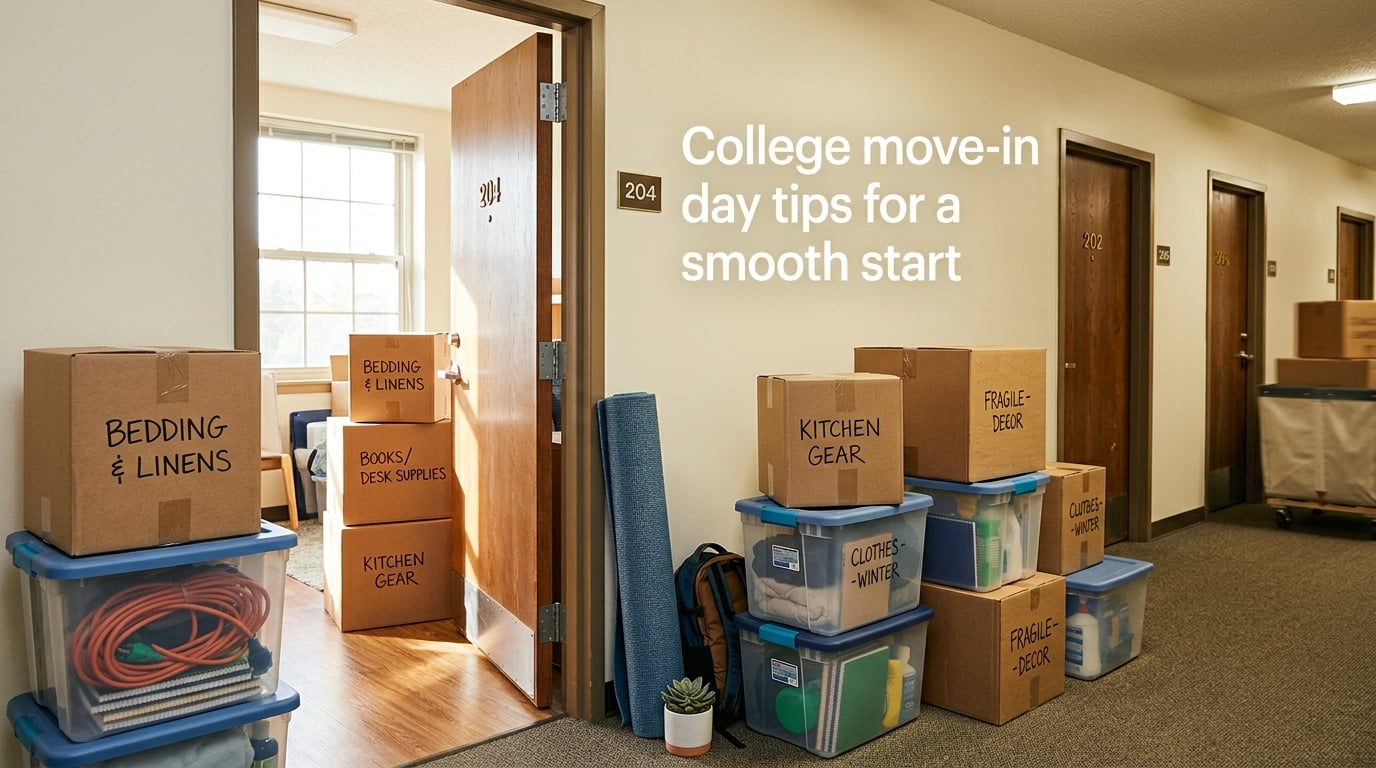
College move-in day tips for a smooth start boil down to one idea: treat it like a project, not a moment. Our team has walked first-years through this day for years, and the students who breeze through move-in are the ones who planned for the boring logistics weeks before the emotions showed up.
This guide walks you through the full arc of move-in day: a 4-week prep timeline, a complete dorm essentials checklist, the items you should leave at home, the morning routine that keeps stress low, and the first-week moves that set you up for a great semester. We have also included a parent section and answers to the questions our students ask the most.
If you read nothing else, read the 12 quick tips below and the dorm essentials checklist. Those two sections alone will save you a stressful trip to the nearest store during move-in week.
Table of Contents
Quick Tips: 12 College Move-In Day Moves for a Smooth Start
If you only have a minute, these are the 12 college move-in day tips our team gives every freshman before they load the car.
- Read your school’s move-in guide twice. Time slots, parking rules, elevator reservations, and banned items are spelled out there.
- Confirm your assigned time slot. Showing up early gets you turned away; showing up late gets you a long line.
- Pack by room zones, not by bag type. One bin per area (bedding, desk, bathroom, kitchen) makes the unpacking pile disappear fast.
- Load the car in reverse unload order. Last things on top, first things off.
- Use the trash-bag hanging clothes trick. Keep shirts and pants on hangers, group 8 to 10 hangers in a trash bag, and hang the whole bundle in your closet. Reddit’s r/college swears by this and so do we.
- Pack a separate first-night bag. Sheets, pillow, phone charger, towel, shower caddy, change of clothes, and toilet paper. You will not fully unpack on day one.
- Bring a 6-outlet surge protector. Dorm outlets are scarce and often placed in awkward spots. A power strip with surge protection is the single most-forgotten item on move-in day.
- Coordinate with your roommate early. Decide who brings the mini fridge, the microwave, the TV, and the rug. Double-buying is the most common freshman mistake.
- Bring your own dolly or hand truck. Schools run out of moving carts by 10 a.m. A folding dolly fits in the trunk and saves your back.
- Clean the room before you unpack. A 20-minute wipe-down of the desk, drawers, and window ledge is the difference between a fresh start and someone else’s dust.
- Keep your door open for the first few hours. It is the single best way to meet the people on your floor. Residence life staff call this the open-door trick.
- Parents: aim to be gone within 2 to 3 hours. Your student bonds faster with their roommate once the room is theirs. More on this below.
What College Move-In Day Actually Looks Like
College move-in day is the scheduled day (or weekend) when incoming students bring their belongings to their assigned dorm room, check in with residence life staff, and officially start their on-campus living experience, usually a few days before classes begin.
Here is the typical sequence. Your school assigns you a check-in time slot. You arrive, get your key and student ID at a check-in table near your residence hall, then drive to an unloading zone. Helpers or your own crew move boxes from the car to the room using carts or a dolly. You clean, unpack, set up the bed, and meet your roommate. Once the room is functional, parents leave, students go to the first floor meeting, and orientation week kicks off.
Expect controlled chaos. The parking lot will be busy, the elevator will have a queue, and the hallways will be loud with music and family photos. None of that is a problem – it is normal. Schools run move-in like a finely tuned operation, and the staff have done this hundreds of times.
The first 24 hours: a quick walkthrough
Hour one is check-in and unload. Hour two is move boxes into the room and meet your roommate. Hour three is the first round of setup (sheets, pillows, toilet paper, phone charger). Hour four is when families start to leave. By dinner, you have eaten in the dining hall, met your floor mates, and started the first of many new conversations.
By the next morning, the room is mostly arranged, the bins are half-unpacked, and you have already learned three things you wish you had packed. That is normal too.
How to Prepare for College Move-In Day: A 4-Week Timeline
The best way to prepare for college move-in day is to start four weeks out, give yourself one full week for packing, and reserve the final 48 hours for rest, errands, and a clean room at home.
Below is the same 4-week timeline our team uses with incoming students. Adjust it to your school’s calendar, but keep the shape: long runway, short sprint.
Four weeks out: read everything and reserve your window
Read every email from the residence life office. Log into the housing portal. Note your assigned move-in date and time slot. Confirm whether the school provides a moving cart or whether you should bring your own dolly. If your school uses an appointment system, lock in your slot now – the early windows fill fast.
This is also the moment to reach out to your assigned roommate. Most schools give you contact info by mid-summer. A short text or email that says “Hey, I am Alex, moving in on August 24 – want to split the big items?” prevents the classic double-fridge, double-microwave problem.
Three weeks out: build the master packing list
Open a shared Google Doc with your roommate. Divide the big-ticket shared items first: mini fridge, microwave, TV, rug, printer. Then build your personal list in four buckets: bedding and bath, school and electronics, kitchen and snacks, decor and cleaning supplies.
Order the items you do not own yet. Move-in week is the worst time to shop because campus-area stores are out of stock. Reddit’s r/college has thousands of posts from freshmen who learned this the hard way.
Two weeks out: order, label, and stage
Order dorm essentials online. Ship-to-home is faster than ship-to-campus because the mailroom gets overwhelmed during move-in week. Pick up command strips, a power strip with surge protection, an extra-long twin mattress pad, a shower caddy, and a laundry basket with wheels.
Buy bins and label every bin with the room zone and your name. Sharpie on packing tape is the cleanest method. Set up a small staging area in your room at home – a corner with all the packed bins ready to carry to the car.
One week out: pack and stress-test the car
Pack non-essentials first. Books, decor, and off-season clothes go in the bottom of the bins. Save the first-night bag, snacks, and the cleaning kit for the top of the load. Do a test fit in your car (or rental) so you are not surprised on move-in morning.
Talk with your family about the goodbye plan. Decide who is staying in the dorm for dinner, who is heading home that night, and what time the car pulls out. The students who struggle most on move-in day are usually the ones whose family departure was a surprise.
The day before: clean, rest, and reset
Wash your sheets and towels. Charge every device. Pull out the first-night bag and put it somewhere you cannot forget it. Check the weather forecast and pack one layer you would not normally wear.
Eat a real dinner. Sleep eight hours. Move-in day is a long physical day, and tired freshmen make silly mistakes in the parking lot.
The Complete Dorm Essentials Checklist (What to Bring)
This dorm essentials checklist covers everything a typical first-year student needs on move-in day and the first month of school. Check off items as you pack and group them by room zone so unloading is fast.
Bedding and bath
- Extra-long twin sheets (dorm mattresses are 80 inches long – regular twin sheets will not fit)
- Comforter, blanket, and a mattress pad or topper
- Pillows and pillowcases (bring two sets so you can rotate)
- Shower caddy, flip-flops for the shower, and quick-dry towels
- Toilet paper, even if your dorm provides it. Week one runs out fast.
School and electronics
- Laptop, charger, and a backup charging cable
- 6-outlet surge protector with USB ports
- Extension cord and a small desk lamp with a USB port
- Notebooks, pens, highlighters, sticky notes, and a planner
- Headphones and a small Bluetooth speaker
Kitchen and snacks
- Mini fridge (if not shared with roommate) and a microwave if allowed
- Reusable water bottle, travel mug, and a few forks, knives, and spoons
- Microwave-safe bowls, plates, and a can opener
- Snack stash: granola bars, trail mix, instant noodles, fruit
- Tea, coffee, or hot chocolate if that is your thing
Cleaning supplies
- Disinfecting wipes, paper towels, and a small trash can with liners
- All-purpose spray, a microfiber cloth, and a hand vacuum
- Laundry detergent, dryer sheets, and a mesh laundry bag
- Stain remover pen for the inevitable coffee spill
Decor and comfort
- Command strips and command hooks (do not bring nails – they damage walls)
- LED string lights, photos from home, and a small mirror
- Removable wallpaper or wall-safe decor if your school allows it
- A cozy throw blanket for the bed
- Door stop and a fun door decoration
Documents and medication
- Photo ID, insurance card, and a printed copy of your class schedule
- Prescription medications with at least a two-week buffer
- Small first-aid kit: bandages, pain reliever, cold medicine
- Earplugs and a sleep mask if you are a light sleeper
What NOT to Bring to the Dorm
What you should not bring to a dorm is almost as important as what you should. Most damage fees and roommate conflicts come from items that felt reasonable at home but do not work in a 130-square-foot shared space.
Appliances and electronics to leave at home
- Hot plates, toasters, and any open-coil appliances (banned in most dorms for fire safety)
- Space heaters unless your school explicitly allows them
- Large TVs – a laptop or a small monitor is enough for a dorm room
- Printers, unless you genuinely need one. Library printing is fast and cheap.
Furniture that crowds the room
- Couches, futons, and large armchairs – they eat floor space and the school will often provide a chair already
- Full bedding sets in the wrong size – regular twin sheets will not fit an extra-long twin mattress
- Floor rugs that are not low-pile, since some buildings require low-pile for fire code
Decor and personal items
- Nails, screws, and duct tape. Damage fees run out of $50 to $200 per hole.
- Anything expensive or sentimental that you cannot replace easily – leave family heirlooms at home for the first semester
- Candles and incense – banned in nearly every residence hall
- Halogen lamps and any bulb that gets hotter than a standard LED
Food and kitchen items
- Full-size kitchen gear like stand mixers or air fryers – save them for an apartment
- Anything that requires a stovetop – dorm cooking is microwave-first
- Bulk snacks that will attract bugs or take up half your bin
When in doubt, check your housing portal. Every school publishes a banned-items list, and the move-in guide will spell out the local rules.
Move-In Day Morning Routine and Timing Strategy
The best move-in day morning routine is short, repeatable, and starts 90 minutes before your scheduled check-in time. Treat it like a flight: same checklist every time, no surprises.
Two hours before check-in
Eat a real breakfast with protein – eggs, yogurt, or a bagel with peanut butter. Hydrate. Check the move-in portal one more time for any last-minute updates. Confirm your family knows the parking plan and the meeting spot if you get separated.
90 minutes before check-in
Load the car. Last items in, first items out – the first-night bag, the cleaning kit, the snacks, and the phone chargers go on top. Walk around the car once and confirm nothing is sitting on the lawn or the driveway.
60 minutes before check-in
Arrive within 15 minutes of your assigned time slot, not earlier. Schools turn away early arrivals because the unloading zone has no buffer. If you hit traffic, call the number on your move-in guide – they will work with you.
At check-in
Have your photo ID and your housing assignment email ready. Pick up your key, your meal card, and any welcome packet. Ask the staff about the building Wi-Fi password, the laundry app, and the quiet hours policy. These three answers will save you a hallway question later.
The first 90 minutes after check-in
Drive to the unloading zone. Pop the trunk. Send one person up with the first-night bag and the cleaning kit. Unload fast, then move the car to long-term parking. Do not leave it in the unloading zone, even for five minutes – you will get towed or ticketed.
On-Site Logistics: Parking, Check-In, Elevators, and Gear
On-site logistics are where most move-in day problems happen. A few small habits prevent the big headaches: the wrong parking lot, the broken elevator, the missing dolly.
Parking and unloading zones
Most schools split traffic into two zones: a fast-pull-up unloading lane and a long-term parking lot. Drop the car at the unloading zone, pop the trunk, unload in 15 minutes, then move the car. Do not try to park and then walk boxes back – it doubles the work.
Elevators and stairwells
Elevators get monopolized between 9 a.m. and noon. If you are on a high floor, send one person up the stairs with light loads while the rest of the crew waits for the elevator with the heavy bins. Bring a folding hand truck so you can do multiple trips without wearing out your arms.
Moving gear that earns its weight
- Folding hand truck or dolly – the single best move-in purchase
- Moving straps that let two people carry a mini fridge without dropping it
- Reusable shopping totes for small loose items that cannot ride in a bin
- A small tool kit with a screwdriver, a small hammer, and zip ties
- Rolls of painter’s tape for labeling on the fly
When something goes wrong
If your room has an issue (broken bed, stained carpet, missing furniture), take a photo and report it to residence life within 24 hours. Most schools will not charge you for pre-existing damage if you document it on day one. If your roommate does not show up, leave a friendly note and text them. Most “no-show” roommates arrive the next morning.
Dorm Room Setup: Make the Small Space Work
Smart dorm room setup is about using the three spaces most freshmen ignore: the wall above the desk, the area under the bed, and the back of the door. Once those three are working, the rest of the room feels twice as big.
Vertical storage above the desk
Add a small shelf or hanging organizer above the desk for notebooks, cables, and small items. Use command strips to mount a magnetic strip for scissors and pens. LED string lights run up the wall with a single command hook – no nails, no damage.
Under-bed storage that earns its space
If your bed is not lofted, lift it with bed risers to create 8 to 10 inches of clearance. Slide flat plastic bins underneath for off-season clothes, shoes, and textbooks. Label the bins so you are not yanking everything out at 11 p.m. looking for a single charger.
Over-the-door and back-of-door space
An over-the-door organizer holds shoes, snacks, toiletries, or cleaning supplies. Hooks on the back of the door hold backpacks, jackets, and umbrellas. The back of the door is the most under-used real estate in any dorm room.
Bedding that pulls double duty
A mattress topper is the single best investment for sleep quality. A mattress pad protects against the inevitable spill. Two sets of sheets means you can rotate. A single throw blanket makes the room feel like home the first night.
Roommate Coordination: Before, During, and After Move-In
Roommate coordination is the single biggest determinant of whether your first semester feels like a community or a constant negotiation. Most roommate conflicts come from assumptions, not personality clashes.
Before move-in: the shared spreadsheet
Within a week of getting your roommate contact, build a shared Google Sheet. Divide big items (fridge, microwave, TV, rug) and shared supplies (trash cans, paper towels, cleaning spray). Agree on quiet hours, sleep schedules, and guest policy. This 30-minute conversation saves a year of small arguments.
During move-in: the open-door hour
Once both families have arrived, take 30 minutes to walk the room together and decide who gets which side. Most schools leave this to you, but doing it in person prevents the silent resentment of a wrong assumption.
After move-in: the 30-day check-in
Plan a low-stakes roommate check-in at the 30-day mark. Ask what is working, what is not, and what each of you would change. If a conflict is brewing, raise it with your RA before it snowballs. RAs are trained for this, and an early conversation almost always solves the issue.
When the match is wrong
If your roommate is a poor match, do not wait. Talk to your RA in week two or three, while room changes are still possible. Document specific behaviors (sleep schedule conflicts, cleanliness standards, guest patterns) instead of personality complaints. Schools are far more responsive to specifics than to vibes.
Tips for Parents on College Move-In Day (Including the 2-Hour Rule)
Yes, parents go to college move-in day, and yes, your presence matters. The students who have the smoothest start are usually the ones whose family treated the day like a runway, not a residency. Most parents stay on campus for about 2 to 3 hours during move-in, and that window is the right size.
The 2-hour rule, explained
Residence life staff have noticed a pattern: students whose families leave within two hours settle in faster, bond with their roommate sooner, and report less first-week stress. The 2-hour rule is not a rule the school enforces – it is a pattern that emerges from years of move-in weeks. Your student needs the room to become theirs before the social clock starts.
What to do during those two hours
Unload together, set up the bed and one shelf, take the family photo, share one meal in the dining hall, and say a real goodbye. That is a full two hours. Once the room is functional, you have done your job.
How to say goodbye without making it weird
The goodbye is the hardest part of the day. Keep it short, specific, and private. A hug, a sentence, and a plan for the first phone call is better than a 20-minute hallway monologue. Other freshmen are watching. If the goodbye drags, your student feels pressure they do not need.
What to ask at check-in (so you do not have to text it later)
Ask residence life about the parking rules, the mail and packages process, the building Wi-Fi, the quiet hours, the maintenance request system, and the locked-floor policy. Capture the answers in a single text to your student so they have a record.
The drive home
Plan something light for the drive home – a meal, a stop at a park, a visit to family. The first hour after drop-off feels heavy even when the goodbye was good. Do not schedule a same-day flight unless you have to.
Settling In: First-Night and First-Week Strategy
The first 48 hours of college are social, not logistical. The students who thrive in the first week are the ones who treat orientation events, dining hall meals, and floor introductions as the actual curriculum of move-in day.
First-night checklist
- Make the bed with the fresh sheets you packed in your first-night bag
- Walk to the dining hall with your roommate or floor mates
- Attend the floor meeting your RA hosts – it is where most orientation info lands
- Keep your door propped for an hour so floor traffic can say hi
- Charge everything before bed
Homesickness is normal
Homesickness usually hits around day three or four, after the novelty fades. It is not a sign that you chose the wrong school. It is a sign that your routine is settling and your old anchors have not yet been replaced. The American College Health Association estimates most first-year students feel some homesickness in the first month. Talk to your roommate, your RA, or the counseling center. None of this is too small to mention.
Syllabus week is your friend
The week before classes is syllabus week. Use it to read every syllabus, set up your calendar, find your classrooms, and meet your professors at office hours. The students who start the academic year organized usually stay organized.
First-week social strategy
Say yes to orientation events for the first week. After that, you can pick. Sit with different people in the dining hall. Join one or two low-commitment clubs. Avoid the trap of locking into a friend group on day two – the friend groups you see on day one usually shuffle by week three.
Frequently Asked Questions
What are some tips for parents on college move-in day?
Help with unloading, take the family photo, share one meal, and aim to leave within 2 to 3 hours. Ask residence life staff about parking, mail, Wi-Fi, quiet hours, and the maintenance request system before you leave. Keep the goodbye short, specific, and private – a hug and a plan for the first phone call beats a long hallway scene. Plan something light for the drive home so the transition does not feel abrupt.
Do parents go to college move-in day?
Yes. Most colleges welcome parents and family members to help with move-in day. Schools design the logistics around parents being present – unloading zones, elevators, and check-in tables assume a family crew. The key is to leave within 2 to 3 hours so your student can settle in and bond with their roommate. Residence life staff have noticed that students whose families leave early tend to adjust faster and report less first-week stress.
What are some tips for college dorm move-in day?
Read your school’s move-in guide twice, confirm your assigned time slot, pack by room zone, and load the car in reverse unload order. Bring a 6-outlet surge protector, a folding dolly, command strips, and a separate first-night bag. Coordinate big shared gear (mini fridge, microwave, TV, rug) with your roommate before arrival. Clean the room before you unpack and keep your door open for the first hour to meet floor mates.
What not to bring to a dorm?
Skip hot plates, toasters, space heaters, candles, and any open-coil appliance (most dorms ban them for fire safety). Leave nails, screws, and duct tape at home – damage fees run out of $50 to $200 per hole. Do not bring a full-size kitchen setup, an oversized couch, or expensive sentimental items for the first semester. Always check your school’s banned-items list in the housing portal, since rules vary by residence hall.
How long do parents normally stay on campus for move-in?
Most parents stay on campus for about 2 to 3 hours during move-in day. That is enough time to unload the car, set up the bed, take the family photo, and share one meal in the dining hall. Staying longer can slow your student’s social adjustment, since they cannot fully settle in until the room is theirs. Plan the drive home around that window so your student has a clean, supported transition.
What to expect on college move-in day?
Expect controlled chaos in the parking lot and hallways, an assigned check-in time slot, a key pickup table, a brief unloading window, and a long list of new faces. Most schools run move-in like a finely tuned operation. You will move boxes, clean, set up the bed, meet your roommate, eat in the dining hall, attend a floor meeting, and start meeting your neighbors – all in the first 6 to 8 hours.
How long does college move-in take?
The on-site move-in itself takes about 2 to 4 hours for most students, from check-in to a functional bed and a clean desk. Add another 1 to 2 weeks of light daily setup to get the room fully organized. Plan for the physical day to feel long – bring water, snacks, comfortable clothes, and patience. The first-week unpacking is real but small; do not try to finish everything on day one.
Final Thought: Starting College Strong
College move-in day tips reduce to a few clear moves: plan the boring logistics weeks early, pack light and labeled, coordinate the big items with your roommate, show up on time, and treat the first 48 hours as social time, not setup time.
You are not going to finish unpacking on day one. You are not going to remember every name you hear. You are not going to feel at home until sometime in week three, and that is normal. The students who start college strong are the ones who give themselves permission to be a little lost for a few days, who keep showing up to meals and events, and who ask for help when the first wave of homesickness hits.
Use the checklists above as your project plan. Trust the 4-week timeline. And remember: move-in day is the runway, not the destination. The semester ahead of you is the real adventure, and you are more prepared than you think.