
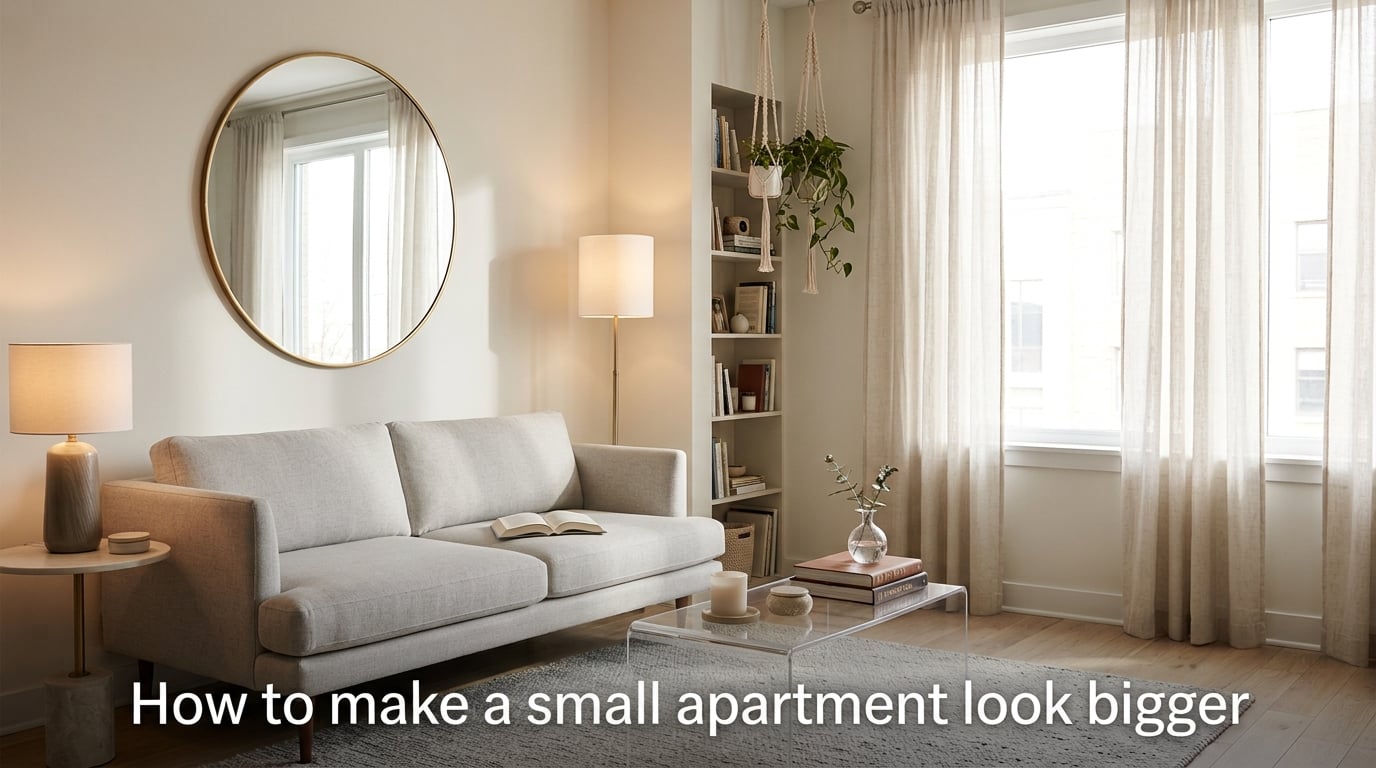
I lived in a 380-square-foot studio for two years of college, and I know exactly how a small apartment can feel like it’s closing in on you. The good news: you don’t need to knock down walls or spend a fortune to make your place feel bigger. After testing dozens of design tricks in my own space and helping a dozen friends redo theirs, I’ve pulled together the strategies that actually work. This guide on how to make a small apartment look bigger walks you through every trick I trust, plus the budget-friendly and rental-safe moves that students and first-time renters actually use.
If you’re moving into a dorm, a college apartment, or your first rental, these tips will help you maximize every square foot without sacrificing style.
Table of Contents
How to Make a Small Apartment Look Bigger: The Complete Guide
The secret to making a small apartment look bigger is tricking the eye, not expanding the room. Light colors recede. Mirrors double visual depth. Exposed furniture legs create the illusion of floor space. Layered lighting removes the shadows that make walls feel closer than they are. We’ll cover each of these ideas, plus student-specific hacks for tight budgets and strict landlords.
I tested each strategy below in real rooms and ranked them by impact. Start with the first four if you only have an afternoon. Work your way through the rest as time and budget allow.
1. Color and Paint Selection
Light, cool colors make a room look bigger because they reflect more light and visually recede. Soft whites, pale greys, dusty blues, and warm beiges open up a space far better than dark, warm tones that absorb light and pull walls inward.
Stick with a monochromatic palette across walls, trim, and ceiling. When everything is one tonal range, your eye reads the whole room as one continuous surface instead of breaking it into boxes. I painted my studio walls, ceiling, and baseboards the same warm white, and the room immediately felt taller and wider.
Here are the colors that consistently perform best in small apartments:
- Soft whites (Benjamin Moore White Dove, Sherwin Williams Alabaster) — reflect the most natural light
- Pale greys (Agreeable Grey, Classic Grey) — hide scuffs better than pure white
- Dusty blues (Quiet Moments, Sea Salt) — add personality without darkening the room
- Warm beiges (Natural Linen, Accessible Beige) — cozy and forgiving on walls with imperfections
Save the bold, dark colors for one accent wall or for the back of a bookshelf. A single dark wall can actually make a long, narrow room feel shorter, so use it sparingly. If you love a dramatic color, try it on the ceiling of a short room to draw the eye up.
2. Furniture Scale and Selection
Choose furniture proportional to your room, with exposed legs and low backs, to make a small apartment look bigger. Bulky, floor-length pieces visually shrink the space; leggy furniture lets the floor show through and creates breathing room.
The biggest mistake I see in small apartments is furniture that’s too large. A 90-inch sofa in a 10-foot room will eat the space. Measure your room first, then leave 30 to 36 inches of walking path around major pieces. Designers call this keeping clear sightlines, and it makes a room feel open even when it’s physically full.
Furniture features that make a small apartment look bigger:
- Exposed legs — sofas, chairs, and beds on visible legs let the floor extend underneath
- Transparent materials — acrylic or glass coffee tables keep sightlines open
- Multi-purpose pieces — storage ottomans, sofa beds, and nesting tables earn their footprint
- Floating furniture — pieces pulled a few inches off the wall feel intentional and modern
When in doubt, go smaller rather than larger. Three petite chairs feel more spacious than one giant sectional.
3. Declutter and Organize Your Space
Less visible stuff equals more visible space, so decluttering is the single fastest way to make a small apartment look bigger. Surfaces count: when a coffee table, kitchen counter, or floor is crowded, the room reads as smaller. Clear those planes and the room breathes.
I follow a 3-5-7 rule for surfaces: a coffee table holds 3 items, a console table holds 5, and a dining table holds 7. Anything beyond that gets put away. It’s a small change that transforms how open a room feels.
Storage solutions that hide clutter without taking up floor space:
- Under-bed storage bins for off-season clothes and extra linens
- Vertical shelving that reaches the ceiling to draw the eye up
- Hooks behind doors for bags, robes, and coats
- Drawer dividers and closet organizers to maximize every inch
- Storage benches that double as seating in tight entries
Before you buy another organizer, edit first. Donating or selling ten items takes less time than building a clever shelf to hold all ten.
4. Mirrors and Reflective Surfaces
Hang a large mirror opposite or perpendicular to a window to make a small apartment look bigger by doubling both light and depth. Mirrors reflect the brightest part of the room back into itself, creating the illusion of an extra window or a doorway that isn’t there.
Placement matters more than size. A small mirror facing a wall bounces nothing back. A large mirror across from a window bounces daylight into the deepest corner of the room. I’ve seen a single 40-inch round mirror make a 9×9 bedroom feel like a suite.
Other reflective tricks that work in small apartments:
- Lean a floor-length mirror against a wall to add vertical depth
- Choose a mirror with a thin or frameless edge for an invisible look
- Group smaller mirrors in a salon-style arrangement for visual rhythm
- Add a glass-top coffee table or a glossy lacquered cabinet to bounce light around
Skip heavy ornate frames in tight rooms. They add visual weight where you need lightness most.
5. Lighting Strategy for Small Spaces
Layer ambient, task, and accent lighting at warm 2700K to 3000K to make a small apartment look bigger, since a single overhead light leaves corners in shadow that shrink the room. Multiple light sources spread brightness evenly and make walls feel farther apart.
Most apartments come with one sad ceiling fixture in the middle of the room. That single source creates harsh shadows and forces your eye to focus on the dark corners. Add a floor lamp in one corner, a table lamp on a side table, and a wall sconce or plug-in picture light to wash another surface. Suddenly the room reads as bigger because there’s no dark spot to define the edges.
Three layers I use in every small space I design:
- Ambient — overhead light or a large floor lamp for general brightness
- Task — desk lamp, reading lamp, or under-cabinet lighting where you work
- Accent — picture light, sconce, or candle for warmth and depth
If your rental doesn’t allow new wiring, plug-in sconces and battery-operated puck lights work just as well. Replace any bulky floor lamp with a slim arc or a wall-mounted option to free up valuable square feet.
6. Curtains and Vertical Lines
Mount curtain rods close to the ceiling and wide enough to frame the entire window to make a small apartment look bigger, because floor-to-ceiling drapery draws the eye upward and makes ceilings feel taller. Low-mounted curtains cut the wall in half and shrink the room.
The rule I follow: hang the rod 2 to 4 inches below the ceiling line, and extend it 8 to 12 inches past each side of the window frame. When curtains hang this high and wide, they expose the full window glass and let in maximum daylight. They also create a long vertical line that visually raises the ceiling.
Curtain tips for small apartments:
- Choose light, airy fabrics like linen or sheer cotton to keep things breezy
- Match curtain color to wall color for a seamless, expansive look
- Let curtains puddle slightly on the floor or hem just above — never float mid-wall
- Use wrap-around brackets that hold the rod close to the ceiling
If you have narrow windows or no windows at all, hang curtains on the wall to fake architectural detail. Designers do this all the time to add elegance to awkward spaces.
7. Rugs, Art and Visual Tricks
Use one oversized rug and one oversized art piece to make a small apartment look bigger, because small rugs and small art break the room into more pieces. Big elements unify the space and create a single strong focal point.
The standard rule for rugs: in a living room, the front legs of all major furniture should sit on the rug. In a bedroom, the rug should extend 18 to 24 inches beyond the sides of the bed. A tiny rug floating in the middle of the floor makes the whole room look like a postage stamp.
For art, scale up. One large piece above the sofa reads as more spacious than a cluster of small frames. A gallery wall is great when you have a specific theme, but in tight rooms I usually prefer one statement piece per wall.
More visual tricks that punch above their weight:
- Paint the back of a bookshelf a contrasting color to add depth
- Use a full-length mirror on the inside of a closet door
- Hang plants from the ceiling to draw the eye up and free up floor space
- Keep window treatments simple so the window stays the focal point
8. Student-Specific Budget Tips
Source furniture from Facebook Marketplace, thrift stores, and college move-out sales to make a small apartment look bigger on a student budget. New furniture is the single biggest expense, and small-space pieces are notoriously overpriced at retail.
I furnished my first apartment for less than the cost of a single new sofa. A solid wood bookshelf from a yard sale, a slipcovered chair from a consignment shop, and a hand-me-down coffee table with new legs got me 80% of the way there. The remaining 20% came from a few targeted splurges: good lamps and one piece of art I loved.
Budget-friendly swaps that move the needle:
- Removable wallpaper or peel-and-stick tiles for an accent wall without paint
- IKEA basics and Target Threshold for affordable, modern furniture
- Paint the back of a thrifted bookshelf for an instant designer look
- Swap heavy curtain rods for tension rods and save on installation
- Use washi tape or removable strips to test art placement before committing
The biggest budget win is restraint. Skip the trendy decor pieces that fill catalogs and invest in the four items that change everything: lighting, mirror, rug, and curtains.
9. Rental-Friendly Solutions
Use removable adhesives, freestanding furniture, and tension-mounted hardware to make a rental apartment look bigger without risking your security deposit. Every change should be reversible in under 30 minutes.
When I was renting, I followed three rules: nothing drilled into the wall, nothing painted that couldn’t be returned to white, and nothing bulky I couldn’t move by myself. Those rules forced me to get creative, and the apartment looked better for it.
Rental-safe upgrades for a small apartment:
- Command strips and hooks for hanging art, mirrors, and curtains
- Tension rods for windows and closet dividers
- Freestanding room dividers to create zones in a studio
- Removable wallpaper on a single feature wall
- Stick-on backsplash tiles in the kitchen
- Washable slipcovers to refresh old furniture
Save your receipts, photograph the original condition, and store original fixtures if you swap any out. Future-you will thank present-you when move-out day arrives.
Common Mistakes to Avoid
Skip these frequent errors if you want your small apartment to actually look bigger. Each one eats visual space, and most are easy to fix in an afternoon.
The mistakes I see most often:
- Pushing every piece of furniture against the wall — it actually shrinks the room. Pull pieces 6 to 12 inches away to create breathing room and depth.
- Choosing a too-small rug — a postage-stamp rug makes the whole room feel tiny. Go oversized.
- Blocking the windows — heavy drapes, tall plants, or furniture in front of windows kill natural light and the sense of openness.
- Painting everything dark — moody colors are trendy but they shrink rooms fast. Use them on a single accent at most.
- Hanging art too high — art should sit at eye level, roughly 57 to 60 inches from the floor to the center.
- Ignoring the ceiling — a white ceiling recedes; a painted ceiling can make a low room feel taller.
Fixing even two of these mistakes will make a noticeable difference in how your apartment feels.
Frequently Asked Questions
What is the 3-5-7 rule in decorating?
The 3-5-7 rule is a styling guideline for how many objects to display on a surface. It suggests using 3 items on a small surface like a coffee table, 5 items on a medium surface like a console, and 7 items on a large surface like a dining table. Grouping objects in odd numbers feels more visually pleasing and gives the eye places to rest, which keeps a small apartment from feeling cluttered and helps it look bigger.
What color makes a small room look bigger?
Light, cool colors make a small room look bigger. Soft whites, pale greys, and dusty blues reflect natural light and visually recede, which opens up walls and ceilings. Stick with a monochromatic palette across walls, trim, and ceiling so the eye reads the room as one continuous surface. Save dark colors for a single accent wall if you want contrast.
How do you use mirrors to make a room bigger?
Hang a large mirror directly opposite a window or perpendicular to it to bounce daylight back into the room. A floor-length mirror leaned against a wall adds vertical depth, and a thin-framed mirror keeps the look light. Group smaller mirrors in odd numbers for a rhythmic effect. Avoid hanging mirrors where they only reflect a blank wall, since they add nothing visually.
How can I make my small apartment look expensive on a budget?
Focus on lighting, mirrors, curtains, and rugs first. Layer warm light sources at 2700K to 3000K, hang a large mirror opposite a window, mount curtains close to the ceiling, and add one oversized rug that anchors the room. Edit your surfaces down to a few intentional objects, hide clutter in closed storage, and remove anything you don’t use or love. Restraint and good lighting make any apartment read as high-end without spending much.
What makes a home look cheap?
A home looks cheap when it has too many small, mismatched items, harsh overhead lighting, cluttered surfaces, and visible cords. Plastic hardware, plastic plants, and tight, short curtains also drag down the look. Stick to a tight color palette, edit your surfaces, hide cords with cable management, and invest in one or two pieces of real art or a quality mirror to lift the whole room.
Conclusion
Learning how to make a small apartment look bigger comes down to a handful of high-impact moves: light paint, scaled furniture, hidden clutter, big mirrors, layered lighting, and tall curtains. Start with the four that fit your budget and your rental situation. Within a single weekend, you’ll feel the difference, and within a month, you’ll wonder how you ever lived without these tricks.
For more on setting up your student space, browse our student accommodation guides for budget breakdowns, room-by-room tips, and rental checklists.