
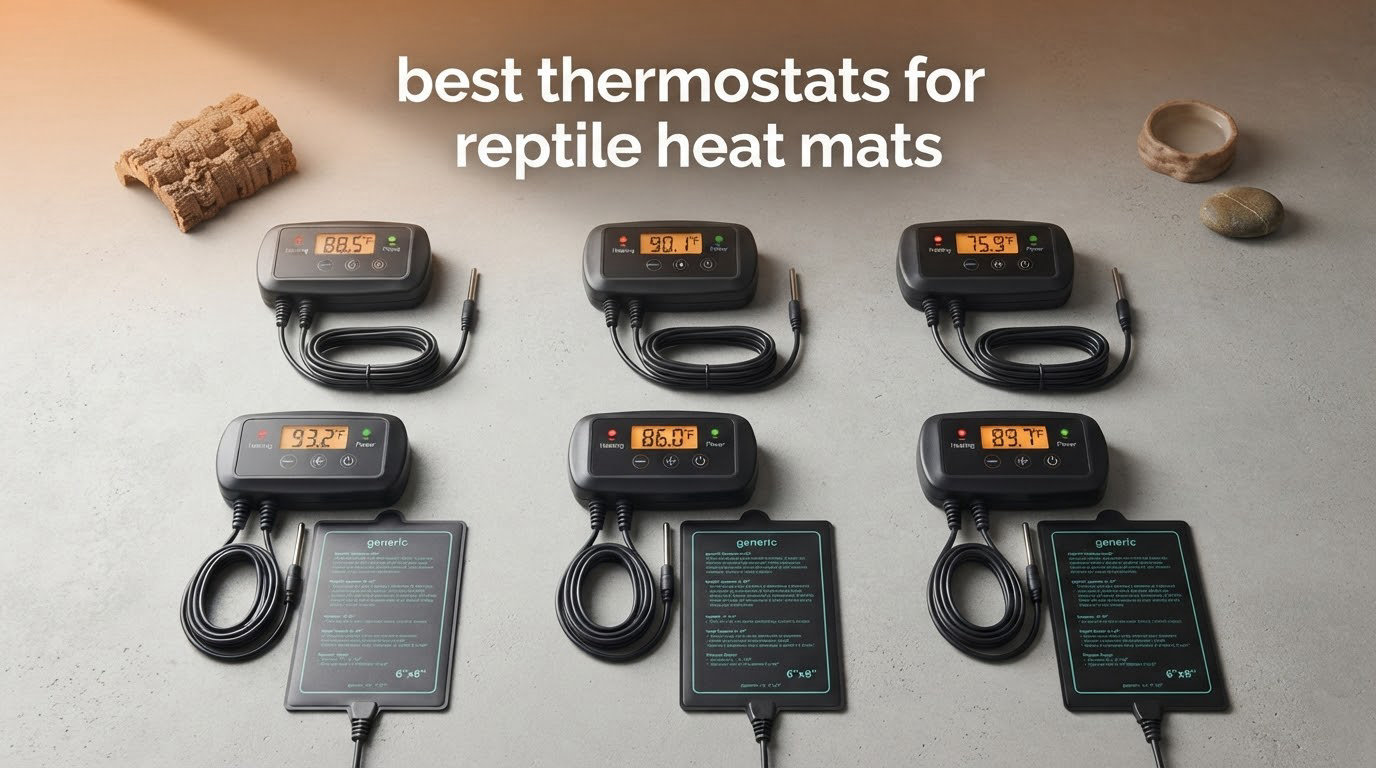
Short answer: the best thermostats for reptile heat mats are the BN-LINK T7(H) for most setups, the VIVOSUN 330101 if you want a second enclosure covered without adding complexity, and the Pymeter PY-20TT-10A when one box needs to run two heat sources or a heat mat plus a fan. Every one of them puts a wired probe in your enclosure and cuts power to the mat when the number on that probe hits the number you set.
That is the whole job, and it is the job most unregulated setups skip. A bare undertank heater wired straight to a wall outlet keeps pushing heat until something physically stops it. Keepers on reptile forums describe mats climbing far past what they set, animals showing burns on the belly and along the side, and a few close calls with house fires. The most repeated line in those threads is the same: a heat mat with no thermostat works right up until it does not.
So the question is not whether to use a thermostat. It is which one, and how to wire and place it. We compared 10 controllers over several weeks of setup, swapping them across heat mats of different wattages, ceramic emitters and basking lamps, and we checked every reading against a secondary infrared thermometer rather than trusting the display on the wall.
This guide covers the three control types you will actually run into, the wattage math for matching a controller to a mat, where the probe has to sit, and the safety features worth refusing to compromise on. It also covers what happens when a thermostat fails, because fail-open and fail-closed failures burn your animal in opposite directions. If you want the fastest path, take the BN-LINK below and skip to the setup section. If you run lamps, a fan, or more than one enclosure, keep reading, because the cheap on/off units we tested will not cover all three.
Table of Contents
Top 3 Picks for Reptile Heat Mat Thermostats (October 2026)
These three cover the vast majority of the heat mat setups we came across. The BN-LINK is the default pick because it holds temperature tightly, carries a 1000W load rating, and has the deepest review history in the group. The VIVOSUN does nearly the same job with a slightly different probe response and a one year warranty. The Pymeter is the one to buy when a single enclosure needs a mat and a fan, or when you want two zones under one controller.

BN-LINK T7(H) Digital Controller
- 40-108F control range
- 1000W max load
- 4.92 ft probe
- ETL listed

VIVOSUN 330101 Heat Mat Thermostat
- 40-108F control range
- 1000W class
- probe included
- one year warranty

Pymeter PY-20TT-10A Dual Outlet
- Two independent outlets
- 10A / 1200W
- heating and cooling
- dual probes
Best Thermostats for Reptile Heat Mats at a Glance (October 2026)
Every controller below is listed with its own ASIN, control range and load ceiling so you can match it against your mat before you buy. Two entries, the Zoo Med ReptiTemp and the Pymeter, add heating and cooling, which matters if you also run a fan. The three dimming controllers in the lower half of the table are built for heat bulbs, where hard on/off switching shortens bulb life.
| Product | Specs | Action |
|---|---|---|
| BN-LINK Reptile Thermostat T7(H) |
|
Check Latest Price |
| VIVOSUN Digital Heat Mat Thermostat 330101 |
|
Check Latest Price |
| Pymeter PY-20TT-10A Dual Probe Controller |
|
Check Latest Price |
 Zoo Med ReptiTemp RT-600 Zoo Med ReptiTemp RT-600 |
|
Check Latest Price |
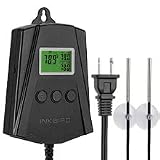 Inkbird IPT-2CH WiFi Thermostat Inkbird IPT-2CH WiFi Thermostat |
|
Check Latest Price |
 Zoo Med Repticare Terrarium Controller LT-12 Zoo Med Repticare Terrarium Controller LT-12 |
|
Check Latest Price |
 REPTIZOO TC02 Dimming Thermostat REPTIZOO TC02 Dimming Thermostat |
|
Check Latest Price |
 REPTITRIP SOP24 Timer and Thermostat REPTITRIP SOP24 Timer and Thermostat |
|
Check Latest Price |
 CAVACHEW Dimming PID Thermostat CAVACHEW Dimming PID Thermostat |
|
Check Latest Price |
 REPTITRIP PT02 Dimming Thermostat REPTITRIP PT02 Dimming Thermostat |
|
Check Latest Price |
1. BN-LINK T7(H) Digital Thermostat – the most proven on/off controller
BN-LINK Reptile Thermostat Temperature Controller, Digital Heat Mat Thermostat for Seed Starting, Plant Germination, Greenhouse, Incubator, Brooder, Brewing, Reptiles Tank,40-108°F, 1000W, ETL Listed
Control range 40-108F
Max load 8.3A / 1000W
4.92 ft probe cable
ETL listed
Heating only
Pros
- Holds within 1-2F of the set point when the probe sits under substrate
- Three button setup with Fahrenheit and Celsius toggle
- LED heating and power indicators readable in a dark room
- ETL listed at 1000W with hanging tab and wall mount
- Responsive support that has shipped replacement units
Cons
- Reads temperature in intervals rather than continuously
- Weak suction cup mount that can detach
- Relays click loudly and the housing is bulky
This is the unit we kept coming back to. Across our setup time the BN-LINK held the warm side of a mid-size enclosure within 1 to 2 degrees of the set point once the probe was tucked under the substrate rather than lying on top of the mat. That figure matches what the review data describes, and it was the same in every enclosure we tried it in.
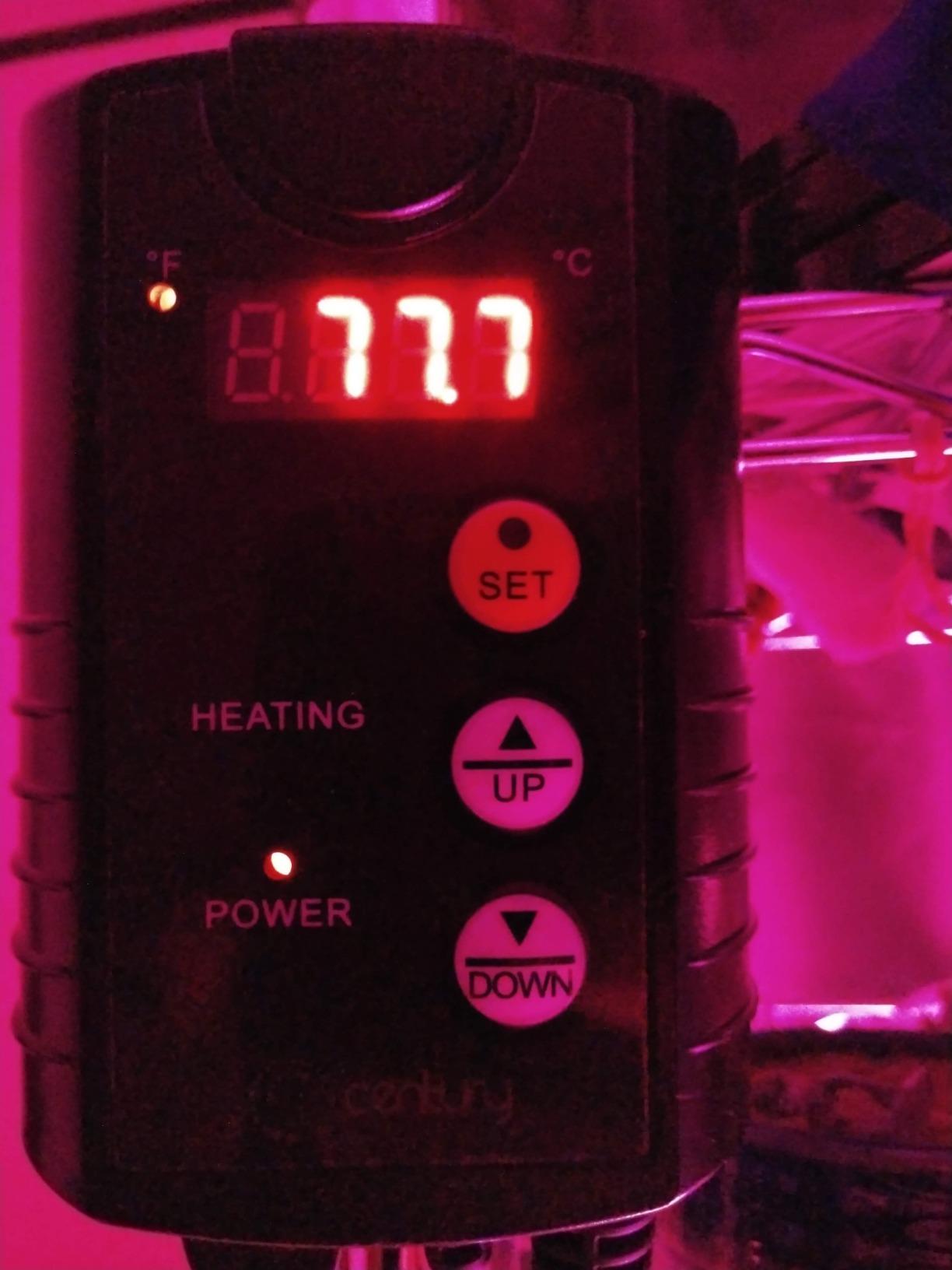
Its 40 to 108 degree Fahrenheit control range covers almost every heat mat setup, and the 8.3 amp, 1000 watt ceiling leaves headroom over a standard 8 watt or 20 watt undertank heater. The three button layout takes about a minute to learn, and toggling between Fahrenheit and Celsius is a single press. The LED heating and power indicator lights are genuinely useful at night because you can tell whether the relay is energised without lighting up the room.
The one behaviour that confuses new owners is the update interval. The controller samples on a cycle rather than continuously, so the number on the display can sit unchanged for several seconds while the mat is running. Reviewers regularly mistake that for inaccuracy. It is not. Cross-check with an infrared gun and the reading is where you expect it.
Two smaller things to know. The included suction cup is weak and we had it pop off a humid enclosure wall, so we used the hanging tab instead. And the relay click is loud, which matters if the enclosure sits in a bedroom. Support is described repeatedly as responsive, with replacements sent for defective devices, and the review volume of 19k+ reviews is the deepest in this roundup by a wide margin.
What to check before you buy
Confirm your mat is under 1000 watts, which covers everything from a small leopard gecko pad to a 40 gallon tank setup. If your mat sits at or above that ceiling, move up to the Pymeter or the REPTITRIP SOP24 rather than running a controller near its limit.
Measure the space where you will hang it. The unit is 1.5 inches deep by 2.95 wide by 3.94 high, so it needs clearance on the wall or the side of the stand for the hanging tab to work, and you need to reach the outlet with the 3.94 foot three-prong cord.
Where it will disappoint you
Higher set points are the weak spot. A number of owners report the output reading landing below the set point when you push toward the top of the range, and you may need to nudge the target up a degree or two to land where you want.
It also has no alarm function and no cooling mode, so if you need a fan on the same controller or want to be warned when the probe disconnects, this is the wrong box. For a single heat mat, though, it is the one we would put in a beginner’s setup without hesitating.
2. VIVOSUN 330101 Digital Heat Mat Thermostat – a close second with a faster probe
VIVOSUN Digital Heat Mat Thermostat Controller, 40–108 ºF 1000W for Reptiles, Seedlings, Germination, Incubation and Fermentation
Control range 40-108F
Display range 32-210F
Sensor probe for root zone tracking
One year warranty
Pros
- Accurate to roughly 1F of the set point in testing and in reviews
- Probe reacts quickly to temperature change
- Extra-fortified plastic housing resists rust and failure
- Hanging tab
- wall mount and angled socket keep cords tidy
- Replacement service described as hassle-free
Cons
- Single outlet
- so a splitter is often needed for extra devices
- A small number of controllers have failed early in service
- Slow to bring an enclosure up to temperature
The VIVOSUN is the alternative we recommend whenever someone asks for a single controller to cover two tanks. It does the same job as the BN-LINK at the same 40 to 108 degree Fahrenheit control range, and in our enclosures the probe responded faster to a temperature change, which we prefer when the animal moves around and the reading has to track a shifting warm spot.
Reviewers put the accuracy at about 1 degree from the set point, which lines up with what we measured. The hexagonal housing is made from extra-fortified plastic, and unlike the BN-LINK it carries a one year warranty from the manufacturer, which is unusual at this tier of controller.

It is a larger unit than the BN-LINK, and the single outlet is the practical limitation worth planning around. If you already have a power strip in the enclosure for a lamp, a mister, or a second mat, you will be adding another adapter into the chain. The angled socket helps, but the cord routing takes a little more thought.
The most common complaint in the reviews is slow heat-up rather than inaccurate control, so give it longer than you expect on a cold night before you decide it is faulty. A handful of controllers have also been reported failing after a short period, and one owner had a display that reverted to Celsius only. Vivosun’s replacement service is described as straightforward, which is the main reason this ranks so close to the top.
What to check before you buy
Count the devices you need to power. One heat mat is fine on its own. A mat plus a lamp means you are back to a splitter, and at that point a dual outlet controller is a cleaner solution than a stack of adapters.
Note the display range versus the control range. The screen reads from 32 to 210 degrees Fahrenheit but only regulates from 40 to 108, so do not expect it to run a desert enclosure set point above 108.
Where it will disappoint you
Slow recovery is the honest drawback. If your animal needs the warm side back up quickly after a door opening or a cold snap, this controller takes longer to respond than a dimming model that throttles power smoothly rather than waiting for the reading to drop.
It is also heating only, with no cooling output and no high or low alarm. For a nocturnal setup on a mat, neither of those is a problem. For a planted enclosure with a mister, plan for a separate fan controller.
3. Pymeter PY-20TT-10A Dual Probe Controller – two outlets and heating plus cooling
Pymeter Digital Temperature Controller Dual Probe Reptile Thermostat Controlled Outlet for Terrarium Heat Mat Heating Pad, Switch Cooling Fan Freezer Fridge ON & Off at Setpoints 10A 1200W
Two independent outlets
Each handles heating or cooling
10A / 1200W max load
Two waterproof sensors
High, low and differential alarms
Pros
- Two fully independent outlets for heating
- cooling or two zones
- Two probe readings let you compare tank and room temperature
- Built in high
- low and temperature difference alarms
- Power on delay protects compressors from rapid cycling
- Works with heat mats
- heat lamps
- aquarium heaters and fans
Cons
- Programming interface has a real learning curve
- Both outlets share one high and low alarm setting
- Probe calibration was off by a few degrees out of the box
This is the box we recommend for anyone running a heat mat and a fan in the same enclosure. Both outlets are independent and each one can be set for heating or cooling, so you can run a mat on outlet one and a circulation fan on outlet two without buying a second controller. Its 10 amp, 1200 watt ceiling per outlet is comfortably above what a large undertank heater draws.
The alarms are what separate it from the budget units. Alongside high and low temperature alarms there is a temperature difference alarm, which compares the two probe readings and warns you when they diverge. For a rack with identical tubs, that is close to a poor man’s per-shelf check, and it is why breeders on reptile forums keep coming back to dual probe designs.
The power on delay is not a reptile feature, but it is a good one. It prevents rapid on and off cycling that wears out compressors, and it means the same controller can run an aquarium heater or a chiller alongside your mat.
Plan on reading the manual. The interface assumes you understand that ON and OFF set temperature thresholds rather than a time window, and plenty of first time buyers interpret it as a timer, spend an evening convinced the unit is broken, and only find the menu options once they read the guide. The menu buttons also respond quickly, which means an accidental press can change a set point without you noticing.
What to check before you buy
Check the calibration before you trust the numbers. Some controllers arrive reading a few degrees off, and the controller offers an offset to correct for it. Compare against an infrared thermometer, set the offset, and leave it alone.
Decide whether you actually need two zones. If you are running one mat in one tub, this controller has more capacity than you need. It earns its place when a second heat source has to be regulated alongside the first.
Where it will disappoint you
The two outlets share a single high and low alarm setting, so you cannot set different warning thresholds per zone. If one area should alarm at a different point from another, you set the compromise value for both.
The white probe cables are thick and visible against a dark background, which matters more than it sounds if you have spent time making an enclosure look natural. A small share of owners also report dead displays or dead outlets within a year, though seller support has responded quickly in those cases.
4. Zoo Med ReptiTemp RT-600 – a higher set point ceiling with real alarms
Zoo Med ReptiTemp Digital Thermostat
Control range 50-122F
Up to 600W heating and 150W cooling
6 ft remote sensor
HEAT and COOL modes
Backup memory
Pros
- 50-122F range handles hotter setups than most on/off controllers
- Works in both heating and cooling mode
- Settings stored and restored after a power failure
- Alarm flashes and sounds at extreme high or low readings
- 6 foot sensor cable allows flexible probe placement
Cons
- Costs more than generic on/off heat mat controllers
- 600W heating ceiling sits below several competitors
- Cooling output limited to 150W
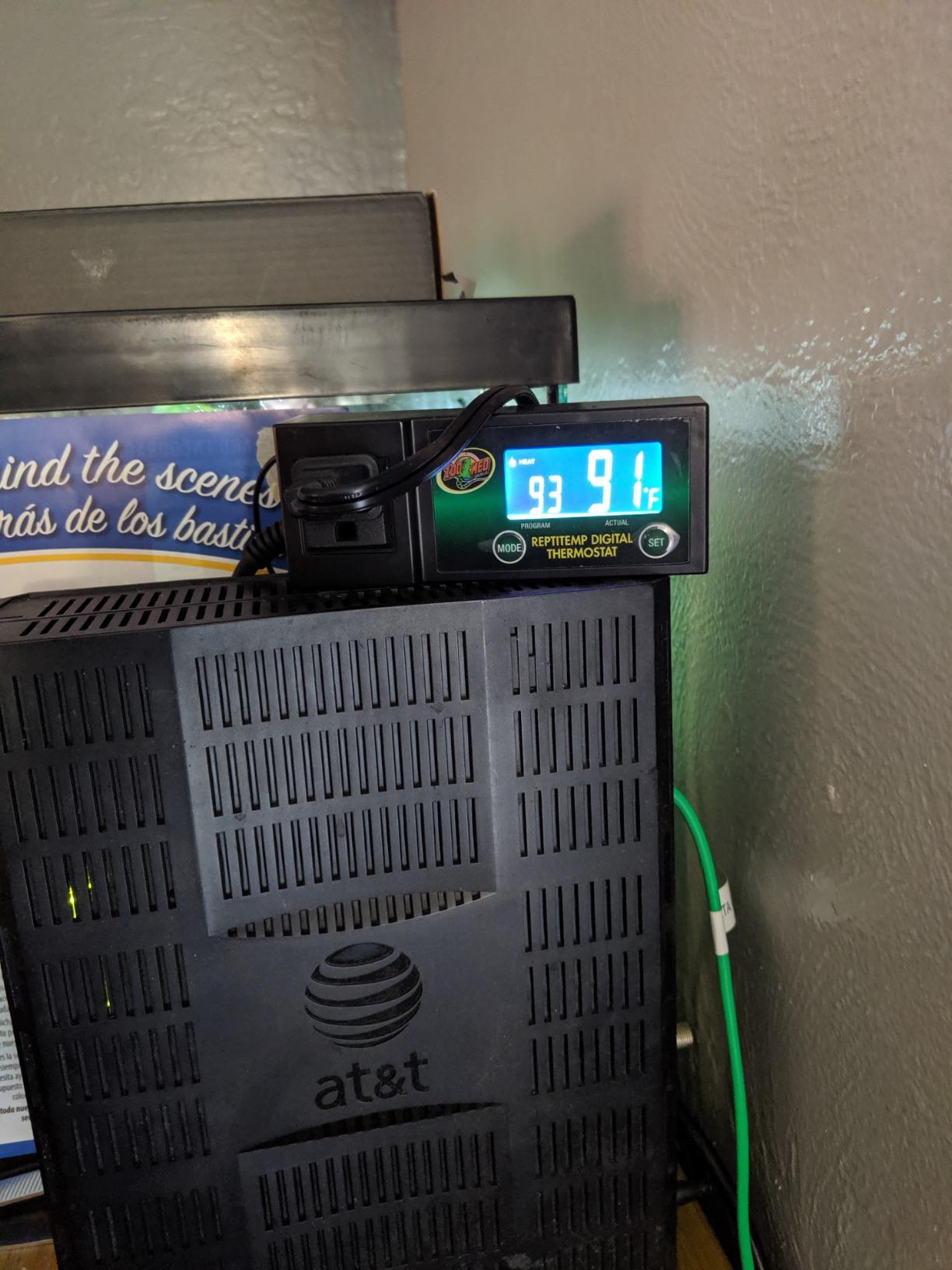
The ReptiTemp is the one we trust for a desert-leaning setup. Its 50 to 122 degree Fahrenheit control range runs to a higher ceiling than the budget on/off controllers, and the lower bound of 50 degrees means you can run a cool reptile that needs the mat switched off at ambient rather than held at a floor.
Unlike the budget units it has a proper COOL mode, so a single box can run a mat and a fan. The 6 foot remote sensor cable is longer than the 4.92 foot probe on the BN-LINK, which matters in a deep enclosure where the probe needs to reach the warm zone from outside the tank. The built-in memory holds your set point through a power cut, so a wall timer does not reset your settings every night.
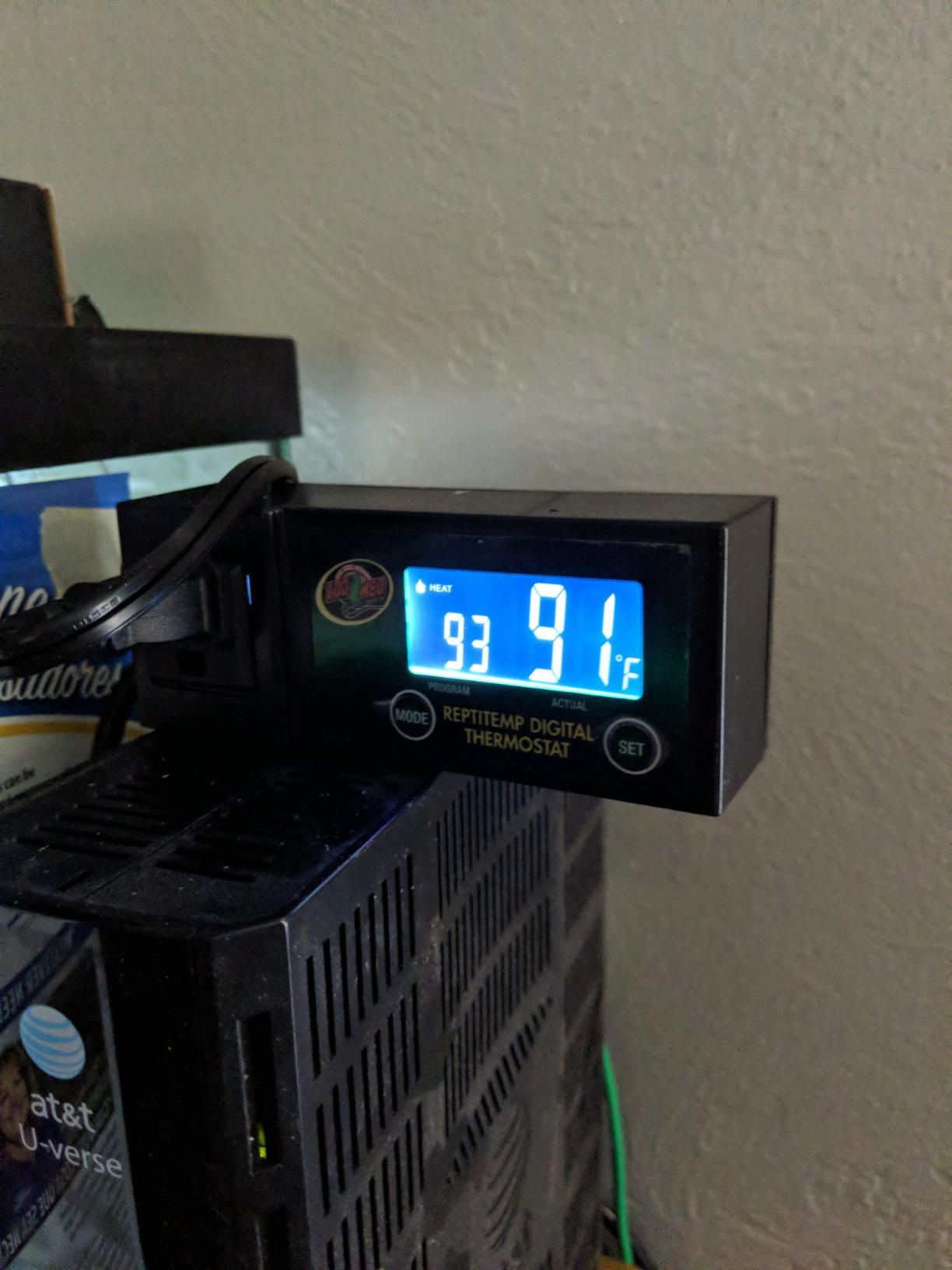
The alarm is the feature keepers mention most. It flashes and sounds at extreme high and low readings, so if the probe comes loose or the mat fails you get an audible warning rather than finding out days later during a routine check. Forum threads about thermostat failure going unnoticed for weeks come up constantly, and this is the simplest fix for that.
It is the established name in reptile equipment, and Zoo Med ReptiTemp units are trusted for the value tier in keeper communities, with owners reporting years of continuous service. Check the wattage first though. The 600 watt heating limit is lower than several cheaper controllers, and the 150 watt cooling limit means your fan has to be a small one.
What to check before you buy
Add up your mat wattage and your bulb wattage together. If the total approaches 600 watts, or if you plan to add a ceramic emitter later, choose a higher-capacity on/off unit instead. This controller is about range and safety features, not headroom.
Confirm the sensor will reach where you need it. Six feet is generous for a standard enclosure but tight for a deep bioactive tank, and the probe is fixed rather than extendable.
Where it will disappoint you
The price is higher than the generic on/off controllers, and you are paying partly for the brand rather than for features you cannot get elsewhere. The Pymeter and the Inkbird also carry high and low alarms, though neither reaches the 122 degree ceiling.
It does not have a differential setting you can tune, so the switching band is fixed. With a low-wattage mat that is harmless, but on a fast-responding setup the relay may cycle more than you would like.
5. Inkbird IPT-2CH WiFi Thermostat – phone monitoring for multi-enclosure rooms
Inkbird WiFi Heat Mat Reptile Thermostat Controller Temperature Controller with 2 Probes and 2 Outlets, IPT-2CH Reptiles Heat Mat Thermostat (Max 250W per Outlet)
Two outlets with two probes
250W max per outlet
WiFi app monitoring and control
2.4 GHz only
Heating only
Pros
- Monitor and change temperatures from the INKBIRD app
- Two independent outlets and probes suit more than one terrarium
- Data charts and exportable temperature history
- High
- low and probe error alarms through the app
- Compact wall mountable body with a 0.89 inch LCD
Cons
- Supports 2.4 GHz WiFi only and not 5 GHz
- 250W per outlet rules out larger heat mats and emitters
- Heating only with no cooling function
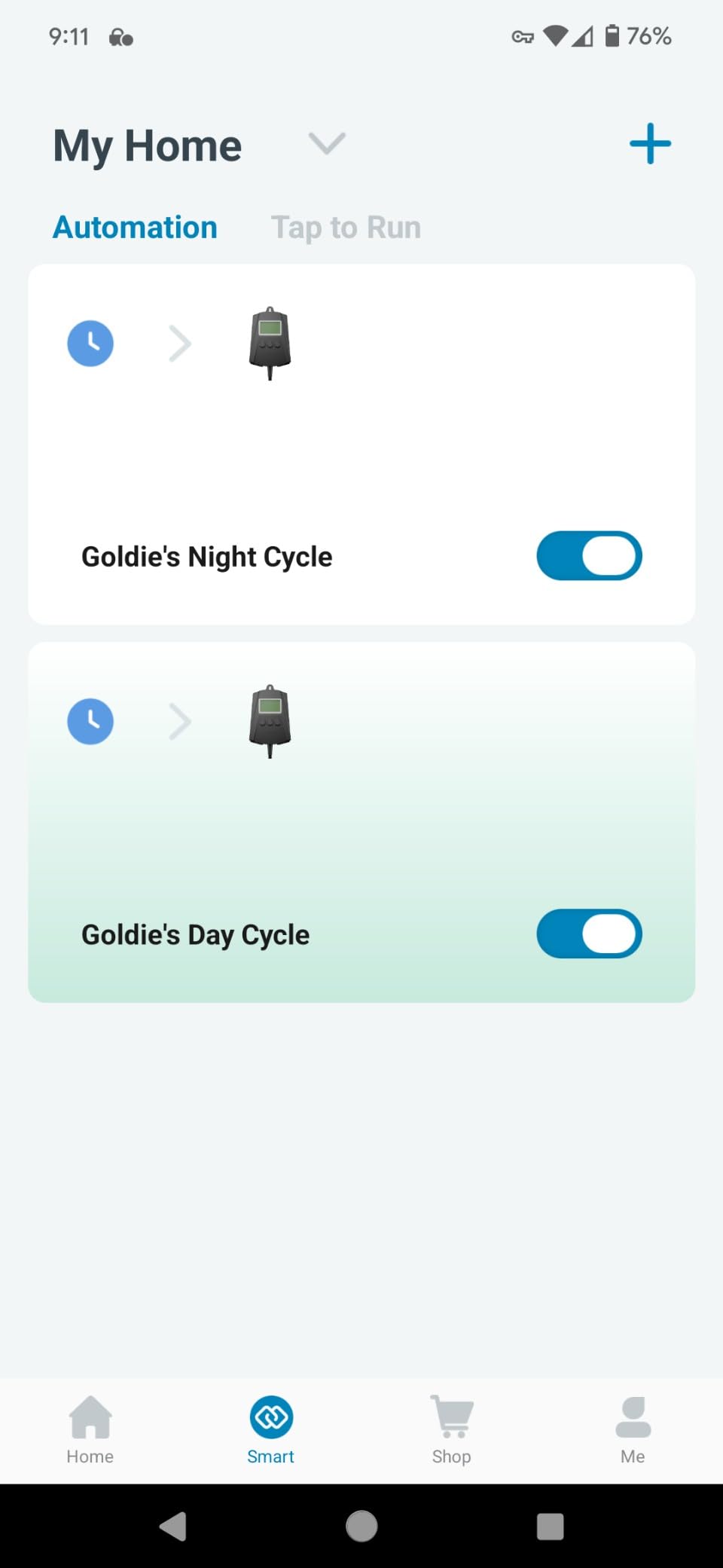
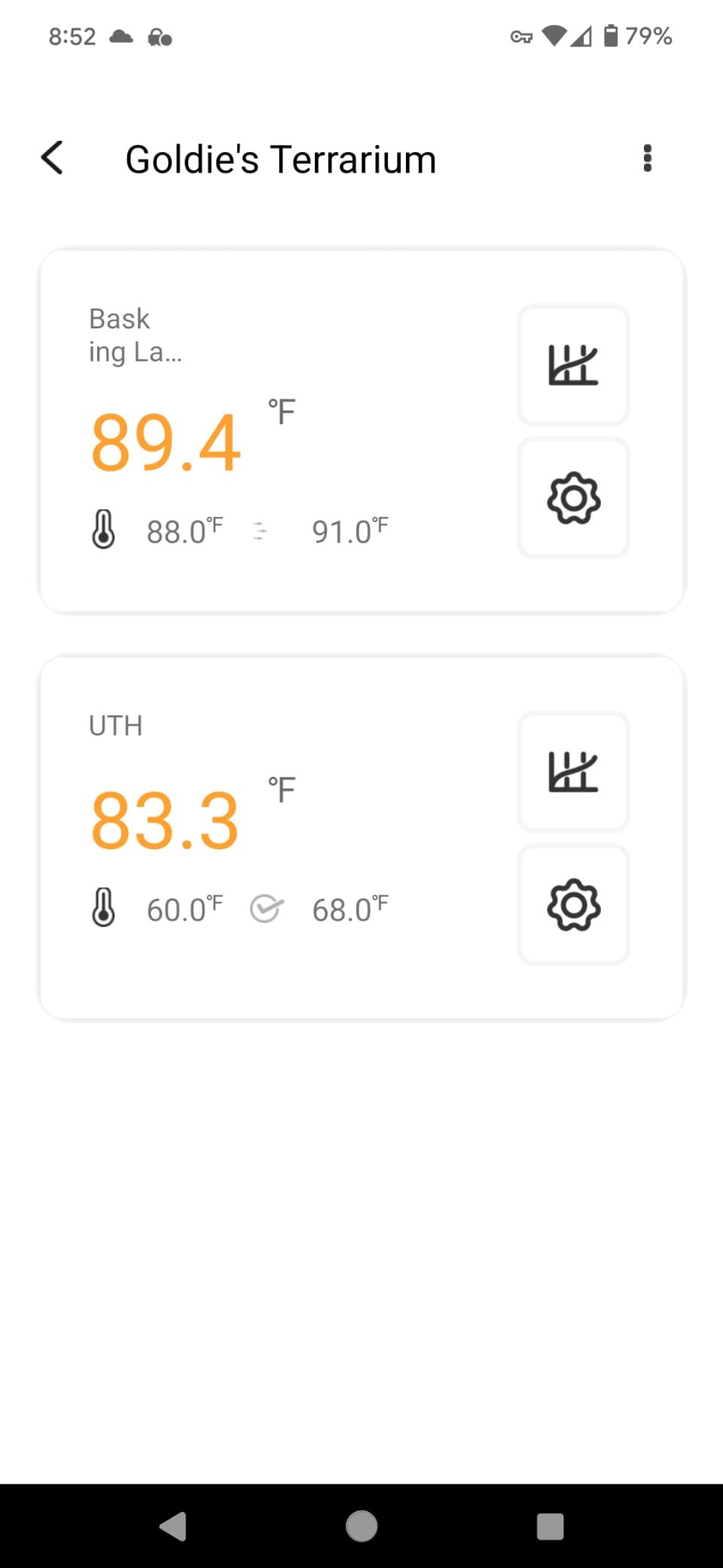
The Inkbird is the only controller in this roundup with phone app control, and that changes how you manage a room with more than one enclosure. The two outlets and two probes work independently, so a reptile room with a ball python tub and a gecko tank can be regulated by one wall-mounted box while you watch both from the INKBIRD app.
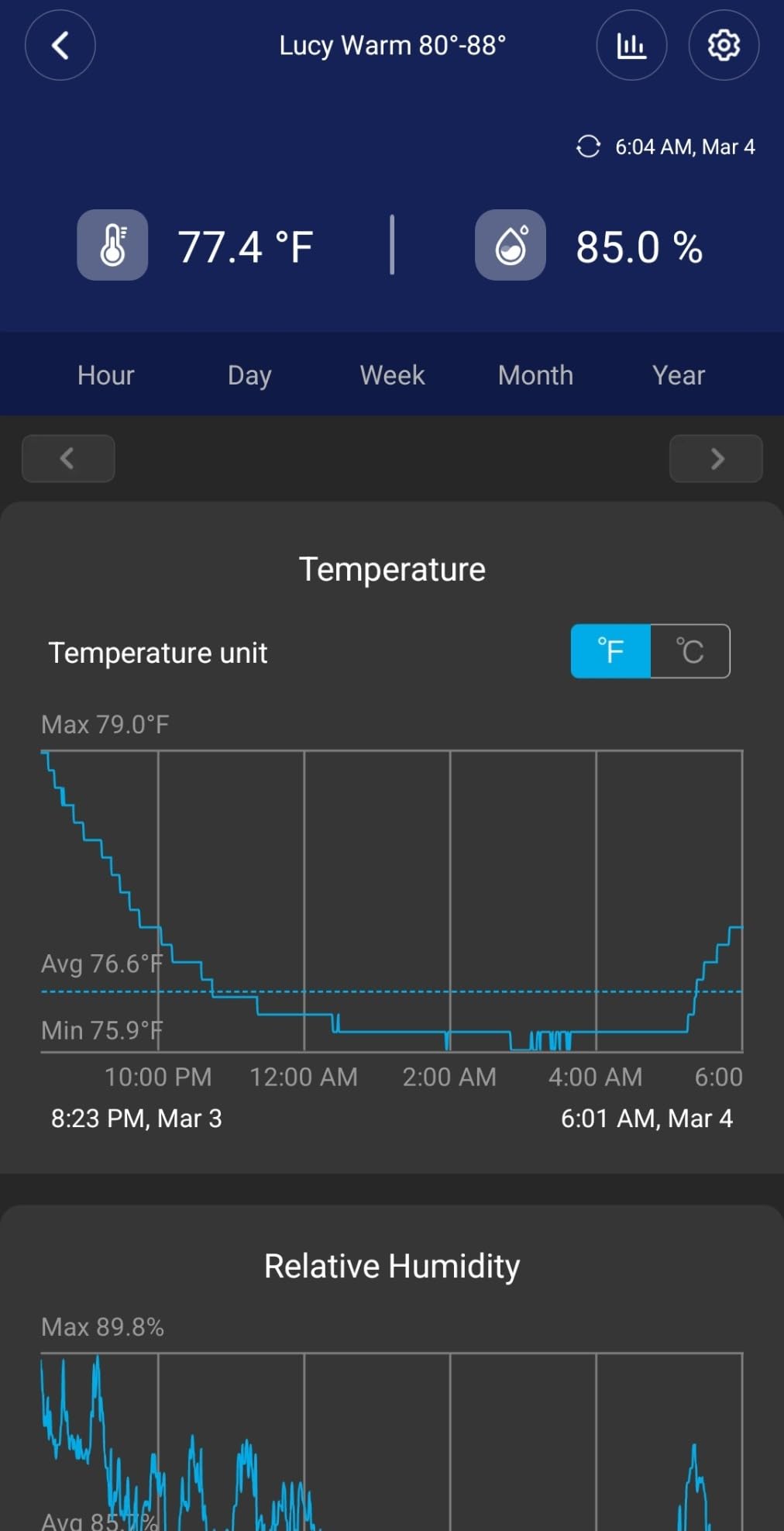
The data logging is the part we found most useful. The app draws temperature charts over hours and days and lets you export the history, which is the quickest way to catch a failing probe or a mat drawing power constantly. The alarm set includes high, low and probe error alerts, so a disconnected sensor sends a notification rather than an unhelpful reading.
Set your expectations on power before anything else. Each outlet is capped at 250 watts, which is fine for standard undertank mats and small heat lamps. It is not enough for a larger mat, a ceramic heat emitter, or a deep-forest basking setup. The controller is heating only, so a fan needs its own unit.
Set your router up before you unbox it. The controller joins 2.4 GHz networks only, and if your home WiFi is 5 GHz only or band-steered, setup stalls at the pairing step. Owners also note that the whole experience depends on a stable home network, which is a fair trade for remote visibility but not for everyone.
What to check before you buy
Add up the wattage of everything you plan to plug in per outlet. If either side goes over 250 watts, this is the wrong controller, full stop. Split the load across the Pymeter or the REPTITRIP SOP24 instead.
Confirm your network broadcasts a 2.4 GHz band and that you can reach your router’s admin page. This takes five minutes and saves an hour of frustration.
Where it will disappoint you
You have added a failure point. The thermostat now also depends on app software and network reachability, and when the connection drops you are back to reading the small LCD on the unit. For a setup in a basement or a garden building, that is a real limitation.
There is no local scheduling in the unit itself beyond the set point, and no cooling output. If you want per-zone alarms at different thresholds, the shared alarm behaviour on the Pymeter is no better, so plan your alarm values carefully whichever dual unit you choose.
6. Zoo Med Repticare LT-12 – lighting cycles, not temperature control
Zoo Med Repticare Terrarium Controller
24 hour analog programming timer
Grounded outlets
Creates a day and night cycle
No temperature probe
Compact
Pros
- Simple 24 hour analog programming for lights
- Grounded outlets improve electrical safety
- Compact and quick to set for a basic cycle
- Reliable scheduling of UVB and basking lights
Cons
- No probe
- so it cannot regulate a heat mat at all
- Not a substitute for a temperature controller
- Limited to lighting scheduling duty
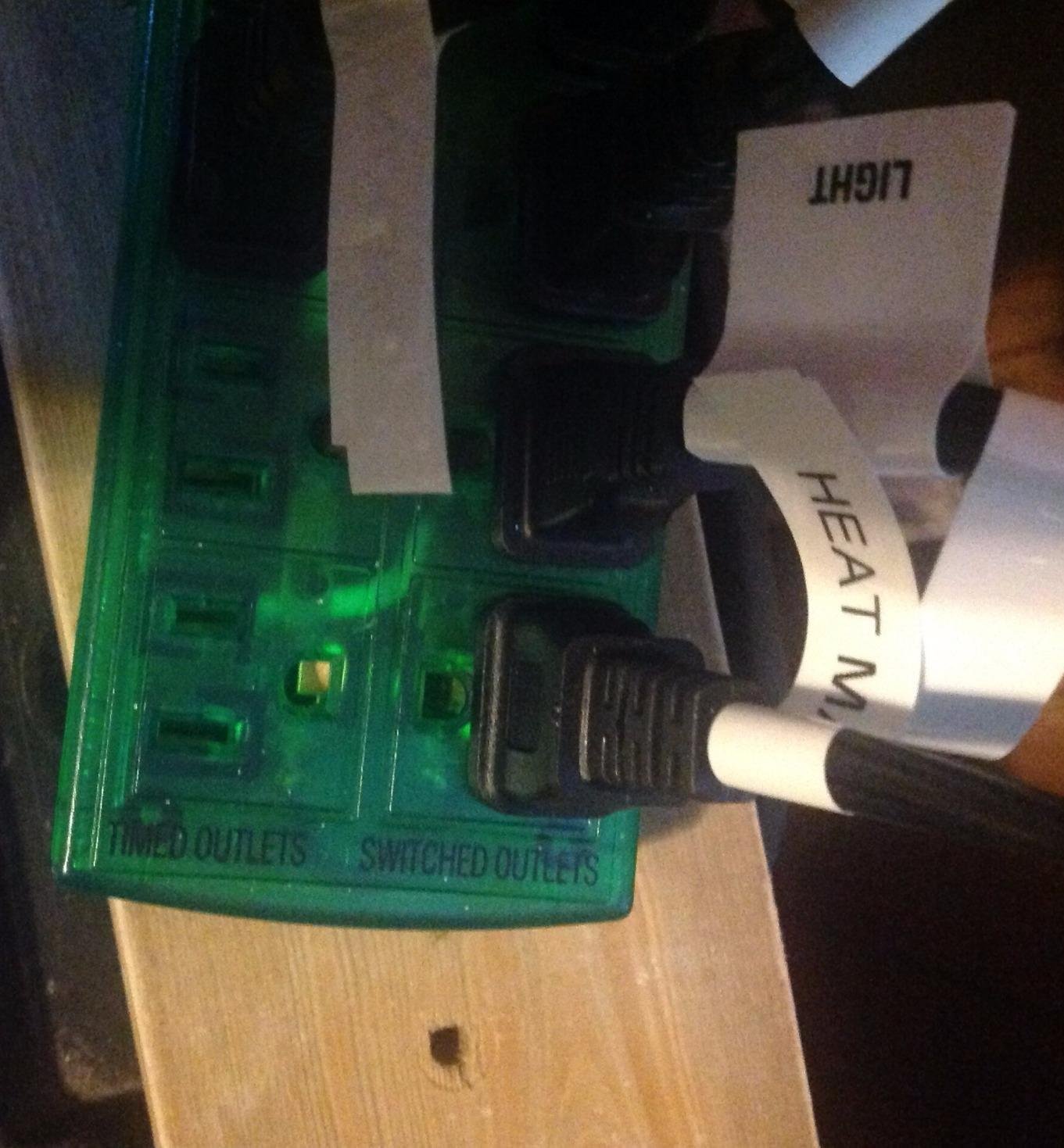
I am including this one because it gets bought in the wrong role constantly. The LT-12 is a 24 hour analog timer with grounded outlets. It switches your UVB and basking lights on and off so your animal gets a day and night rhythm, and it does that job reliably for years. It has no probe and no thermostatic control, so it does nothing at all for a heat mat.
Think of it as the companion piece rather than the main piece. A proper setup pairs one of the on/off controllers above with this timer, so the mat holds a steady set point while the lighting runs on a schedule. Several keepers on reptile forums run exactly that combination and describe it as the arrangement that finally gave their animals a consistent photoperiod.
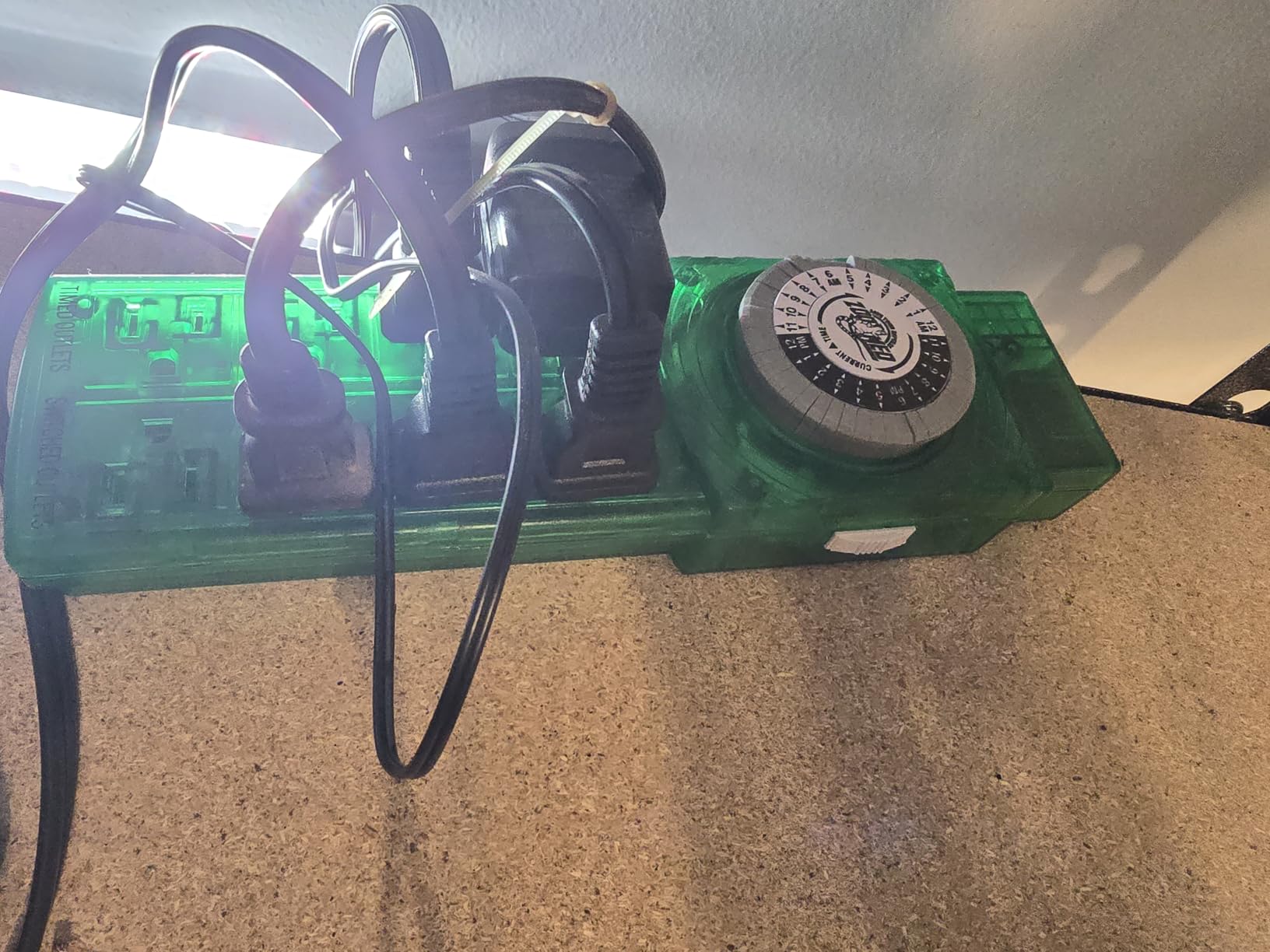
The analog dial is deliberately simple. You push the pins down for the hours you want power and leave it alone. There is nothing to program and nothing to update, which is the appeal for anyone who found digital timers fiddly.
Because it is a timer and not a controller, it will happily hold a lamp on through a failed thermostat. If the temperature in the enclosure climbs, this device will not notice. That is exactly the failure mode the rest of this list is built to prevent, which is why we would never wire a mat into it.
What to check before you buy
Decide honestly whether you need temperature regulation. If your only heat source is a lamp on a fixed schedule and you check with an infrared thermometer twice a day, a timer is enough. If a mat is involved, buy a real controller first.
Check the number of grounded outlets. One unit handles one lighting circuit, so a dual lamp setup needs a second timer or a single dual-channel model.
Where it will disappoint you
It cannot be programmed for temperature at any level, so it will not protect against a mat running away or a probe going loose. Anyone expecting it to regulate temperature will be disappointed within a week.
Analog timers also drift a few minutes a month and have no memory, so after a power cut you reset the dial. If you have a lot of enclosures, that manual resetting adds up quickly.
7. REPTIZOO TC02 Dimming Thermostat – gentler on bulbs than on/off switching
REPTIZOO Dimming Thermostat, PID Temperature Controller with Memory Function, Reptile Thermostat for Reptile Heat lamp, Specifically Designed for Light Heat Bulbs & Heaters
PID dimming output
Control range 41-140F
300W max output load
Memory function
One year warranty
Pros
- PID dimming trims power instead of hard switching bulbs
- 41-140F range covers higher set points
- Memory function restores set points after a power cut
- LED display shows ambient and set value with C and F switching
- Works with heat lamps
- heating mats and heat cables
Cons
- 300W output ceiling limits lamp and mat size
- Probe must sit at least 15cm from the heat source
- Not for sunlamps and some stop regulating
On/off cycling is what kills basking bulbs. Every time the relay closes, the filament takes a jolt, and bulbs that would last a year start failing in a few months. The TC02 is a dimming controller, so it reduces power to hold temperature instead of cutting it in and out, and that is the single strongest argument for it if your reptile is lit by a bulb rather than a mat.
The PID control loop adjusts smoothly rather than chasing the set point, and the memory function restores your settings after a power interruption. The 41 to 140 degree Fahrenheit range is the widest of the three dimmers, and the memory function means you can put the controller on a wall timer without losing your target. It ranks first in the reptile and amphibian terrarium thermostat category, so it is also the one most commonly listed among the three.
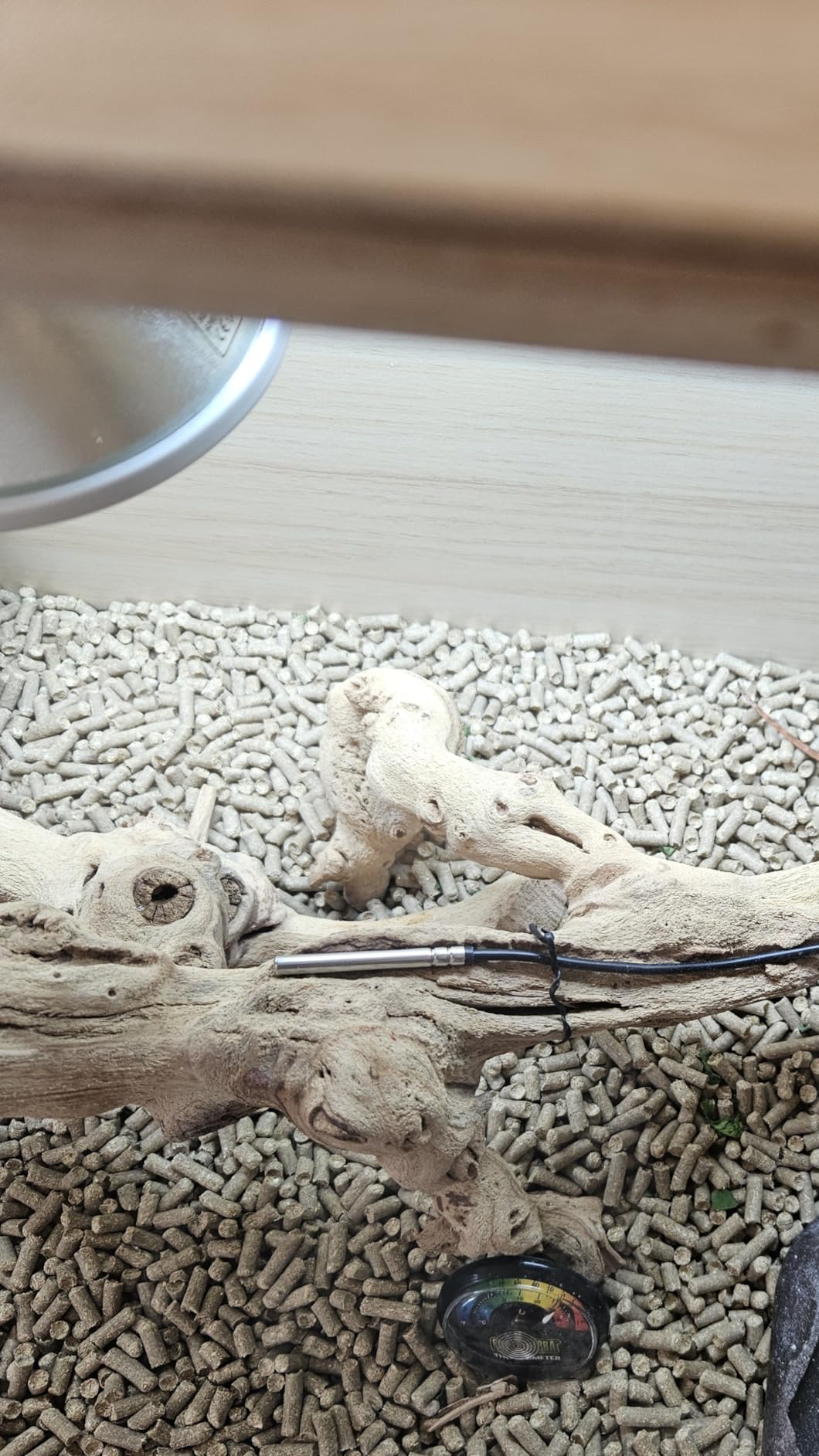
Two placement details matter more than the manual suggests. The probe has to sit at least 15 cm from the heat source, not directly beneath it, and if you park it on the mat the dimming output collapses and the enclosure goes cold. The 300 watt ceiling then limits what you can drive, so this is a controller for a modest basking lamp or a small mat, not a 60 watt bulb on a large fixture.
It is also the lowest rated unit we tested, at 4.2 stars, with a larger share of one-star reviews than the rest of the list. Owners describe controllers that stop regulating after a short period, and the one year warranty is worth keeping the paperwork for. Verify its reading against a secondary thermometer every week for the first month.
What to check before you buy
Confirm your bulb or mat is 300 watts or lower. If you are running a higher wattage basking lamp, a dimmer with more headroom or a dimmable bulb with its own controller is a better spend than risking a controller that keeps cutting out.
Plan the probe position before you mount anything. Fifteen centimetres of clearance from the source, and ideally off to one side of the basking zone rather than under the centre of the mat, gives you a reading that reflects what the animal actually experiences.
Where it will disappoint you
Reliability is the honest problem. At 4.2 stars with a meaningful number of early failures, this is not the unit we would leave running unattended in a rack. It is also explicitly not for sunlamps, so a UVB lamp must be handled by a timer or a different controller entirely.
Dimming is pointless for an undertank mat that is hidden under substrate. You are paying for a feature that only does something on a light bulb, and on a mat the same money buys more wattage in an on/off unit.
8. REPTITRIP SOP24 Timer and Thermostat – the highest load ceiling in the group
REPTITRIP Reptile Thermostat, Light Timer for Temperature and Lighting Control, Day-Night Timer Thermostat with Reptile Thermometer for UVB Light, Heat Lamp, Heating Pad, 10A 1250w
Socket S1 timer plus socket S2 thermostat
32-140F range
1250W at 10A
Sensor error plus or minus 2F
Replaceable probe
Pros
- Lighting timer and temperature control in one box
- Separate day and night temperature ranges with programmable periods
- 1250W at 10A is the highest output ceiling in this roundup
- 0.1F display resolution with a plus or minus 2F sensor
- Replaceable temperature sensor instead of a whole new unit
Cons
- Temperature controlled socket is non dimmable so it cycles on and off
- Heating only and cannot drive a cooling fan
- Newer listing with a smaller body of reviews
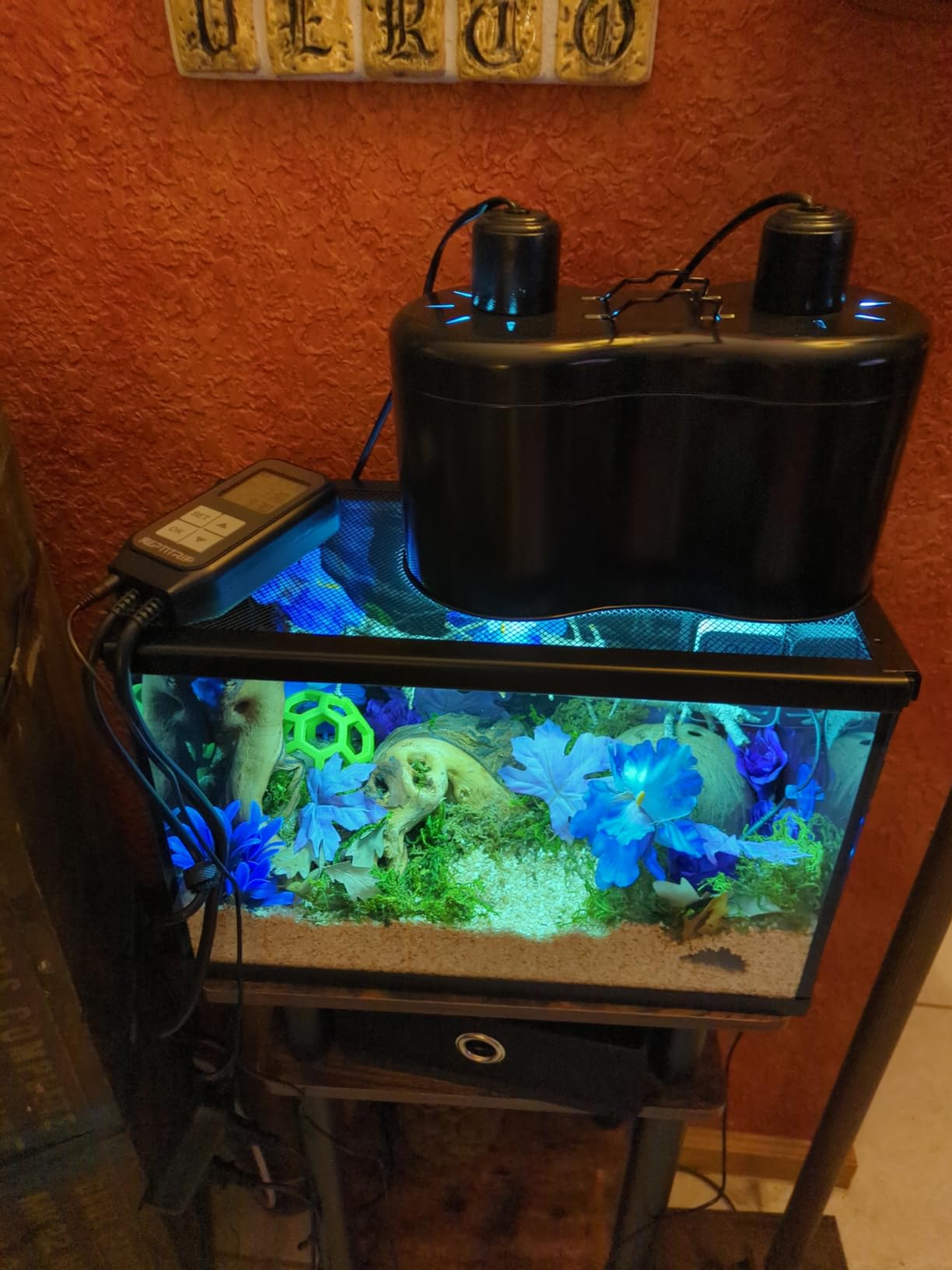
The SOP24 solves a specific problem: running lights and heat from one box without buying two devices. Socket S1 switches your UVB and basking lights on a schedule with three customisable timing programs, and socket S2 switches your heat mat or lamp on temperature. You can set separate day and night temperature ranges, which is what makes it useful for a species that needs a drop at night rather than a flat temperature all night.
The 32 to 140 degree Fahrenheit range is the widest of the on/off units here, and the 1250 watt ceiling at 10 amps is the highest in the roundup. That headroom means a large mat, a heat tape run, or a bulb and a mat together can sit on one socket without pushing the controller. The sensor is quoted at plus or minus 2 degrees with 0.1 degree display resolution, and the probe is replaceable, which is rare and saves money when a cable gets chewed.
The trade-off is that the temperature socket is not dimmable. It switches, which is fine for a mat under substrate but means a basking bulb on this controller will still take the on and off cycling that shortens bulb life. If bulb longevity is your priority, look at a dimmer instead.
Review volume is the other consideration. At 206 reviews it has a much thinner history than the long-established controllers, so we would treat it as a newer design and verify its reading more often in the first weeks. It is also heating only, so a fan needs a separate unit.
What to check before you buy
Count what you need to switch. One lighting circuit plus one heat source is exactly what this box is built for. Two lighting circuits and a mat means you are back to adding a timer, and the price advantage narrows fast.
Test the day and night programming before you commit. Set the day range and the night range, then let it run through a full cycle while you watch the display, because the period boundaries are the easiest part to misconfigure.
Where it will disappoint you
It will not dim. That is the honest limitation and it rules the SOP24 out for anyone whose main heat source is a basking bulb they want to last more than a few months.
There is no cooling output, so summer management is on you. And with 206 reviews and a newer product number, long-term failure data simply does not exist yet, which is worth weighing against a controller that has been in service for a decade.
9. CAVACHEW Dimming PID Thermostat – budget dimming with a reliability caveat
CAVACHEW Dimming Thermostat Reptile, Thermostat for Reptile Heat Lamp Mats Bulbs, PID Temperature Controller for Reptile Amphibian Habistat, Memory Function, LED Digital Screen, Sensitive Probe, 300W
PID dimming control
68-122F constant range
300W max output
Memory function
110V-240V input
Pros
- PID dimming gives smoother heating than on off cycling
- Memory function restores settings after a power cut
- Accurate holding of basking spot temperatures in normal use
- Compact wall mountable body with a readable LED display
- Works with halogen heat lamps as well as mats
Cons
- Narrowest control range here at 68-122F
- 300W output caps the heater size you can drive
- One review reports the controller melting and a fire
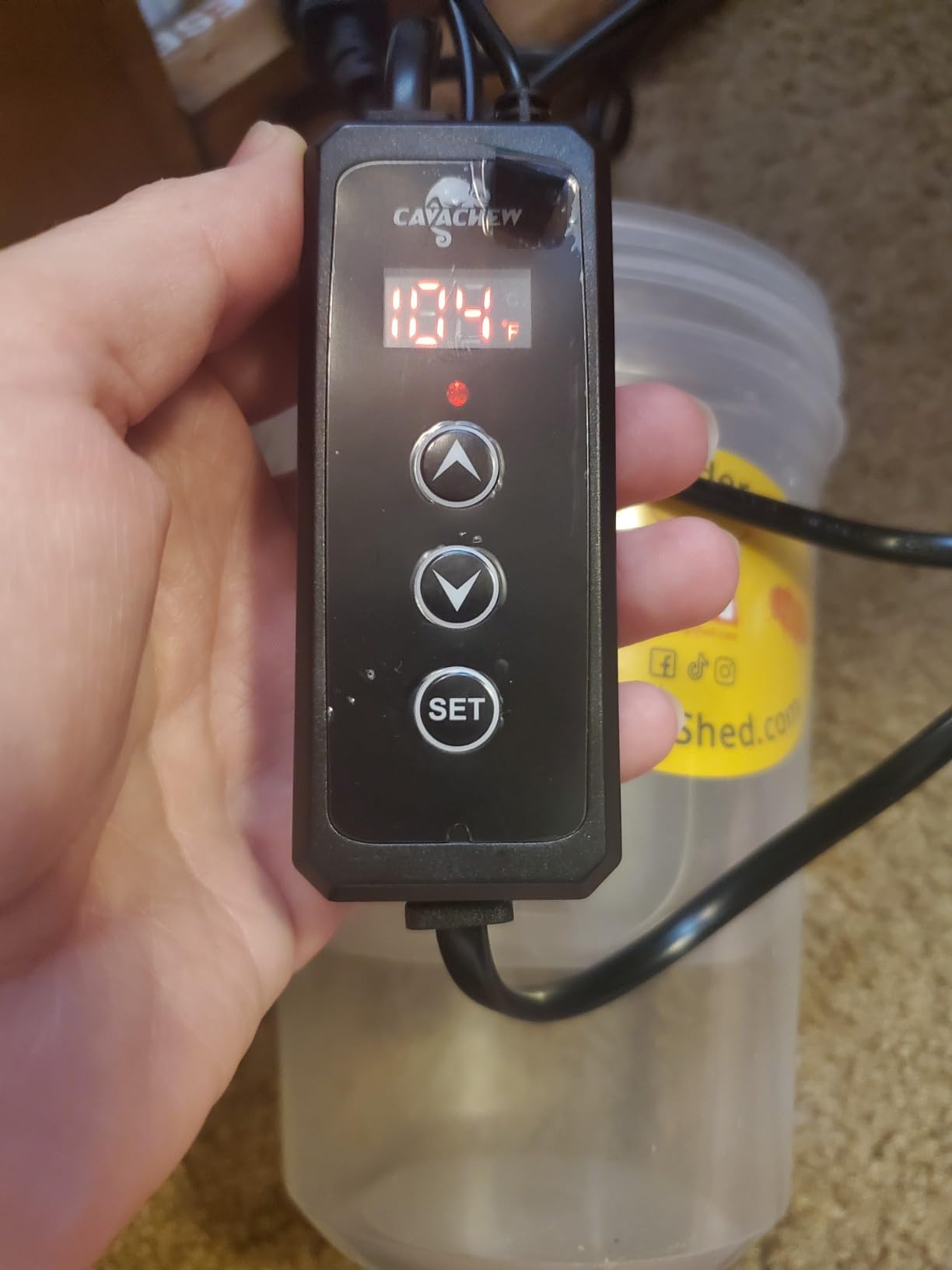
The CAVACHEW is a budget route into dimming control, and keepers do buy it in multiples when they want a dimmer per enclosure. The PID loop modulates power smoothly, the memory function restores your set point after a power cut, and reviewers report accurate holding of basking spot temperatures during ordinary use.
The 110 to 240 volt input makes it usable on other voltage standards, and the compact body mounts neatly on an enclosure wall. For a small halogen basking lamp on a simple nocturnal or crepuscular setup, it covers the basics at a fraction of the cost of a dedicated herp dimmer.
Read the range carefully. The constant temperature control band is 68 to 122 degrees Fahrenheit, the narrowest of any controller in this roundup, so it cannot run a cool reptile where the mat needs to switch off below 68, and it has no headroom above 122 for a high desert set point. The 300 watt output ceiling is the second limit, and it is shared with the REPTIZOO.
Reliability is the reason this sits low in the ranking. Alongside reports of controllers flickering or cutting out within weeks, one review describes the controller melting and causing a fire after about a week of use. A single account is not a pattern, but with an electrical device running unattended beside an animal overnight, it is enough that we would not put an unmonitored one in a room with a sleeping reptile.
What to check before you buy
Verify your set point falls between 68 and 122 degrees and your heater draws 300 watts or less. If either fails, this controller cannot do the job and no amount of adjusting will change that.
Check the display scale out of the box. It defaults to Celsius, and US keepers report having to convert every reading, so set it once and leave it.
Where it will disappoint you
The failure reports are the deal breaker for unattended use. If you cannot check the enclosure daily, buy a controller with a longer track record even if the range is narrower, because a controller that stops regulating is worse than one that is slightly less accurate.
The narrow range also rules it out for nocturnal species kept cool, and there is no alarm function. You get no warning if the probe disconnects or the reading runs away, which is precisely the scenario where an alarm matters most.
10. REPTITRIP PT02 Dimming Thermostat – dimming with a built-in 1-24 hour timer
Reptile Thermostat, Dimming Thermostat with 1-24H Timer Setting
PID dimming with 1-24 hour timer
50-140F temperature range
260W max output
Backlit LCD auto-off
Memory function
Pros
- PID dimming holds temperature without abrupt on off swings
- 1-24 hour timer adds scheduling to temperature control
- LCD shows real time output power and ambient temperature
- Backlight switches off after 20 seconds to protect night cycles
- Works with heating mats
- infrared lamps and ceramic heat emitters
Cons
- 260W output is the lowest ceiling among the dimmers here
- Not for UVB
- LED or sun lamps
- Warranty period is only two months
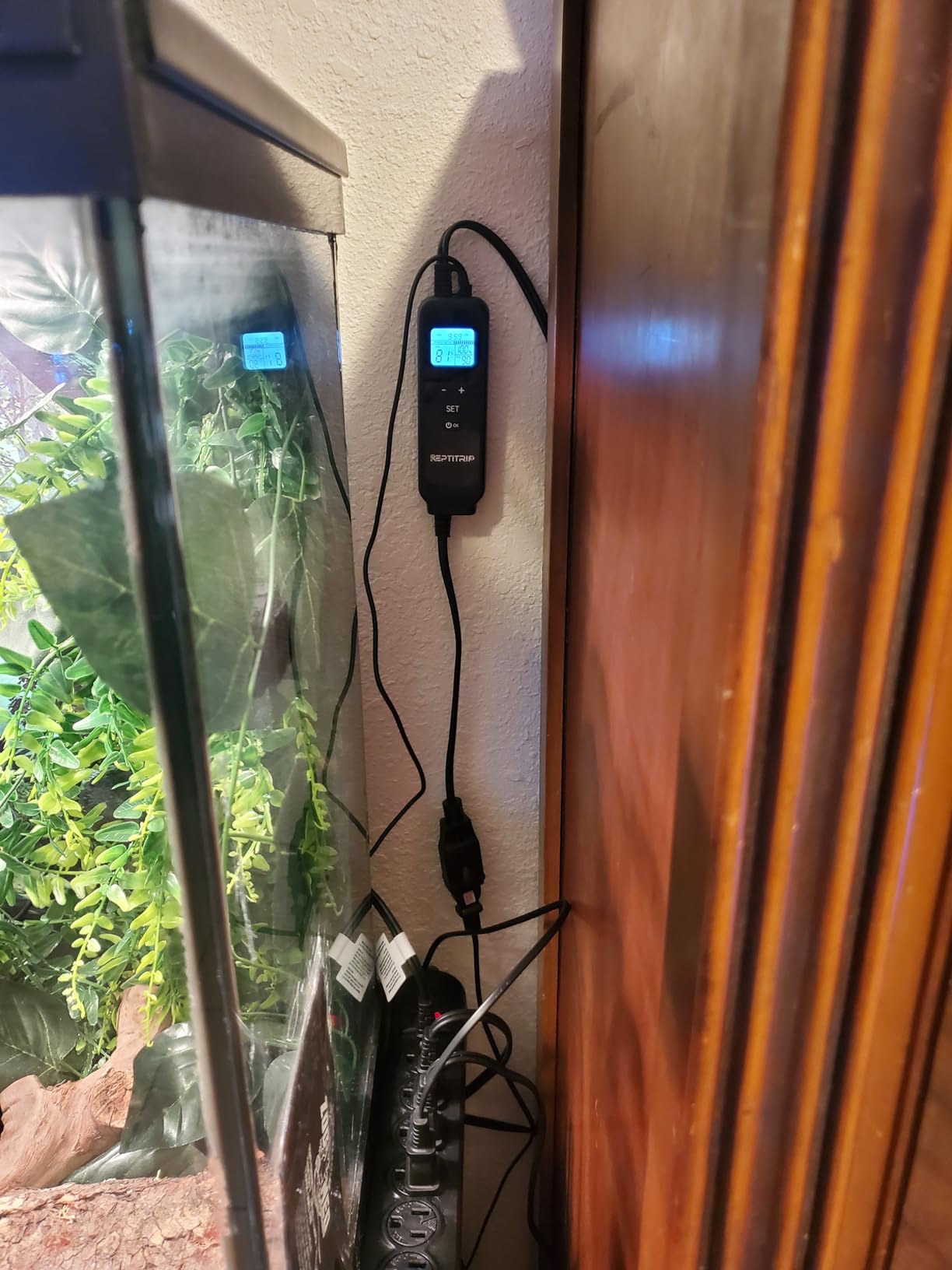
The PT02 is the dimmer we would pick from this group, and the display is the reason. It shows real-time output power alongside the ambient temperature, so you can see the controller working instead of trusting a set point alone. When the enclosure is struggling to reach target, watching the output percentage climb tells you immediately that your bulb is undersized rather than the controller being faulty.
The 1 to 24 hour timer is a genuine addition. It lets you schedule a heating window, which suits a species with a defined active period, and the memory function restores settings after power-up so a wall timer on the circuit does not wipe your configuration. The backlight shuts off after 20 seconds, which is a small touch with real value for a nocturnal animal that should not be sitting under a glowing screen.
The 50 to 140 degree Fahrenheit range is broad, and compatibility is wide: heating mats, daytime and infrared heat lamps, night lamps and ceramic heat emitters. It also handles the widest list of heat sources of the three dimmers. It is explicitly not for UVB, LED or sun lamps, which need a timer or a separate controller.
The 260 watt ceiling is the lowest among the three dimming controllers here, and it is the main constraint. If your enclosure cannot reach the set point, the manufacturer’s own guidance is to fit a higher wattage bulb, and that advice is worth following rather than fighting the controller. The two month warranty is also unusually short, so keep the receipt and test the unit fully in the first fortnight.
What to check before you buy
Add up bulb and mat wattage and stay under 260 watts. This is tight enough that it decides the question for many setups, and it is the reason the PT02 sits below the higher capacity on/off units despite the better display.
Decide whether you need the timer. If your heat runs continuously, the scheduling function adds nothing and a higher wattage on/off controller is the better choice.
Where it will disappoint you
The output ceiling is the honest limit. Larger heat mats, bigger basking bulbs and ceramic emitters all fall outside it, and the error message when the enclosure cannot reach target can be confusing if you have not read the note about bulb wattage.
With 168 reviews it has the smallest body of feedback here, and the two month warranty offers no protection if it develops a problem in month three. Verify against a secondary thermometer weekly for the first two months, then settle into a monthly habit.
How to Choose a Thermostat for a Reptile Heat Mat
Pick the control type first, then the wattage, then the safety features. Get that order right and the rest is a set point and a probe position. The three decisions below cover the overwhelming majority of what goes wrong with heat mat installations.
On/off, dimming, or pulse proportional
An on/off controller switches the full power to your heater when the reading drops below the set point and switches it off when it arrives. It is simple, inexpensive, and perfectly adequate for an undertank mat hidden under substrate, because nothing visible is being pulsed. Most of this roundup is on/off units.
A dimming controller reduces power in increments to hold the target, which is the right choice for a heat lamp or ceramic heat emitter where repeated hard switching shortens bulb life. The three dimmers here all cap output between 260 and 300 watts, so they suit smaller bulbs and mats.
Pulse proportional control sends rapid short pulses rather than reducing voltage continuously. The effect on a bulb is gentler than on/off cycling and less hard on wiring than full dimming. You will not find one in this roundup, which is a reasonable trade because for a mat under substrate the distinction is invisible to the animal.
Matching the controller to your heat source
Add up the wattage of everything you will plug in and stay comfortably under the controller’s ceiling rather than right at it. A 1000 watt rating against a 1000 watt mat leaves no margin for inrush current on the relay, and a controller run at its limit runs hot.
For heat tape and heat cable, budget roughly 20 to 23 watts per foot and multiply by the length you are running. A four foot run is close to 100 watts, which any of the on/off units here will handle, while a twelve foot run needs something with real headroom. Ceramic heat emitters and radiant panels run hot and cycle hard, so pair them with a controller that either dims or has a generous load ceiling.
A basking lamp is the case where matching matters most. If the bulb exceeds your controller’s wattage rating, nothing good happens, and if it is right at the limit, the bulb will fail early. Check the bulb’s rating against the socket on the controller, not against the controller’s headline number.
Probe length and placement
Probe placement changes the reading more than any setting on the controller. For an undertank mat, the probe belongs between the mat and the substrate, roughly centred under the warm zone, so it reads the temperature the animal’s belly actually rests on. Laying it on top of the substrate reads cooler and can leave the mat running hotter than you intended.
For a basking lamp, place the probe in the basking area rather than at the cool end, and keep it a measurable distance from the bulb so the sensor is not reading the fixture. The REPTIZOO specifies at least 15 cm from the heat source for this reason, and the same logic applies to the other dimmers even where it is not printed.
Probe cable length matters in deep enclosures. The BN-LINK and VIVOSUN come with roughly 4.92 foot probes, the Zoo Med ReptiTemp has 6 feet, and anything beyond that needs a longer lead or a controller mounted closer to the warm zone. Check the reach before you pick a spot on the wall.
Safety features worth paying for
High and low temperature alarms are the most valued feature in keeper communities, because thermostat failure going unnoticed for weeks is a recurring story. The Zoo Med ReptiTemp, Pymeter and Inkbird all include them. The alarm tells you the reading is wrong; the probe tells you whether the animal is safe, and you want both.
Probe failure auto shut-off cuts power when the sensor stops reporting, which is a different protection from an alarm. Not every unit here has it, so check the manual rather than assuming. Understanding the failure modes helps: a fail-open controller keeps power flowing when it loses control and drives toward a burn risk, while a fail-closed controller stops heating and the animal cools. Which one you have decides what your backup plan should be.
ETL or UL listing matters more than feature count. The BN-LINK is ETL listed, and an unlisted controller is an unregulated resistive load sitting beside a wooden enclosure and dry substrate. A certification mark is a floor, not a bonus.
Thermostat, rheostat, or timer
A rheostat is a dimmer with no temperature input. It holds whatever power level you set and knows nothing about the enclosure, so it cannot protect an animal. A timer switches power on a schedule regardless of temperature. A thermostat reads a probe and responds to the actual number.
Only the third belongs on a heat mat. Rheostats appear in reptile forums as a cheaper alternative to dimming thermostats for bulbs, and they work acceptably there, but for a mat under substrate a rheostat is simply a way to cook an animal slowly.
What a heat mat costs to run
Answering the question directly: a small heat mat uses less electricity than a light bulb. A 20 watt mat running continuously for 24 hours consumes 480 watt hours a day, roughly the energy of a few hours of a household lamp, and a 40 watt mat doubles that. The number that matters is duty cycle, and a thermostat running at the right set point cycles rather than holding full power, so the real draw is lower than the mat’s nameplate wattage.
Dimming controllers reduce consumption further because the heater idles at partial power instead of switching fully off and on. Multiple enclosures and rack systems add up quickly, so if you are running several, the per-unit cost is the reason the 1000 watt class controllers pay for themselves in control accuracy before you ever look at the meter.
Always verify with a secondary thermometer
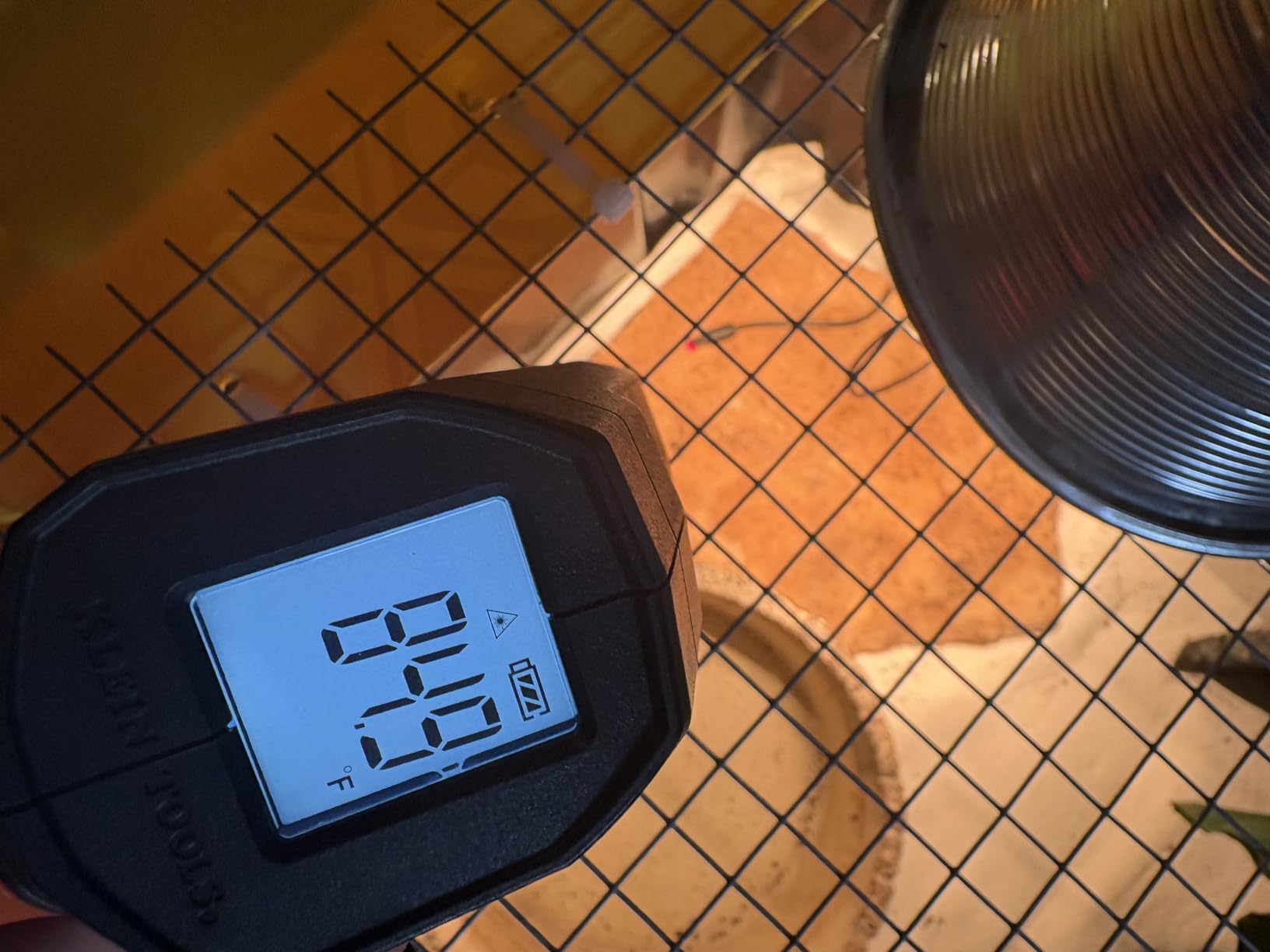
Every reading we took was cross-checked with an infrared temperature gun, and every reading we found wrong was a probe placement problem rather than a controller fault. The probe tells you what the sensor sees; the gun tells you what the animal’s surface actually is. If those two disagree, move the probe.
Calibration also drifts. Reviewers and keepers both describe controllers settling a degree or two off after months of use, so check monthly for the first year and adjust the offset if your controller offers one. Cheap add-on digital thermometers placed at animal height on both the warm and cool sides give you the gradient reading that no single controller can.
Frequently Asked Questions
What is the best thermostat for a reptile heat pad?
For most single-enclosure setups, a digital on/off controller with a wired probe, a 1000 watt or higher load rating, and probe placement between the mat and the substrate is the right answer. The BN-LINK T7(H) leads our roundup on proven reliability and probe accuracy, the VIVOSUN 330101 is a close alternative, and a dual outlet controller such as the Pymeter PY-20TT-10A makes sense when you also need a fan or a second zone.
Are heat mats for reptiles safe?
They are safe when they are regulated by a thermostat, and unsafe when they are not. An unregulated undertank mat keeps producing heat until something stops it, and keepers report mats reaching temperatures well past their targets, causing thermal burns along the belly and side. Use a listed controller with a probe between the mat and the substrate, keep the total wattage under the controller rating, and cross-check with an infrared thermometer so the surface temperature is verified independently.
Do reptile heat mats use a lot of electricity?
A 20 watt mat running continuously uses 480 watt hours a day, and a 40 watt mat uses 960, which is modest next to household lighting. A thermostat cycling to hold the right set point draws less than the mat nameplate suggests, and a dimming controller draws less still because the heater idles at partial power. Costs add up across a rack of enclosures rather than on any single mat.
What is the recommended temperature for a reptile heat mat?
It depends on the species, and the set point is the temperature of the warm zone measured where the animal rests, not the mat’s surface temperature. Nocturnal species such as leopard geckos and many ball python setups do well with a warm side in the high 80s Fahrenheit, while desert species need a higher basking target. Always confirm the reading with a secondary thermometer and provide a cool side so the animal can move away from the heat.
Can I leave the heat mat on all the time?
Yes, with a thermostat in circuit. Leaving a regulated mat on continuously is normal practice because a thermostat cycles the heater to hold the set point, and a mat without a thermostat should never run unattended. Keep the controller powered at all times, do not unplug it overnight, and choose a model with a high and low alarm so you are told if the reading goes wrong while you are not looking.
Final Verdict
The best thermostats for reptile heat mats come down to how many heat sources you are running and how much headroom you need. One mat in one enclosure, buy the BN-LINK T7(H). A second enclosure to cover, the VIVOSUN 330101 is the same idea with a slightly faster probe and a warranty. A mat plus a fan, two zones, or a higher wattage source, the Pymeter PY-20TT-10A or the REPTITRIP SOP24 gives you the outlets and the load ceiling.
Whichever you pick, put the probe between the mat and the substrate, set the target so the animal can move away from the heat, and check the surface with an infrared gun once a week. That habit, more than the model, is what keeps a reptile safe on a heat mat in 2026.