

Carbon monoxide is colourless, odourless and produced by exactly the appliances most basements are built around: a furnace or boiler, a water heater, and sometimes a gas range or a wood stove. The best carbon monoxide detectors for basements are the units that survive cold, damp concrete rooms, keep working through a power cut, and give you enough evidence to act on. We spent weeks comparing eight of them against what actually matters below ground level.
Most CO detector roundups stop at “buy a UL 2034 listed unit and mount it on a wall”. That advice breaks down the moment the outlet is on the wrong side of a utility closet or the joists are sweating in June. This guide is written for the basement specifically: where the alarms go, which ones tolerate basement humidity, and what to do when one keeps chirping at three in the morning.
We also cover the part nobody mentions in student housing: who is actually responsible for the alarm in a rental basement, and why a unit on the ground floor matters more than the one in your upstairs bedroom.
Table of Contents
Top 3 Picks for Basement CO Detection (October 2026)

Kidde KN-COB-LP2 Battery…
- Electrochemical sensor
- No wiring
- 2 AA batteries included
- Event memory
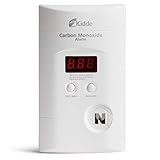
Kidde KN-COPP-3 Plug-In CO…
- Digital CO display
- 9V backup battery
- Peak level memory
- 85 dB alarm

First Alert CO605 Plug-In…
- Plug-in with battery backup
- Electrochemical sensor
- Test and silence button
- End-of-life chirp
Best Carbon Monoxide Detectors for Basements in 2026
| Product | Specs | Action |
|---|---|---|
| Kidde KN-COB-LP2 Battery CO Alarm |
|
Check Latest Price |
| Kidde KN-COPP-3 Plug-In CO Alarm |
|
Check Latest Price |
| First Alert CO605 Plug-In Detector |
|
Check Latest Price |
| First Alert CO400 Battery CO Alarm |
|
Check Latest Price |
 First Alert SC9120B Hardwired Smoke and CO First Alert SC9120B Hardwired Smoke and CO |
|
Check Latest Price |
 Kidde 900-CUDR Battery Combo Alarm Kidde 900-CUDR Battery Combo Alarm |
|
Check Latest Price |
 X-Sense SC07 Sealed 10-Year Combo X-Sense SC07 Sealed 10-Year Combo |
|
Check Latest Price |
 Siterlink Plug-In CO Alarm 10-Year Backup Siterlink Plug-In CO Alarm 10-Year Backup |
|
Check Latest Price |
Do You Really Need a CO Detector in a Basement?
Yes. The International Association of Fire Chiefs recommends a carbon monoxide alarm on every level of a home, including the basement, because that is where the combustion appliances live. The CDC records roughly 150 accidental CO poisoning deaths a year in the United States, and the International Association of Fire Chiefs guidance is the standard most local codes reference.
Basements concentrate risk in a way upper floors do not. A furnace, boiler or water heater sits below grade, often in a utility closet with a door and poor ventilation, and a backdraft through a cracked flue or a blocked vent sends exhaust into the room instead of up the chimney. CO mixes with air and spreads through the lowest reachable parts of a home, so a basement is frequently the first room to register a fault.
Add the secondary sources and the case gets stronger. An attached garage under the basement floor, a wood stove or fireplace in a finished rec room, a gas range in a basement kitchen unit, and even a charging area where a car idles in cold weather all belong on the same list.
For renters and students, the practical reason is simpler. If you live above a basement mechanical room, that room’s detector is the one that will hear a backdraft before anything reaches your bedroom. Ask your landlord what is installed down there before you buy anything yourself.
Where to Place a CO Detector in a Basement
Mount the unit about 5 feet from the basement floor, or at breathing height for an adult standing in the room, on a wall or on the underside of the joists. Homeowners on r/homedefense describe the same pattern we recommend: hardwired units go on the joists about 5 feet away from the downstairs furnace, and a second unit covers the upstairs sleeping areas. InspectApedia training guidance sums up the tension neatly, since the alarm must be close enough to a source for early detection but not so close that it nuisance-alarms.
Here is the sequence we use. It takes about fifteen minutes with a drill and a stud finder.
Pick the room, not the wall. Start with the mechanical room or utility closet that holds the furnace, boiler or water heater, then cover any sleeping area and any finished basement bedroom separately.
Set the height at 5 feet from the floor. If you have a choice between a low wall mount and a joist mount, the joist underside at roughly that same height is better in a bare basement because it keeps the unit away from splashing water and cleaning knocks.
Stay near but not directly above the source. Mount beside the appliance or on an adjacent wall, not on the ceiling directly over the flue. A unit sitting in the plume above a furnace collects condensation and reacts to every minor combustion irregularity.
Avoid cold surfaces and air movement. Keep the unit off bare concrete, away from a supply register, an open basement window, a dehumidifier exhaust or a sump pump air gap. Cold joists and moving air both push electrochemical sensors toward nuisance alarms.
Cover every level and every sleeping area. One unit in the basement plus one on the floor where people sleep is the minimum sensible layout. If you want a basement alarm to wake someone upstairs, you need interconnectable units rather than a louder siren.
Two things people argue about online that we can settle. Yes, being three feet from a furnace is far enough to avoid constant nuisance alarms while still catching a real fault early. And a plug-in unit on a basement wall is fine as long as it is not the only alarm and the outlet is not shared with something that trips the breaker.
1. Kidde KN-COB-LP2 Battery CO Alarm – Best Overall for a Basement
Kidde Carbon Monoxide Detector, Battery Powered CO Alarm with LEDs, Test-Reset Button, Low Battery Indicator, Portable
Electrochemical sensor
Two AA batteries included
Wall or tabletop mount
10-year limited warranty
Pros
- Keeps detecting through a power cut on two AA batteries
- No wiring so it mounts on concrete
- joists or a table
- 10%-95% non-condensing humidity range suits damp basements
- Event memory records the last CO detection or test
- 36k+ reviews at a 4.7 average
Cons
- No digital display of the measured CO level
- AA batteries need replacing every year or so
This is the unit we keep coming back to for basements, and it wins our list because it removes the two problems that cause people to leave a basement unprotected: there is no wiring to run and no outlet to find. The KN-COB-LP2 is the model number printed on the box, and it is one of the most reviewed CO alarms on the market with more than 36,000 reviews at a 4.7 average.
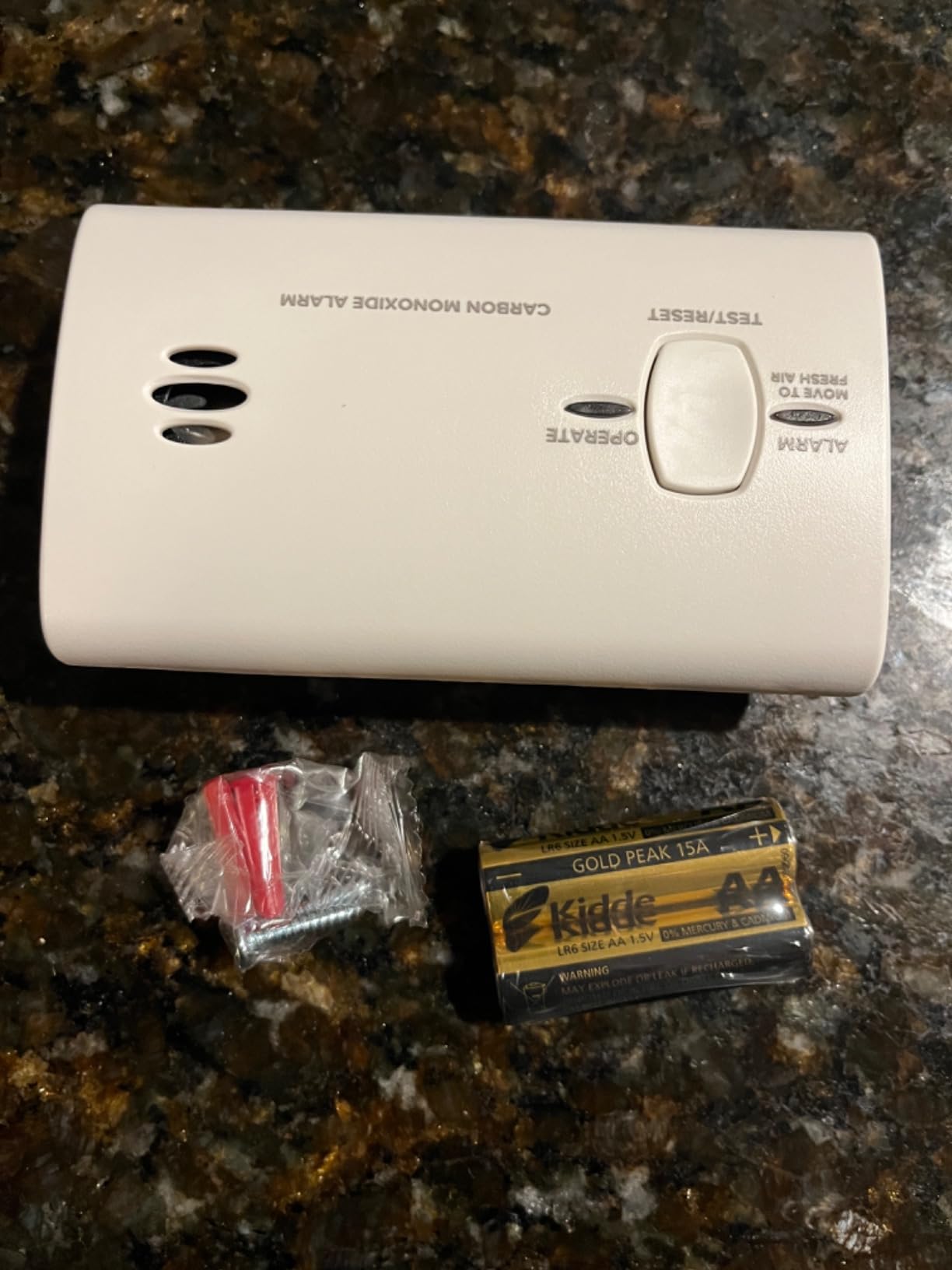
For a concrete mechanical room where the nearest outlet is behind the water heater, that freedom is the whole argument. Mounting hardware and drywall anchors are in the box, and the same unit can sit on a shelf or a shelf-height ledge if you would rather not drill. Two AA batteries are included, so the alarm is doing its job from the first day rather than after a trip to the shop.
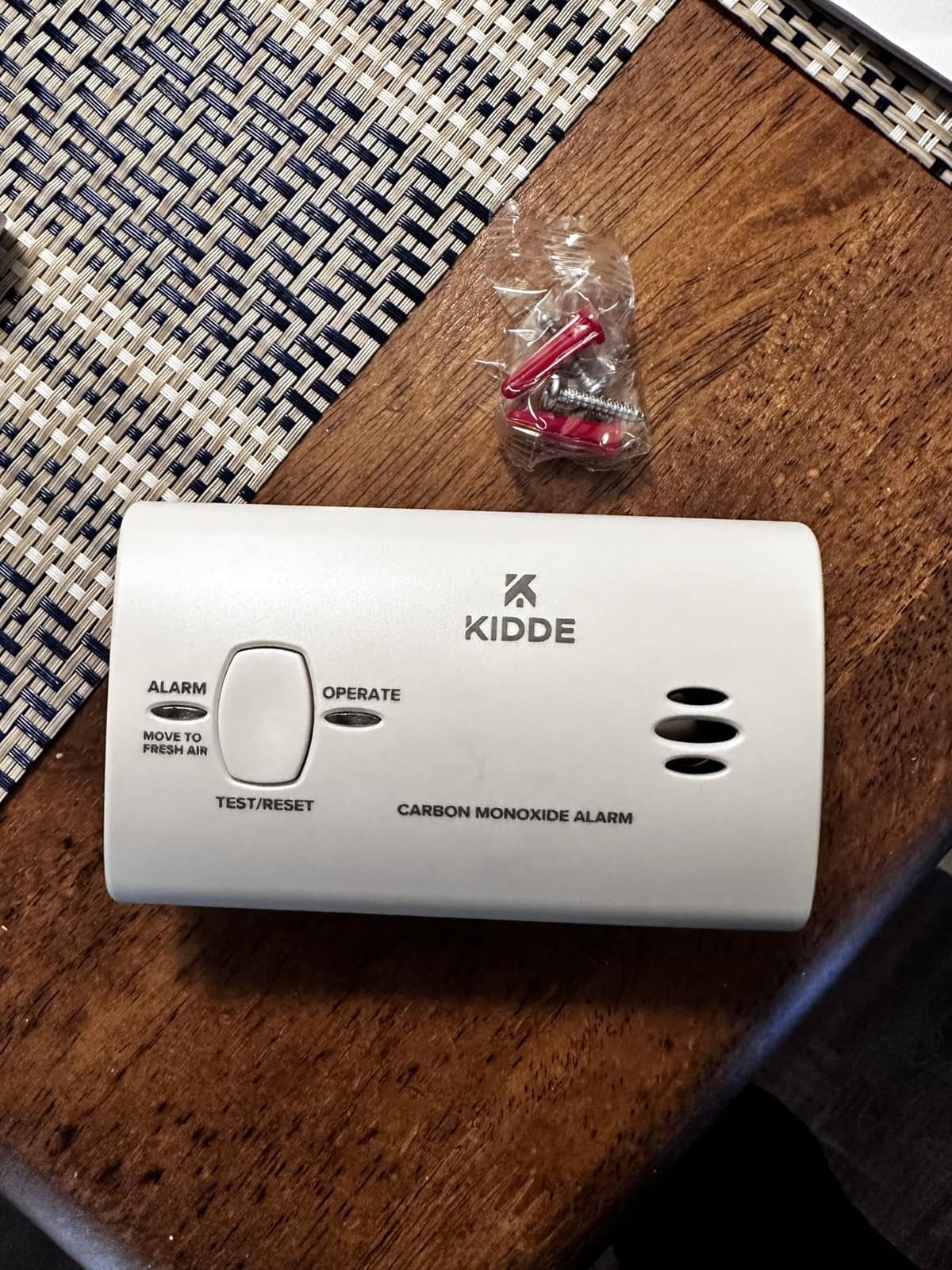
The specs that matter for a basement are the humidity range and the temperature ceiling. This one is rated for 10% to 95% relative humidity non-condensing with an upper temperature rating of 100 degrees F, which covers a typical below-grade room across the seasons. The sensor is electrochemical, the type that holds its calibration best through temperature and humidity swings compared with the metal oxide and biomimetic alternatives.
Feedback on event memory is worth pausing on. The unit stores the last time CO was detected or the last time it was tested, so after an alarm you can tell the difference between a real event and a test chirp weeks later. For a landlord or an insurance conversation, that small red LED memory is genuinely useful.
What you give up is information. There is no numeric readout, so during a nuisance-alarm investigation you cannot tell whether the unit is seeing 12 ppm or 90 ppm. You find out that CO was present and when, not how much.
When this is the right call for a basement
This is the pick for a bare mechanical room, a utility closet, a sump pump room or a rental where you are not allowed to touch the wiring. It also works well as the bedroom unit in a finished basement, since battery-only operation means a power cut in the building does not silence it.
If your building has hardwired interconnected alarms upstairs, this is not the right unit to buy. It cannot be linked to the rest of the system, so a fault downstairs stays downstairs.
Where it falls short
Two AA batteries degrade faster in a cold, damp mechanical room than they would in a dry hallway, and a low-battery chirp is easy to ignore until it becomes permanent. Test it with the button on the first of every month and the problem stays theoretical.
The second limitation is the missing display. If you have ever wanted to watch a reading fall after you ventilated the room, or you are chasing an intermittent alarm that only fires when the furnace runs, this unit will not tell you anything beyond yes and no. For that diagnostic work, the plug-in model below is the better tool.
2. Kidde KN-COPP-3 Plug-In CO Alarm with Digital Display – Best Value
Kidde Carbon Monoxide Detector, Plug-In with 9V Battery Backup, Digital Display, 85 dB Alarm, LED Status Light Indicators, 3rd Edition
Digital CO level display
9V battery backup
Peak level memory
85 dB alarm
Pros
- Numeric display lets you confirm a real reading during an alarm
- 9V backup covers a power outage
- Peak level memory recalls the last CO event
- Plugs into any standard 120V outlet
Cons
- Placement limited to somewhere near an outlet
- 9V battery needs occasional replacement
- END signal makes the unit unusable at around 10 years
The digital display is what separates this from every other basic plug-in unit, and for a basement it changes how you handle an alarm. When the KN-COPP-3 sounds, you can read the concentration instead of guessing. If the number climbs while you stand there, it is a real fault. If it sits near zero and drops after you open the door, it was almost certainly a nuisance event.
It shares the same 4.7 average as our top pick across more than 27,000 reviews, and the pros and cons in owner feedback are consistent: people like the display, the 9V backup and the plug-in simplicity, and a minority report a unit that failed or a plug that ran hot.
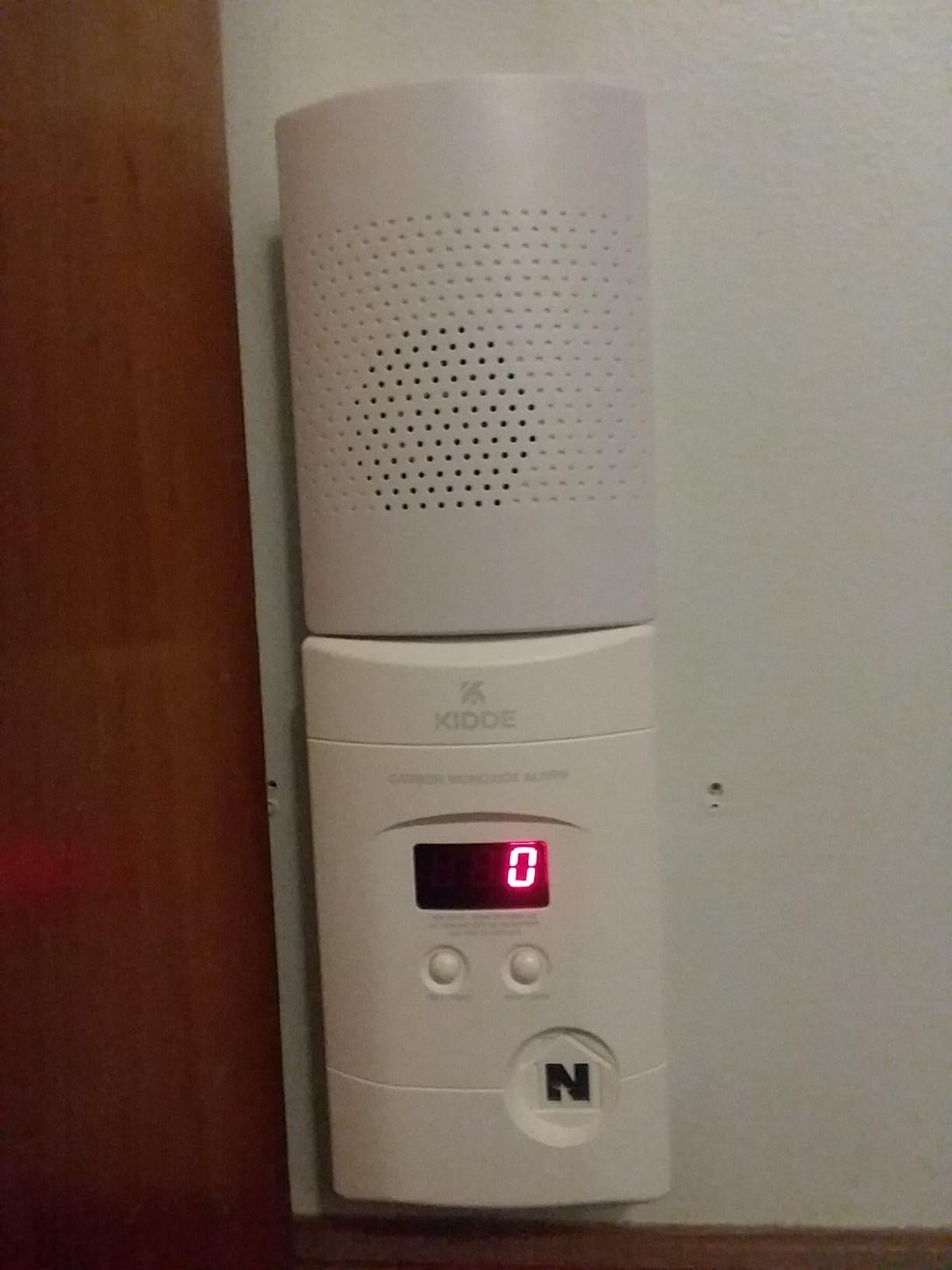
For a basement the technical details are workable. Operating humidity is 5% to 95% relative humidity non-condensing, with an upper temperature rating of 100 degrees F, and the warranty is 10 years limited. The box includes the alarm, a 9V battery, mounting hardware for a wall-mount option and a manual, so you can also mount it on a wall away from the socket if the outlet is badly placed.
Peak level memory stores the highest reading from the last event, which is the feature that matters if an alarm sounds while you are asleep upstairs. The display will show you what the peak was after you come down, rather than leaving you to guess whether it was a 30 ppm nuisance or a serious reading.
The honest limitation is outlet dependence. In a bare utility room where the receptacle is behind the boiler or on a different wall than the source, you are choosing between an awkward mount and a different alarm entirely. Many people end up using a short extension to reach a better position, which is fine as long as it does not become a trip hazard across a walkway.
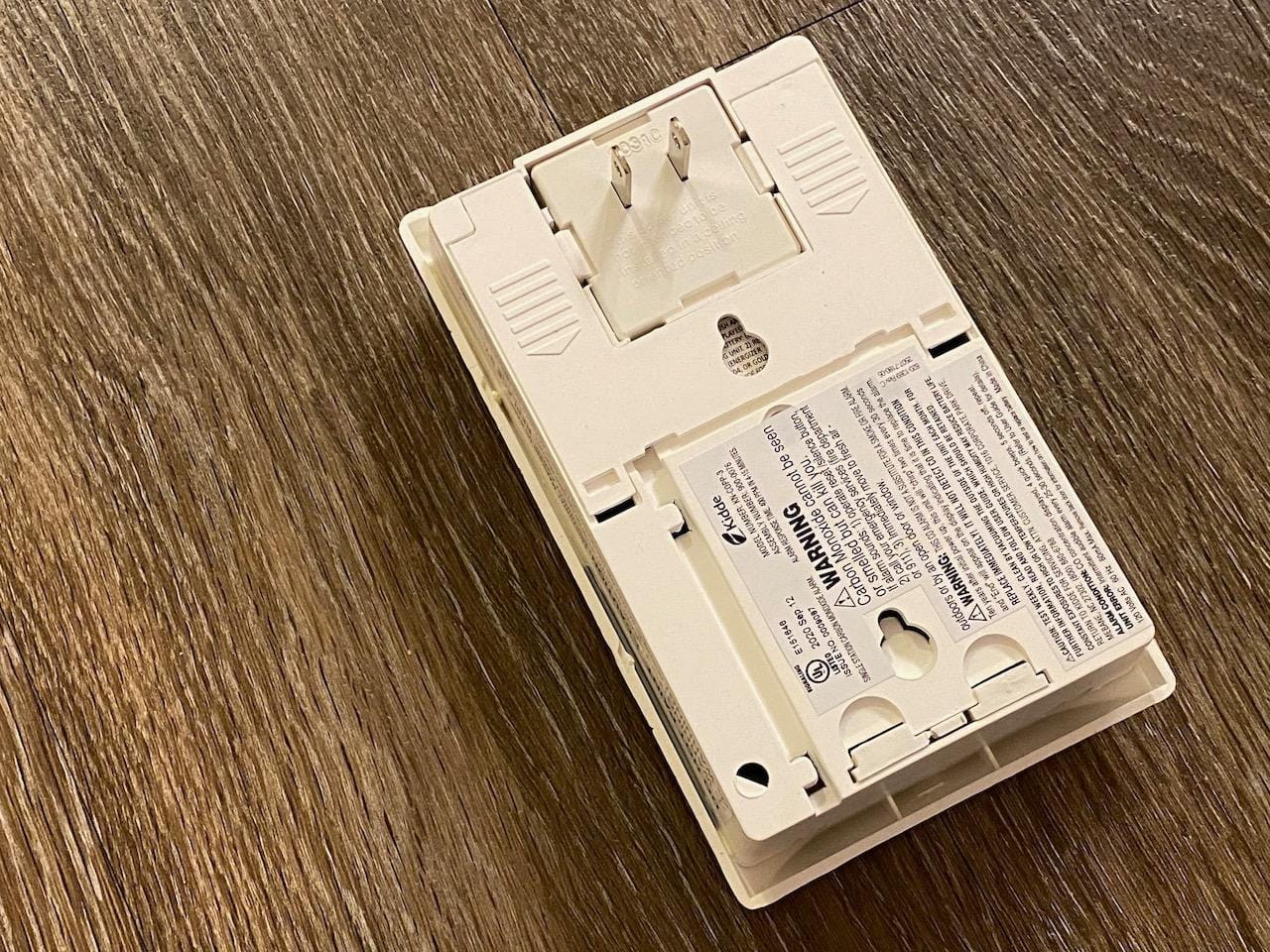
When this is the right call for a basement
Pick this one when your basement is finished enough to have reachable outlets and you want visibility into actual readings. It is the unit we recommend for a finished basement rec room, a laundry area or a basement kitchen unit where you want to know whether a recurring alarm is real.
It is also the sensible rental pick for a student basement apartment, because it needs no tools, no electrician and no landlord permission as long as you are using an existing outlet.
Where it falls short
It is a plug-in unit and cannot be interconnected with hardwired alarms, so a fault detected down there will not sound in an upstairs bedroom. If people sleep above that alarm, you need a second unit near them or an interconnected system.
The END signal is worth planning around. At roughly the 10-year mark the display shows END and the unit stops protecting, which catches people out because the alarm still looks fine on the wall. Put a reminder in your phone the year you install it.
3. First Alert CO605 Plug-In CO Detector – Best Budget Plug-In
FIRST ALERT CO605 Plug-in Carbon Monoxide Detector with Battery Backup, White
Plug-in with battery backup
Electrochemical sensor
Test and silence button
7-year warranty
Pros
- Works in any standard outlet with no wiring
- Battery backup keeps it live during a power cut
- Single button handles test and silence
- Low battery mute quiets the chirp for up to 8 hours
Cons
- No digital display of the measured CO level
- 7-year warranty is shorter than most rivals
The First Alert CO605 is the simplest good answer for a basement that has an outlet in a sensible spot, and it does the fundamentals without fuss. It is rated 10% to 95% relative humidity, runs on an electrochemical sensor, and weighs just over 4 ounces, which makes it easy to reposition while you work out the best spot.
Owner feedback is overwhelmingly about installation speed and the end-of-life chirp. Buyers like that a single test and silence button handles everything, and that the low battery warning can be muted for up to 8 hours so a dying battery does not wake the house at night.
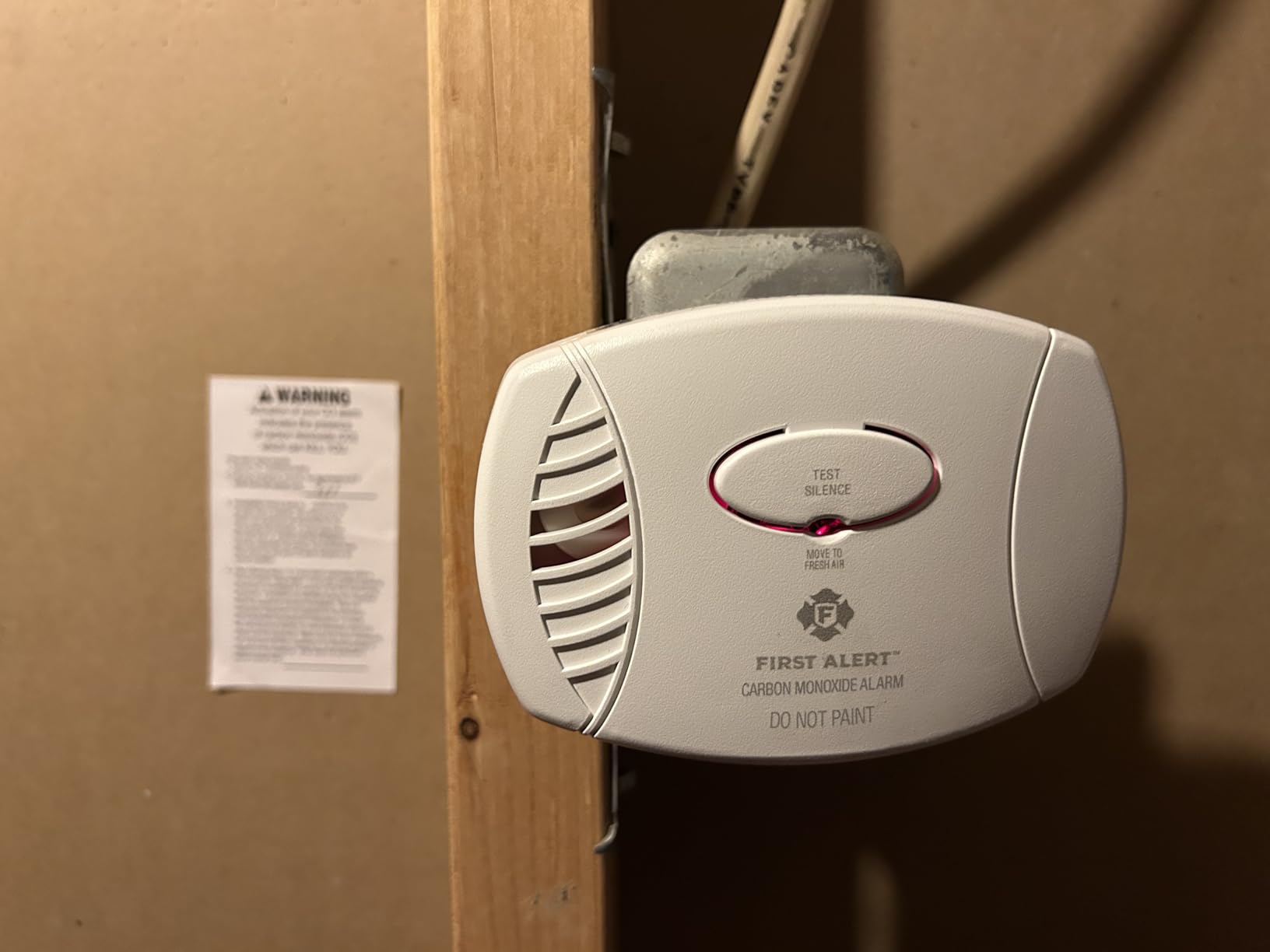
The 4.6 average across more than 23,000 reviews puts it close behind the Kidde units, and the most common complaint by a wide margin is the missing numeric readout. As with any no-display alarm, you get a clear yes and no and nothing in between.
For basement placement, the electrochemical sensor is described by First Alert as accurate in any room position, which is reassuring in a space where you may be mounting on a joist rather than at eye level. The 85-decibel alarm is the same figure across this whole category and is loud enough to be heard through a closed utility closet door.
Our one reservation is warranty length. Seven years is respectable but it is shorter than the 10-year terms on both Kidde units here, which means you are scheduling a replacement in year seven rather than year ten.
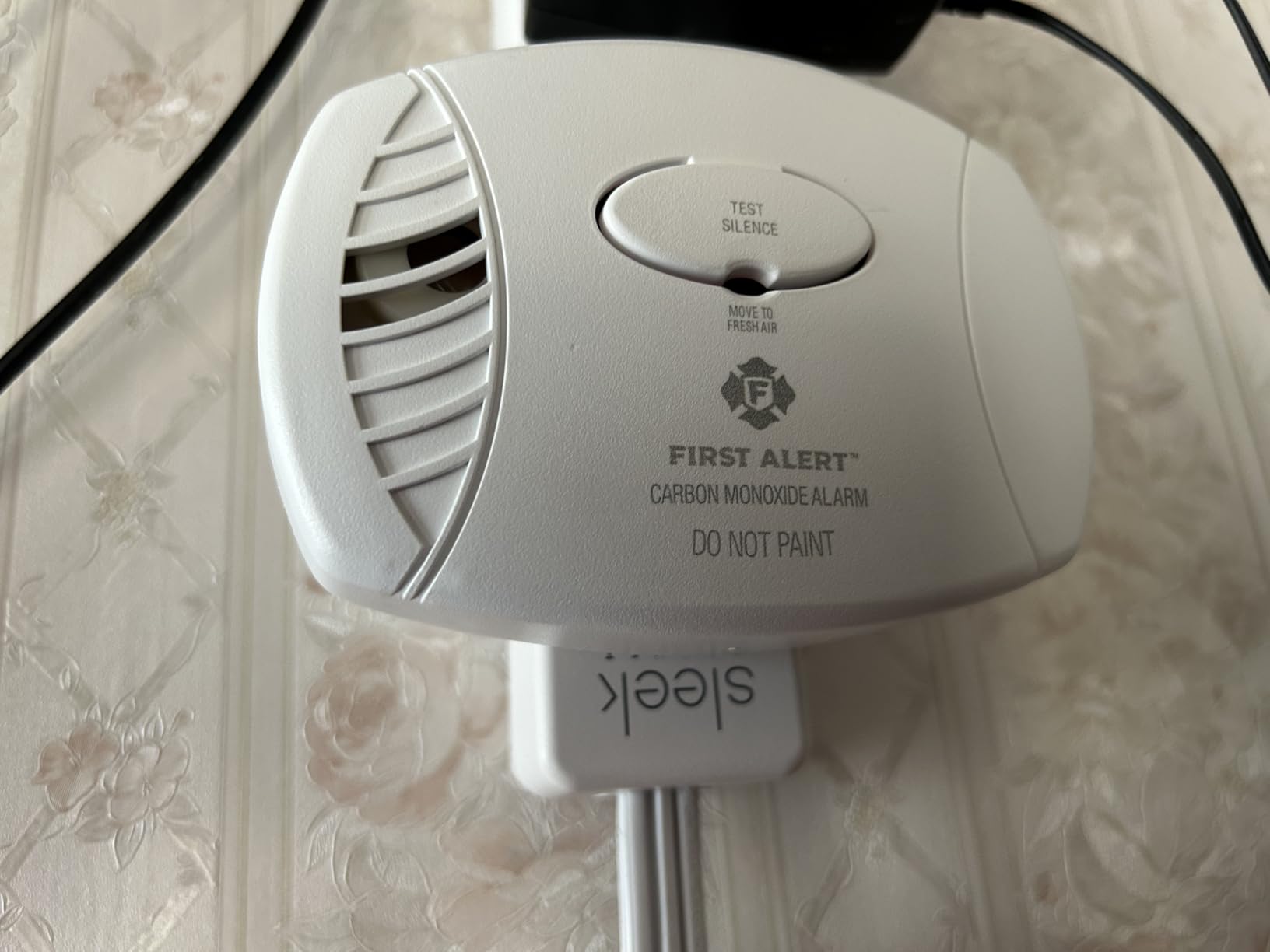
When this is the right call for a basement
This is the pick for a basement bedroom or a utility room where you want a reliable plug-in alarm and nothing more. It suits renters perfectly, since there is no wiring, no battery format to get wrong and no landlord conversation required.
It also works well as a second unit in a finished basement, because the low battery mute stops the annoyance factor that leads people to pull a unit off the wall.
Where it falls short
No display means you cannot triage an alarm. If the unit goes off once a week in a damp mechanical room, this model gives you no way to distinguish a sensor struggling with condensation from a genuine combustion irregularity.
It also cannot be linked to other alarms, so it works on its own only. In a house where the basement is the only place with fuel-burning equipment, that is still a real limitation for anyone sleeping upstairs.
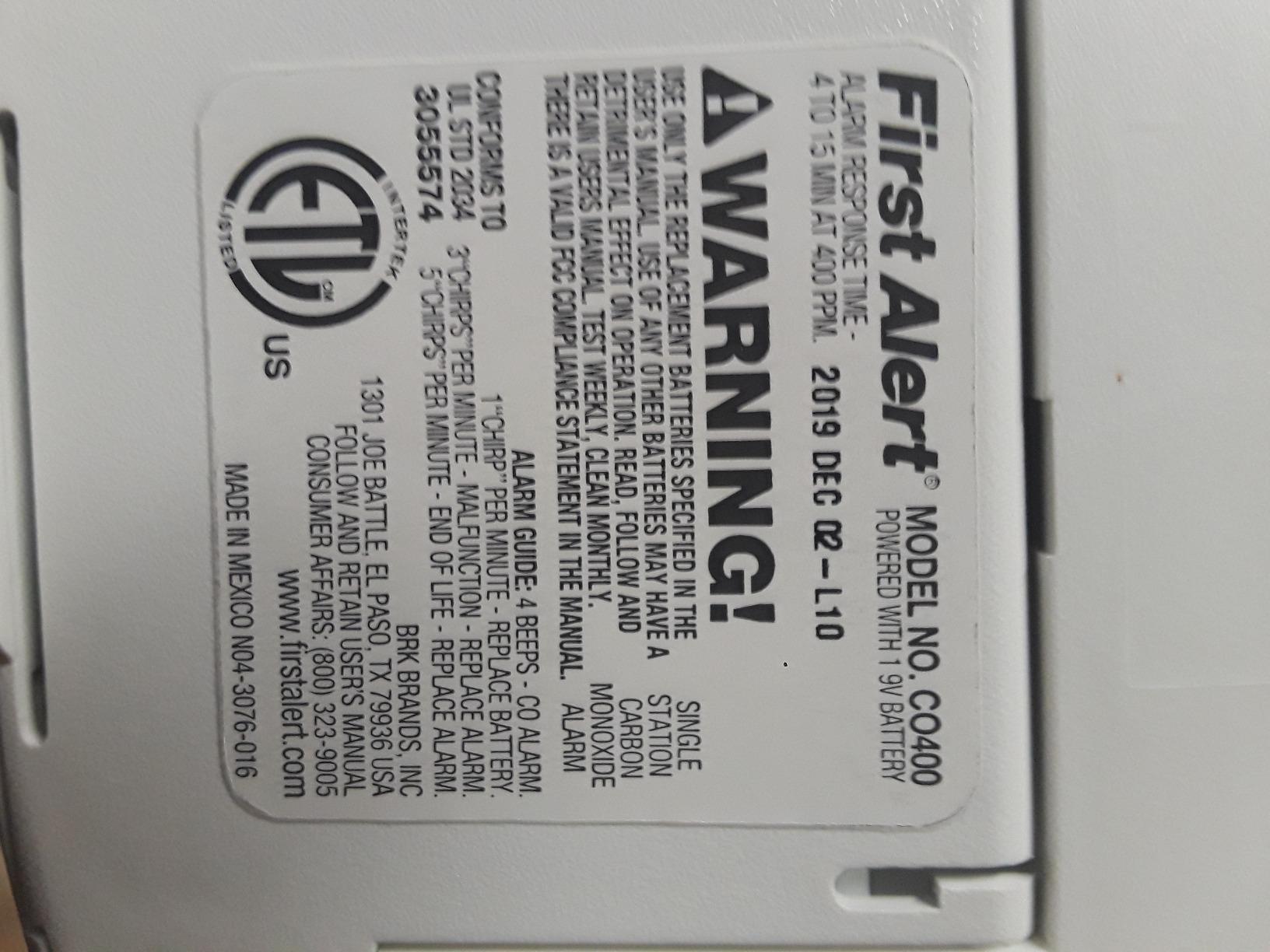
4. First Alert CO400 Battery CO Alarm – Best When There Is No Outlet
First Alert Battery Carbon Monoxide Alarm
Battery powered,9V battery included
Electrochemical sensor
85 dB alarm
5-year warranty
Pros
- Battery power means placement is not dictated by outlets
- 9V battery included so it is ready to mount
- Compact and light so it can be repositioned easily
- Works through a power failure
Cons
- No digital display of the measured CO level
- 5-year warranty and no sealed long-life battery
Where the CO605 needs an outlet, the CO400 does not, and in a bare basement that difference decides the whole question. It runs on a single 9V battery that is included in the box, works in any room position, and has a bracket, manual and battery in the packaging, so you can mount it the day it arrives.
It carries a 4.6 average across more than 21,000 reviews, and reviewers describe it as a dependable replacement for the same unit they have owned for years. That continuity matters if you are replacing an older model and want the same behaviour without relearning anything.
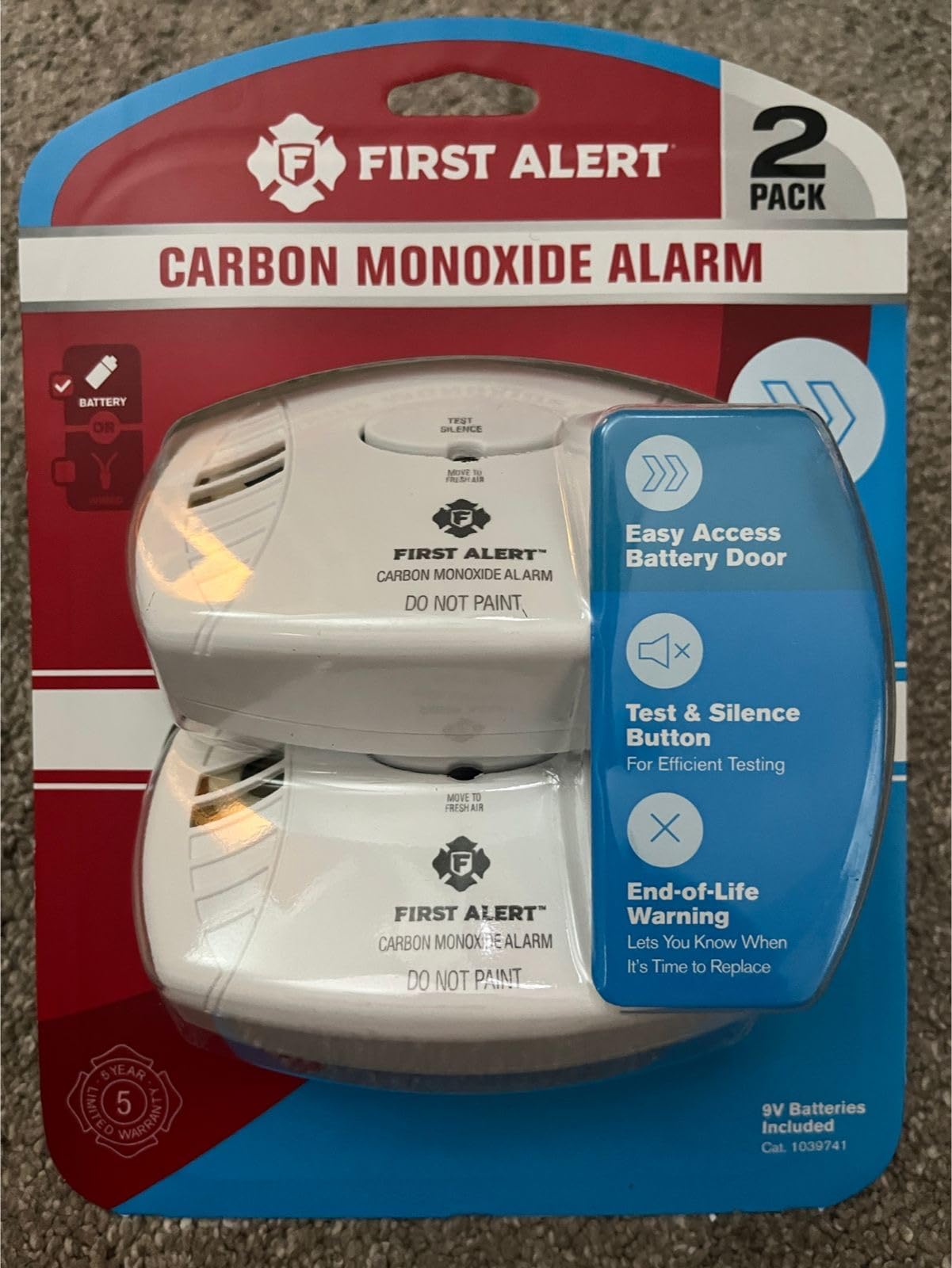
Owner feedback specifically praises mounting it low on a wall for faster CO pickup, which lines up with the placement advice above. The electrochemical sensor is the same technology as the more expensive units here, and the 85-decibel alarm is loud enough to reach a bedroom through a closed door.
The specification that gives us pause is warranty length. A 5-year limited warranty with an end-of-life signal chirp is the shortest term in this lineup, and there is no sealed battery option, so the 9V cell needs checking on a schedule. Operating humidity is 10% to 95% RH, which is fine for most basements but leaves less margin than the 5% floor of the Kidde plug-in.
Like the rest of the no-display group, it cannot tell you a concentration. That is the one capability you give up, and in a mechanical room it is the capability that would help most.
When this is the right call for a basement
Choose this when the only outlet in the mechanical room is behind the water heater, or when the concrete walls mean you would rather not run an extension cord across a walkway. It is also a good second alarm for a small basement bedroom where you want something that survives a power cut.
Because it is small and light at around 11 ounces, it is easy to move between the utility room and a garage or a storage space during seasonal checks.
Where it falls short
Five years is a short working life for a life-safety device, and with a standard 9V battery rather than a sealed cell you have one more recurring maintenance task. For a rental where you might not be there to maintain it, that is a real argument against.
It is also not interconnectable. If you later upgrade the rest of the house to linked alarms, this one stays silent unless someone is standing next to it.
5. First Alert SC9120B Hardwired Smoke and CO Detector – Best for Interconnected Homes
FIRST ALERT BRK SC9120FF Hardwired Smoke and Carbon Monoxide (CO) Detector with Battery Backup, 1 pack , White
Hardwired with 9V backup
Smoke and CO in one unit
Interconnectable
10-year warranty
Pros
- One unit covers both smoke and CO in the basement
- Hardwired with 9V backup so outages do not silence it
- Links to other BRK or First Alert units so all alarms sound
- Tamper-resistant locking bracket suits shared buildings
Cons
- Needs a 120V hardwired circuit
- so an electrician is required
- Ionization smoke sensor can nuisance-alarm on cooking
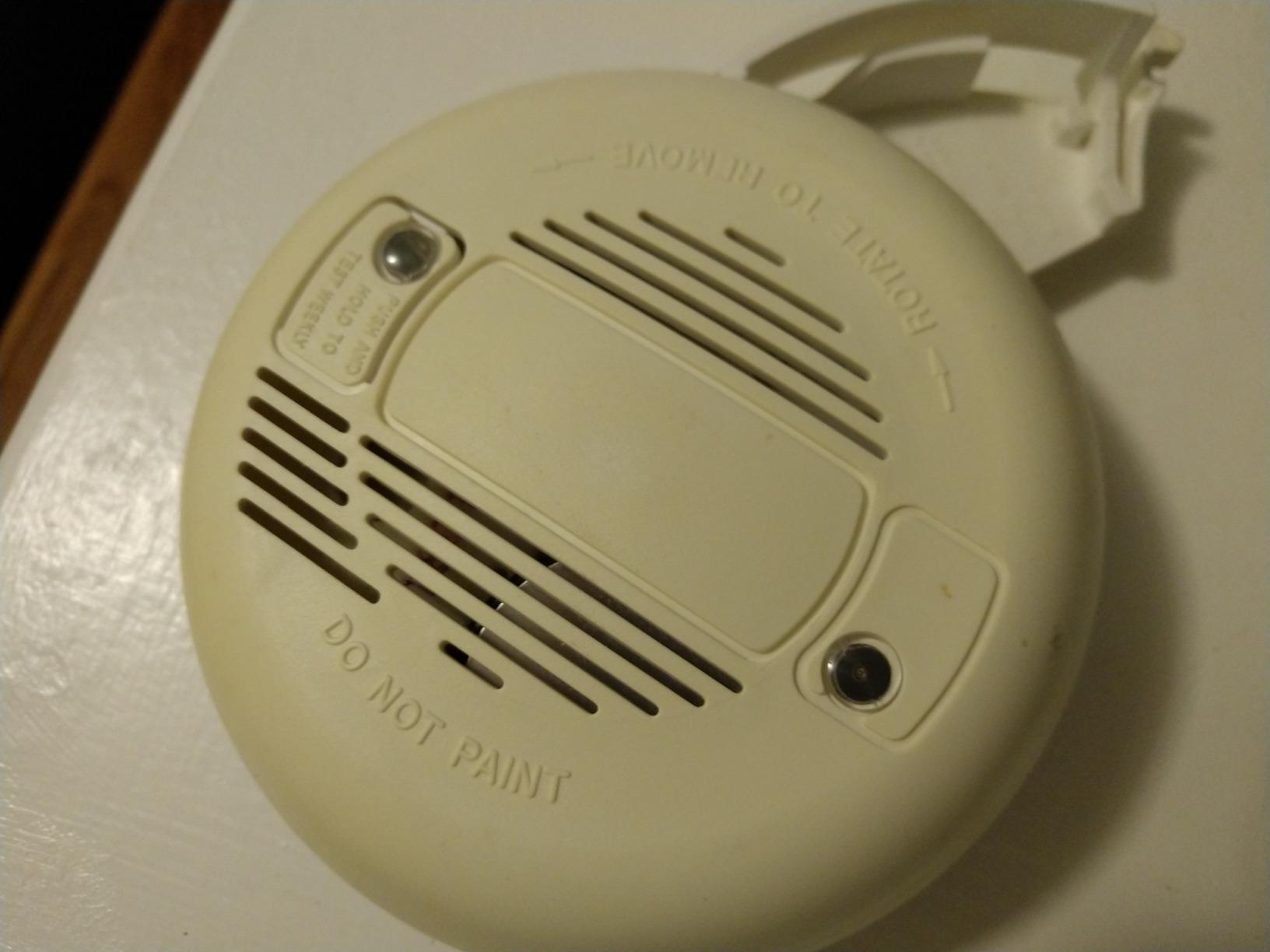
Interconnection is the reason to choose this unit, and in a house where people sleep upstairs it is the feature that actually changes outcomes. When the SC9120B detects CO in the basement, compatible BRK and First Alert units throughout the building sound at the same time. SmartThings owners describe the same preference for linked units in the basement, garage and hallway.
It combines an electrochemical CO sensor with an ionization smoke sensor in one body, which solves a specific basement problem: many below-grade rooms have no working smoke coverage at all, and one device covers both hazards rather than needing two ceilings of hardware.
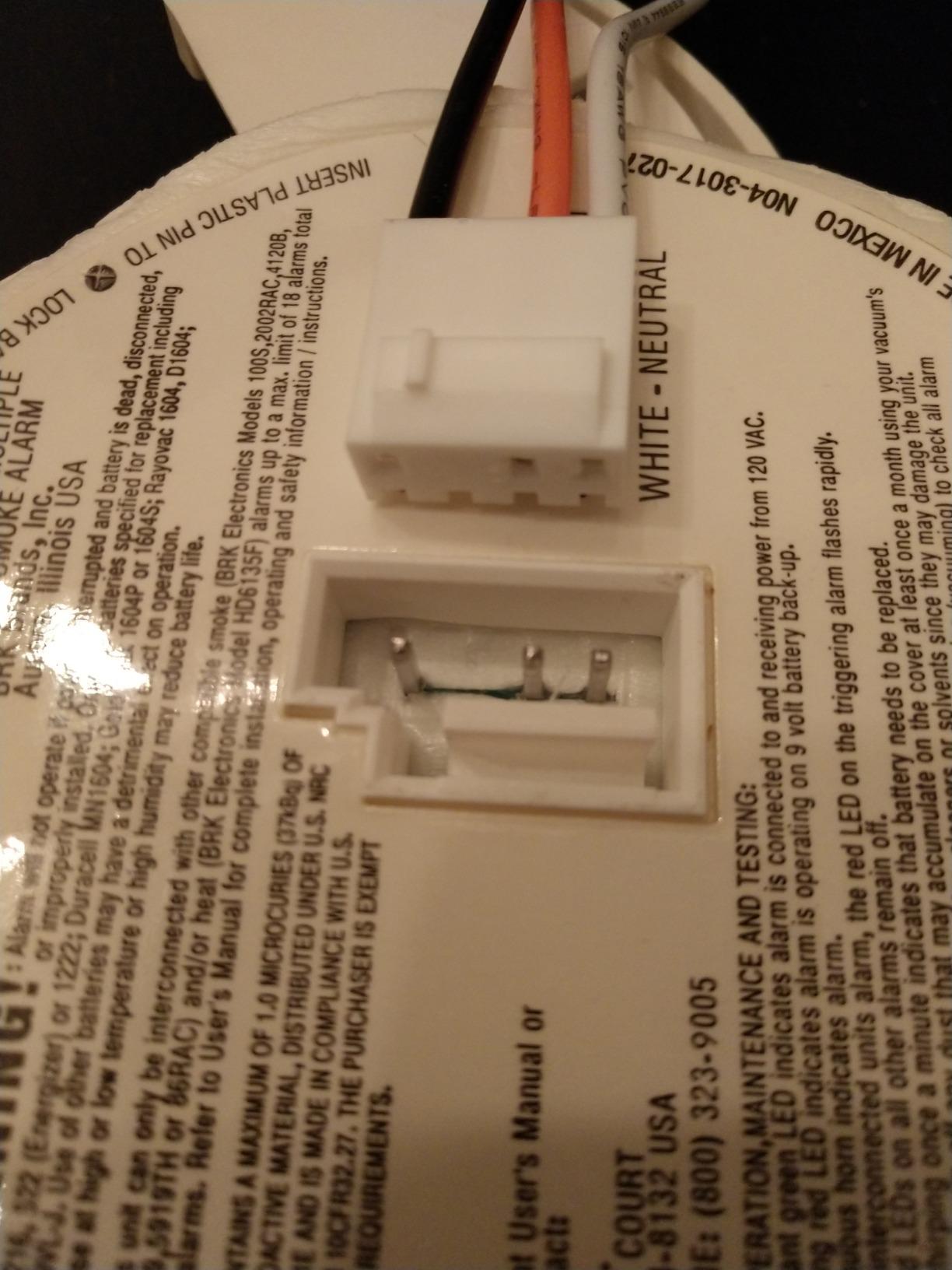
Power is hardwired with a 9V backup battery, so a power cut in the building does not take the alarm offline. That combination is also what many local codes expect for a permanently installed alarm, and hardwired units with battery backup are the configuration most often cited in fire service guidance.
Reviewers value the dual sensing, the reliability of the hardwiring and the linking capability, and the main tradeoff everyone names is installation complexity. A 4.7 average across more than 20,000 reviews is strong, and the face indicator lights that show whether the alarm triggered for smoke or for CO are genuinely useful when you are trying to work out why the house went off.
The ionization smoke sensor is the detail to watch in a basement used as a kitchen or a laundry. Ionization units are more sensitive to slow cooking-related particles than photoelectric models, so in a space with a sink, a dryer or an occasional hotplate, nuisance smoke alarms are possible.
When this is the right call for a basement
This is the pick for a house with multiple floors, an owner-occupied home, or any building where you want a basement alarm to wake people on the upper floors. It is also the right call when local code requires a hardwired alarm and a listed battery unit would not satisfy an inspection.
For a basement with no smoke detection at all, the two-in-one design is efficient: one bracket, one wiring run, one maintenance schedule for both hazards.
Where it falls short
It cannot be relocated without cutting and re-running a circuit, so location mistakes are expensive to fix. If your basement walls are unfinished concrete and there is no existing cable run, budget for an electrician rather than a DIY afternoon.
For a rental or a dorm-style unit where you have no right to modify the wiring, this is the wrong product entirely. A plug-in or battery unit is the correct tool for a tenant.
6. Kidde 900-CUDR Battery Combo Smoke and CO Alarm – Best Photoelectric Combo on AA Batteries
Kidde Smoke & Carbon Monoxide Detector, AA Battery Powered, LED Warning Light Indicators, 1 Pack
Photoelectric smoke plus electrochemical CO
Two AA batteries
24/7 self-testing
Four-orientation bracket
Pros
- Photoelectric sensor reduces cooking-related nuisance alarms
- 24/7 self-testing keeps the electronics checked
- Bracket installs in four orientations for low ceilings and joists
- Two AA batteries keep it live through a power cut
Cons
- Lowest average rating in this group at 4.4
- AA batteries need periodic replacement
- No digital CO level readout
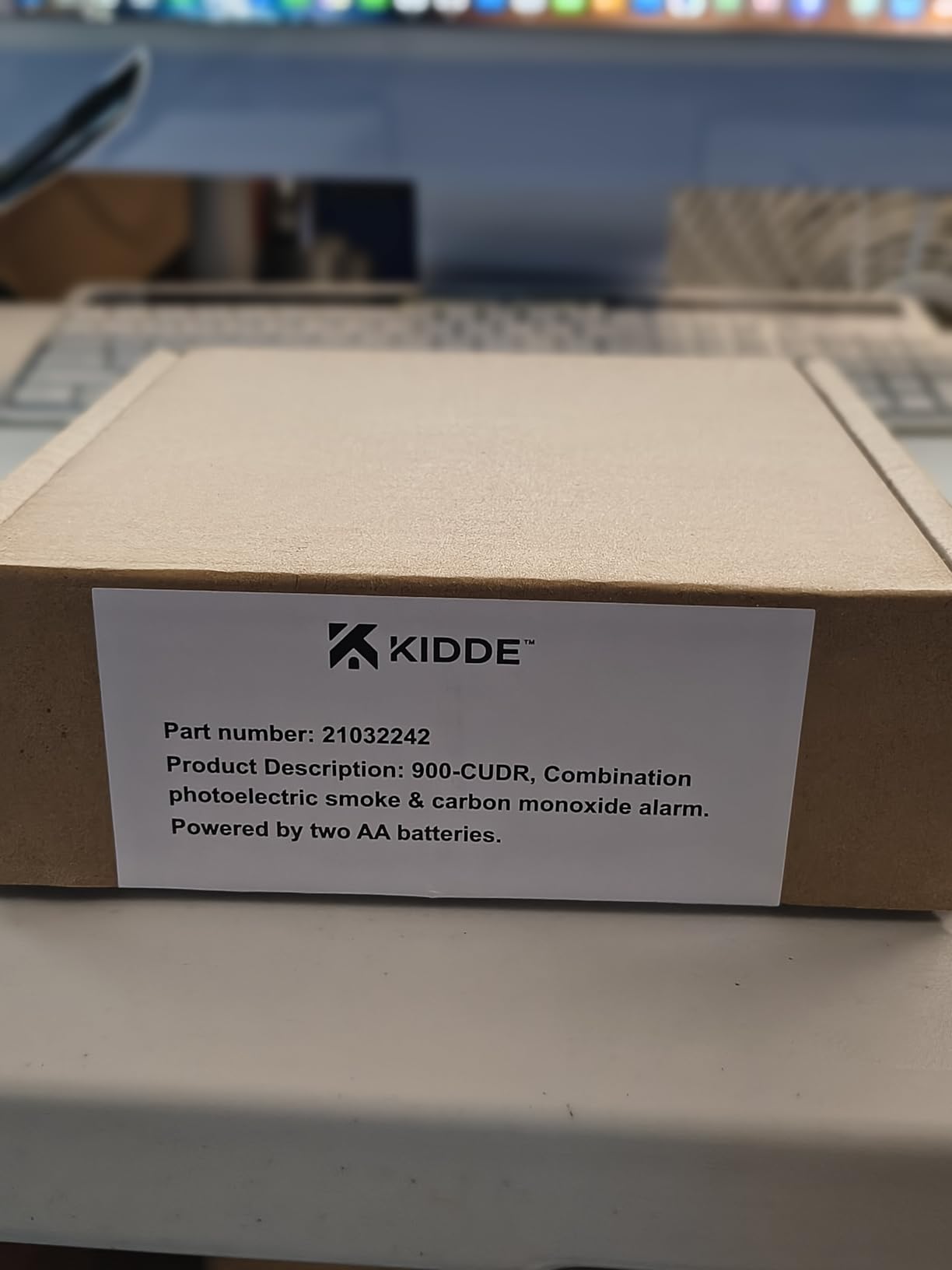
The 900-CUDR is the combo alarm to consider when your basement doubles as a kitchen, a laundry or a storage space where cooking particles are likely. It pairs a photoelectric smoke sensor with an electrochemical CO sensor, and photoelectric sensing is what keeps a toaster or a dryer cycle from setting off the whole room.
It is also the only unit here with 24/7 self-testing, which checks the components continuously. The manufacturer is clear that this is not a replacement for the manual push test, and we agree, but it does catch a failing component before you need it.
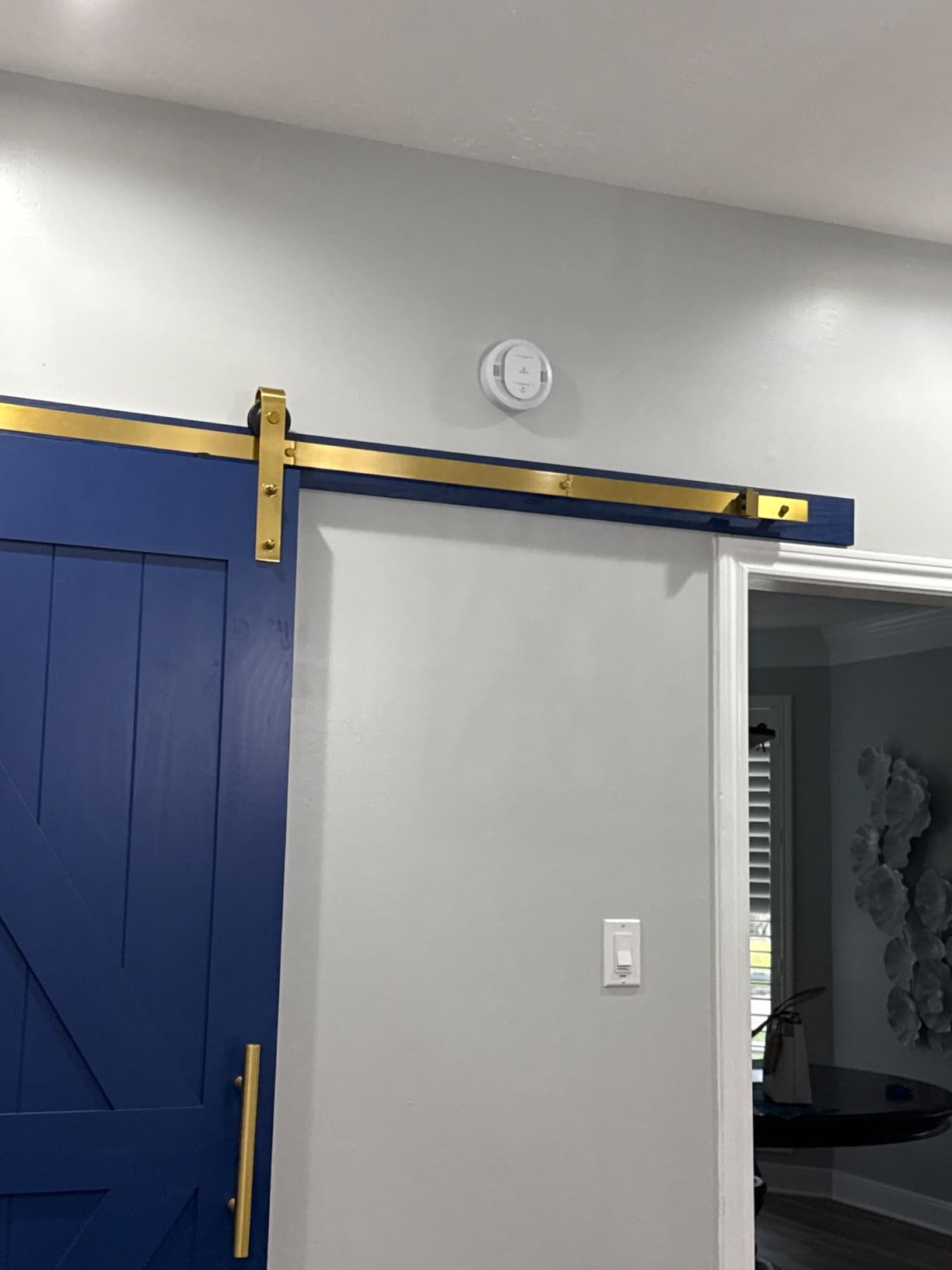
The four-orientation mounting bracket is the quietly useful feature for basements. It lets the unit sit on a wall, a ceiling, a joist or a sloped surface, which matters in a low-ceilinged mechanical room where the only clean mounting surface is overhead.
We want to be straight about the weakness here. This is the lowest-rated unit in the lineup at a 4.4 average from 1,896 reviews, with a 9% one-star share, and review feedback includes a visible minority reporting early failures. The 75% five-star share is also lower than the rest of this group. Two AA batteries are included and keep it working through a power cut, but they need replacing rather than sitting for a decade.
The LED status colours are well chosen for a dark room: green for normal, amber for an operating error, red for a smoke, fire or CO event. What you do not get is a CO number, and in a mechanical room that is a real limitation when you are trying to judge whether a nuisance alarm is genuine.
When this is the right call for a basement
This is the pick for a finished basement with a kitchenette, a laundry area or a workshop where smoke nuisance alarms would otherwise be a problem, and where you want one device handling both hazards.
It suits a rental where the existing smoke alarm is old or missing and you can mount on the wall or ceiling yourself, and the 10-year limited warranty from date of power-on is a solid term for a battery combo.
Where it falls short
The 4.4 average and the early failure reports are the reason this is not higher on the list. On a life-safety device, a higher failure rate matters more than on almost any other purchase, and you should test it monthly rather than trusting the self-test.
Two AA batteries mean two devices to check batteries on if you also run a standalone CO alarm, and the missing display means a recurring alarm gives you no data to act on.
7. X-Sense SC07 10-Year Sealed Battery Combo Alarm – Best for Zero Battery Maintenance
X-Sense Smoke Detector Carbon Monoxide Detector Combo, SC07, 1-Pack
Sealed 10-year lithium battery
Photoelectric and electrochemical sensors
LCD status display
UL 217 and UL 2034
Pros
- Sealed lithium battery removes battery changes and low-battery chirps
- Photoelectric sensor cuts nuisance smoke alarms
- Independently certified to UL 217 and UL 2034
- Installs on a wall or ceiling with no rewiring
Cons
- No wireless interconnection
- Wi-Fi or base station connection
- 5-year quality warranty is shorter than the battery life
The X-Sense SC07 solves the maintenance problem that annoys people most about alarms: nothing to replace, nothing to chirp about. The sealed lithium cell is rated for an average 10-year life, so there are no AA batteries to check in January and no low-battery warning interrupting sleep.
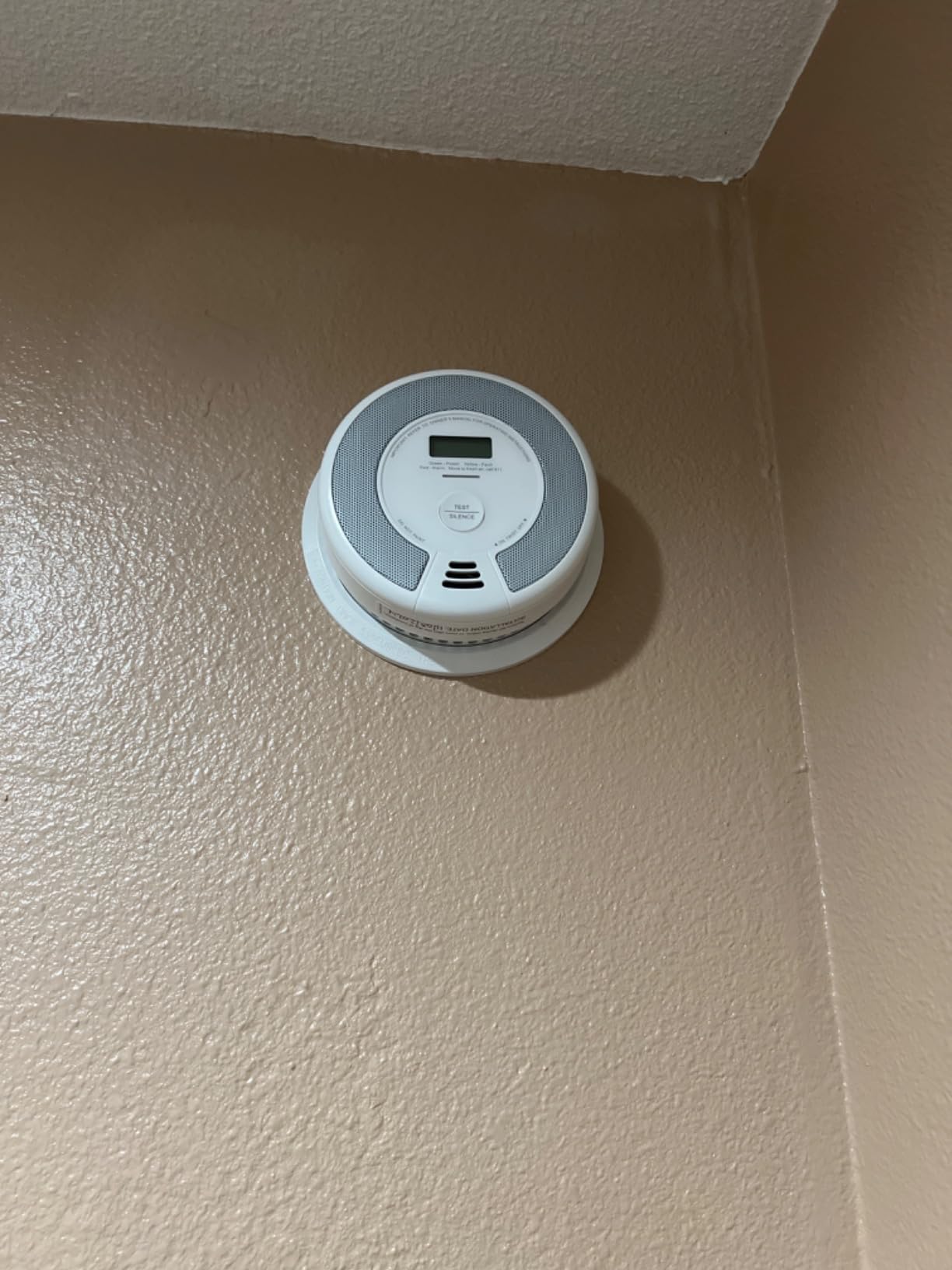
It is a two-in-one unit with a photoelectric smoke sensor and an electrochemical CO sensor, an 85 dB alarm and an LCD status display. The display shows the unit’s condition rather than a live CO reading, which is a smaller step up than the digital models above but still more feedback than an LED alone.
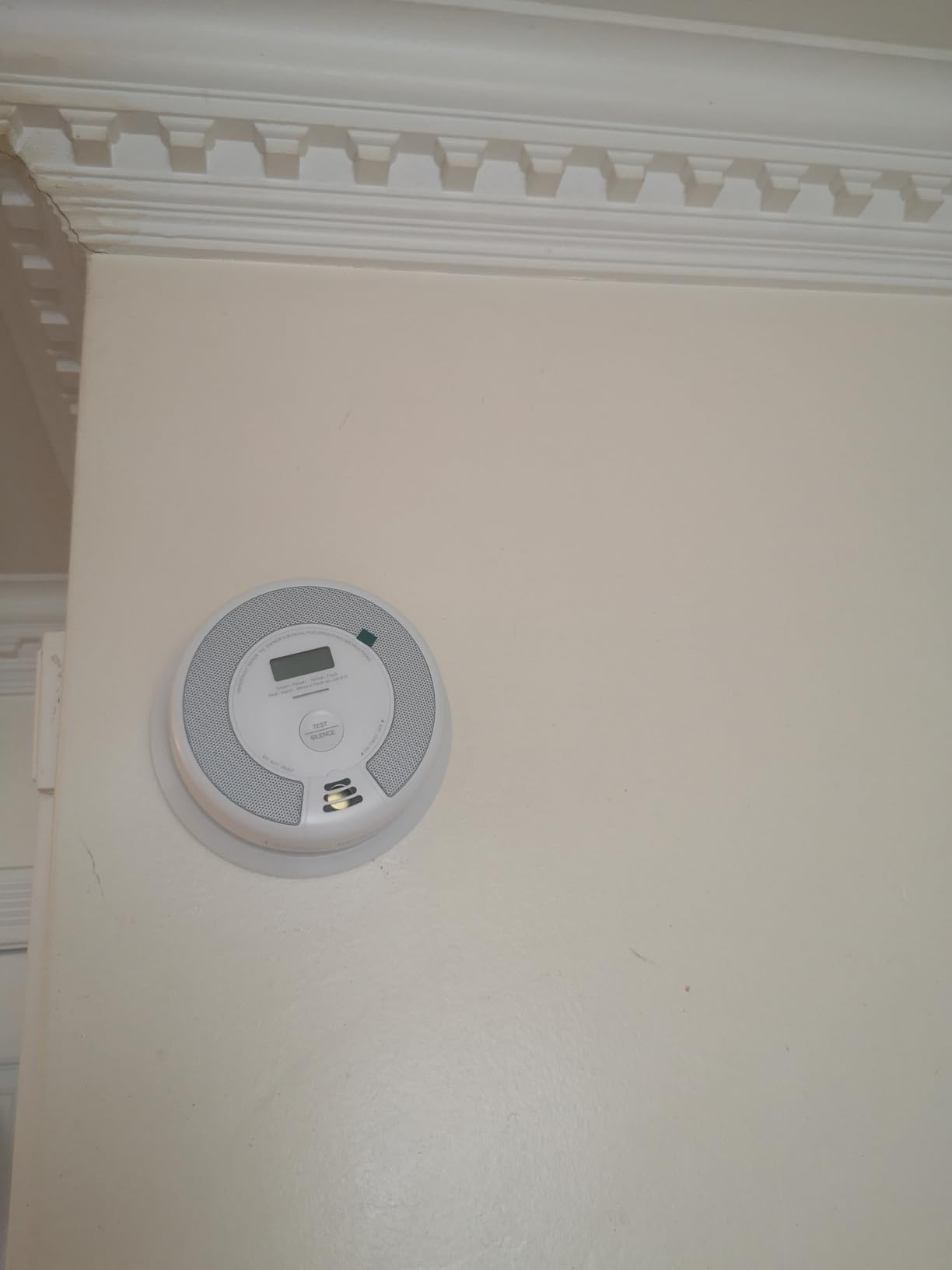
For a basement specifically, the installation story is good. It mounts on a wall or ceiling with the included bracket, screws and anchor plugs and needs no rewiring, and it is independently certified to UL 217 for smoke alarms and UL 2034 for CO alarms, which is the listing combination we look for on any life-safety device.
Owner feedback concentrates on two things: the sealed battery removing maintenance entirely, and the photoelectric sensor’s lower nuisance-alarm rate compared with ionization units. The common caveat is that this is a standalone model. There is no wireless interconnection, no Wi-Fi and no base station connection, so it cannot be added to a linked system later.
At 4.5 across 4,268 reviews, it sits mid-pack on rating with a 5% one-star share, and a minority of buyers report early failures. The warranty structure is also unusual: a 60-day money-back guarantee, a 5-year quality warranty and lifetime technical support. A 5-year warranty against a 10-year battery is a mismatch worth noting, since the sensor is often what limits the useful life.
When this is the right call for a basement
This is our pick for a finished basement bedroom or a rental where you want decade-long coverage without touching the unit. A sealed battery is especially valuable in a space you do not visit every week, such as a storage room that also houses a gas appliance.
It is also the right choice where the wall is bare concrete and running cable is not realistic, and where a combination alarm covers a room that has no smoke coverage of its own.
Where it falls short
The lack of interconnection is the deal-breaker in a multi-level home. If the goal is for a basement alarm to wake someone in an upstairs bedroom, this unit simply cannot do that, and you would need the hardwired combo further up this list instead.
The 5-year warranty also means the sealed 10-year battery is somewhat theoretical in practice. Plan on replacing the unit once in the first decade rather than treating it as a set-and-forget device.
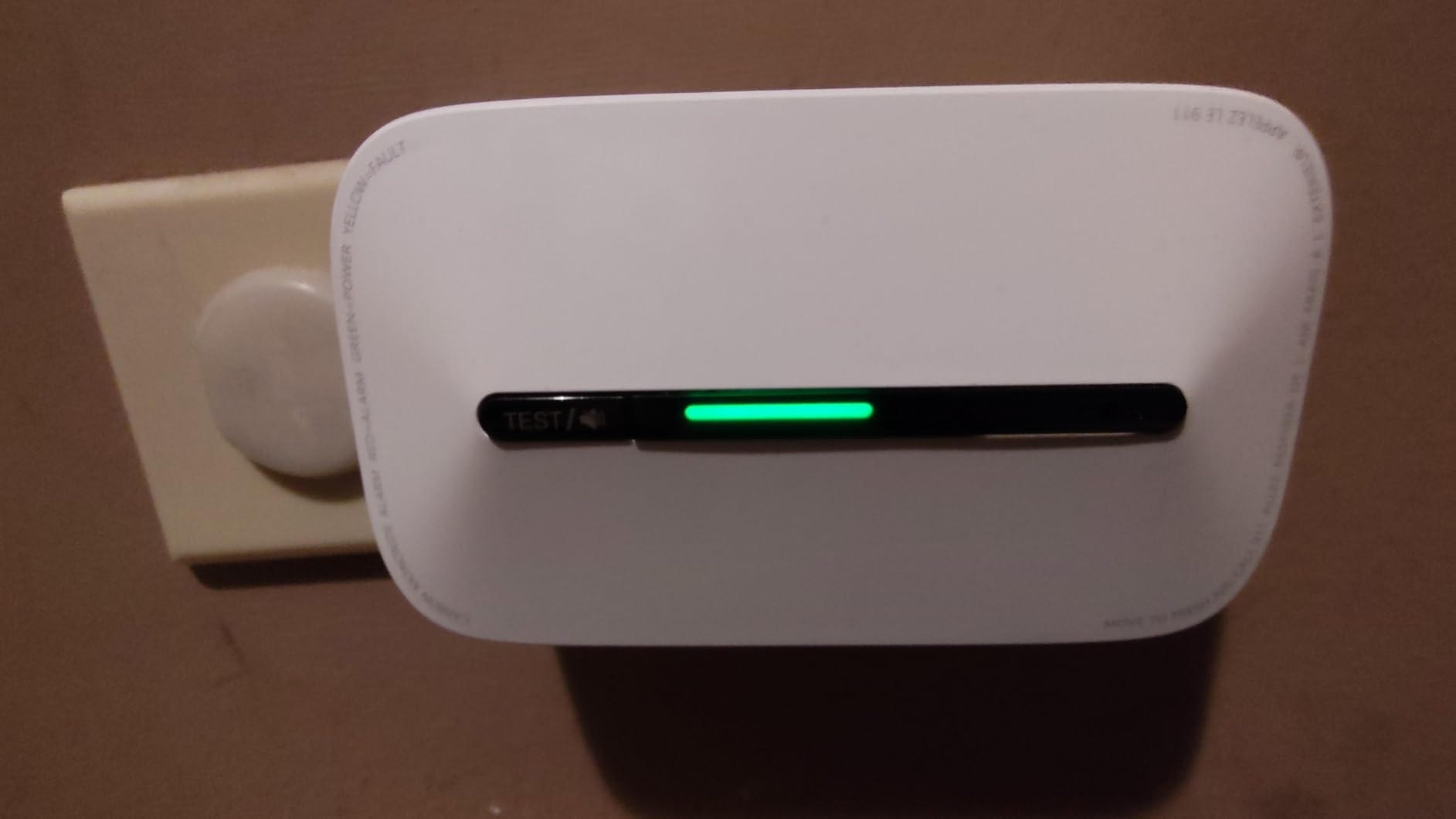
8. Siterlink Plug-In CO Alarm with 10-Year Backup Battery – Best Compact Travel Unit
Siterlink Carbon Monoxide Detectors Plug in,10 Year Replaceable Battery
AC plug-in with 10-year backup battery
Foldable travel plug
Electrochemical sensor
Dim green status light
Pros
- Plug-in operation with 10-year battery backup covers outages
- Foldable plug and travel-size body suit hotels and trips
- Soft green breathing status light will not disturb sleep
- New electrochemical sensor built to reduce false alarms
Cons
- Small review base at 322 reviews
- No digital display of the measured CO level
- Only a modest warranty is specified
The Siterlink is the odd one out in this lineup and the reason it earns a place: the plug folds away, which makes it the only unit here that works as a genuinely portable alarm. For a basement, the practical value is checking a room before you move into it or after running a furnace through a cold snap, and the foldable plug makes that something you can actually do rather than something that stays bolted to a basement wall.
It is plug-in with a 10-year replaceable backup battery, so it keeps monitoring through a power cut without the annual battery swap that the AA-powered units require. The soft breathing-style green status light is a considered choice for a bedroom, and it will not wake you at 2am.
At a 4.6 average the rating is competitive with the established brands, but the review base is 322 against tens of thousands for the Kidde and First Alert units, and that difference matters. Newer and less reviewed means less long-term durability feedback, and on a life-safety purchase we weight that heavily.
The new electrochemical sensor is engineered to reduce false alarms, which is the correct priority for a basement. The trade-off is the same as the rest of the no-display group: you get a yes-or-no answer and no numeric reading, and the warranty is described only as modest compared with the 5- and 10-year terms elsewhere in this list.
We would not make this the sole alarm in a basement with a gas furnace. We would absolutely use it as a supplementary check while investigating an intermittent alarm or as a travel unit for a rental that changes.
When this is the right call for a basement
Pick this for a basement you visit periodically, a garage or workshop where you want a spot check, or a rental where you move often. The foldable plug makes it the easiest unit here to pack for a hotel room or a cabin with a wood stove.
It is a reasonable second unit in a finished basement bedroom, especially if the green status light matters to you at night, and the 10-year backup battery means it stays covered through outages without attention.
Where it falls short
With 322 reviews, there is simply not enough long-term data to rank it alongside units with tens of thousands of ratings. If the basement holds the building’s furnace, we would put a heavily reviewed alarm there and keep this as the portable one.
It is also plug-in only, so a bare concrete room with no accessible outlet rules it out entirely, and there is no display or peak memory to help you triage a nuisance alarm.
Basement False Alarms: The Four Causes and How to Fix Them
Four triggers account for almost every repeated basement alarm: a real combustion fault, humidity and condensation, solvent or paint vapour, and vehicle exhaust. Work through them in that order. Treat the first as real until you have ruled it out, because a backdraft through a cracked flue connector is the one that kills people.
1. A real combustion fault or backdraft. An aging furnace, a blocked or disconnected flue, a water heater with a failed draft hood, or a negative pressure situation created by an exhaust fan can all push combustion gases into the room. If the alarm sounds more than once, or sounds while appliances are running, stop testing the detector and book an HVAC inspection.
2. Humidity and condensation. Electrochemical sensors respond to conditions outside their rated range. Every unit in this list is rated to 95% relative humidity non-condensing, and basements routinely sit at or above that in summer. Condensation dripping onto a cold joist-mounted unit is a common trigger. Move the unit to a wall at about 5 feet, off the concrete and out of the airflow from a dehumidifier, and run a dehumidifier on the room.
3. Solvent and paint vapour. Paint stripper, solvents, wood finishing products, new carpet adhesive and some cleaning products can trigger CO alarms even though they are not carbon monoxide. If the alarm sounds while you are painting, working on the floor or running a solvent-based product, ventilate the basement first, then wait and retest. If it only ever sounds on painting days, that is the explanation.
4. Vehicle exhaust. A car idling in an attached garage, or a running vehicle in a basement-adjacent space, can push exhaust into the stairwell and down into the basement. Check for a garage door left open, a door to the house left open while the car runs, and any exhaust system that terminates near an air intake.
Our triage order when an alarm sounds: hit the test button to confirm the unit itself is working, note the time and what was running, then work the four causes above in order. If the alarm repeats with no solvent source and no vehicle running, it is an HVAC call, not a detector problem. The recurring complaint theme across homeowner forums is people eventually pulling a nuisance-alarming unit off the wall, which is the worst possible outcome for a basement.
What to Do When a Basement CO Alarm Goes Off
Get everyone out of the building and call emergency services from outside. Do not try to find the source first, and do not go back inside for pets or belongings. Carbon monoxide is colourless and you cannot judge how much is in the air by how you feel.
Leave immediately. Wake anyone sleeping and get out through the nearest door. Do not use the phone, matches or candles inside.
Call 911 or your local emergency number from outside. Stay at the door or in a vehicle until responders arrive, and tell them the alarm came from the basement mechanical room.
Do not re-enter until cleared. Responders meter the air before anyone goes back in, and a unit that has been silenced or unplugged does not make the room safe.
If it turns out to be a false alarm, fix the cause. Work the four triggers above, move the unit if humidity or a cold surface is involved, and never simply mute a repeat alarm and leave it.
For renters, one more step: report it in writing to your landlord or housing office the same day, whether it was a real fault or a nuisance alarm. Basement CO events get resolved faster when there is a timestamp and a record, and it protects you if it turns out to be a real fault later.
How to Choose a Basement CO Detector
Only buy a UL 2034 listed unit. This is the single strongest trust signal on this topic and the one fire service guidance centres on. Every product in our list meets it or the equivalent standard, and cheap unlisted units should be flagged rather than recommended, no matter how good they look on paper.
Check the sensor type. Electrochemical sensors are the most accurate and hold their calibration best across temperature and humidity swings, which is exactly the basement environment. Metal oxide semiconductor and biomimetic sensors are cheaper and more prone to drift, so we would not choose one for a damp mechanical room.
Match the power source to your access. A plug-in unit needs a reachable outlet, which in a utility closet behind a water heater is often the wrong answer. A battery unit can go anywhere on the wall or the joists. A hardwired unit with battery backup is what most local codes expect for a permanent installation, and it is the only option here that can be interconnected so a basement alarm sounds upstairs. If you want a unit that keeps working through a power cut without a battery habit, look for a sealed 10-year lithium cell.
Look at the humidity range, not just the alarm features. Most units are rated to 95% relative humidity non-condensing, and many basements exceed that in summer. A wider range gives you more margin, and pairing the alarm with a dehumidifier keeps you inside the rated window rather than hoping.
Decide whether you need a display. A digital CO level readout is the difference between triaging an alarm and reacting to it blindly. It is worth paying for in a mechanical room where you may need to decide whether an intermittent alarm is real. If you skip it, make sure your plan is a test button and an HVAC technician rather than guesswork.
Plan for end of life. Warranty lengths here run from 5 years to 10 years, and a sealed 10-year battery does not mean a 10-year sensor. Every unit has an end-of-life signal, but most people only notice it when it starts chirping. Put the install date in your phone and set a reminder for one year before the warranty ends.
Know who is responsible in a rental. Local codes generally place the duty on the property owner, and most states and provinces have specific CO alarm requirements for rented dwellings. Students in shared housing should ask the landlord what is installed in the basement and add a portable or plug-in unit of their own if the answer is nothing. If you are the owner or the tenant in charge, the placement rules earlier in this guide are the ones to follow.
Consider a low-level CO alert if you have a fuel-burning appliance. A standard alarm is designed to sound before a sleeping occupant is overcome, which is why placement and interconnection matter more than extra sensitivity. A low-level unit gives an earlier heads-up near an appliance, and it belongs in the mechanical room alongside the standard alarm, not instead of it.
Frequently Asked Questions
Should I put a carbon monoxide detector in my basement?
Yes. The International Association of Fire Chiefs recommends a carbon monoxide alarm on every level of a home, including the basement, and the CDC records roughly 150 accidental CO poisoning deaths a year. Basements concentrate the sources: furnace, boiler, water heater, gas range, wood stove and attached garage exhaust. CO mixes with air and spreads through the lowest reachable parts of a home, so a basement is often the first room to register a combustion fault.
Where should I place a carbon monoxide detector in a basement?
Mount it about 5 feet from the floor, or at adult breathing height, on a wall or on the underside of the joists. Place it near a fuel-burning appliance but not directly above it, and keep it away from bare cold concrete, drafts, open windows, dehumidifier exhaust and sump pump air gaps. Then add a second unit on every level where people sleep.
Is carbon monoxide common in basements?
More than upstairs, because the appliances that make it are down there. A furnace, boiler, water heater, gas range or wood stove in a below-grade room, plus an attached garage beneath the floor, put the source and the occupants in the same enclosed space. Backdraft through a cracked flue or a blocked vent is a documented cause of CO accumulating in basements.
Why is my carbon monoxide detector going off in my basement?
Four causes cover most cases. A real combustion fault or backdraft, which needs an HVAC inspection. Humidity and condensation on a cold joist or concrete surface, which pushes an electrochemical sensor outside its rated range. Solvent, paint or adhesive vapour. And vehicle exhaust drifting in from an attached garage. Work the test button, then the fuel appliance, then solvents, then the vehicle, in that order, and never just mute a repeat alarm.
Do carbon monoxide detectors false alarm in humidity?
They can. Most residential CO alarms are rated to 95% relative humidity non-condensing, and basements routinely exceed that in summer. Condensation dripping onto a unit mounted on a cold joist is a common trigger. Move the alarm to a wall about 5 feet from the floor, off bare concrete, and run a dehumidifier to bring the room back inside the rated range.
Which carbon monoxide detector is the most accurate?
Accuracy comes from the sensor type and the listing, not the brand. An electrochemical sensor holds its calibration best across temperature and humidity swings, which matters in a basement. Only trust a performance figure from a unit certified to UL 2034. The units we recommend all meet that standard, and a digital display helps you judge accuracy in practice because you can see the reading change.
What carbon monoxide detector do firemen recommend?
Fire service guidance consistently centres on the same points: a UL 2034 listed unit, one alarm on every level including the basement, placement near sleeping areas and near fuel-burning appliances, an end-of-life indicator, and a test button. Hardwired units with battery backup satisfy most local codes and can be interconnected so a basement alarm sounds on the upper floors.
Hardwired or battery carbon monoxide detector for a basement?
Hardwired with battery backup is the choice for a house you own and want to interconnect, because it keeps working through a power cut and can sound throughout the building. Battery or plug-in is the choice for a rental, a bare concrete room with no accessible outlet, or anywhere you cannot modify wiring. A sealed 10-year lithium battery removes the recurring battery replacement habit entirely.
How often do carbon monoxide detectors need replacing?
Plan on the warranty period rather than the price you paid. In this lineup that ranges from 5 years to 10 years, and a sealed 10-year battery does not mean a 10-year sensor. Every unit has an end-of-life signal, but you will usually only notice it when it chirps, so set a reminder one year before the warranty ends and test the unit monthly in the meantime.
Can a landlord refuse to install a carbon monoxide detector in the basement?
Local law varies, but most jurisdictions place the duty on the property owner and have specific CO alarm requirements for rented dwellings. Students in shared housing should ask the landlord what is installed in the basement in writing. If the answer is nothing and you do not feel confident in the flue and appliances down there, adding your own plug-in or battery unit is a reasonable step.
What should I do if my carbon monoxide alarm goes off?
Get everyone out of the building and call emergency services from outside. Do not try to find the source first and do not re-enter for belongings or pets, because you cannot judge the air by how you feel. Wait to be cleared. If responders find nothing, treat it as a false alarm and fix the cause rather than silencing the unit and leaving it.
Best Carbon Monoxide Detector for Basements: Final Verdict
The Kidde KN-COB-LP2 is our pick for the best carbon monoxide detectors for basements, because no wiring and no outlet searching is worth more below ground level than any extra feature. It runs on an electrochemical sensor, tolerates 10% to 95% relative humidity, and carries more than 36,000 reviews at a 4.7 average. For a room with reachable outlets and a need to read actual concentrations, the Kidde KN-COPP-3 with its digital display is the upgrade.
For most basements the right setup is two units, not one: a battery or sealed-battery alarm down in the mechanical room at about 5 feet from the floor, off bare concrete and away from the furnace flue, and a second alarm on the level where people sleep. If you own the wiring and want the basement alarm to wake the whole house, the hardwired combination unit is the only option here that does it properly.
Check what your landlord has already installed before you buy anything, mount the unit where the air moves least from cold surfaces, and test it on the first of every month. In a basement, the detector that actually works six months from now is the one that stayed on the wall.