
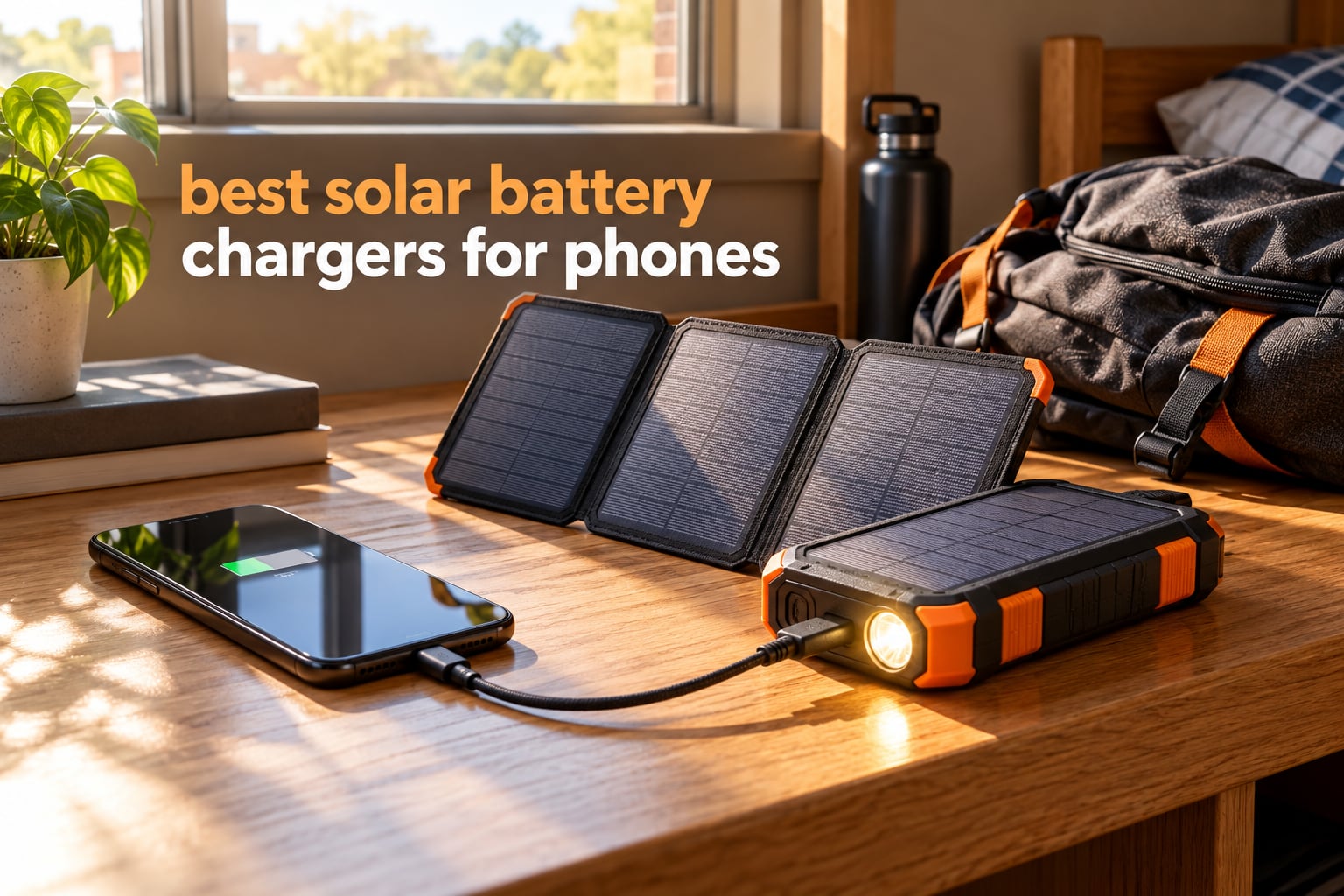
Three weeks before finals, the power went out in our whole residence hall and the campus dining hall went dark at the same time. Nobody had a charger, and the library was closed. What I learned that night is that the best solar battery chargers for phones are not really solar chargers at all. They are big, dependable batteries with a small panel bolted on that rescues you when everything else fails.
That distinction matters, because a lot of marketing blurs it. A panel the size of a playing card will not refill a 20000mAh battery in an afternoon, and anyone selling you one who says otherwise is selling you a number rather than a product. What these devices do well is sit in a backpack for three weeks, hold their charge, and quietly top themselves up whenever the sun touches them. That is exactly the job you want in a dorm, on a study abroad trip, or at a festival where the only outlet belongs to someone else.
We went through twelve solar power banks, weighing the stated capacity against the weight, the port layout, the water rating, the flashlight and lamp extras, and the honest limits of each panel. The short version: pick the battery you would actually be happy carrying, and treat the solar panel as an emergency top-up rather than a power source. The rest of this guide explains which ones hold up under that standard and which ones are mostly a solar panel stuck to a heavy brick.
Table of Contents
Top 3 Solar Battery Chargers for Phones (October 2026)
BLAVOR Solar Power Bank…
- 10000mAh real-rated cell
- Qi wireless pad
- 20W USB-C output
- IPX5 and 9.3 oz
BLAVOR 20000mAh Wireless…
- Wireless pad for phones and Apple Watch
- 20W USB-C output
- 4 built-in cables
- Compass and thermometer
GOODaaa Solar Power Bank…
- 24000mAh cell
- 5 outputs and 3 inputs
- Built-in thermometer
- Dual flashlights with SOS mode
The BLAVOR 10000mAh leads on review volume and everyday weight, the BLAVOR 20000mAh wins on features, and the GOODaaa 24000mAh matches the top rating of the group. All three charge a phone multiple times from a wall outlet and all three treat the panel as a backup rather than a source.
All 12 Solar Battery Chargers Compared in 2026
| Product | Specs | Action |
|---|---|---|
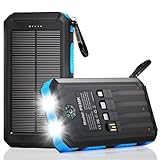
| BLAVOR Solar Power Bank 10000mAh |
|
Check Latest Price |
 Durecopow Solar Power Bank 20000mAh Durecopow Solar Power Bank 20000mAh |
|
Check Latest Price |
 SOARAISE Solar Power Bank 48000mAh SOARAISE Solar Power Bank 48000mAh |
|
Check Latest Price |
| BLAVOR Solar Power Bank 20000mAh |
|
Check Latest Price |
| GOODaaa Solar Power Bank 24000mAh |
|
Check Latest Price |
 FEELLE Solar Power Bank 50000mAh FEELLE Solar Power Bank 50000mAh |
|
Check Latest Price |
 Solar Power Bank 20000mAh USB-C Solar Power Bank 20000mAh USB-C |
|
Check Latest Price |
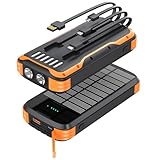 MINRISE Solar Power Bank 40000mAh MINRISE Solar Power Bank 40000mAh |
|
Check Latest Price |
 Nuynix Solar Power Bank 49800mAh Nuynix Solar Power Bank 49800mAh |
|
Check Latest Price |
 Uukto Solar Power Bank 20000mAh Uukto Solar Power Bank 20000mAh |
|
Check Latest Price |
 DJKK Solar Power Bank 66800mAh DJKK Solar Power Bank 66800mAh |
|
Check Latest Price |
 BLAVOR 20000mAh with 4 Foldable Panels BLAVOR 20000mAh with 4 Foldable Panels |
|
Check Latest Price |
Every one of these carries a battery, and every one of them will give you more usable charges from a wall outlet than from the sun. The columns that actually separate them are capacity, weight, output wattage and the number of devices you can charge at once.
1. BLAVOR Solar Power Bank 10000mAh – The One to Pack
BLAVOR Solar Power Bank 10,000mAh Portable Wireless Charger for Cell Phones
10000mAh real-rated cell
Qi wireless pad plus 20W USB-C
3 devices at once
IPX5, 9.3 oz
Pros
- Genuinely pocketable at 9.3 ounces
- Qi wireless pad avoids cable juggling
- IPX5 shell with flashlights and carabiner
- 3 year warranty with lifetime support
Cons
- Solar input is a trickle charge only
- 10000mAh gives roughly 2 to 3 phone charges
- Qi alignment is fussy with a case on
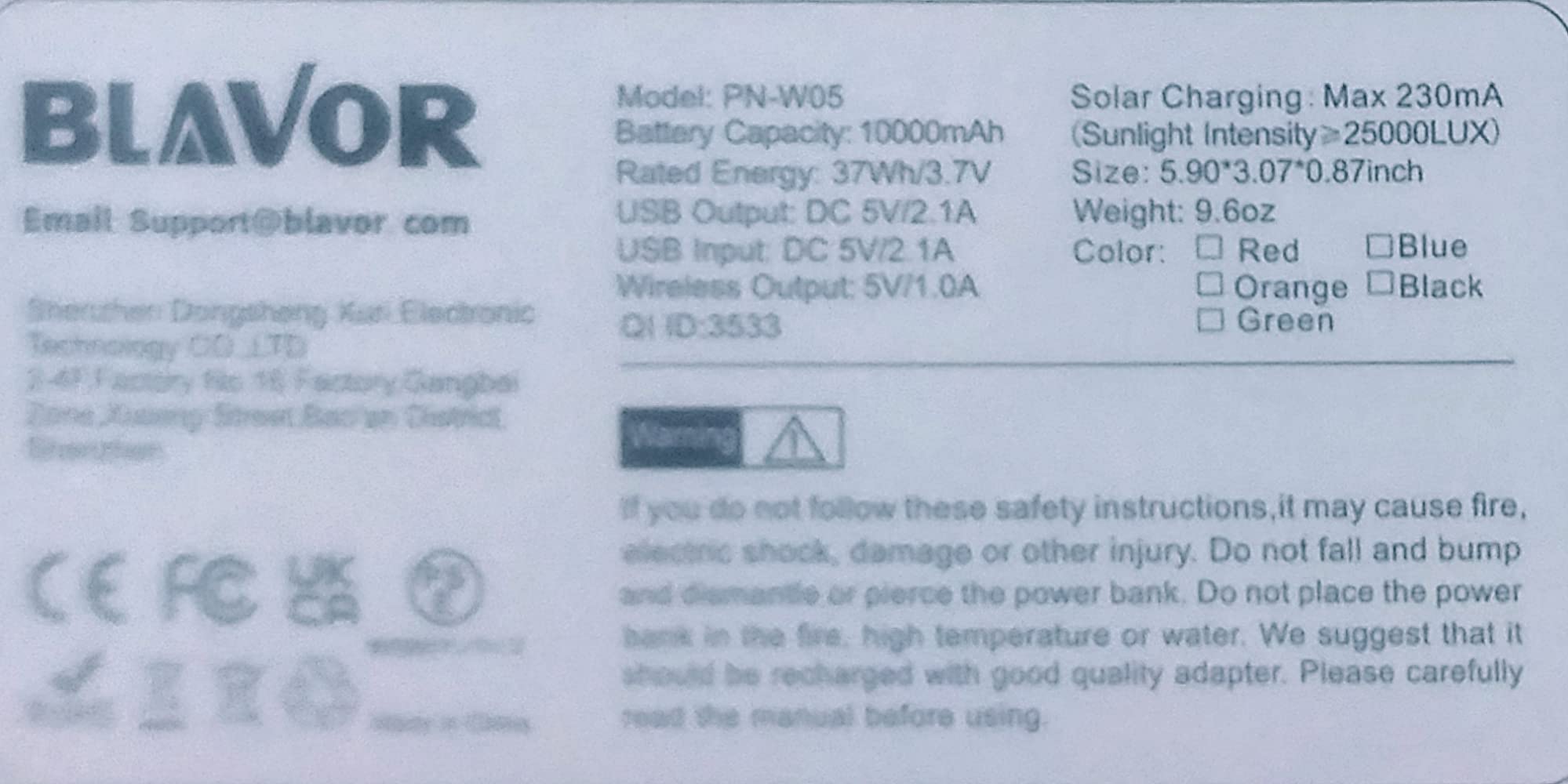
Bottom line: this is the charger I would put in a backpack on a Monday and forget about until a blackout. It weighs 9.3 ounces, measures roughly 5.9 by 3.1 inches, and holds a real-rated 10000mAh rather than a rounded-up number. Buyers report charging an iPhone 15 from empty to 65 percent in about half an hour through the USB-C port, which is fast enough to top up between classes.
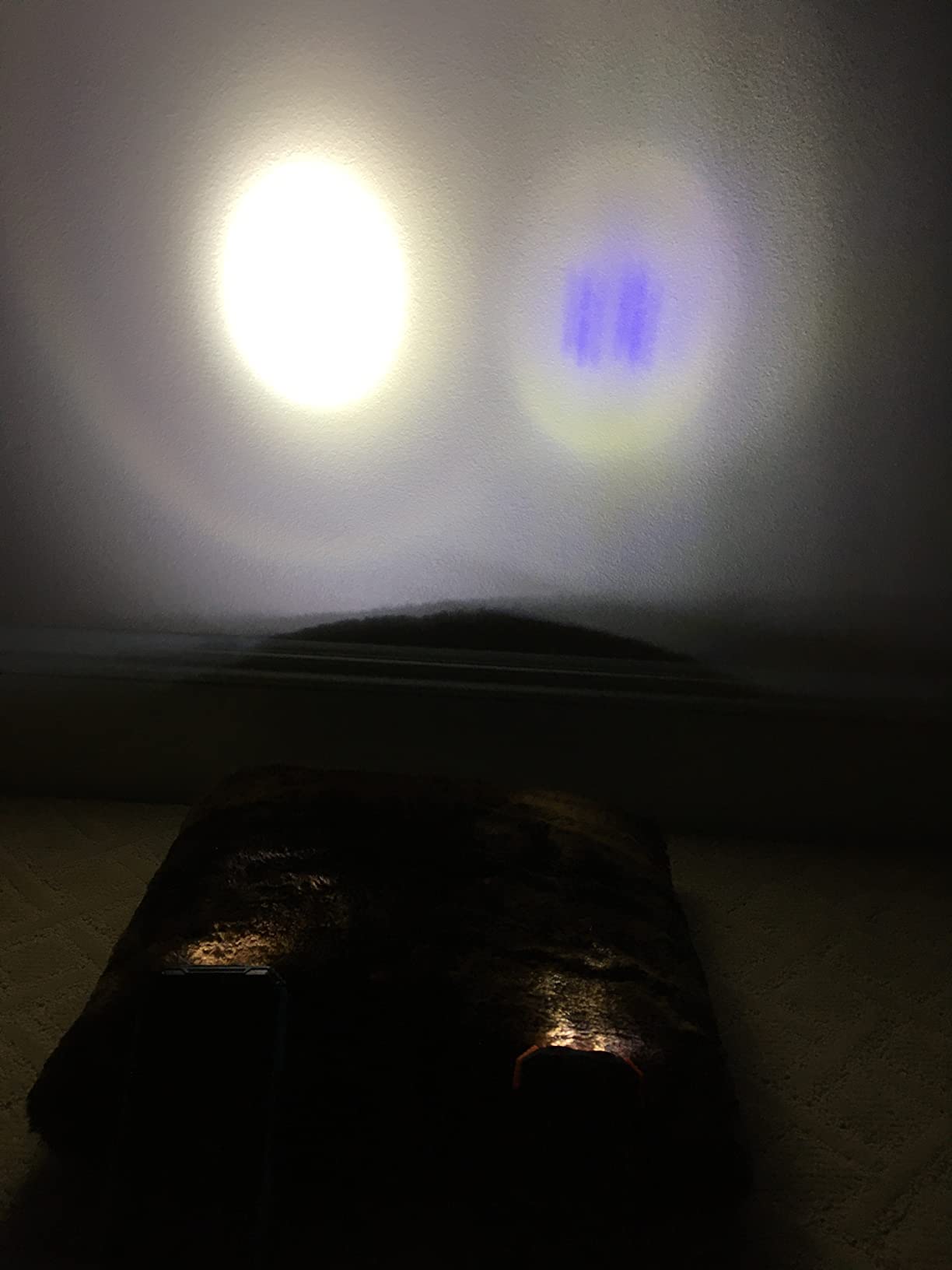
What makes it useful on campus is the feature list rather than the wattage. There is a Qi wireless pad for phones that support it, three ports so three devices can run at once, dual super-bright flashlights, a compass, and a carabiner so it clips to a bag strap instead of sitting loose in a pocket.
The honest limitation is the panel. Buyers are consistent about this one, and the manual is unusually candid: the integrated solar is a trickle top-up, not a recharge. Charge it by cable before you leave and the sun only needs to hold the battery awake when you are caught out.
One more thing to know before you commit. The wireless pad is finicky if your phone is in a case, and it only gives you around two to three full phone charges from 10000mAh. That is a day and a bit of heavy use, or a comfortable week of normal dorm life.
What you get for your backpack weight
At 9.3 ounces with a carabiner included, this is the pick for anyone who carries a laptop and a textbook and does not want to add meaningful bulk. The IPX5 rating covers splashes and dust, which is the right level for a bike commute or a rainy walk between buildings.
The battery itself is a lithium-polymer pack with a three-year warranty and lifetime customer support behind it. That warranty length is unusual in this category and worth something if you are the type who loses a charger in a library.
Where it falls short
If you need to run a phone, a tablet, earbuds and a laptop through a three-day camping trip, 10000mAh is not enough capacity. Move up a size rather than planning to ration, because rationing a phone battery is miserable.
It is also worth saying plainly that no solar power bank in this list refills itself quickly. On the BLAVOR 10000mAh, the panel is for the moment you realise you left the pack unplugged, not for the trip itself.
2. Durecopow Solar Charger Power Bank 20000mAh – Four Built-In Cables
Durecopow Solar Charger Power Bank 20,000mAh, Portable Charger, 4 Cables 3 Ports Fast Charging External Battery Pack with USB C for Cell Phones, Solar Panel Charger with Dual Flashlight for Camping
20000mAh lithium-ion cell
4 built-in cables and 3 ports
Two lights with SOS and strobe
250 g, 12 month warranty
Pros
- Type-C
- Lightning
- Micro USB and USB-A cables built in
- Up to 6 devices with 3 ports plus 3 cables
- Steady
- SOS and strobe light modes
- Silicone corner bumpers resist drops and dust
Cons
- Solar charging is supplemental and slow
- 250 g is heavy for the footprint
- No wireless charging and output is only 2.4A
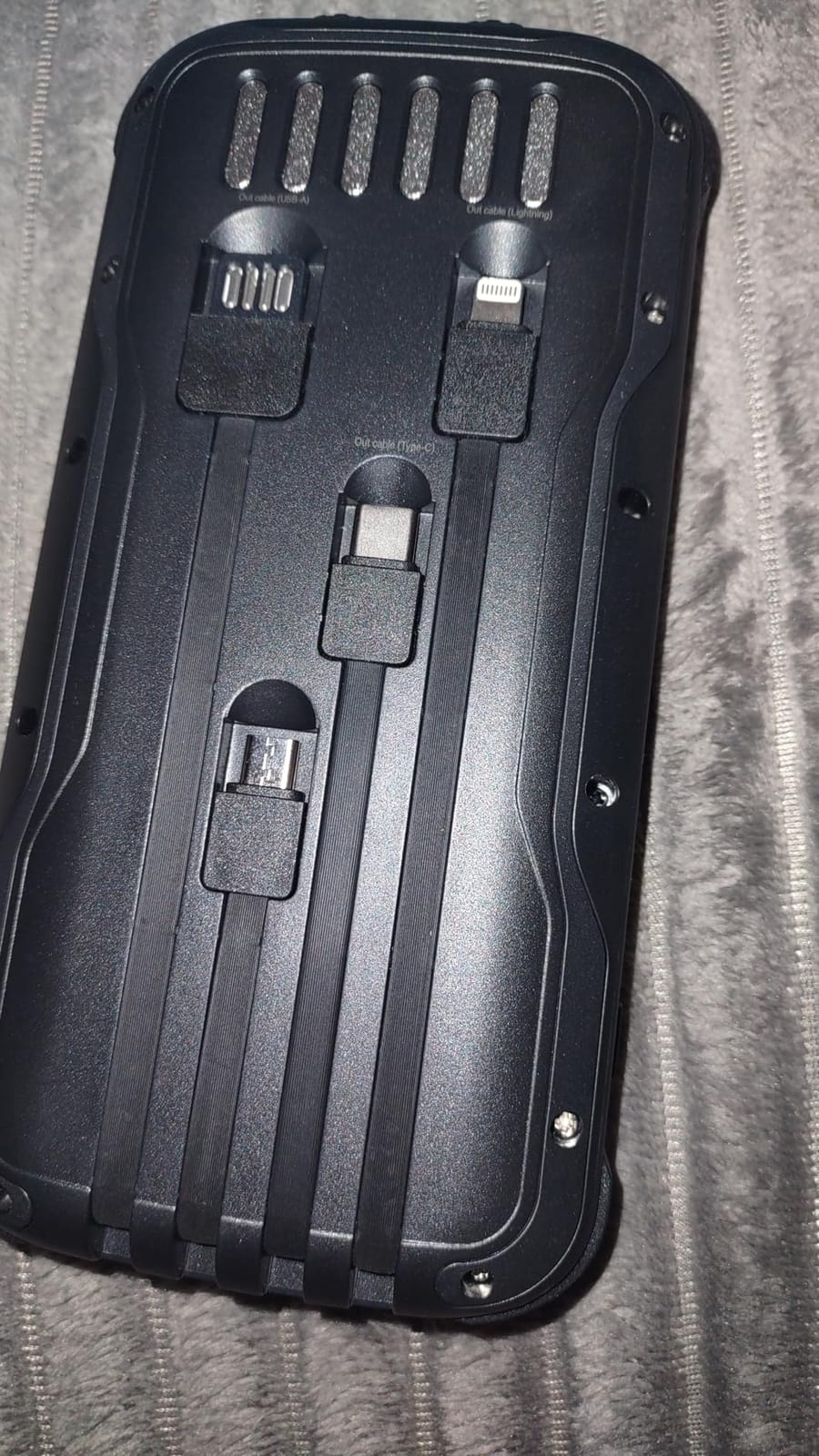
Bottom line: if your problem is arriving somewhere with no cables, this solves it completely. Four cables are built into the body, covering USB-C, Lightning, Micro USB and USB-A, so you can charge most devices without carrying a single cord in your bag.
The capacity is 20000mAh in a lithium-ion pack measuring 5.9 by 3.14 inches. With three ports alongside the built-in cables, buyers routinely run up to six devices at once, which is exactly the situation you hit in a shared flat when everyone wants to top up before a night out.
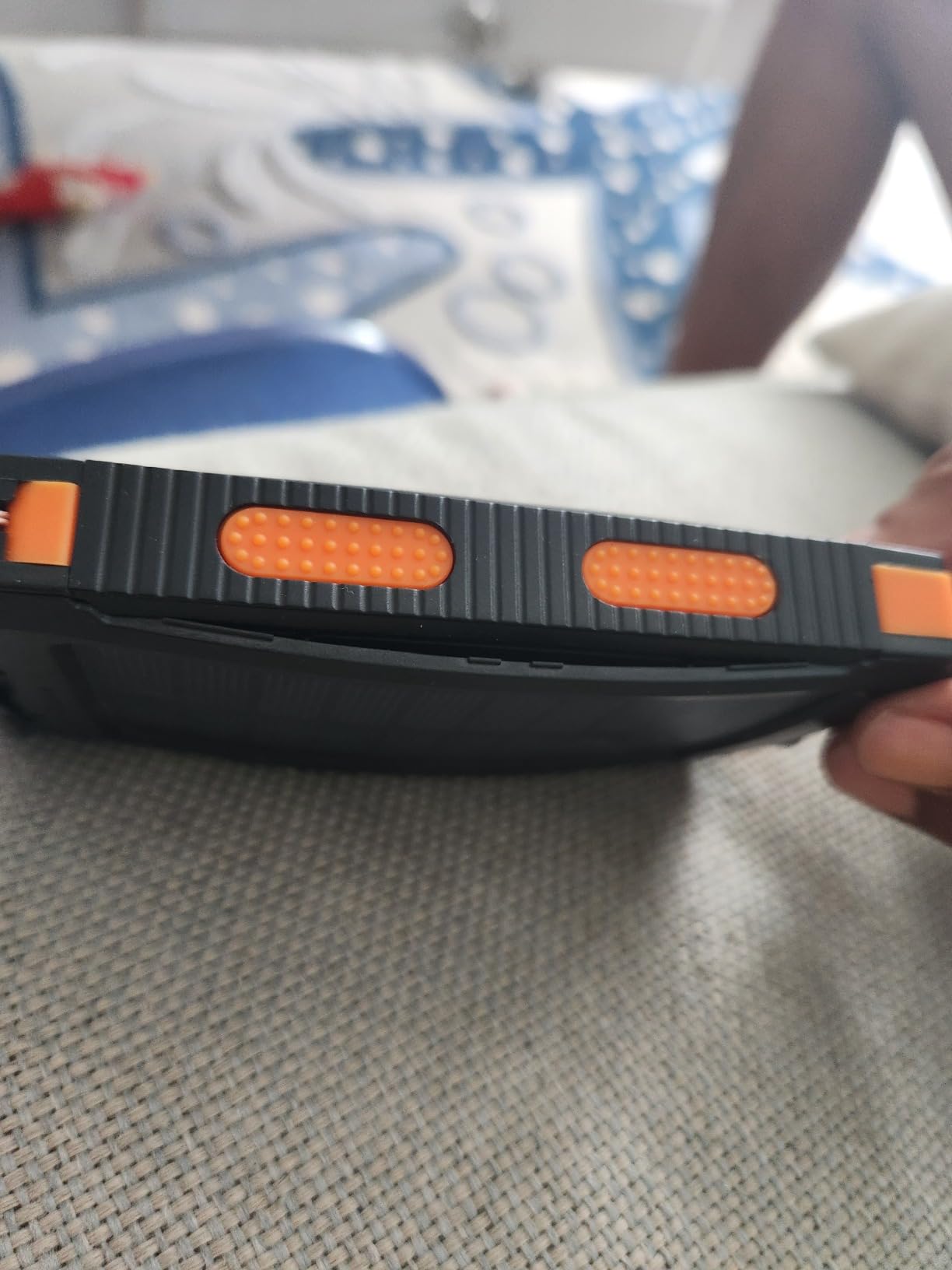
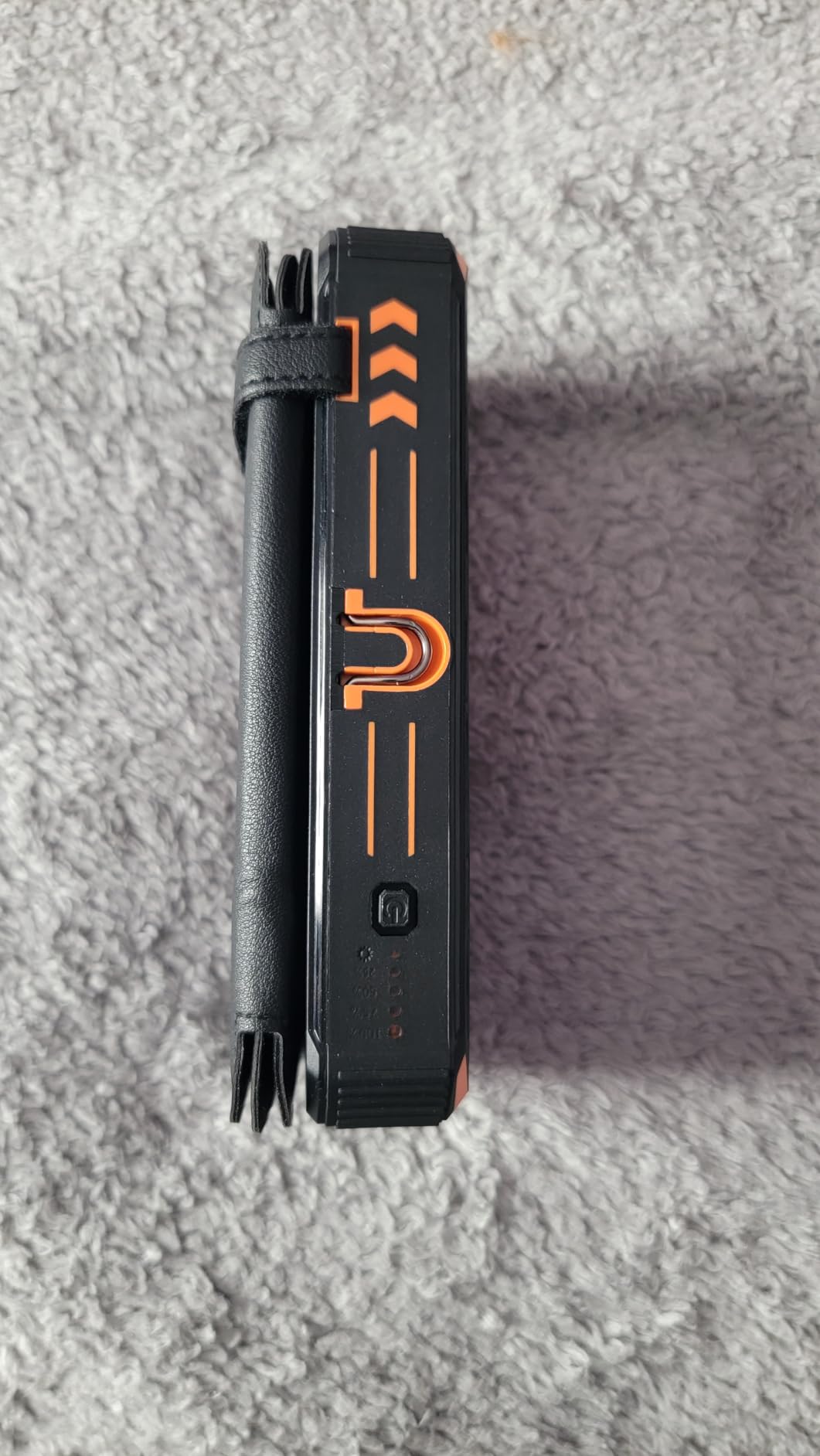
The light situation is unusually good. There are two LED lamps with steady, SOS and strobe modes, plus five battery status indicators, and the shell has thick silicone corner bumpers that survive being dropped on a dorm floor.
Two details worth knowing: the stated output is 2.4A, which is fine but not fast, and there is no wireless charging, so a Qi phone still needs a cable. The carabiner and compass come in the box, and the warranty is a limited twelve months.
Who this suits
Students living in shared accommodation will get more out of the built-in cables than most people, because the thing you forget in a hostel or a lecture hall is always a charging lead. Leaving them permanently attached means there is nothing to lose.
Two lights and a carabiner make it a reasonable grab-and-go item for night walks home or a late library session. Just set expectations about speed: 2.4A is a comfortable overnight top-up rather than a fast charge between sessions.
What to know before you buy
The 250 g weight is the trade-off for the extra capacity. That is not a phone-pocket charger, but it is still smaller than most textbooks and it clips to the outside of a bag.
As with every integrated panel at this size, the solar input is a trickle. The listing is described as solar powered, but the panel is a backup source. Recharge by cable before a trip and treat the sun as a safety net.
3. SOARAISE Solar Power Bank 48000mAh – Real Capacity in a Hand-Sized Body
SOARAISE Solar Power Bank 48000mAh Wireless Portable Charger with 4 Cables
48000mAh lithium-polymer,4 built-in solar panels
Wireless pad plus 4 cables
5V/3A USB-C output
6.38 by 3.43 inches
Pros
- Roughly 60 Wh of usable energy measured by buyers
- 4 cables and 3 ports charge up to 7 devices
- Reliable wireless pad cuts cable clutter
- Holds charge for long stretches as a dashcam source
Cons
- The 48000mAh figure is not backed by a watt-hour rating
- 4 panels only reach about half a full charge in good sun
- Bulky enough to be awkward in a pocket
- Needs a 5V or higher adapter to charge
Bottom line: this is the biggest energy store we found in a body you can still hold in one hand, and it is the pick for anyone going somewhere without a power outlet for several days. Buyers who measured it report roughly 60 watt-hours of usable output, which works out to about three and a half to four modern phone charges.
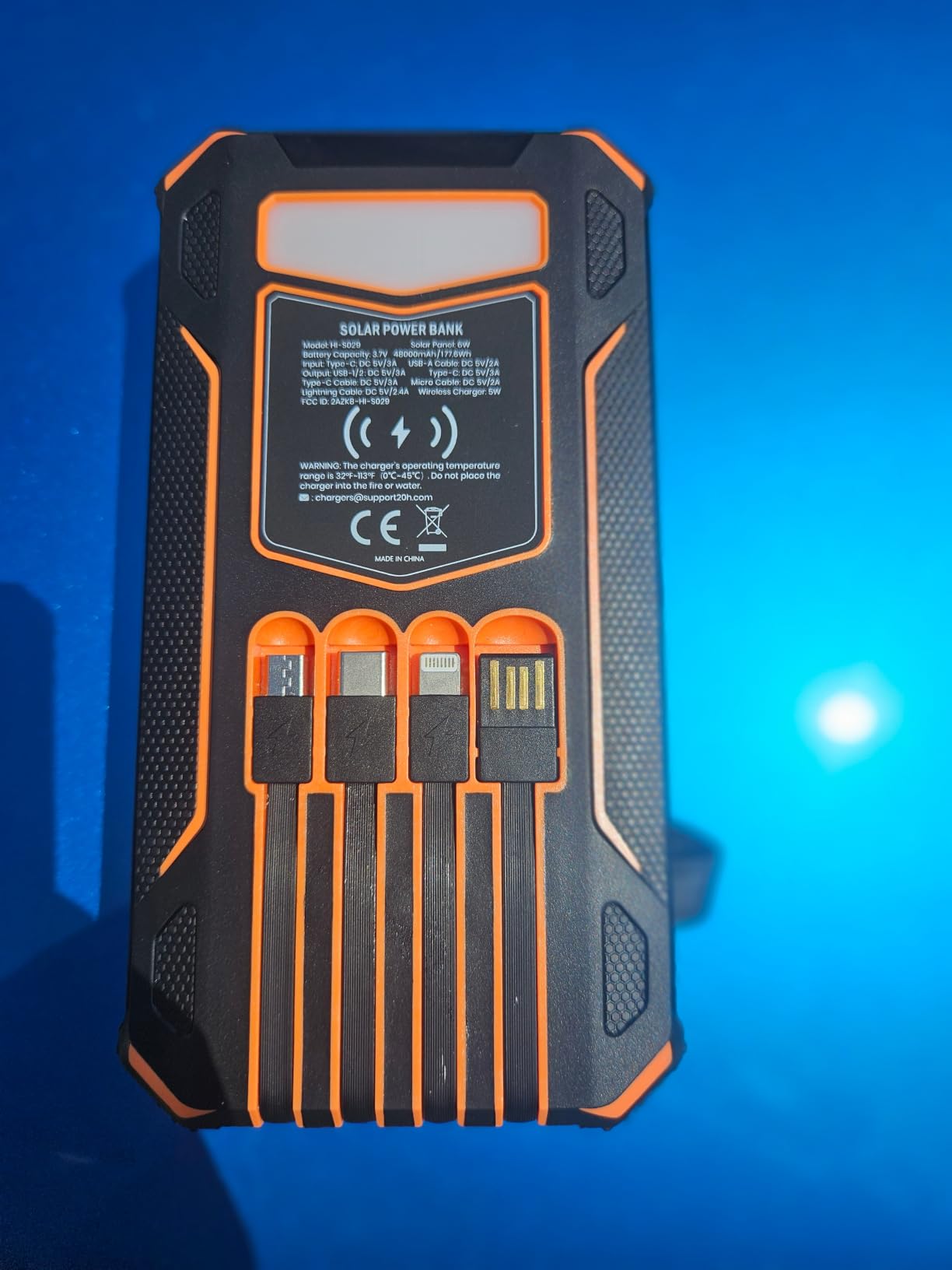
It is a strange-looking brick at 6.38 by 3.43 inches and close to a pound, but the top surface is covered by four solar panels rather than one, and the face carries four built-in cables, three ports and a Qi wireless pad. That combination can power up to seven devices at once.
Charging speed through the USB-C port is 5V and 3A, which buyers say takes an iPhone from 15 to 60 percent in half an hour. It also works as a long-running source for a dashcam or a Wi-Fi hotspot, which is a use case most people in this category never think about.
One caveat that catches people out: the unit needs an adapter supplying at least 5V. Plug it into a low-voltage source and the charge stalls around the halfway mark, which reads as a fault if you do not know the cause.
What makes the capacity worth carrying
On a study abroad trip, a week-long hiking route or a festival weekend, the math is what matters. A 48000mAh pack covers four phones in reserve, so nobody in the group is negotiating over the one cable in a tent at midnight.
The four panels are a larger solar array than most units here, but even so buyers report topping out near half a charge in ordinary sun. That is still far more than a single-panel bank manages, and it is enough to add a call in an emergency.
Where the spec sheet misleads
The headline number is milliamp-hours without a watt-hour figure, and a few buyers flag the mismatch. Real capacity is closer to 60 Wh than to the 48 number times 3.7 volts suggests, so size your expectations on measured output rather than the label.
The weight is the other issue. At around a pound this is not a pocket item, and anyone who needs daily top-ups for a phone alone is carrying more battery than they need to.
4. BLAVOR Solar Power Bank 20000mAh – Wireless Charging for Phones and Apple Watch
BLAVOR Solar Power Bank 20000mAh, Wireless Charger for Phones & Apple Watch
20000mAh with 20W USB-C output
Qi pad for phones and Apple Watch
4 cables plus 3 ports
Compass and thermometer
Pros
- Wireless area covers both phones and Apple Watch
- 4 built-in cables and 3 ports run 6 devices
- 20W USB-C gives several full phone charges
- Compass
- thermometer
- 3-mode flashlight and camping light
Cons
- Heaviest of the compact group at 0.78 kg
- Built-in cables are short so the pack often gets held in the hand
- Apple Watch charging is inconsistent with no clear indicator
- Earlier BLAVOR models bulged after heavy daily use in direct sun
Bottom line: this is the feature-richest unit in the group and one of the few with a dedicated charging area for an Apple Watch alongside the phone pad. For anyone travelling with a watch, that removes a whole category of anxiety about arriving with a dead wrist and a dead phone.
Capacity is 20000mAh with a 20W USB-C output rated at 20 watts, plus four built-in cables and three ports for up to six devices. The extra tools are extensive: a three-mode flashlight, a three-level camping light, a compass, a physical thermometer and a red indicator light, all in a shell described as waterproof, shockproof and dustproof.
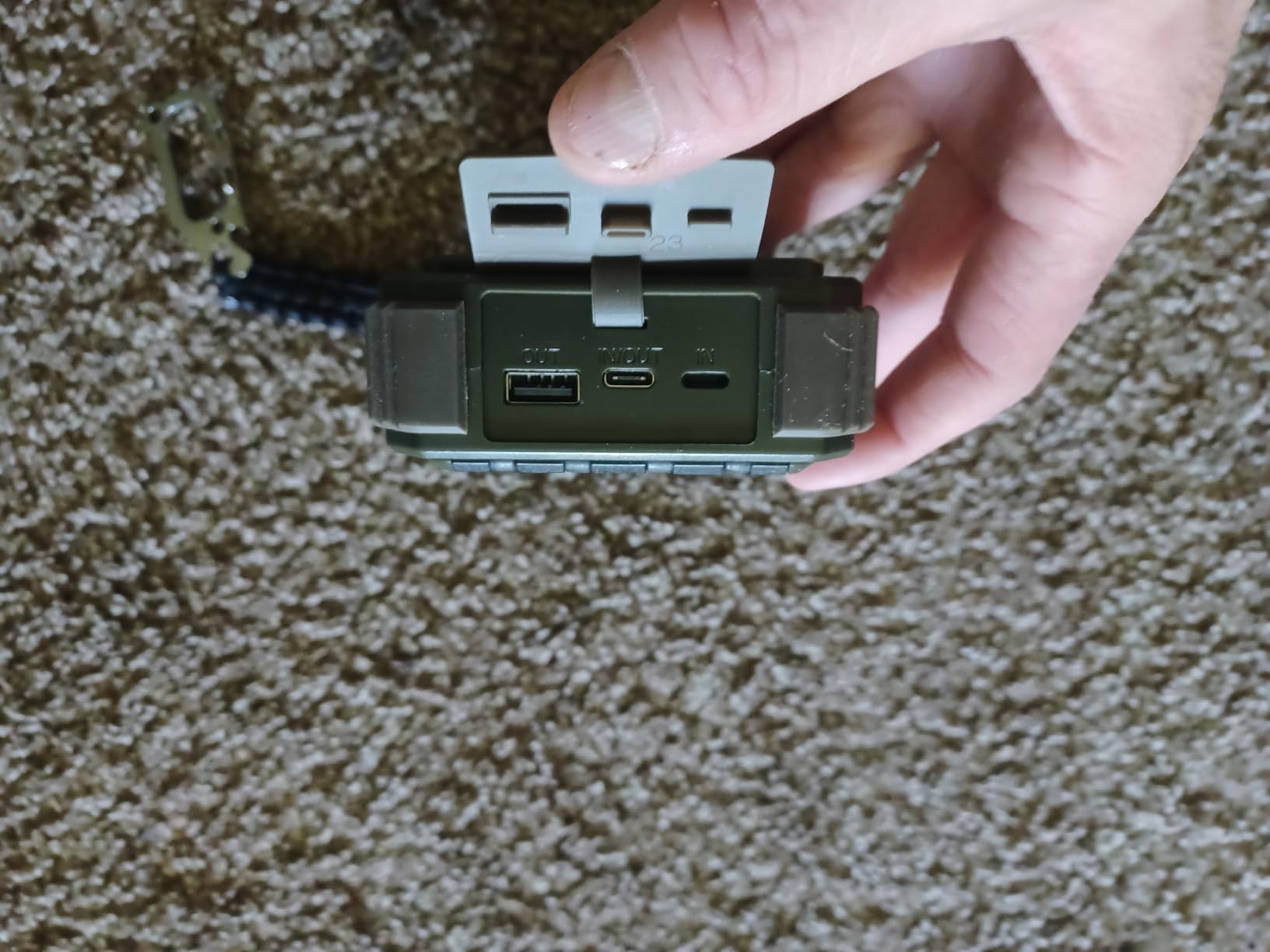
Protection circuitry covers overcharge, over-discharge, over-current and short circuit, and buyers repeatedly mention responsive customer support. The 4.3 average rating comes with a 71 percent five-star share, which is a strong consistency signal for a pack in this class.
Two practical notes. The built-in cables are on the short side, so in practice you often hold the pack in your hand while your phone charges. And the Apple Watch pad is inconsistent, with no light confirming that the watch has actually picked up the charge.
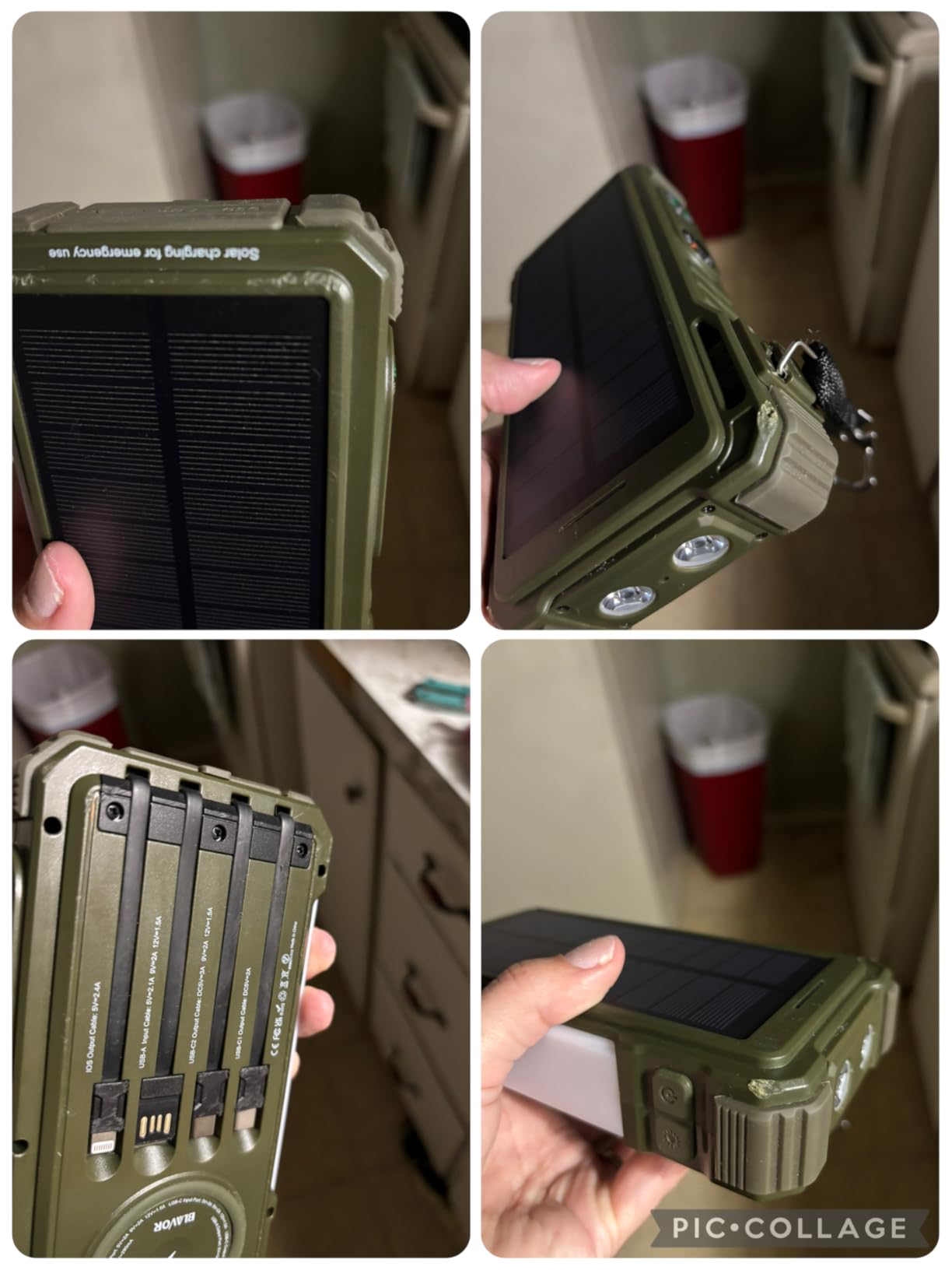
What the feature set actually buys you
For a study abroad traveller, the compass, thermometer and three-level camping light are not gimmicks. They are three functions you would otherwise carry separately, packed into one object that fits in a laptop sleeve.
The 20W output also means this is not limited to phones. It comfortably handles earbuds, a handheld console, an e-reader and a watch, which covers nearly every device a student owns.
What to watch out for
At 0.78 kg it is heavy, and several buyers describe it bluntly as a brick. If you are walking between classes all day, weight matters more than any feature on the casing.
There is also a documented caution: earlier BLAVOR units developed bulging batteries after heavy daily use in direct sun. The panel on this model is a top-up feature, and charging the pack by cable away from direct sun is the safer habit.
5. GOODaaa Solar Power Bank 24000mAh – The Best-Rated Pick
GOODaaa Solar Power Bank 24000mAh, Portable Charger with 4 Built-in Cables
24000mAh lithium-polymer cell
5 outputs and 3 inputs
3 integrated output cables
420 g, drop-proof ABS
Pros
- 4.4 average rating with a 73 percent five-star share
- Three integrated cables plus USB-A input
- Real capacity near 3.5 iPhone charges or 1.8 iPad charges
- Built-in thermometer with no power draw
- Steady
- strobe and SOS light modes
Cons
- Solar adds only a partial charge over a full day of sun
- Wall recharge is slow
- Heavier and larger than most 24000mAh rivals
- Thin instructions and no app
- Some buyers report capacity fading after a year to a year and a half
Bottom line: this is one of the two best-rated products we looked at, and the reasons are unglamorous and useful. Five outputs, three inputs, three integrated cables and real capacity of roughly three and a half iPhone charges or 1.8 iPad charges.
It is a chunky pack at 7 by 3.5 by 1.3 inches and 420 grams, with a drop-resistant ABS body, thick silicone corner bumpers and sealed port covers. Multiple input options mean you can still recharge it by cable if a connector is lost, which is a small thing that prevents a very annoying one.
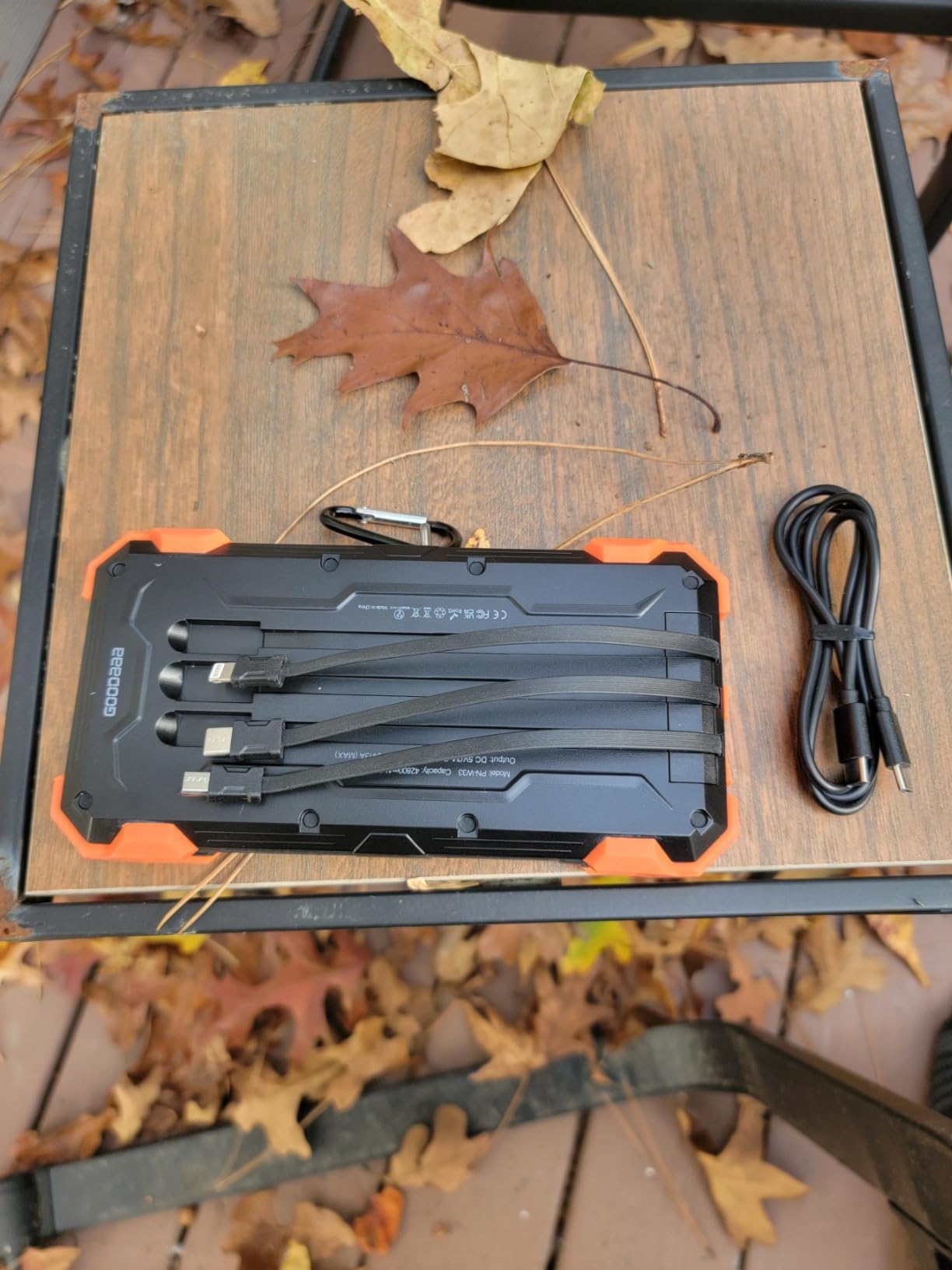
The built-in thermometer is unusual and costs no power, so it stays on in a backpack without draining anything. Two LED flashlights cover steady, strobe and SOS modes, and a carabiner is included for clipping to a pack.
Real capacity is the standout. Buyers consistently report about three and a half iPhone charges rather than the one charge that headline milliamp-hour figures often translate to in practice.
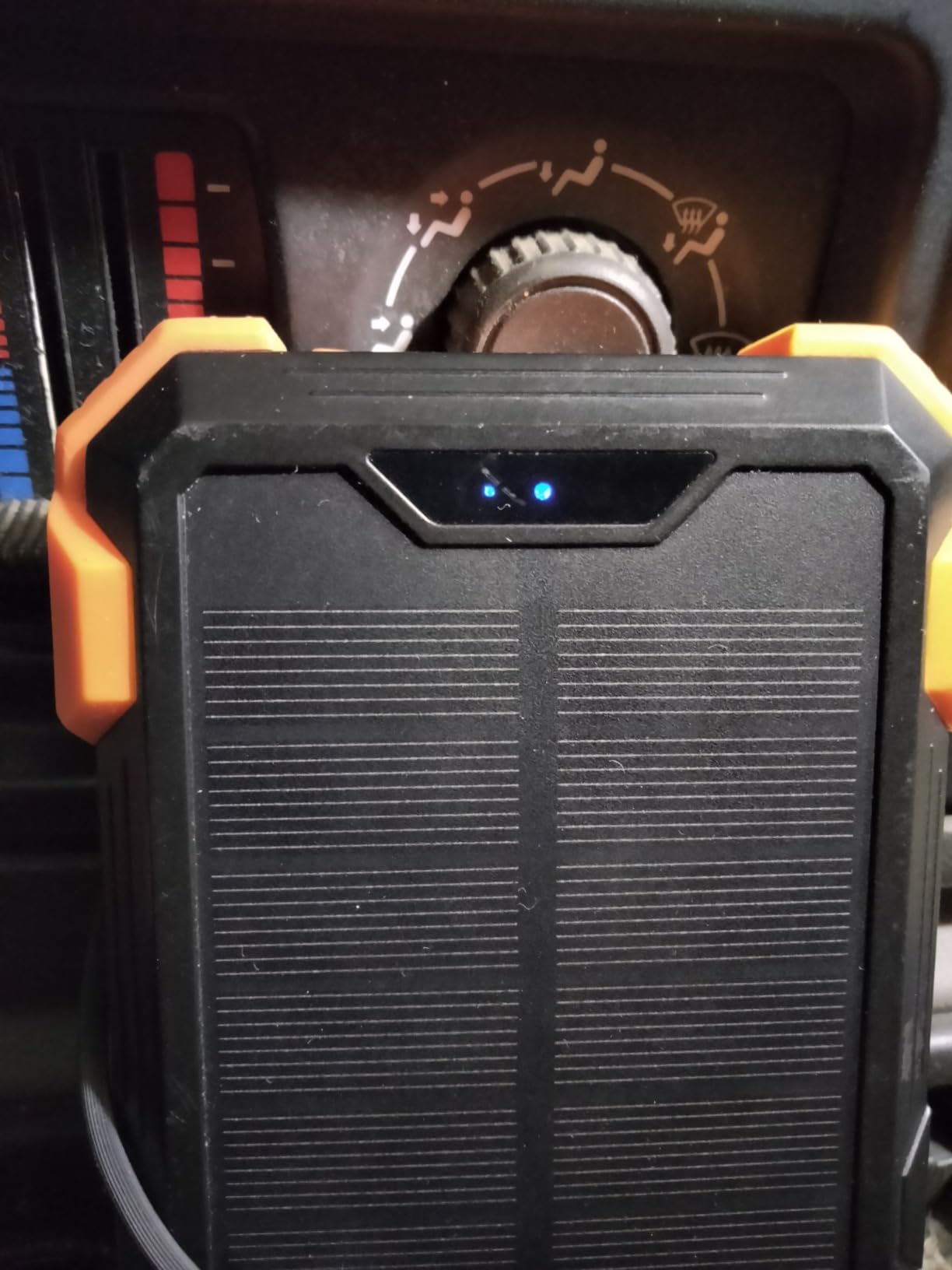
Why the rating is so strong
Long review histories tend to be kinder, and this one goes back a long way. A 4.4 average with a 73 percent five-star share means the small disappointments are the same ones everyone in this category has, rather than a new surprise each month.
For a student who wants one charger that covers a phone, earbuds, a watch and a partner’s phone, five outputs means nobody is unplugging anyone else. That social argument matters more than the wattage.
The trade-offs to plan around
Recharge time is the honest weakness. Buyers report slow wall charging even with help from a large solar battery, and the solar panel itself only adds a partial charge over a full day of sun.
There is no app for monitoring charge state and the instructions are thin, so learn the indicator lights before you need them. A few owners also report capacity declining after a year or eighteen months of daily use, so treat it as a replace-every-couple-of-years tool rather than a lifetime purchase.
6. FEELLE Solar Power Bank 50000mAh – Magnetic Charging and a Hand Crank
FEELLE Solar Power Bank 50000mAh Magnetic Portable Charger with Hand Crank
50000mAh lithium-polymer cell
15W magnetic wireless charging
Hand-crank generator and compass
0.5 kg, 3 year warranty
Pros
- 15W magnetic pad self-aligns the phone for iPhone 12 to 17 series
- Four cables and 3 ports run up to 6 devices
- 3A USB-C takes an iPhone from 0 to 60 percent in 30 minutes
- Hand crank gives a genuine last-resort option
- Built-in high-precision compass
Cons
- Weighs 0.5 kg and is nearly 2 inches thick
- Magnetic efficiency drops with thick cases
- High mAh rating does not translate proportionally to charges
- Thinner review history at roughly 1355 reviews
Bottom line: the hand crank is what makes this one unusual. If you are building a dorm emergency kit or a go-bag, a generator that produces charge with no wall, no sun and no cable is a genuinely different backup from a battery that depends on all three.
Nominal capacity is 50000mAh in a lithium-polymer pack measuring 7.24 by 3.54 inches. Four built-in cables and three ports run up to six devices, and the 3.0A USB-C output takes an iPhone from zero to 60 percent in about half an hour.
The magnetic wireless pad is 15W and self-aligns the phone, working with the iPhone 12 through 17 series. That removes the alignment guesswork that trips people up on other Qi pads, which matters when you are fumbling in the dark in a stairwell.
Four redesigned solar panels, a high-precision compass, a three-mode LED flashlight, shockproof silicone corners and a three-year warranty round out a pack that is clearly aimed at emergency preparation rather than daily commute.
Where a hand crank earns its place
Think about what fails in a campus emergency. The grid goes out, and the router and library Wi-Fi go with it. A hand crank works with no infrastructure at all, and it needs neither sunlight nor a socket, which makes it the one input here that survives a long outage.
It is not a substitute for a battery, and the listing treats it that way. But as the last tier below solar and wall power, it is a real option rather than a novelty.
What the capacity claim is worth
As with every high-milliamphour pack here, the headline figure overstates what you get. Buyers note that the mAh rating does not translate proportionally into full phone charges, and the magnetic pad loses efficiency through a thick case. A magnetic case under 3mm is recommended if you plan to use wireless.
At half a kilogram and nearly two inches thick, this is a kit item you leave in a drawer, not something you carry every day. Paired with the DJKK unit further down, you have two credible options for a genuine dorm emergency setup.
7. Luvknit Solar Power Bank 20000mAh – A Lightweight Daily Carry
Solar Power Bank 20000mAh with USB-C, Portable Charger for Travel Camping
20000mAh under 100Wh,TSA carry-on friendly
15W USB-C plus USB-A
IP65 water-resistant shell
0.52 lb, 24 month warranty
Pros
- Light and about the size of a cell phone
- IP65 shell survived repeated drops without scratches
- 15W USB-C takes an iPhone 15 from 15 to 65 percent in 30 minutes
- Three-mode flashlight
- Under 100Wh so it is TSA approved
Cons
- Solar panel is explicitly an emergency trickle only
- Capacity drains in about two days of full use
- Some reports of ports loosening or failing after months
- Fewer outputs and no built-in cables
Bottom line: at 0.52 lb and roughly 5.6 by 2.9 inches, this is the one to carry every day if you refuse to carry a brick. The form factor is closer to a large phone than to most solar power banks, and the shell has an IP65 rating that held up through repeated drops in buyer testing.
Wired performance is genuinely good for the size. The 15W USB-C output takes an iPhone 15 from 15 to 60-something percent in half an hour, and a USB-A port means you can run two devices at once. A three-mode flashlight covers strong, strobe and SOS.
The selling point for anyone flying anywhere is the capacity. At 20000mAh it sits under 100 watt-hours, which is the threshold that keeps it in your carry-on rather than checked luggage, and that is a detail that trips up far too many travellers.
What works well day to day
Two devices at once, a 15W port and a real IP65 shell is a solid daily carry. Overcharge and short-circuit protection are built in, and the warranty is 24 months with a refund window inside 30 days and replacement inside 60 days.
It also has wireless charging listed under the Qi standard, which is a bonus at this weight if your phone supports it.
Where it runs out
Capacity is the limit, not the panel. Buyers report that a full day of heavy use without a wall charger empties it in about two days, so it is a daily top-up tool rather than an off-grid one.
Durability feedback is mixed at the ports. A few owners report a USB port failing or loosening after months, and there are fewer outputs and no built-in cables here, so you do need to carry a lead.
8. MINRISE Solar Power Bank 40000mAh – 20W PD and a 25-Hour Flashlight
MINRISE Solar Power Bank 40000mAh, Portable Charger PD 20W Fast Charging
40000mAh lithium-polymer cell
20W PD USB-C output
4 built-in cables, 9 charging methods
1.1 lb, 1.8W solar panel
Pros
- 40000mAh without a size or weight penalty
- 20W PD takes an iPhone 15 from 15 to 65 percent in 30 minutes
- Four built-in cables plus 5 outputs and 4 inputs
- Flashlights reach 165 ft and run up to 25 hours
- Smart protection IC with overcharge and short-circuit cutoffs
Cons
- 1.1 lb is heavy for the capacity
- Solar panel is only 1.8W and strictly for emergencies
- Full recharge takes about 6 hours
- Indicator lights are ambiguous about remaining charge
Bottom line: the flashlight is the standout here, not the solar. Two super-bright LEDs reach roughly 165 feet and run for up to 25 hours, which turns the pack into a genuine piece of emergency equipment rather than an oversized battery with a panel on it.
Capacity is 40000mAh in a 6.67 by 3.35 inch body, and the 20W PD USB-C output is among the faster in this group, moving an iPhone 15 from 15 to 65 percent in half an hour. Four built-in cables combine with five outputs and four inputs for nine charging methods in total.
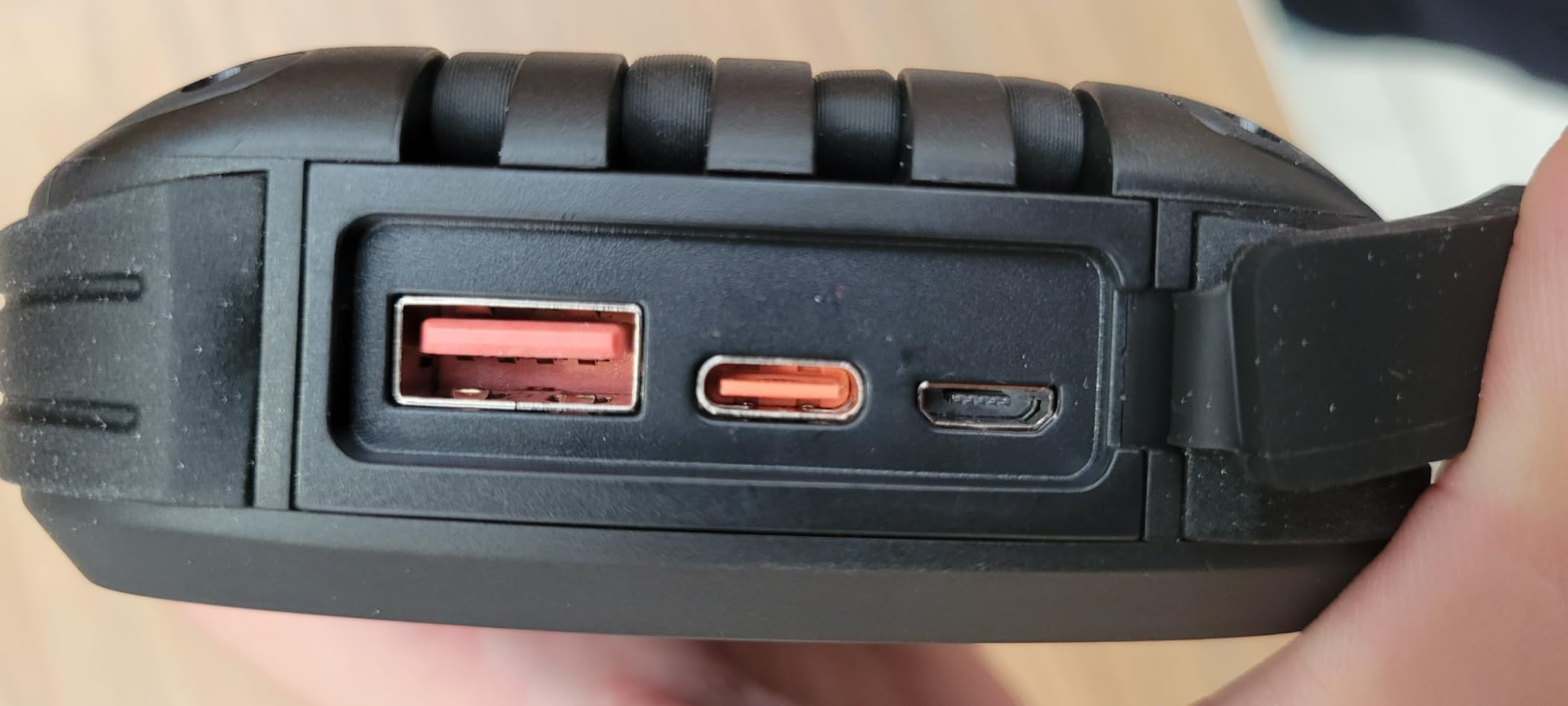
Protection is handled by a smart protection IC alongside overcharge and short-circuit cutoffs, and the body is ABS with anti-fall thick silicone corners and covered ports for drop, dust and water resistance. Support is available around the clock according to the listing.
It is 1.1 lb, which is real weight for a backpack. The people who carry this one are carrying it as a weekend kit rather than a daily charger, and the flashlight is the reason it earns its place.
Why the light matters more than the panel
A 1.8W panel is a token input. Even so, the listing treats it as an emergency backup rather than a charging method, which is the honest framing. In a power cut, a flashlight that runs for 25 hours is worth considerably more than a few extra percent of battery.
For students in halls with unreliable heating and lighting in winter, or for anyone walking home along unlit paths, the two-mode beam covering 165 feet covers a real need that a phone screen does not.
Plan around the weight and the recharge
A full recharge takes about six hours, so charge it overnight and treat the indicator lights as approximate rather than precise. Several owners find the four-light display ambiguous about how much charge remains.
Nine charging methods and four built-in cables is genuinely useful in a shared flat, but at 1.1 lb this is a pack for a car, a tent or a drawer rather than a day on campus.
9. Nuynix Solar Power Bank 49800mAh – Capacity Without the Premium
Nuynix 49800mAh Solar Power Bank with 15W Fast Charging & USB Charging
49800mAh lithium-polymer cell
15W USB-C fast charging
3 ports for multiple devices
Rugged housing, 12 month warranty
Pros
- Very high 49800mAh capacity
- 15W USB-C plus multiple USB ports for simultaneous charging
- Buyers report about 2.5 Galaxy S22i charges
- Rugged water
- dust and impact resistant housing
- Bright multi-mode LED flashlight
- Carabiner included
Cons
- No wall charger included
- Very slow solar input
- Long wall recharge time
- Some units stopped working after about 90 days
- Ports can loosen and the housing is easy to disassemble
Bottom line: the capacity-to-cost ratio here is hard to argue with, and the caveat is that you supply your own wall charger. Buyers who keep it plugged in overnight rate it highly, and the measured figure is around two and a half full Galaxy S22i charges.
The 15W USB-C output and the additional USB ports handle simultaneous device charging, and the housing is described as resistant to water, dust and impacts. A bright multi-mode LED flashlight and a carabiner are included, alongside overcharge protection and a twelve-month limited warranty.
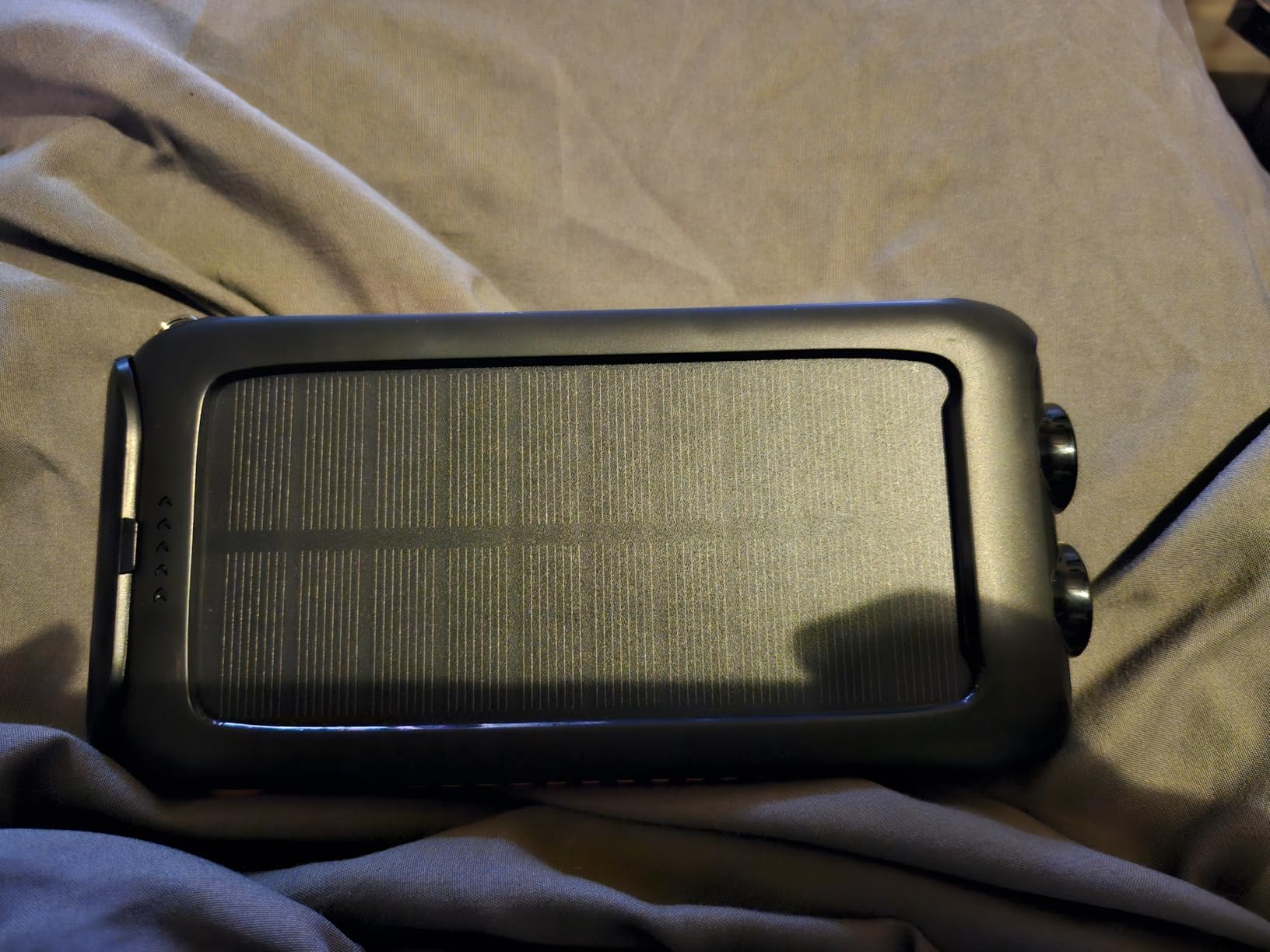
What makes this interesting for a student budget is the scale of the number. 49800mAh in a 7 by 3.4 by 1.2 inch body is a lot of stored energy for the money, and the alternative is carrying two smaller packs.
Buyers also note a charging rate of roughly one percent of phone battery per minute, which is a useful way to think about whether the pack will last through a long study day away from a socket.
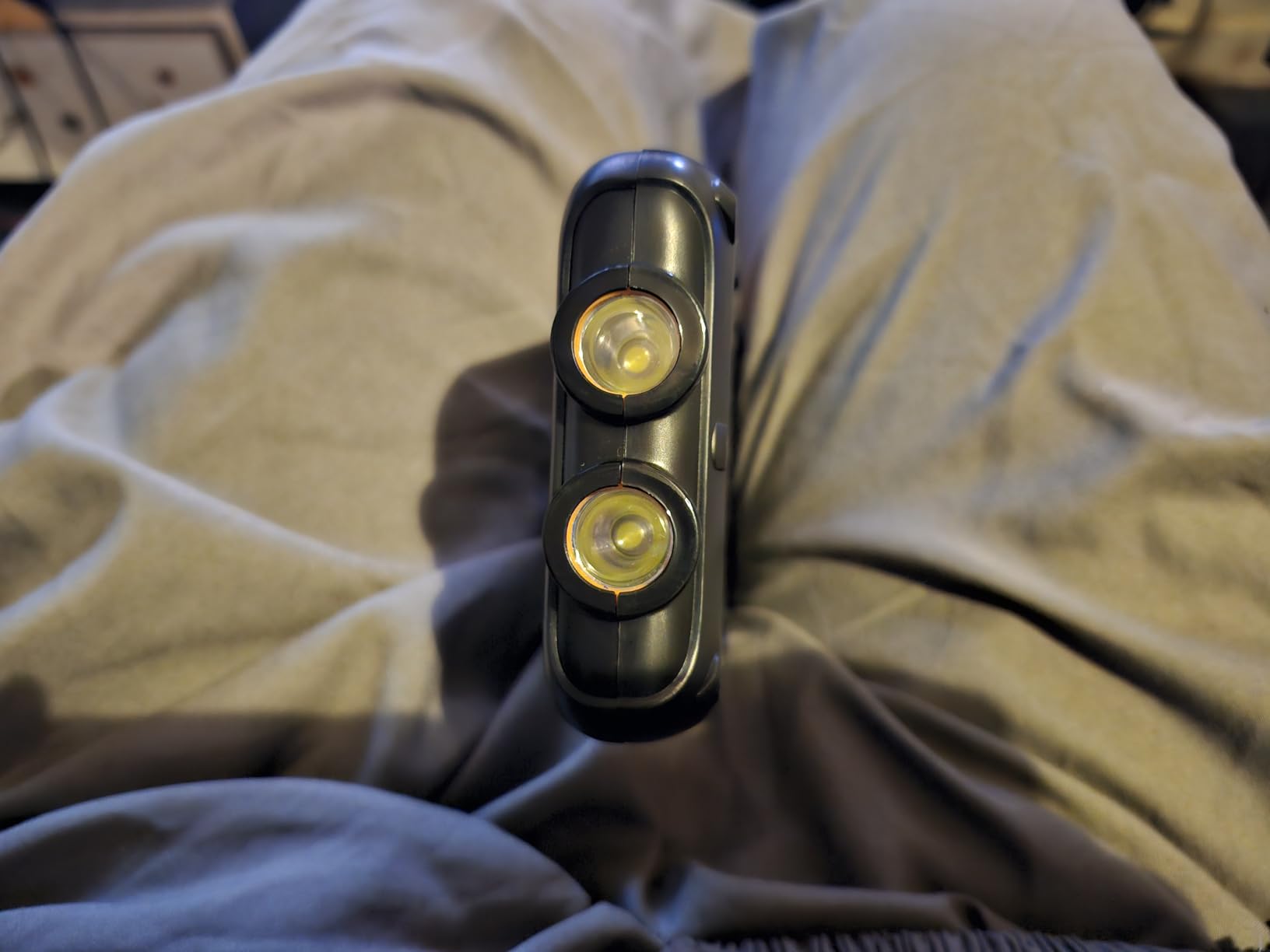
What you get for the money
If your plan is a shared trip, a festival weekend or an outage kit for a house with several people, capacity is the whole point and this delivers it. One pack replacing three smaller ones in a bag is a real saving in space.
Do plan on owning a USB wall adapter. The omission is a common complaint and it is easily solved with something most rooms already have.
What the reviews flag
Durability is inconsistent, and a number of owners report models that stopped working after about 90 days. Ports loosening or jamming is also mentioned, and the housing is easy to take apart, which makes field repair impractical.
Solar input is very slow, so this is a wall-charged battery with a panel attached. If the plan depends on the sun doing real work, look at the four-panel BLAVOR later in this list instead.
10. Uukto Solar Power Bank 20000mAh – Built for a Dorm Kit
Uukto Solar Charger Power Bank 20000mAh Fast Battery Pack for Cell Phones
20000mAh lithium-polymer cell
3 built-in cables and 3 ports
Camping light plus 2 flashlights
2 year warranty, IP-rated shell
Pros
- Three built-in cables and 3 ports charge up to 5 devices
- Bright camping light plus two flashlights with SOS and strobe
- Waterproof
- shockproof and dustproof fire-proof PVC shell
- USB-C works as both input and output
- Two year warranty with lifetime support
Cons
- Bulky for its 20000mAh capacity
- Built-in cables are short
- Solar panel is a trickle rather than a recharge
- Occasional reports of units that stop charging after a few months
Bottom line: the 4.4 average rating here matches the best in the group, and the reason is the light. A large camping light plus two multi-mode flashlights is exactly what a residence hall corridor needs at eleven at night, and the three built-in cables mean nothing to lose in a shared kitchen drawer.
Capacity is 20000mAh and the body holds three built-in cables alongside three output ports, charging up to five devices at once. The USB-C port works as both input and output, so one cable does everything.
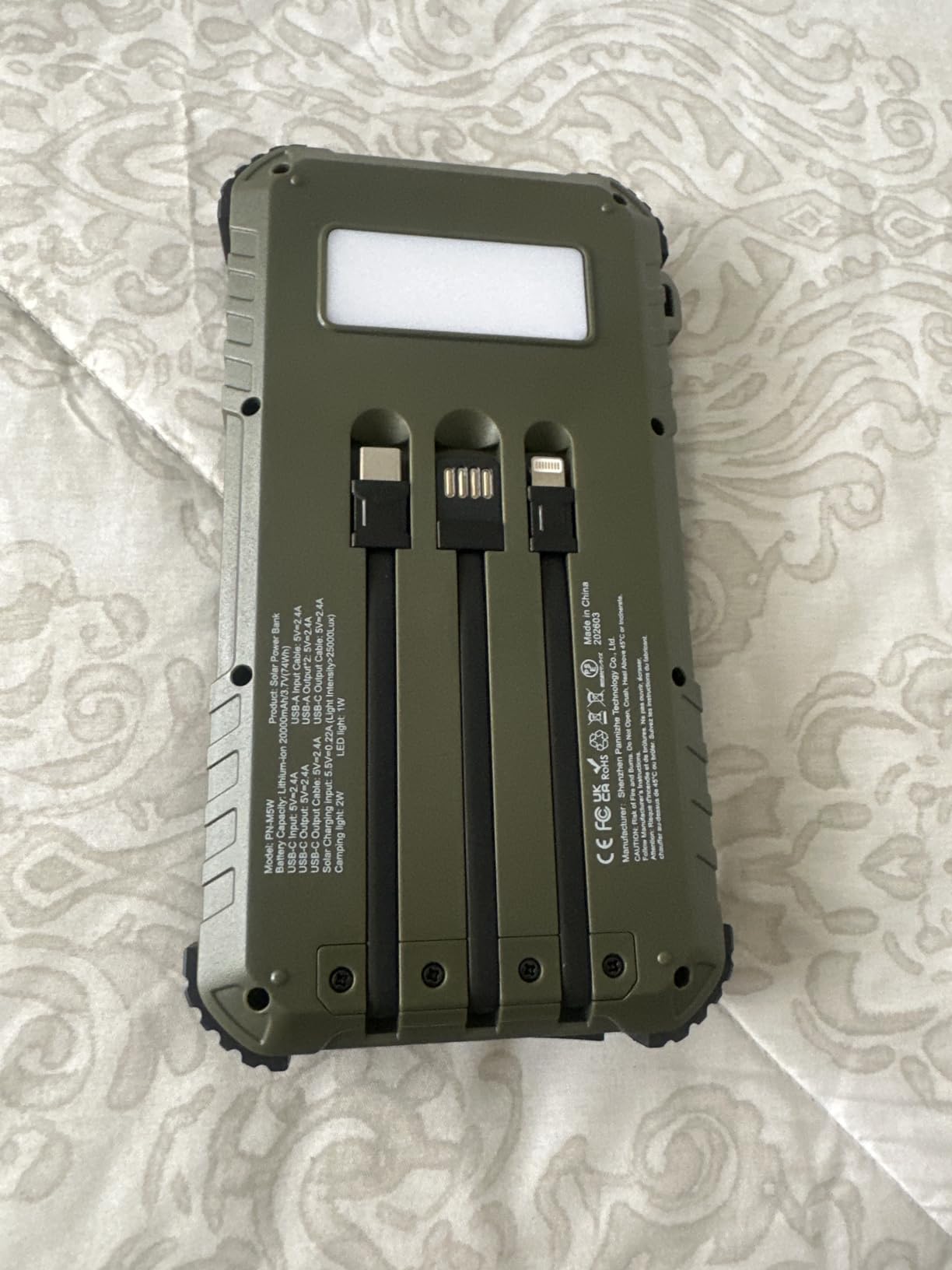
Protection is stated for overcharge, short circuit and overheating, and the fire-resistant PVC shell is described as waterproof, shockproof and dustproof. The warranty runs two years with lifetime customer support behind it.
It weighs 503.8 g and measures 6.97 by 3.74 inches, which is on the heavy side for 20000mAh. The three built-in cables are also on the short side, so expect to hold the pack while your phone charges.
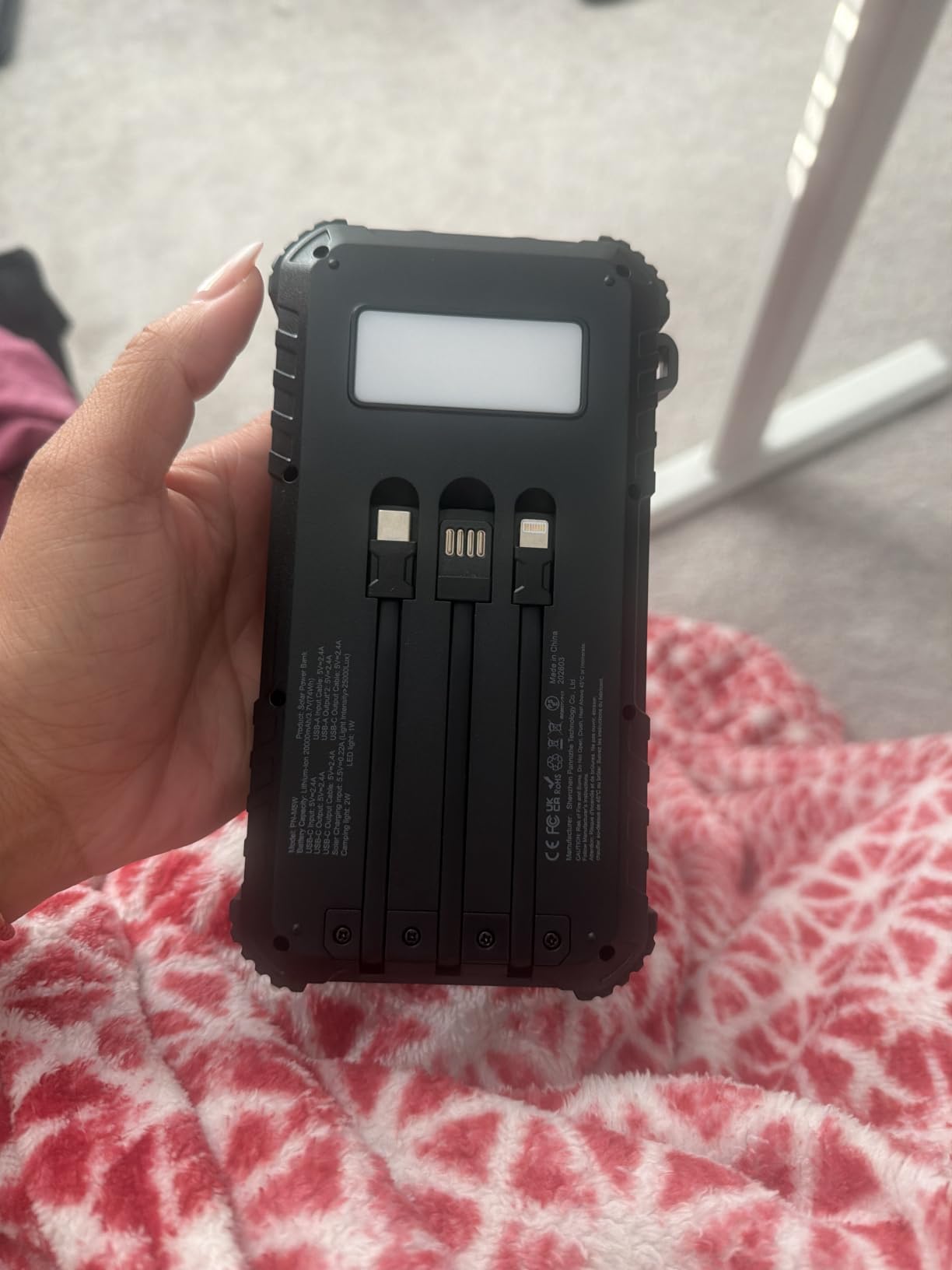
What makes it a dorm-specific choice
Everything on this unit maps to a shared-building problem. The camping light covers a corridor or a stairwell, the cables cover a flat where everyone forgets a lead, and the two-year warranty covers a charger that gets knocked about in a communal kitchen drawer.
Compatibility is broad as well, with the listing naming phones, tablets, earbuds, watches, cameras, e-readers and game consoles, which covers essentially everything a student carries.
What to keep in mind
There is a small minority of reports of models that stop charging after a few months, so keep a cable-based backup if you depend on it. The rating reflects the majority experience, not every one.
The solar panel is a trickle charge, and with a 20000mAh cell you should charge this by cable before a trip rather than trusting a day of sun.
11. DJKK Solar Power Bank 66800mAh – The One That Works as a Lamp
Solar Power Bank Portable Charger 66800mAh Battery Pack for Camping
66800mAh lithium-polymer cell
22.5W USB-A2 and PD 20W on Type-C
4 ports plus 2 built-in cables
IP67 housing, hand crank
Pros
- Very high 66800mAh capacity replaces several smaller packs
- 22.5W on USB-A2 and PD 20W on the built-in Type-C cable
- Four ports and 2 cables charge up to 5 devices
- Works as a desk lamp
- hanging lantern and flashlight with 100+ hours of light
- Hand crank and solar add emergency input options
Cons
- Weighs about 1.6 lb
- Hand crank and solar produce very little charge
- Needs a full charge before first use and monthly topping up
Bottom line: this carries the highest stated capacity in the list and it doubles as a reading light, a hanging lantern and general illumination. With more than 100 hours of light and a 1.6 lb weight, it is a piece of equipment rather than a pocket accessory.
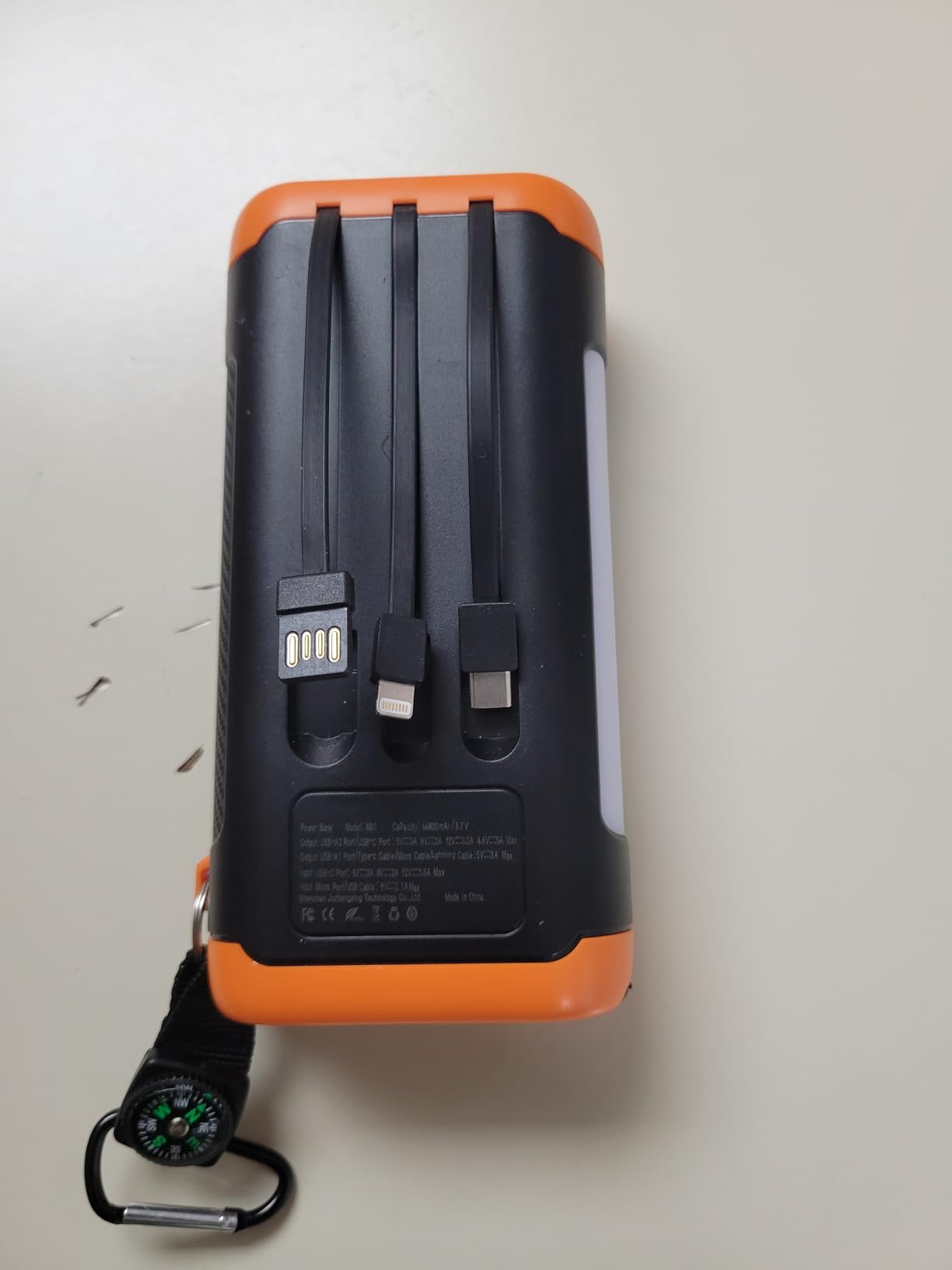
Capacity is 66800mAh across three lithium-polymer cells in a 6.9 by 3.4 by 1.8 inch body. Four ports, including a USB-A2 that outputs 22.5W, plus two built-in cables let it charge up to five devices at once, with PD 20W on the built-in Type-C lead.
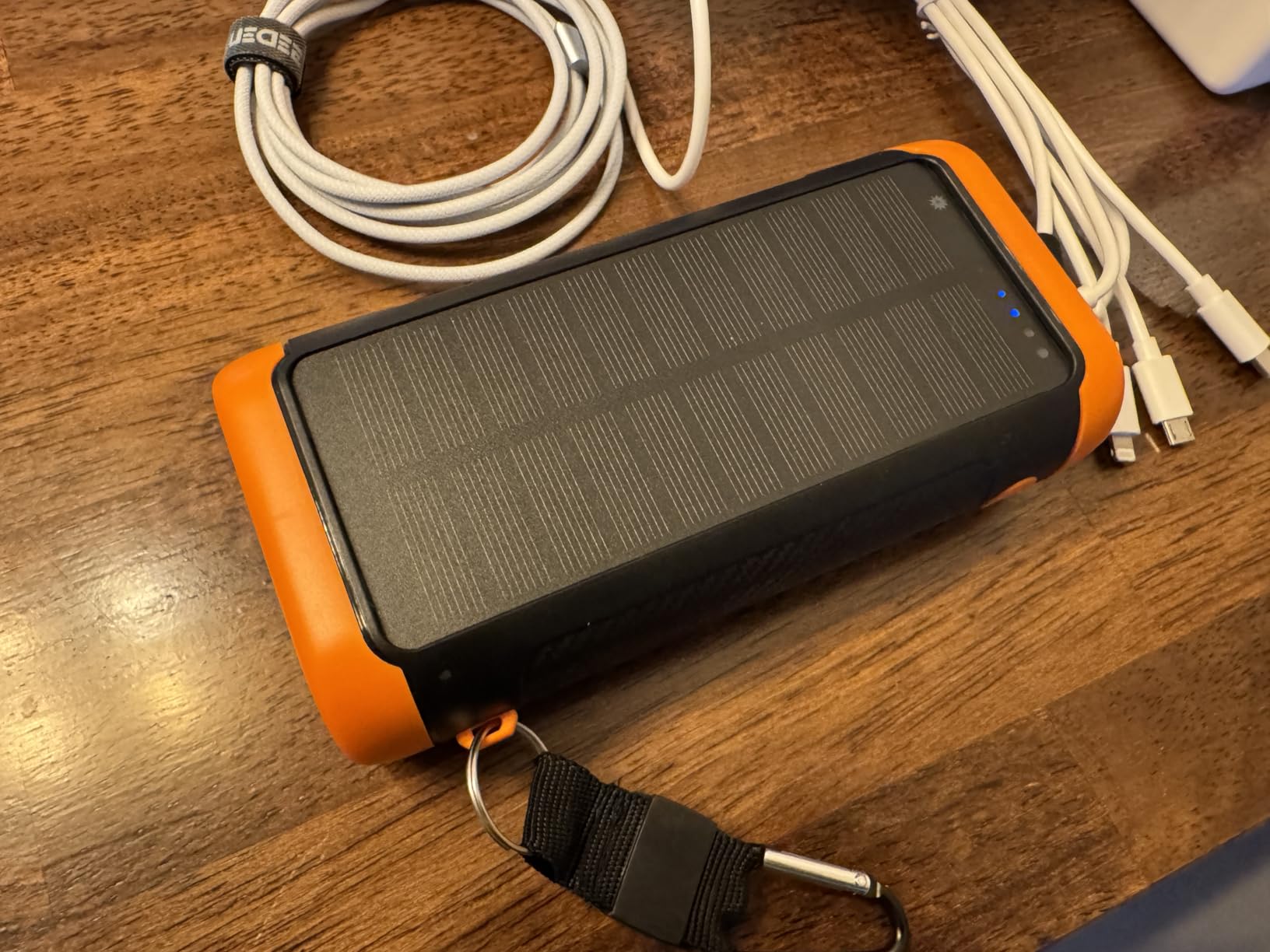
The lighting side is what separates it. Buyers describe it working as a bedside reading light, a lantern hung from a tent pole, and a reliable source during a power cut, with the hand crank and solar panel sitting underneath as emergency inputs.
The shell is IP67 waterproof, dropproof and dustproof ABS, and the listing notes the pack passes UN38.3, UL 2056 and MSDS safety certification. A compass carabiner and a USB-C cable come in the box.
When 66800mAh is the right amount
Picture a house of four students through a two-day outage, or a camping trip where nobody wants to ration a phone. At this capacity one pack covers every device in the group, which removes the negotiation entirely.
It can also support 12V equipment according to the listing, which widens its use beyond phones for anyone who wants to run a small fan during a heatwave.
What the care requirements are
It is heavy at about 1.6 lb, so it belongs in a car, a tent or a hall cupboard rather than a backpack you carry all day. Plan on a full charge before first use.
The listing also recommends charging it once a month during long storage to hold around 50 percent, which is a sensible habit for any lithium pack kept in a cupboard between terms. Hand crank and solar add a trickle only, so treat them as last-resort inputs.
12. BLAVOR Solar Power Bank 20000mAh with 4 Foldable Panels – Real Solar Input
BLAVOR Solar Power Bank with 4 Foldable Panels, 20000mAh Portable Charger
20000mAh with 4 foldable panels
Panels deliver 1.2A at 25000 lux
18W PD USB-C and QC 3.0 USB-A
1.3 lb, IPX5, 3 year warranty
Pros
- 4 foldable panels charge far faster than single-panel banks
- 1.2A combined output at 25000 lux sunlight
- 18W PD USB-C and 18W QC 3.0 USB-A
- Real-rated 20000mAh recharges an iPhone 14 about 4.6 times
- Three-level camping light plus normal
- SOS and strobe flashlight
Cons
- Heavier and bulkier than comparable single-panel packs
- Charge indicator only lights two dots
- Manuals do not clearly explain the indicators
- Some reports of cells losing charge holding after about a year
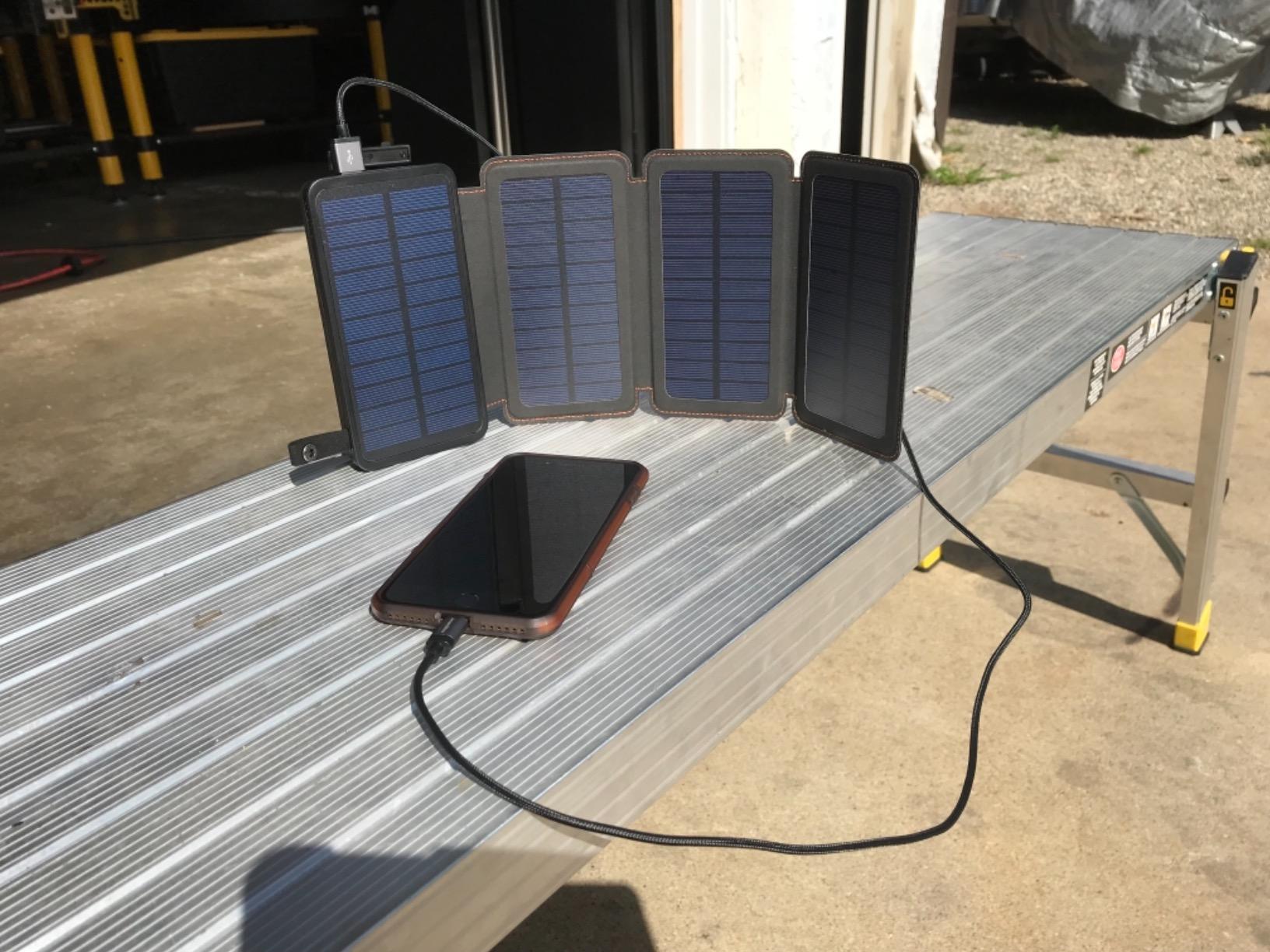
Bottom line: this is the only unit in the list where the four solar panels are combined with a real-rated 20000mAh cell and 18W wired output, which makes it our pick when the sun is meant to do actual work. Four foldable panels produce up to 1.2 amps in total under 25000 lux of sunlight, which the brand puts at seven times the input of a standard single-panel solar power bank. That is still modest, but it is a category apart from a trickle top-up.
The capacity is a real-rated 20000mAh, and the brand states it recharges an iPhone 14 about 4.6 times, a Samsung S22 about 4.2 times and an iPad Air twice from a full charge. Both wired outputs are strong: 18W Power Delivery over USB-C and up to 18W from the QC 3.0 USB-A port.
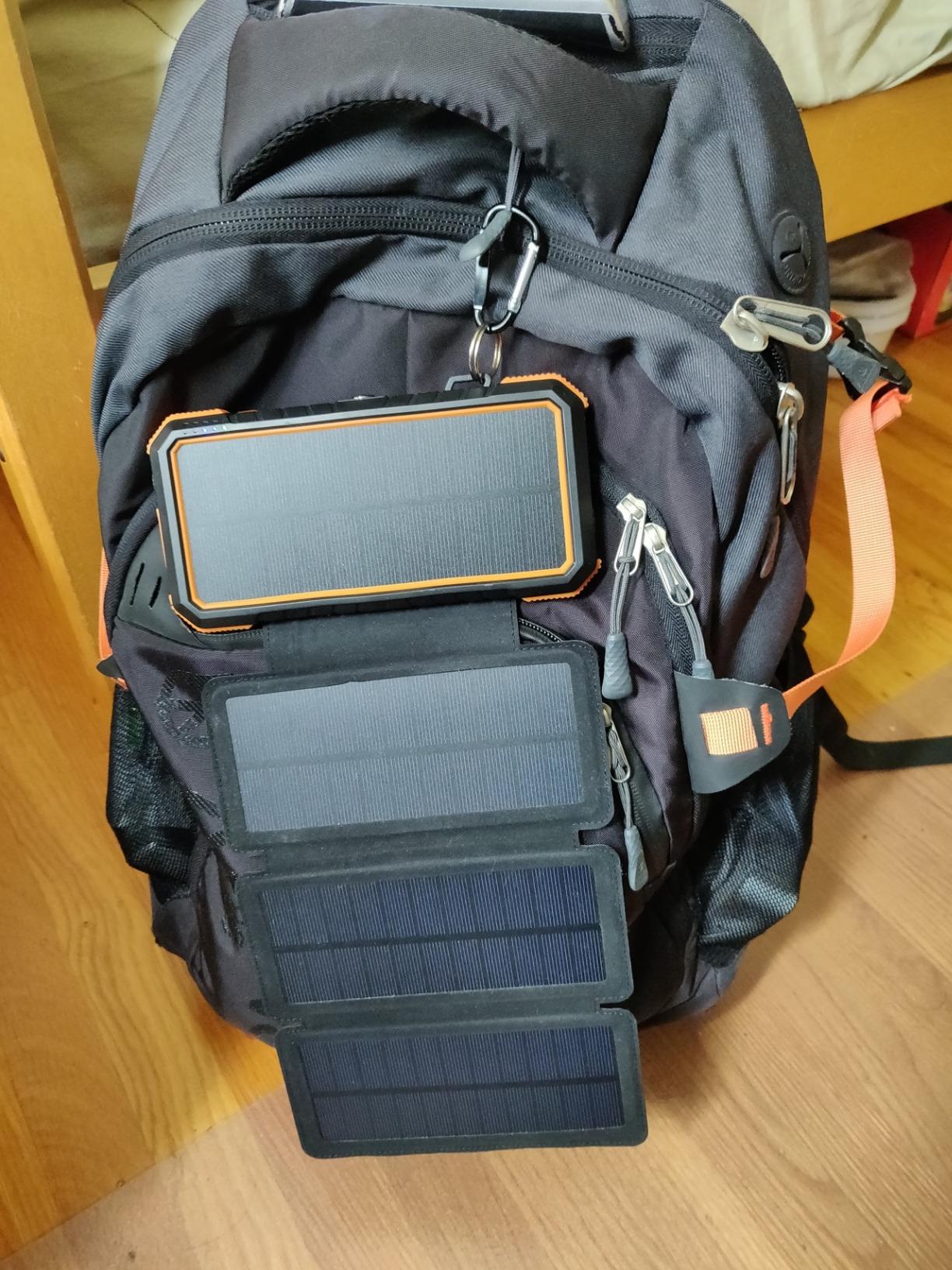
The lighting is a three-level camping light plus a flashlight with normal, SOS and strobe modes. The shell carries an IPX5 rating with a compass and carabiner, three outputs for simultaneous charging, and a three-year warranty with lifetime support.
Buyers consistently treat the four-panel array as the reason they bought it, reporting that it visibly recharges in direct sun and can run several devices plus lighting across a multi-day trip.
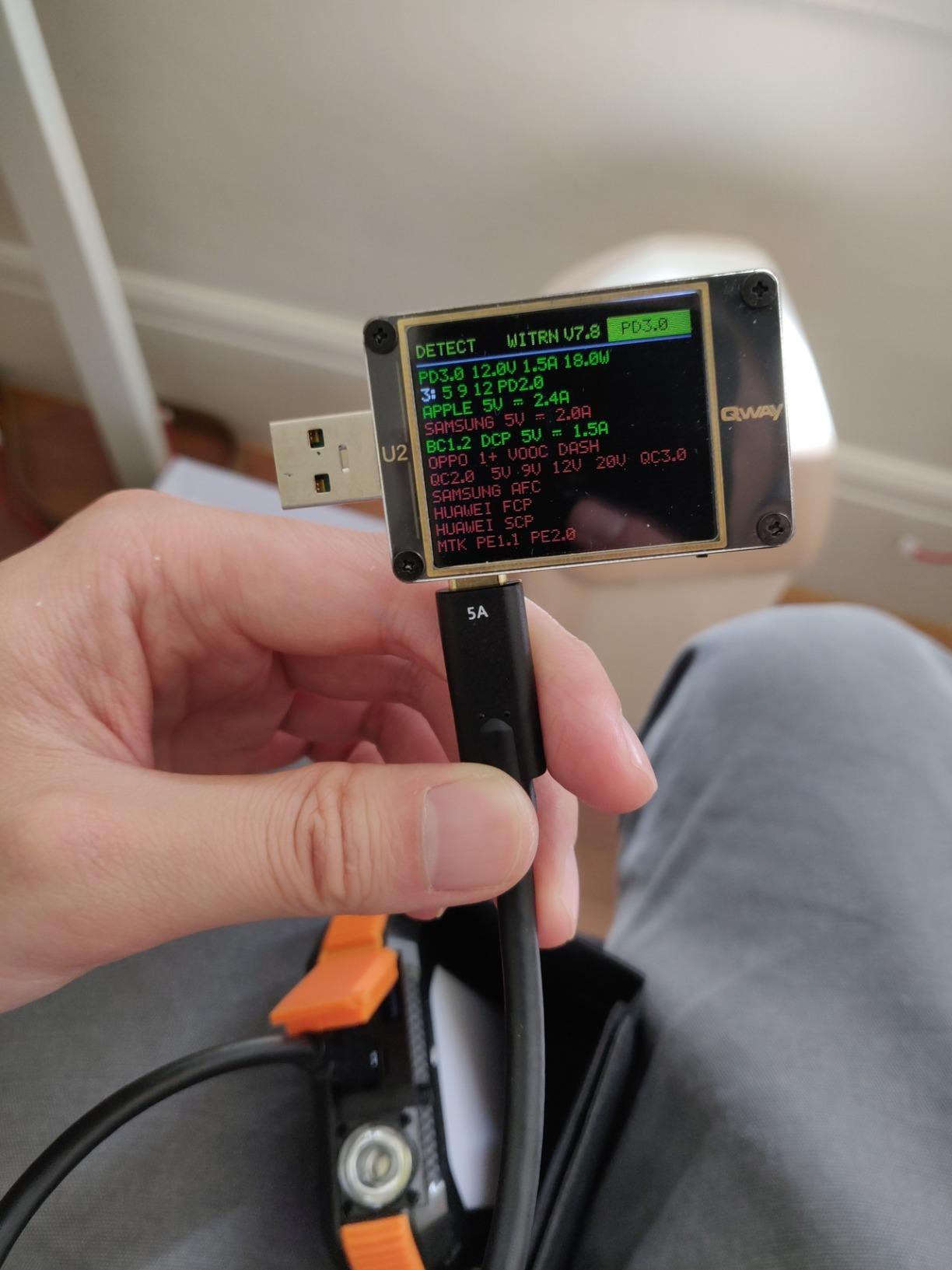
What four panels actually change
The number that matters is 1.2 amps, split as 300 mA across four panels. For a phone that is a genuine charge over a long sunny day, which is the opposite of the token input on a single-panel bank, and it is why this is the pick for a trip where the sun is the point.
Direct sunlight matters enormously here, and partial shade reduces output sharply. If your trip is a city break or a term indoors, a larger capacity battery will serve you better than a better panel.
The trade-offs to plan around
At 1.3 lb and 7 by 3.5 by 1.6 inches it is bulky for a backpack, so it suits car camping and festivals more than a walking route. The charge indicator only ever lights two dots, which buyers find unhelpful for reading remaining capacity.
Documentation is thin on what the indicators mean, and a small number of owners report cells that no longer hold a full charge after about a year of storage. The manual also does not clearly explain the light modes, so spend two minutes with it before a trip.
How to Choose a Solar Battery Charger for Phones?
Choosing between these twelve is mostly a question of what you are carrying and for how long. The panel matters far less than the battery, and almost every disappointment in this category traces back to expecting a token solar input to do a full recharge. Decide that expectation first and the rest is straightforward.
Decide what the panel is actually for
On every unit except the four-panel BLAVOR, treat the solar panel as a top-up that keeps a battery from hitting zero while it sits unused. If your trip involves three days of direct sun and no wall outlet anywhere, the panel becomes the main event and only a genuine multi-panel unit qualifies. If you will be near buildings, a larger battery wins every time.
Read milliamp-hours as watt-hours before anything else
Milliamp-hours alone tells you nothing useful, because the cell voltage changes between products. Multiply by the cell voltage, typically 3.7V, to get watt-hours, and a typical phone battery of around 15 Wh needs roughly one full charge per 15 Wh after allowing for conversion losses. Once you work in watt-hours, a 48000mAh label at 3.7V is about 178 Wh, and the measured reality on that unit is closer to 60 Wh. Where a listing publishes no watt-hour figure at all, treat the milliamp-hour number as marketing.
Match the ports to your devices
Count what you need to charge at once rather than what the listing claims. A phone, earbuds and a watch is three; add a partner’s phone and a small speaker and you need five. Units with four or five outputs exist here, and several include built-in cables, which removes the single most common failure point in student accommodation: a lost or bent lead.
Check the output wattage too. A 15W or 20W USB-C port will restore a phone in half an hour, while a 2.4A port at 5V is a comfortable overnight top-up. Both are fine, they just suit different days.
Check the water rating against your weather
IPX5 covers splashes and dust, IP65 adds a water jet, and IP67 allows immersion. For a bike commute or a rainy walk between buildings, IPX5 is adequate. For festivals, river trips and anything you might drop in a puddle, look for IP65 or IP67. None of these is meant to sit in a rainstorm on a tent roof.
Size it to the trip, not to the spec sheet
Add up the device batteries you need to cover, then divide by roughly 15 Wh per phone. A weekend trip for one person needs about 30 Wh of headroom, a shared house outage kit for four people needs considerably more, and a week abroad justifies the half-kilo options. Finally, check the airline limit: anything under 100 Wh stays in your carry-on, and the Luvknit 20000mAh and Uukto 20000mAh are both comfortably under it.
Solar Charger Scams and Red Flags to Avoid in 2026
Forum discussion around these products is dominated by one complaint: buyers who expected a solar power bank to recharge itself in a day and received a brick that takes weeks. That gap between the listing and the device is the whole problem, and it is avoidable.
The first red flag is a large capacity number with no watt-hour figure anywhere on the page. The second is a single small panel described without an input current, which is how you end up with the widely repeated 100-plus-day recharge experience. The third is a listing that never states a realistic panel output under stated lux conditions. The BLAVOR four-panel unit is a good model here, because it publishes 1.2 amps at 25000 lux, and you can check that claim against reality.
Watch for inconsistent certification too. A pack that mentions UN38.3, UL 2056 and MSDS in the same listing is a better bet than one with no safety information at all, particularly if you are flying with it.
Finally, be sceptical of a device where the solar panel is the main selling point and the battery is a footnote. In this category the battery is what charges your phone. Anything that prioritises the panel is prioritising the part of the product that does the least work.
Maintenance and Care for Solar Power Banks
Lithium-polymer cells do not like three things: heat, prolonged emptiness and long periods at full charge. Most premature failures in this category come from storing a pack in a hot car or a hot windowsill, which is worth avoiding in a room with south-facing windows.
Charge by cable before a trip, not by sun. The panel is a backup, and a pack that leaves the house full is the whole point of carrying it.
Top up dormant packs once a month to around 50 percent. Both the DJKK listing and general lithium guidance recommend this between long periods of storage, which matters over a summer break.
Never leave a pack charging in direct sun. Earlier BLAVOR models reportedly developed bulging cells after heavy daily use in the heat, and heat is the single biggest enemy of these batteries.
Keep the ports covered when you are not using them. Sealed port covers keep dust and grit out, and grit in a USB-C socket is a common cause of the loosening buyers report.
Do not bend the built-in cables hard. The short fixed cables on several of these units are the first thing to crack, and they cannot be replaced.
Store the pack in a hall cupboard or a desk drawer, not a car dashboard or an unheated shed in winter. Steady moderate temperatures extend cell life far more than any charging habit.
Recharge fully before a long absence, then check it monthly. A pack brought back from a term break at three percent will not perform like one that has been maintained.
Clean the solar surface with a dry cloth. Dust and fingerprint film on a small panel make a measurable difference to a low-current input.
Do not disassemble a pack to fix a loose port. Several housings open easily, and the cell underneath is not something to reseat yourself.
Test the pack before you travel. A full charge and a phone top-up ten minutes before you leave will tell you more than any indicator light.
Frequently Asked Questions
Do solar power phone chargers really work?
Yes, but as a top-up rather than a full recharge. A single small panel on a power bank adds a trickle of charge over hours of direct sun, which is enough to keep a battery alive when you are caught out. The only unit here that meaningfully recharges in sun is the BLAVOR with 4 foldable panels.
What is the best solar battery charger for phones?
For everyday carrying, the BLAVOR 10000mAh wins, weighing 9.3 ounces with Qi wireless charging, 20W USB-C and three ports. For a trip without wall outlets, the SOARAISE 48000mAh provides roughly 60 Wh of measured energy. For genuine solar input, the BLAVOR 20000mAh with 4 foldable panels is the only real option in this group.
Are solar charging power banks worth it?
Worth it as a battery with a safety net. Every unit here charges a phone several times from a wall outlet, and the panel simply keeps that charge from draining during a long trip. They are not worth buying for the panel alone, and any listing with a large capacity number but no watt-hour figure deserves scepticism.
Is BLAVOR solar power bank good?
The BLAVOR 10000mAh is our top pick, rated 4.2 across more than 47000 reviews, with a Qi pad, 20W USB-C, IPX5 and a three-year warranty. The 20000mAh model adds wireless charging for an Apple Watch and a compass and thermometer, rated 4.3. Both treat the integrated panel as an emergency top-up rather than a charging method.
Can you overcharge a battery with a solar charger?
Not with any of these units. They use charge controllers with overcharge, over-discharge, over-current and short-circuit protection, and a full pack simply stops taking current. The genuine risk is heat rather than overcharging, so avoid leaving any pack charging in direct sun.
Final Verdict: Which Solar Battery Charger Should You Take
Start with the BLAVOR 10000mAh. It weighs 9.3 ounces, carries a Qi pad and 20W USB-C, and has more reviews and a longer warranty than anything else here. For most students on a budget who want one charger that disappears into a backpack, it is the correct answer to the question of the best solar battery chargers for phones.
Then match the size to the gap. Buy the GOODaaa 24000mAh for a house-share kit, the SOARAISE 48000mAh for a trip with no outlets, or the DJKK 66800mAh if you also want a lamp for a blackout. If the sun is genuinely the point of the trip, the BLAVOR with 4 foldable panels is the only one that does more than top up.
Whichever you choose, charge it by cable before you leave. In 2026, the panel is the safety net and the battery is the plan.