
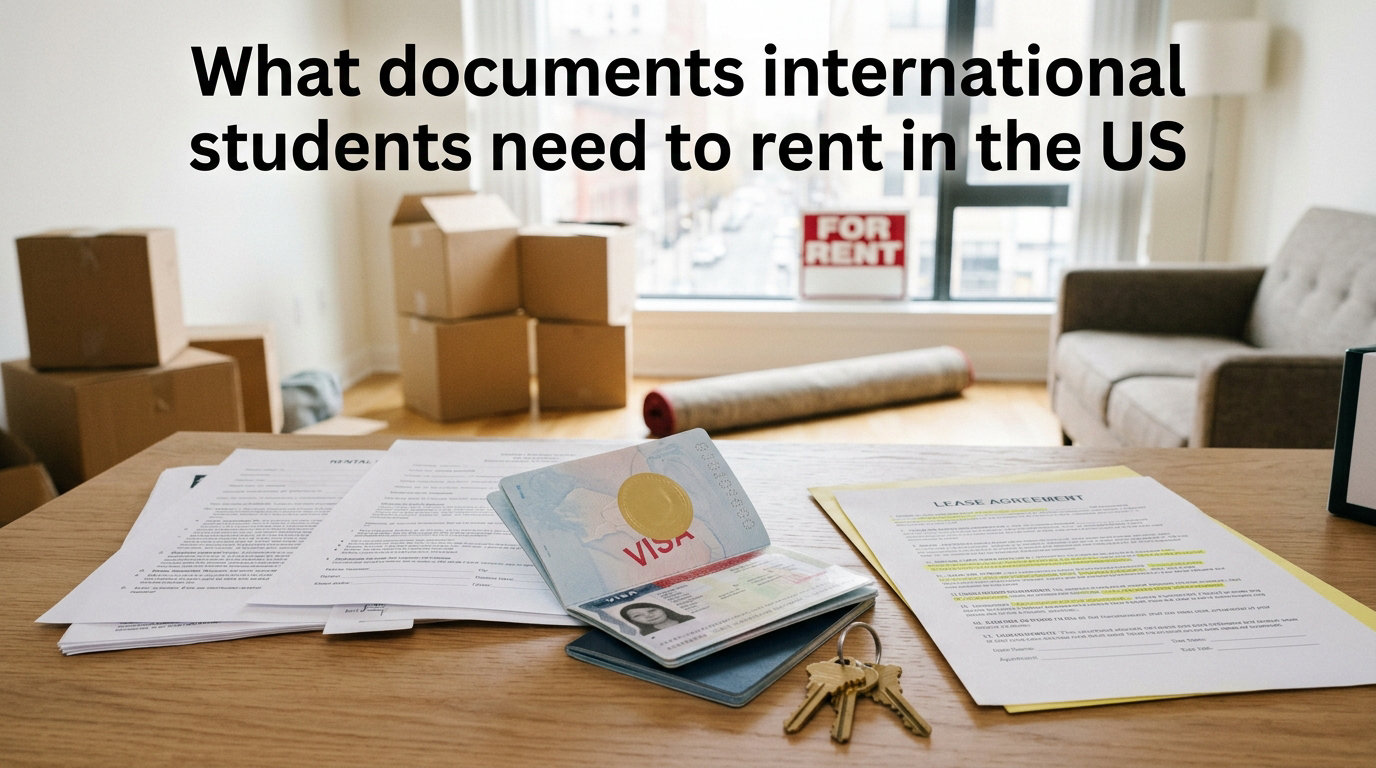
International students need a passport, a valid student visa (F-1 or J-1), the matching Form I-20 or DS-2019, proof of enrollment, proof of funds, a co-signer or guarantor, a completed rental application, and a security deposit or prepaid rent to rent an apartment in the US. The eight documents below cover roughly 95% of what landlords ask for, and I have ordered them so the most-requested items sit at the top of your stack. If you are reading this from overseas or you just landed last week, this guide walks you through every item, including what to do when something is missing.
I have helped international students prepare rental applications at three universities over the past four years. The same questions come up every semester, and the same handful of documents decide whether a landlord approves the lease. I will show you exactly which papers matter, why landlords ask for them, and how to handle the gaps that catch most students off guard.
Table of Contents
Can You Rent an Apartment in the US as an International Student?
Yes. Any non-US citizen studying at a US college or university on an F-1, J-1, or M-1 visa can sign a lease and rent an apartment in the United States. Your visa status is your proof of legal presence, and landlords are required to follow the same fair housing rules for international students as for US citizens.
Expect stricter screening than a domestic applicant. Most landlords will ask for a co-signer or US-based guarantor because you have no US credit history. Some will request a larger security deposit, often 2 to 3 months of rent instead of the usual one. A small number of landlords, especially in cities with many international students, have a streamlined process that avoids the co-signer requirement altogether.
The Complete Document Checklist (8 Must-Have Items)
Before we go deep on each item, here is the full list. Print this or save it on your phone so you can check off documents as you gather them.
- Passport (valid for the entire lease term)
- Student visa (F-1 or J-1) in the passport, plus a valid I-94 arrival record
- Form I-20 (F-1 students) or Form DS-2019 (J-1 students)
- Proof of enrollment (enrollment verification letter, recent transcript, student ID)
- Proof of funds (bank statements, scholarship letter, sponsor letter)
- Co-signer or guarantor documents (US-based signer or paid guarantor service)
- Completed rental application (per property)
- Security deposit or prepaid rent (certified funds)
Landlords will sometimes accept a US phone number, a US bank account, or passport-style photos as supplements, but the eight items above are the core. If you have these ready, you can apply to almost any rental in the country.
Passport: Your Primary Proof of Identity
Your passport is the document landlords look at first. It proves who you are, what country you are from, and how long you can legally stay in the US. Bring both the original and at least one photocopy, because most landlords keep a copy in their tenant file.
Two practical points matter. First, your passport must be valid for the entire length of your lease. If your passport expires in six months and you are signing a 12-month lease, the landlord will reject the application. Renew your passport before you apply. Second, some properties still ask for two or four passport-style photos for their records. This is rare but it does happen, especially in larger purpose-built student housing buildings.
Student Visa: F-1 vs J-1 Documentation
Your student visa is the sticker or stamp inside your passport that lets you enter the US for study. Two visa types cover almost every international student who rents off-campus: F-1 for academic students and J-1 for exchange visitors.
Both visas make you eligible to rent. The paperwork that comes with each one is different, which is why landlords ask to see the matching form (I-20 or DS-2019) along with the visa page. The table below shows the side-by-side comparison.
| Item | F-1 Student | J-1 Exchange Visitor | |
|---|---|---|---|
| Visa type | Academic study | Exchange program | |
| US school form | Form I-20 | Form DS-2019 | |
| Issued by | Designated School Official (DSO) | Responsible Officer (RO) at sponsor | |
| Allowed to rent? | Yes | Yes | |
| Typical program length | Full degree program | Short-term exchange, 6-24 months | |
| Work authorization | On-campus up to 20 hrs/wk; CPT/OPT later | With sponsor approval only |
Hold on to your I-94 arrival record too. It is the digital or paper slip that proves your most recent entry into the US. Landlords and leasing offices occasionally ask for it as supporting proof that you are currently inside the country in valid status.
Form I-20 and Form DS-2019 Explained
Form I-20 is a multi-page document issued by your US school’s Designated School Official (DSO) after you are admitted and pay the SEVIS fee. It lists your program of study, start date, end date, and financial information. Landlords treat it as proof that you are a real, enrolled F-1 student.
Form DS-2019 is the J-1 counterpart. It is issued by your program sponsor (often the university, sometimes a third-party exchange organization) and confirms you are a J-1 exchange visitor. J-1 students usually receive this before arrival and must carry it with them when re-entering the US.
Keep both the original and a digital copy. If you travel outside the US during your lease, you will need the same form to re-enter, so do not let a landlord hold the only physical copy. A scanned PDF in your email or cloud storage is enough backup.
Proof of Enrollment: Academic Documents
Landlords want to know you will actually be a student for the length of the lease. Three documents satisfy this question.
- Enrollment verification letter from your registrar’s office (often free for current students)
- Recent unofficial transcript showing current courses and degree program
- Student ID with photo, plus a class schedule if requested
Ask your international student office or registrar for the enrollment letter at least 30 days before you plan to apply for housing. Most schools can issue the same letter in English within 48 hours. Some landlords also accept an acceptance or admission letter for the first semester, then ask for updated enrollment verification before the second semester.
Proof of Funds: Showing You Can Pay Rent
US landlords have no way to verify foreign income, so they rely on bank statements and sponsor letters. Plan to bring three documents from this list.
- Bank statements showing 3 to 6 months of history in your name or your sponsor’s name
- Scholarship or assistantship letter stating your award amount and duration
- Sponsor letter from a parent or guardian committing to cover your living expenses
- Financial affidavit if your school requires one for I-20 issuance
Most landlords want to see funds equal to at least 12 months of rent, sometimes more. A checking account balance that comfortably covers annual rent plus living expenses gives you room to spare. If your funds are in a foreign bank, ask the bank for a statement in English with a clear balance in US dollars. Some landlords accept a notarized translation; others want a statement from a US bank after you open one.
Co-Signer or Guarantor: When Landlords Require One
A co-signer signs the lease alongside you and shares equal legal responsibility for rent. A guarantor is different: they only pay if you default, and they do not appear on the lease as a tenant. Landlords usually accept either, but they want one because you have no US credit.
If you do not have a US family member or friend willing to co-sign, paid guarantor services solve the problem. Three companies work with international students in most major cities.
- Insurent – accepts international students, fee roughly 65 to 95% of one month’s rent
- TheGuarantors – works with non-US citizens and non-US income, fee around 70 to 110% of one month’s rent
- Rhino – offers security deposit replacement instead of full guarantor service, fee 5 to 10% of annual rent
Guarantor services typically take 24 to 72 hours to approve your application once you submit your visa, I-20, and bank statement. Most landlords accept them as a drop-in replacement for a US co-signer.
Do You Need an SSN or Credit History?
No. You are not legally required to have a Social Security Number to rent an apartment in the US. Landlords can ask for one, but they cannot reject your application solely because you do not have one. If pressed, you can decline and offer an ITIN instead.
An ITIN (Individual Taxpayer Identification Number) is issued by the IRS to non-citizens who cannot get an SSN. It serves the same function on a rental application. Apply for one through IRS Form W-7 if you do not have an SSN, and bring the ITIN letter with you.
If you have a credit history from your home country, Nova Credit translates it into a US-style credit report that some landlords accept. Nova Credit works with credit bureaus in over a dozen countries including India, China, Brazil, Mexico, the UK, and Canada. It is not universal, but in cities with many international students it can replace the SSN requirement entirely.
Rental Application, Security Deposit and Prepaid Rent
Every property has its own rental application form. Plan to fill one out per property, even when the listings look identical. Most applications ask for the same eight items we have already covered, plus references and prior rental history.
Application fees vary widely by city and property. Some landlords waive the fee for international students or apply it toward the security deposit if you are approved. Ask before you pay, and never wire an application fee to a landlord you have not met.
Upfront costs are where international students get surprised. The standard is one month of security deposit, due at signing. If you do not have a US co-signer, some landlords ask for 3 to 12 months of prepaid rent instead. Forum threads from NYU and USC students report prepaying 6 months when no co-signer is available. Always confirm the total move-in cost in writing before you sign anything.
Timeline: When to Gather Each Document
Most international students underestimate how long it takes to gather these documents. Here is the timeline I recommend.
- 60 days before arrival: confirm passport validity, receive I-20 or DS-2019, pay SEVIS fee
- 30 days before arrival: request enrollment verification letter, gather transcripts, identify a co-signer or research guarantor services
- 14 days before arrival: download 3-6 months of bank statements, finalize sponsor letter, open a US bank account if possible
- 7 days before arrival: make certified copies, arrange certified translations if any document is in another language, prepare cashier’s check for deposit
Starting early gives you buffer time for missing transcripts, slow notarization, or a delayed bank statement. It also means you can apply for housing from your home country if needed.
What If You Are Missing a Document?
It happens to almost every student. Here is what to do when a document is missing, expired, or unavailable.
No US co-signer? Use a paid guarantor service such as Insurent, TheGuarantors, or Rhino. They accept international students with a visa and bank statement. The fee is far cheaper than 6 months of prepaid rent.
Bank statement not in English? Ask your bank for an English version or a notarized translation. Most international banks provide this on request. Some landlords will accept the statement as-is if it includes the bank’s English name and SWIFT/BIC code.
I-20 not yet issued? Ask your DSO for an admission letter and proof of SEVIS fee payment. Some landlords accept this short-term, with a follow-up I-20 once it arrives.
No US bank account? Open one with Bank of America, Chase, or Wells Fargo using your passport and I-20. This takes 1 to 2 hours if you visit a branch with both documents. Some landlords will hold the application until the account is open.
Worried about scams? Never wire money before signing a lease in person. Verify the landlord owns the property through the county assessor’s website. Use reputable listing platforms such as Zillow, Apartments.com, or your university’s off-campus housing office.
Frequently Asked Questions
Can an international student rent an apartment in the USA?
Yes. International students on an F-1, J-1, or M-1 visa can rent an apartment in the United States. Landlords apply the same fair housing rules to international students as to US citizens, but most require a co-signer, US-based guarantor, or prepaid rent because you do not have a US credit history.
Do you need a Social Security number to rent in the US?
No. A Social Security Number is not required to rent an apartment in the US. If a landlord asks for one, you can offer an ITIN (Individual Taxpayer Identification Number) instead, or use a service like Nova Credit to translate your home-country credit history into a US-style report.
Can an international student get a guarantor for rent?
Yes. International students who do not have a US family member to co-sign can use paid guarantor services such as Insurent, TheGuarantors, or Rhino. These companies accept visa holders and foreign income, and they typically charge 65 to 110 percent of one month’s rent as a fee.
What if I don’t have a US co-signer?
Three options work without a US co-signer. First, use a paid guarantor service such as Insurent or TheGuarantors. Second, offer a larger security deposit, often 2 to 3 months of rent. Third, apply to purpose-built student housing near your university, which often has streamlined approval for international students with an I-20 or DS-2019.
Do guarantor services like Insurent really work?
Yes. Insurent, TheGuarantors, and Rhino are widely accepted by landlords in major US cities. They approve applicants in 24 to 72 hours based on your visa, I-20, and bank statement. Fees typically range from 65 to 110 percent of one month’s rent, which is usually cheaper than paying 3 to 6 months of rent upfront.
What is Nova Credit and how does it help international students?
Nova Credit is a credit translation service that converts your home-country credit history into a US-style credit report that some landlords accept. It works with credit bureaus in over a dozen countries including India, China, Brazil, Mexico, the UK, and Canada. Nova Credit does not replace a visa or I-20, but it can remove the no-credit barrier when applying for an apartment.
Bringing It All Together
The documents international students need to rent in the US come down to eight must-haves: passport, student visa, Form I-20 or DS-2019, proof of enrollment, proof of funds, co-signer or guarantor, rental application, and security deposit. Gather them 60 days before your move-in date so you have time to fill gaps, and remember that paid guarantor services exist if you cannot find a US co-signer.
Start by checking your passport validity this week, then request your I-20 or DS-2019 from your international student office if you do not already have it. Once those two documents are in hand, the rest of the checklist falls into place within a month.