
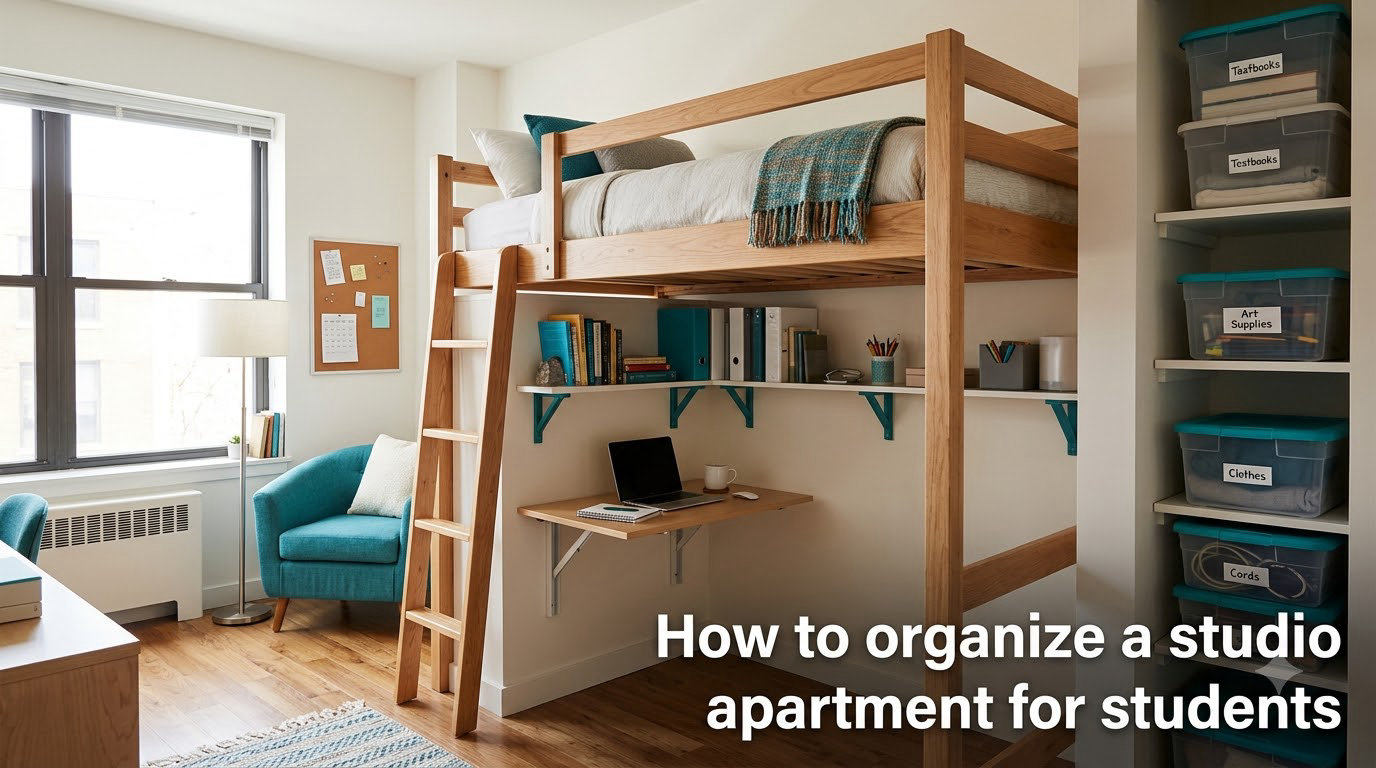
Learning how to organize a studio apartment for students can feel overwhelming when you’re staring at 300 square feet and wondering how everything will fit. I’ve been there — moving into a tiny studio with no closets, a bed that takes up half the room, and textbooks piling up on every surface. After years of trial and error (and helping friends set up their own student apartments), I’ve found that a few smart strategies can transform even the smallest studio into a functional, comfortable home.
A well-organized studio apartment helps students focus on studying, reduces stress from clutter, and makes the most of limited space during demanding academic years. The good news: you don’t need a big budget or permanent modifications to make it work.
Table of Contents
Quick Tips: How to Organize a Studio Apartment for Students
Here’s the fast-track version if you need results today:
Declutter before you buy anything — donate or toss what you don’t use weekly
Create distinct zones — divide your studio into study, sleep, living, and kitchen areas
Go vertical — install floating shelves, use wall hooks, and stack storage upward
Choose multi-functional furniture — ottomans with storage, fold-down desks, beds with drawers
Use under-bed space — slide bins, drawers, or rolling crates beneath your bed frame
Use renter-friendly solutions — command hooks, tension rods, and adhesive strips avoid damage
Maintain weekly — a 10-minute reset every Sunday keeps clutter from creeping back
Read on for the full breakdown of each strategy, plus tips for kitchens, bathrooms, and tech gear.
Start by Decluttering Ruthlessly
Every organization expert — and every Reddit thread on the topic — starts here for a reason. You cannot organize clutter. Before buying a single shelf or bin, go through everything you own and ask: have I used this in the last month?
For students, this is especially important during move-in. You’re likely coming from a dorm room or your parents’ house, bringing items that made sense in a larger space but will suffocate a studio. Be honest about what you actually need.
A practical approach: sort everything into four piles — keep, donate, trash, and store elsewhere (like at a parent’s home or in a shared storage unit). According to discussions on r/StudioApartments, real users consistently recommend getting rid of duplicates first — you don’t need two sets of pots, three winter coats, or five tote bags.
Student-specific tip: Do a semester cleanout at the end of each term. Textbooks you won’t reference again, notes from completed courses, and clothes you didn’t wear all season can all go. This prevents the slow accumulation that turns an organized studio into a chaotic one.
Create Functional Zones in Your Studio
This is the single biggest challenge unique to studio apartments. Without walls separating your bedroom from your living room — let alone your study area — everything blurs together. Zone creation solves this.
Think of your studio as four mini-rooms: a study zone, a sleep zone, a living/relaxation zone, and a kitchen zone. You don’t need drywall to separate them. Here’s how real students do it:
Room dividers: A bookshelf turned sideways creates a wall and provides storage on both sides. Curtain rods with fabric panels work too — and they’re renter-friendly.
Rug placement: Different rugs under different “rooms” signal where each zone starts and ends.
Lighting: A desk lamp in the study zone, a floor lamp by the couch, and string lights over the bed each define a different mood and function.
Furniture arrangement: Position your couch with its back to the bed area. Face your desk toward a wall or window, not toward the sleeping area, to reduce distraction.
Users on r/femalelivingspace emphasize that even a small studio feels bigger when your brain knows where each activity belongs. Studying in bed becomes harder when there’s a clearly defined desk area three feet away.
Go Vertical: Maximize Wall and Overhead Space
Floor space is your scarcest resource. Wall space is practically unlimited by comparison. Most students dramatically underuse their vertical square footage.
Floating shelves are the backbone of vertical storage. Install them above your desk for books and supplies, above the kitchen counter for spices and dishes, and near the entryway for keys and mail. They’re renter-friendly when installed with the right hardware — and many landlords allow them if you fill the holes before moving out.
Other vertical solutions that work:
Command hooks: Hang bags, hats, jackets, and kitchen utensils without drilling. Reddit users on r/Frugal swear by the heavy-duty versions for pots and pans.
Tension rods: Use them inside cabinets for extra shelf space, in closets for hanging organizers, or in windows for curtains that double as room dividers.
Pegboards: Mount one above your desk for supplies, scissors, headphones, and notes. It’s customizable and looks clean.
Over-the-door organizers: Perfect for shoes, toiletries, cleaning supplies, or pantry items. They turn dead space into functional storage.
Renter-friendly reminder: Always check your lease before drilling. Most student apartments allow small nail holes but prohibit larger anchors. When in doubt, command hooks and adhesive strips are your best friends.
Choose Multi-Functional Furniture
In a studio, every piece of furniture should earn its spot by doing at least two jobs. Single-purpose items are a luxury you can’t afford when square footage is limited.
The most popular multi-functional picks among students:
Storage ottoman: Works as a seat, a footrest, a coffee table (add a tray), and hidden storage for blankets, textbooks, or snacks.
Fold-down desk: Mounts to the wall and folds flat when you’re done studying. It disappears completely, freeing up floor space for other activities.
Bed with built-in drawers: Eliminates the need for a separate dresser. Many affordable options exist at IKEA and budget furniture stores.
Nesting tables: A set of two or three tables that stack together. Pull them apart when you have guests, stack them when you don’t.
Bookshelf as room divider: Accessible from both sides, it separates zones while holding books, decor, and storage bins.
Users on r/organization and r/StudioApartments repeatedly recommend thrifting and IKEA as the best sources for affordable multi-functional furniture. Don’t overlook Facebook Marketplace — students moving out often sell furniture at steep discounts.
Under-Bed Storage: Your Secret Weapon
The space under your bed is one of the largest storage areas in your entire studio — and most students waste it entirely. Real users on Reddit consistently recommend under-bed storage as the single highest-impact upgrade you can make.
Here’s what works:
Rolling bins or Sterilite drawers: Slide them out when you need something, push them back when you don’t. Great for off-season clothes, extra bedding, and textbooks.
Fabric storage bags: Vacuum-seal bags compress bulky items like winter coats and comforters to a fraction of their size.
Bed risers: Add 3-6 inches of height to your bed frame for more clearance. Some risers even include USB ports and outlets — a clever dual-purpose upgrade.
If your bed doesn’t have built-in drawers and you can’t add risers, consider a loft bed. It frees up the entire footprint underneath for a desk, couch, or closet. Just make sure your ceiling height allows it comfortably.
Tame Kitchen and Bathroom Clutter
Student kitchens are notoriously tiny — often just a strip of counter, a mini fridge, and a microwave. Bathrooms are even worse. But a few targeted solutions make a big difference.
Kitchen organization:
Use a rolling cart as a portable kitchen island. It stores pots, utensils, and dry goods, and you can move it out of the way when cooking is done.
Mount a magnetic knife strip on the wall to free up drawer space.
Use stackable bins inside the fridge and pantry to group items by type — snacks in one, condiments in another.
A collapsible dish rack stores flat when not in use, saving precious counter space.
Bathroom organization:
An over-the-door shoe organizer holds toiletries, hair tools, and cleaning supplies in clear pockets.
A tension rod under the sink creates a second tier for spray bottles and smaller items.
Adhesive shower caddies stick to tile without drilling and hold shampoo, soap, and razors.
Manage Cables and Tech Gear
This is a topic most competitors skip, but in a studio where your desk is also your dining table and sometimes your bed, cable management matters. Tangled cords create visual clutter and make cleaning harder.
Simple fixes:
Cable clips: Adhesive clips along the edge of your desk keep charging cables within reach without dangling.
Cable sleeves or zip ties: Bundle multiple cords running to the same outlet into one clean line.
Charging station: A small box or tray on your desk with a power strip inside keeps phones, tablets, and laptops charged without a mess of wires.
Cord labels: Small tags or colored tape help you identify which cable goes where — especially useful when you’re troubleshooting behind your desk.
This tip comes from the student-focused guide at University Edge, and it’s one I wish I’d known sooner. When your study space is also your bedroom, a clean desk makes it easier to shift into work mode.
Keep Your System Going: Maintenance Habits
Organizing once isn’t enough. The real challenge is keeping your studio organized through midterms, finals, and the chaos of a social life. Building small habits prevents the slow slide back into clutter.
Three routines that work:
The 10-minute Sunday reset: Set a timer and put everything back in its zone. Dishes in the kitchen, books on the desk, clothes in the closet. It takes less time than you think.
The one-in-one-out rule: Every time something new enters your apartment, something old leaves. This prevents accumulation — especially important when you’re tempted by free campus event t-shirts.
The semester purge: At the end of each term, go through your belongings again. Donate what you didn’t use, toss expired food, and reorganize any zones that stopped working.
As users on r/organization note, a clean and organized small space opens up visually. It feels larger, calmer, and more inviting. That feeling is worth ten minutes of tidying each week.
Frequently Asked Questions
What is the best way to organize a studio apartment?
The best way to organize a studio apartment is to declutter first, create distinct functional zones (study, sleep, living, kitchen), go vertical with shelves and hooks, and choose multi-functional furniture with built-in storage. Start with the areas that bother you most and build from there.
What is the perfect layout for a studio apartment?
The perfect studio apartment layout places the bed against the farthest wall from the door, with a room divider or bookshelf separating the sleeping area from the living space. Position your desk near a window for natural light, and keep the kitchen zone clearly defined with a rolling cart or small island. The key is creating visual separation without blocking light or airflow.
What are the must-haves for a studio apartment?
Studio apartment must-haves include a bed with built-in drawers or under-bed storage, floating shelves for vertical organization, a storage ottoman that doubles as seating, over-the-door organizers for shoes and toiletries, and a fold-down or wall-mounted desk. These items maximize functionality in minimal square footage.
How do you divide a studio apartment into zones?
Divide a studio apartment into zones using bookshelf room dividers, different rugs under each area, distinct lighting for each zone, and furniture arrangement that faces different directions. Curtains on tension rods work as renter-friendly dividers. The goal is to create visual boundaries so your brain associates each area with a specific activity.
Conclusion
Organizing a studio apartment for students comes down to three principles: declutter relentlessly, use every inch of vertical and hidden space, and choose furniture that works harder than you do. Start with the quick tips list above, tackle one zone at a time, and build the maintenance habits that keep your space functional all semester long. Your studio might be small, but with the right system, it can feel like exactly the home you need.