
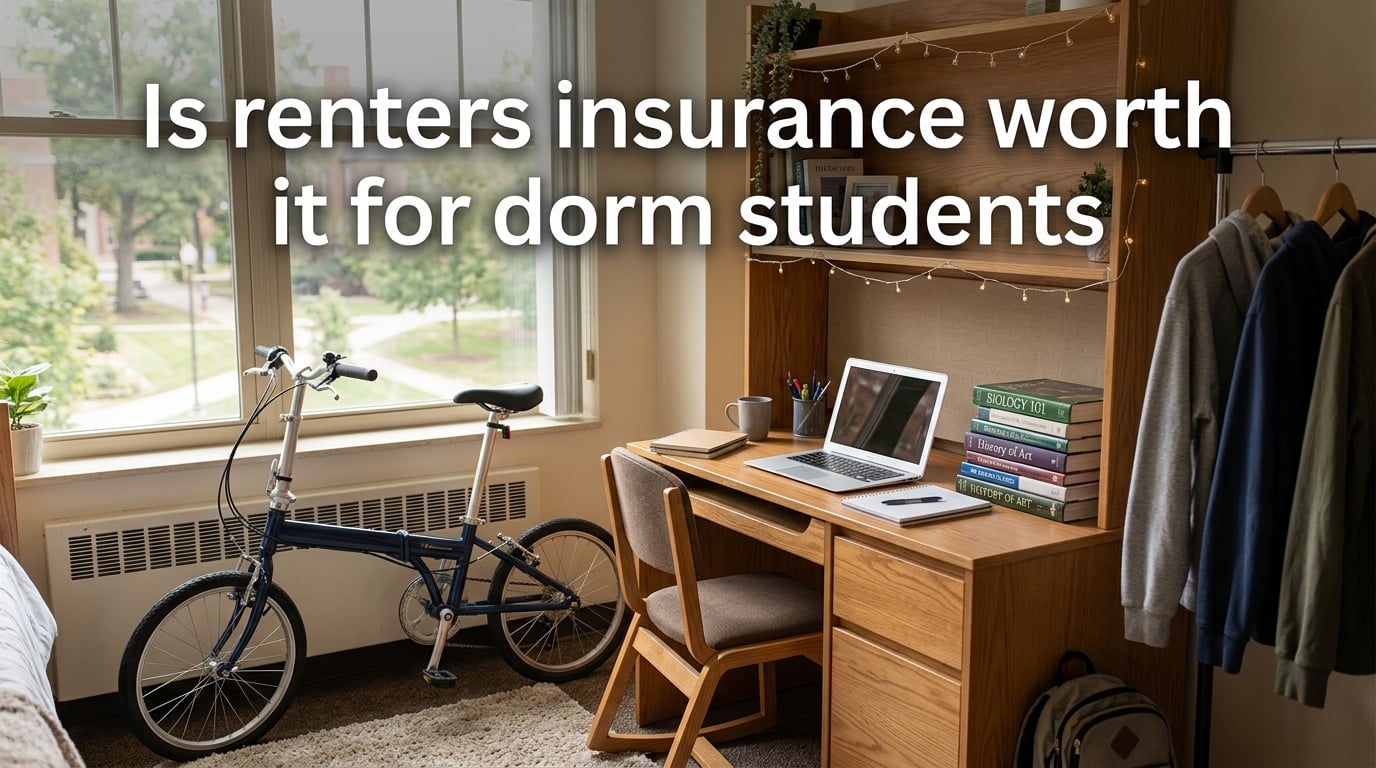
Yes, in most cases renters insurance is worth it for dorm students. For roughly $10-$20 per month, a policy protects your laptop, phone, clothing, and gear from theft, fire, and certain damage, plus covers you if someone gets hurt in your dorm room. If your parents have a homeowners policy, you may already have partial coverage through them, but it usually caps at 10% of their personal property limit and comes with a high deductible. Most dorm students end up buying their own policy because the cost is small compared to the risk of replacing $2,000-$5,000 of belongings out of pocket.
Table of Contents
What Renters Insurance Actually Covers
Renters insurance for college students is a contract that pays you back when covered events damage or destroy your stuff, or when you’re held legally responsible for someone else’s injuries or property damage. A standard policy has three main parts, and understanding each one helps you decide whether the cost makes sense for your situation.
Personal Property Coverage
Personal property coverage pays to repair or replace your belongings – laptop, phone, textbooks, clothing, mini-fridge, bike, furniture – up to your policy limit if they’re damaged or stolen. Most student policies set this limit between $10,000 and $30,000, which is plenty for a dorm room or small apartment.
The catch is whether your policy pays “replacement cost” or “actual cash value.” Replacement cost pays for a new equivalent item; actual cash value deducts depreciation, so a 2-year-old laptop might only get $600 back instead of the $1,200 you paid. For students with newer electronics, replacement cost is worth the small extra premium.
Personal Liability Coverage
Personal liability coverage pays out if you’re legally responsible for injuring someone or damaging their property. If a friend trips on your desk and breaks their wrist, or if you accidentally start a small kitchen fire that damages the dorm, liability coverage handles the medical bills or repair costs up to your limit – typically $100,000 to $300,000.
For dorm students, party liability is the biggest concern. If you host a gathering and someone gets hurt, or if alcohol-related damage occurs, you could face a lawsuit. Liability coverage also pays for your legal defense, which alone can run $5,000-$20,000 even for a minor claim.
Additional Living Expenses (ALE)
Additional living expenses coverage pays for temporary housing, food, and other essentials if your dorm or apartment becomes uninhabitable due to a covered event like a fire or major water damage. ALE is often overlooked by students, but it’s the part of the policy that keeps you from sleeping in your car while repairs happen.
Is Renters Insurance Worth It for Dorm Students
The honest answer depends on where you live and what you already have. Off-campus students almost always need their own policy – many landlords require it, and your parents’ homeowners policy doesn’t extend to apartments you rent in your own name. Dorm residents have a more nuanced decision.
Dorm Residents vs Off-Campus Students
If you live off campus in an apartment, house, or any rental where you sign your own lease, renters insurance is essentially mandatory. Your landlord’s insurance covers the building structure but not your belongings, and most leases require tenants to carry their own liability coverage. Skipping it means a single broken pipe or burglary wipes out your savings.
Dorm residents technically fall under the university’s master insurance policy for the building itself, but that policy doesn’t cover your personal belongings at all. Whether you need renters insurance depends on what your parents’ homeowners policy already covers for you.
When Your Parents’ Policy Covers You
If you’re under 26, a full-time student, and living in a dorm (not an off-campus rental), most standard homeowners policies extend a portion of coverage to you automatically. The common rule is 10% of your parents’ personal property limit applies to your dorm room. If your parents have $100,000 in personal property coverage, you get up to $10,000 in dorm coverage through their policy – with no extra premium.
This extension usually covers the same perils as your parents’ policy: theft, fire, vandalism, and certain water damage. It’s a genuine benefit, but it has limits: the coverage applies to your parents’ deductible (often $1,000-$2,500), the 10% cap can be tight if you own expensive gear, and it disappears the moment you move off campus or take a gap year.
When You Need Your Own Policy
You should buy your own renters insurance if any of the following apply: your parents don’t have homeowners insurance; your parents’ deductible is too high to make small claims practical; you own more than $10,000 in electronics, instruments, or gear; you live off campus even part-time; or you’re an international or graduate student whose parents’ policy doesn’t extend to the U.S.
For most students, the deciding factor is the deductible math. If your parents have a $1,000 deductible and your laptop costs $1,500 to replace, you’d only get $500 back after filing through their policy. With your own renters policy at a $250 or $500 deductible, you’d get the full replacement minus a much smaller out-of-pocket cost.
Dorm vs Off-Campus Coverage Needs
The risks and required coverage look different for dorm life versus off-campus housing. Here’s a side-by-side look at what each situation demands.
| Coverage Factor | Dorm Resident | Off-Campus Student |
|---|---|---|
| Policy requirement | Usually optional | Often required by lease |
| Typical personal property value | $3,000-$8,000 | $8,000-$20,000 |
| Recommended coverage limit | $10,000-$15,000 | $20,000-$30,000 |
| Parents’ policy overlap | Often covers 10% automatically | Does not extend to rentals |
| Theft risk level | Moderate (shared access, unsecured doors) | Higher if ground floor or shared entry |
| Liability risk | Party liability for dorm damage | Higher – visitors, guests, shared spaces |
| Monthly cost range | $5-$15 | $12-$25 |
| Deductible sweet spot | $250-$500 | $500-$1,000 |
Off-campus students face more risks and higher replacement costs, which is why their policies tend to cost a bit more. But even dorm students with $5,000 of belongings can lose a semester’s worth of savings to a single theft or fire.
How Much Coverage Does a Dorm Student Need
A common rule of thumb is to add up what it would cost to replace everything you own at today’s prices. For a typical dorm student, that adds up faster than most expect.
Estimating Your Belongings Value
Walk through your room and add up: laptop ($800-$2,500), phone ($600-$1,200), textbooks ($300-$800 per semester), TV or monitor ($200-$500), bike or scooter ($300-$1,500), clothes and shoes ($500-$2,000), mini-fridge and microwave ($150-$300), bedding and decor ($200-$500), gaming console or instruments ($300-$1,500). Most students carry $5,000-$15,000 without realizing it.
If your total is under $5,000, a $10,000 policy with a $500 deductible covers you comfortably. If your gear is closer to $15,000 – especially if you have a high-end laptop, camera, or instruments – bump your personal property limit to $25,000 or $30,000 and consider a separate rider for any single item worth more than $1,500.
Deductible Choices
The deductible is what you pay out of pocket before insurance kicks in. A $250 deductible means a smaller premium but higher out-of-pocket cost per claim; a $1,000 deductible means a lower premium but you’d only file claims for major losses. Most students do best with a $500 deductible – it keeps the premium low while making smaller claims worthwhile.
How Much Does Renters Insurance Cost for College Students
Renters insurance for college students typically costs between $10 and $20 per month, or roughly $120-$240 per year. That’s less than a single textbook for an entire year of protection, and most insurers let you pay monthly with no fees.
Average Cost by State
Where you go to school affects your rate. States with higher catastrophe risk and higher overall insurance costs charge more for renters insurance too. Here’s what students in different regions typically pay per month.
| State | Average Monthly Cost | Average Annual Cost |
|---|---|---|
| California | $17-$22 | $200-$265 |
| Texas | $15-$20 | $180-$240 |
| Florida | $16-$22 | $190-$265 |
| New York | $14-$18 | $170-$215 |
| Ohio | $10-$14 | $120-$170 |
| Wisconsin | $9-$13 | $110-$155 |
| Massachusetts | $12-$16 | $145-$190 |
Your actual rate depends on your coverage amount, deductible, claims history (usually clean for students), and any discounts you qualify for.
Discounts That Lower Your Premium
Most insurers offer discounts that bring student rates down further. Bundling renters with auto insurance through the same company typically saves 5%-15%. Having a smoke detector, security system, or smart doorbell in your apartment can also reduce the premium. Some insurers offer good-student discounts of up to 10% if you maintain a B average or higher, and paying annually instead of monthly often removes a small service fee.
What Renters Insurance Does Not Cover
Renters insurance covers a lot, but it has gaps that surprise students. Knowing what isn’t covered helps you avoid filing a claim that gets denied.
Flood and Earthquake Damage
Standard renters policies exclude flood and earthquake damage entirely. If you attend school in a flood-prone area or near a fault line, ask your insurer about adding a separate flood or earthquake rider. The federal National Flood Insurance Program covers renters in participating communities, and earthquake riders are usually cheap – $50-$100 per year for most students.
Wear and Tear and Mechanical Breakdown
If your laptop stops working because the hard drive failed after three years, that’s not a covered event. Renters insurance covers sudden, accidental loss from named perils (theft, fire, vandalism, certain water damage) – not gradual wear, defects, or mechanical failure. For electronics, consider a manufacturer warranty or separate device protection plan.
Roommate Damage Scenarios
This is where things get tricky. If your roommate accidentally floods the bathroom and ruins your laptop, their renters policy (if they have one) should cover your belongings – not yours. Your own policy typically covers damage from certain water events like burst pipes, but if a named insured on your policy caused the loss, your claim may be denied.
The practical solution: every roommate in an off-campus apartment should carry their own policy with adequate personal property and liability limits. It protects everyone and avoids disputes after a loss.
High-Value Items Beyond Standard Limits
Most policies cap coverage on any single item at $1,000-$2,500. If you own a $3,000 laptop, $5,000 camera setup, or $10,000 musical instrument, you need a personal articles policy or scheduled rider to fully protect it. These add-ons typically cost $50-$200 per year per item and cover theft, accidental damage, and worldwide coverage.
Common Student Scenarios and What Happens
Walking through real situations helps you see exactly how renters insurance pays out – and what happens when you don’t have it.
Laptop Stolen From the Library
You step away from your laptop for two minutes at the campus library and return to an empty table. Without renters insurance, you’re out $1,500. With a policy, you file a claim, provide the police report and your purchase receipt, and receive the replacement cost minus your deductible (typically $250-$500). Most insurers process these claims within 7-14 days.
Bike Stolen From the Dorm Bike Rack
Bikes are a top theft target on campus. A $1,000 bike locked to a dorm rack can disappear in under a minute. If your policy includes personal property coverage and you have the serial number and original receipt, your claim pays out the replacement cost after the deductible. Some policies require you to register the bike when you buy the policy, so mention high-value items upfront.
Dorm Fire Damages Your Belongings
A small electrical fire damages your room and everything in it. Your laptop, textbooks, and clothes are gone. Renters insurance pays to replace them up to your personal property limit. If the fire made your dorm room uninhabitable, your additional living expenses coverage pays for temporary housing, meals, and other costs above your normal living expenses while the dorm is repaired.
Party Liability – Someone Gets Hurt
You host a small gathering in your dorm or apartment and a guest trips down the stairs, breaking an ankle. Their medical bills and any lawsuit they file fall under your personal liability coverage, which pays for their medical costs (up to the limit), your legal defense, and any settlement or judgment. Without coverage, you’re personally on the hook for everything.
Roommate’s Actions Damage Your Stuff
Your roommate leaves the sink running and floods the kitchen. Your laptop and textbooks are destroyed. If your roommate has their own renters policy, their liability coverage should pay for your damaged property. If they don’t, your own policy may still cover water damage from internal plumbing failures, but it gets messy. This is why every roommate should carry their own policy – it protects everyone quickly and cleanly.
Water Damage From the Floor Above
A pipe bursts in the unit above yours and soaks your ceiling, ruining your furniture and electronics. Your renters policy typically covers this as sudden water damage from an internal plumbing failure. Document everything with photos and videos before cleaning up, and file your claim within 24-48 hours to keep the process moving.
Pre-Move-In Inventory Checklist
No competitor offers this, and it’s the single best step you can take to make sure your claim gets paid quickly. Spend 30 minutes on move-in day to document everything you bring.
Photo and Video Documentation
Walk through every room with your phone camera and record a slow video showing every item you own. Open drawers, look inside closets, and zoom in on serial numbers for electronics. Date the video and save it to cloud storage immediately – phone storage alone can be lost if your device is stolen.
Receipts and Serial Numbers
Keep digital copies of receipts for any item worth more than $100. Screenshot order confirmations, save PDFs of receipts, and email them to yourself so they exist in a cloud account you can access from any device. Record serial numbers for laptops, phones, tablets, cameras, bikes, gaming consoles, and instruments – insurers ask for these when you file a claim.
Cloud Backup of Records
Upload your photos, videos, and receipts to a cloud service like Google Drive, iCloud, or Dropbox the moment you finish documenting. Don’t rely on a single device. If your laptop is stolen, the proof you need to file a claim should not be on that same laptop.
How to Buy Renters Insurance as a Student
Buying renters insurance takes about 15 minutes online. Here’s the process most students follow.
Step 1: Check Your Parents’ Policy First
Ask your parents to call their homeowners insurer and confirm whether their policy extends to your dorm room. Find out the personal property limit (usually 10% of theirs), the deductible, and whether you’re covered for theft off-premises (laptop stolen from library) or only at your dorm. If their coverage is solid and your belongings are below the cap, you may not need your own policy.
Step 2: Decide Between Dorm-Specific and Standard Renters Insurance
Dorm-specific policies from providers like GradGuard or Gallagher Student are designed for students and often bundle low limits at low premiums. Standard renters insurance from companies like Lemonade, State Farm, or Allstate offers higher coverage limits and more flexibility. If you own less than $5,000 in belongings, a dorm-specific policy may be enough. If you own more, standard renters insurance is usually a better value.
Step 3: Get Quotes From Two or Three Insurers
Quotes are free and take 5-10 minutes each. Most insurers let you enter your address, coverage amount, and deductible online and get an instant price. Compare not just the premium but the coverage details – replacement cost vs actual cash value, personal property limits, liability limits, and any optional riders you might want.
Step 4: Buy Online and Bind Coverage
Once you pick a policy, you can buy it online and your coverage starts immediately or on a date you choose. Pay monthly if you want flexibility, or annually if you want to save the service fee. Save your declarations page (the document summarizing your coverage) to your cloud storage along with your move-in inventory – you’ll need both if you ever file a claim.
How to File a Claim as a College Student
No competitor walks through the actual claims process for students, so here’s what to expect if the worst happens.
Document the Loss Immediately
Take photos and video of all damage before cleaning up or moving anything. Note the date, time, and location. If theft is involved, file a police report within 24 hours – most insurers require one before they’ll pay a theft claim. Save the police report number and the officer’s contact information.
File Your Claim Within 24-48 Hours
Call your insurer’s claims line or log into their app to start the claim. Most student claims are filed online and processed within 7-21 days. Provide the police report, your inventory documentation, and any receipts or proof of ownership. The faster you file, the faster you get paid.
Provide Proof of Ownership
Insurers will ask for proof that you owned the items and what they were worth. This is where your pre-move-in inventory pays off. Photos, videos, receipts, serial numbers, credit card statements, and original packaging all count. If you have no documentation for an item, the insurer may use industry average values, which are usually lower than what you actually paid.
Receive Reimbursement Minus Deductible
Once your claim is approved, the insurer pays the replacement cost (or actual cash value, depending on your policy) minus your deductible. For example, a $1,500 laptop claim with a $500 deductible on a replacement-cost policy pays you $1,000. Repairs to the building or other people’s property go through your liability coverage and may involve a longer process.
Frequently Asked Questions
Is renters insurance worth it for dorm students?
Yes, in most cases renters insurance is worth it for dorm students. Policies typically cost $10-$20 per month and protect your laptop, phone, clothing, and gear from theft, fire, and certain damage. Dorm students whose parents have homeowners insurance may already have partial coverage through them, but it usually caps at 10% of the parents’ personal property limit and comes with a high deductible.
How much does renters insurance cost for college dorms?
Renters insurance for college dorms typically costs between $10 and $20 per month, or roughly $120 to $240 per year. Rates vary by state – students in California, Texas, and Florida pay $15-$22 per month on average, while students in Ohio and Wisconsin pay $9-$14 per month. Discounts for bundling with auto insurance or maintaining good grades can lower the premium further.
Does my parents’ homeowners insurance cover my dorm?
Most homeowners policies extend 10% of the personal property limit to dependent college students living in dorms. If your parents have $100,000 in personal property coverage, you get up to $10,000 in dorm coverage through their policy automatically. However, the parents’ deductible (often $1,000-$2,500) applies, and the coverage ends when you move off campus or stop being a full-time student.
Should college students in dorms get renters insurance?
College students in dorms should get renters insurance if their parents don’t have homeowners insurance, if their parents’ deductible is too high to make small claims practical, or if they own more than $10,000 in electronics or gear. Students who travel with laptops, cameras, or instruments almost always benefit from their own policy even when parents’ coverage exists.
Is $100,000 in renters insurance a lot?
For a dorm student, $100,000 in personal property coverage is more than most need. Most students carry $5,000-$15,000 in belongings, so a $20,000 or $30,000 personal property limit is plenty. The $100,000 figure usually refers to the personal liability limit, which is the part that pays if you’re held responsible for injuring someone or damaging their property.
What is the best insurance for college dorms?
The best insurance for college dorms depends on your belongings and budget. Students with less than $5,000 in gear often do well with dorm-specific policies from GradGuard or Gallagher Student. Students with higher-value electronics, instruments, or cameras usually get better value from standard renters insurance from Lemonade, State Farm, Allstate, or USAA, with optional riders for expensive items.
The Bottom Line
Is renters insurance worth it for dorm students? For off-campus students, the answer is essentially yes – your landlord likely requires it, your parents’ policy doesn’t extend to your rental, and the cost is small compared to the risk. For dorm students, the answer is yes if your parents don’t have homeowners insurance, if your gear is worth more than $10,000, or if you want a low-deductible policy that makes smaller claims worthwhile.
Start by checking your parents’ homeowners policy to see whether it already covers you. If it does and your belongings fit within the 10% cap, you may not need your own policy. If it doesn’t, or if you want broader coverage and a lower deductible, get quotes from two or three insurers – Lemonade, State Farm, Allstate, and USAA all offer student-friendly policies that bind online in minutes. Then spend 30 minutes on move-in day documenting everything you bring. That single step makes any future claim faster, easier, and more likely to be paid in full.