
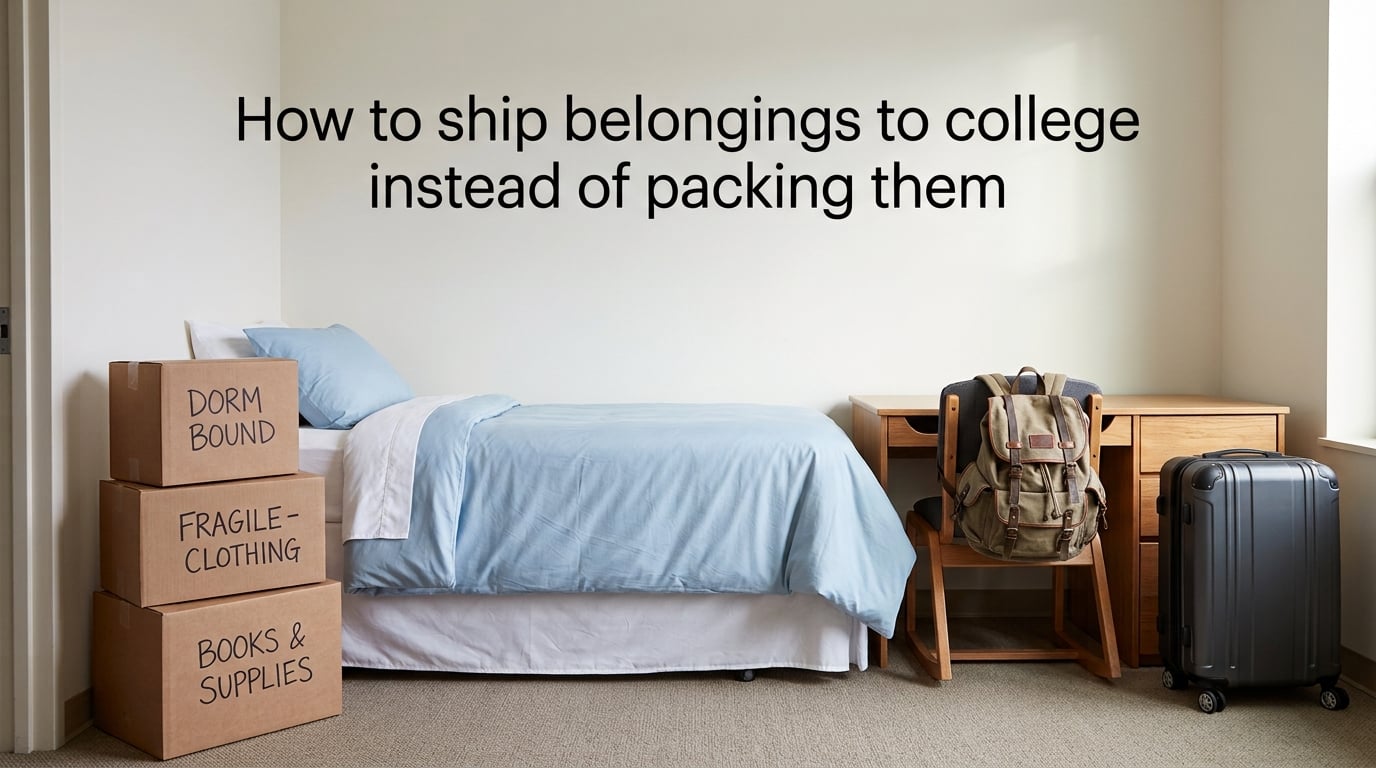
Sophomore year, my friend Priya flew from Texas to her school in Boston with three suitcases, a mini-fridge tied to her roller bag with bungee cords, and tears of frustration. Her first mistake was stuffing a 12-foot rug into a checked bag that barely fit inside the airline’s oversized compartment. The next mistake was paying a luggage fee for a shipment that nearly tipped the Uber driver at curbside check-in. That’s the moment I learned the smarter approach: figure out how to ship belongings to college instead of packing them into your luggage, your roommate’s minivan, or your parent’s already-overloaded trunk.
Shipping boxes to college is not just for out-of-state students anymore. It’s the easiest way for any first-year or returning student to travel light, save money on checked bags, and arrive on campus without throwing out their back. After helping our team coordinate moves for more than 60 students over the past three school years, I’ve seen what works and what creates a logistical nightmare on move-in day. This guide walks you through every decision — what to ship, when to ship, where to ship, and how to pack boxes so they survive the trip.
Table of Contents
Should I Ship My Belongings to College or Carry Them? The Quick Answer
Ship anything heavy, bulky, or replaceable. Carry anything you can’t afford to lose, that you need on day one, or that breaks the rules for what shipping carriers accept. If you’re flying with overweight luggage fees adding up fast, the math almost always comes out in favor of shipping. Parents driving in often forget that stuffing a sedan with linens, books, and shoes means no legroom for the people doing the driving.
The rule of thumb our team uses with students is this: anything that costs you extra at the airport or barely fits in your suitcase is the first thing to box up. Anything small, sentimental, or essential during transit stays with you. Below is the comparison table we share with every family we coach.
Ship vs Pack Comparison Table
| Category | Ship It | Pack It Yourself |
|---|---|---|
| Heavy items | Books, microwaves, mini-fridges, printers, shoes | One spare pair of shoes if your trip includes walking tours |
| Bulky items | Pillows, comforters, blankets, winter coats, rugs | Compression bags for one jacket |
| Bedding | Twin XL sheets, mattress topper, duvet insert | One set of pillowcase + sheet in case of delay |
| Dorm gear | Storage bins, command strips, lamps, organizers | Chargers, extension cords, a flashlight |
| Clothing | Seasonal clothes, formal wear, dress shoes | 5–7 days of everyday outfits, underwear, one formal outfit |
| Toiletries | Full-size shampoo, backup toothpaste, hair tools | Travel-size basics for the trip + first 48 hours |
| Documents & valuables | Nothing — never ship these | Passport, ID, financial aid papers, prescriptions, jewelry |
| Tech | Cables, old laptops, printers, monitors | Primary phone, primary laptop, primary charger |
| Sentimental items | Photo boxes, stuffed animals from childhood | One photo, a small memento |
| Restricted items | Anything flammable, perishable, or liquid (see carriers’ lists) | Drinks, snacks, meds in original labeled bottles |
What to Ship to College: A Packing Checklist by Category
Once you commit to shipping, the next question is what exactly goes in the boxes. I organize things by room function rather than packing room-by-room at home, because the dorm layout you’ll face is different from your bedroom at home. Here is the master checklist our team uses when coaching families.
Bedroom Essentials to Ship
- Twin XL sheets (two sets so you can rotate while one is in the wash)
- Comforter, duvet, or thick blanket — anything too bulky to compress
- Pillow(s) — most suitcases only fit one
- Mattress topper if your dorm mattress is the standard concrete slab
- Bed risers if your bed needs lifting for under-bed storage
- Reading lamp, clip-on desk lamp, or string lights
Bathroom and Personal Care to Ship
- Full-size shampoo, conditioner, body wash, and lotion
- Hair dryer, straightener, or curling iron (with auto-shutoff preferred)
- Razors, shaving cream, nail clippers, tweezers
- Loofah, bath towel sets (dorm towels get lost fast — bring extras)
Clothing to Ship
- Out-of-season wardrobe (winter coats for fall move-ins, summer clothes for spring)
- Formal wear, interview outfits, business-casual basics
- Sneaker rotation, dress shoes, boots
- Specialty athletic gear — ski boots, cleats, hiking boots
Dorm Setup to Ship
- Storage bins, under-bed containers, hanging closet organizers
- Command strips, 3M hooks, extra adhesive
- Whiteboard, cork board, push pins
- Decorations, posters in poster tubes
- Reusable water bottle, mini kettle (if your dorm allows it)
Many students on r/collegeadvice note that USPS charges by weight, making clothing shipments underwhelming for value. Bulky bedding, shoes, and decorations almost always ship cheaper than they fly. That single insight has saved our families hundreds of dollars over the past two school years.
What to Pack in Your Suitcase and Carry-On
Your suitcase is for the trip and the first two days of move-in. Anything you can’t live without for 48 hours without a backup stays in your carry-on. Phone charger, medications, and a change of clothes are non-negotiable. You do not want to discover your boxes are sitting in a Baltimore warehouse on day one of classes and your only winter jacket is in them.
Carry-On Must-Haves
- Phone, laptop, primary charger, portable battery pack
- ID, passport if international, student ID if you already have it
- Insurance cards, prescriptions in original labeled bottles, glasses or contacts
- Cash, debit card, credit card — kept separately from your wallet backup
- One change of clothes rolled tight into a compression bag
- Toothbrush, travel deodorant, face wipes, period products if applicable
- Headphones, a book, snacks for the trip
Suitcase Priorities
The suitcase serves as your “week one” kit plus overflow. Pack like you’re going to a hotel with no room service — comfortable outfits for the first week, gym clothes for tryouts, and one outfit nicer than your everyday wear for the first networking event or career fair.
Pack for the Climate You’ll Arrive In, Not the One You’re Leaving
Parents often pack what the weather looks like when boxes leave the home, not when the student arrives on campus. A student shipping from Phoenix in July heading to Boulder in August is arriving in 60-degree mornings and 50-degree nights — not 100-degree afternoons. Our team always tells families to check the school’s historical climate data for move-in week, not the forecast three days out. Stack seasonal clothing for that climate first, then top up with pieces for the month you’ll actually unpack them in.
When to Ship Boxes to College So They Arrive on Time
Most shipping services recommend a 5 to 10 business day window for ground shipping within the continental United States. Move-in week is the worst week to ship because every other student is doing the same thing — carriers hit peak volume, weather delays stack up, and your friendly mailroom worker is buried under 1,800 packages trying to find yours in the pile.
The sweet spot for dorm delivery is 3 to 7 days before your official move-in date. Ship too early and your package sits in a mailroom no one is checking. Ship too late and you’re carrying your stuff through the airport anyway because it didn’t arrive in time.
Sample Move-Season Shipping Timeline
- 8 weeks out: Order free box bundles from USPS, FedEx, or UPS. Request packing materials.
- 6 weeks out: Confirm your dorm assignment and official mailroom address. Some schools release shipping labels and unique mail codes at this point — keep them.
- 4 weeks out: Start packing non-essentials. Label boxes with name, student ID, room number, and a unique color of tape so you can identify them quickly.
- 2 weeks out: Book your shipping pickup or drop-off date. Reserve a tracking dashboard.
- 10 days out: Ship your first wave — seasonal clothes, decor, winter coats.
- 5 to 7 days out: Ship your second wave — bedding, electronics, anything heavy.
- 3 to 5 days out: Ship your final wave — last-minute items, snacks you want when you arrive.
- Day of arrival: Confirm with roommate who is grabbing your packages from the mailroom to save you the trip.
If you’re moving internationally, give yourself 4 to 6 weeks because customs clearance adds days you’ll never see on a tracking page.
Where to Send the Boxes: Dorm vs Off-Campus Address
Where your boxes physically arrive depends on whether you’re moving into a dorm or an apartment, and the difference matters more than most students realize. A mailroom is a fully staffed package receiving service with limited hours. An apartment leasing office is a casually staffed front desk that may or may not accept deliveries on a moving day.
Shipping to a Dorm Address
Use the exact format your school’s housing office gives you. Most dorm addresses follow one of three templates:
- Building mailroom: [Your Name], [Hall Name], [Room Number], [Street Address], [City, State, ZIP]
- Package center: [Your Name], [Student ID], [Package Center], [Street Address], [City, State, ZIP]
- Mailbox-only residence halls: [Your Name], [Mailbox Number], [Hall Name], [Street Address], [City, State, ZIP]
Always include your student ID and room number on the second line. If your school uses a package center separate from your dorm, the package center address is what gets used for boxes, and your dorm address is for letters. Mixing those up is the most common reason packages sit unclaimed for days.
Shipping to an Off-Campus Apartment
Use the leasing office address with your name on the package so the office knows to hold it for you. Lease offices typically accept packages during business hours only, and most will not sign for a 40-pound mini-fridge dropped off at midnight by a freelance driver. If you’re not moving in the same week your boxes arrive, ask the leasing office in writing how long they’ll hold packages. Anything beyond two weeks usually gets returned or rerouted, and that gets expensive.
What Actually Happens When Boxes Arrive
Every campus is different. Some mailrooms require photo ID to release packages, others accept any student ID, and a few just yell your name across the room. Larger universities contract with a third-party package center like Luxer One or Parcel Pending — you’ll get a code by text or email, scan in, and grab your box from a locker. Smaller schools still run a paper-and-pen sign-out sheet by a window with a tired student worker behind it.
Either way, do not depend on same-day delivery of oversized packages during move-in week. Anything labeled “signature required” or “oversize” tends to wait until the queue clears. Our team has seen students wait four days for a box that arrived within 24 hours — because the mailroom wouldn’t release a “heavy” package without the student being physically present.
How to Pack Boxes for College Shipping
Boxes go through conveyor belts, get stacked under heavier shipments, and spend 24 to 96 hours in trucks that are not gentle. Packing for shipping is not the same as packing to move across town. Here’s the process that has gotten our team’s boxes through every move so far without a single crushed item.
Step 1: Pick the Right Box Size
Use small boxes (12 to 16 inches) for heavy items like books and shoes. Use medium boxes (18 inches) for mixed clothing and bathroom gear. Use large boxes (22 inches or more) only for bedding and lightweight items — large boxes filled with paperbacks are how boxes break mid-transit. Never overpack a box; if you can’t close it without sitting on it, redistribute.
Step 2: Wrap Fragile Items Individually
Wrap each fragile item in bubble wrap or clothing. Coffee mugs in socks. Picture frames in hoodies. Chargers and cables bundled together inside a hoodie so they cushion each other. The rule is every item is protected by something on every side.
Step 3: Fill Every Gap
Empty space inside a box is what causes the damage. Once the box is closed and shaking it makes no sound, you’re done. If you can hear things moving, fill the gaps with crumpled paper, packing peanuts, old t-shirts, or towels. Do not trust “it’ll be fine” — carriers do not have a gentle side.
Step 4: Seal Like a Pro
Use heavy-duty packing tape — not masking tape, not duct tape. Apply tape to every seam, including the top and bottom seams. We use a single continuous strip along each center seam, then add an extra strip across the edge where the flaps meet.
Step 5: Label on Three Sides
Print your label with the full delivery address and a return address. Then hand-write the same info on the side and top of the box in marker. If the shipping label gets scuffed or torn off the top during transit, your box still finds its way back to you or to the school. Add color-coded tape per box so your roommate can identify yours quickly in the mailroom pile.
Step 6: Take Photos Before Closing
Snap a photo of each open box with the contents visible. This is your insurance claim gold standard if anything goes missing. Most carriers reimburse up to $100 with their default coverage; UPS and FedEx let you buy extra coverage for around 1 percent of the declared value. Skip this step only if your shipment is fully clothing and shoes.
The shipping world is mostly fine until it isn’t. A photo log keeps the panic short.
What Not to Ship to College
Some items are restricted by carriers. Others are restricted by dorm rules. A few are restricted by common sense. The list of prohibited items is longer than most guides admit, and parents on r/collegeadvice regularly post complaints about boxes rejected at the mailroom because of seemingly innocent products.
Carrier-Restricted Items
- Aerosol cans (hairspray, deodorant spray, spray paint)
- Flammable items (lighters, gasoline, lithium battery packs over a certain size)
- Perishable food and open beverages
- Weapons and replicas
- Nail polish and remover (USPS restricts quantities)
- Live plants
Dorm-Restricted Items
- Extension cords without surge protection
- Hot plates, open-element heaters, toasters — depends on school policy
- Large halogen lamps
- Any appliance with an exposed heating element
- Lofted furniture unless the school provides it
Items That Just Don’t Make Sense to Ship
- Large, easily replaced trash cans
- Anything you can buy for less than what shipping costs
- Perishable snacks — they may sit in transit for a week
- Documents, IDs, or anything irreplaceable
Always check your specific residence hall policy before you pack. Our team has a cheat sheet for the top 50 U.S. universities, but every hall is different — even at the same school. A quick email to the residence life office two weeks before move-in saves you from a rejection at the mailroom window.
How Much Does It Cost to Ship Belongings to College
Ground shipping for a typical 25 to 50 pound box moving 1,000 miles lands somewhere between $25 and $80 depending on carrier and speed. A typical 35-pound box moving coast to coast hits the upper end of that range with major carriers. Full-service ship-to-school companies that pick up boxes from your door and deliver them into your dorm sit at the higher end of the market, often landing $200 to $500 for the same move.
Students on r/collegeadvice regularly complain about USPS by weight being expensive for low-density shipments like clothes. Parents consistently get caught off guard by “fuel surcharges” and “residential delivery fees” that get added in transit. Our team builds a budget cushion of 20 percent over the quoted shipping rate to absorb those surprises.
DIY vs Full-Service at a Glance
| Approach | Typical Use Case | Trade-Off |
|---|---|---|
| USPS Priority Mail | Light, low-density shipments under 70 lbs | Cheapest for zip-to-zip, slow in peak season |
| UPS Ground / FedEx Ground | Boxes 20–50 lbs over long distances | Reliable tracking, better insurance options |
| UPS 2nd Day Air / FedEx Express | Time-sensitive shipments | Faster but much costlier |
| Collegeboxes (U-Haul) | Box bundles and pickup for college moves | Convenience premium, less control over timing |
| Door-to-dorm full service | First-year students with lots of boxes | Highest cost, lowest effort from your end |
| Send My Bag / LugLess | Suitcase-sized shipments instead of boxing | Useful for heavy suitcases you’d rather not fly |
To get the cheapest shipping, break one large shipment into two or three smaller boxes — carriers charge oversize fees that punish boxes over a certain cubic size. Ship non-urgent items two weeks earlier than the urgent ones. Cluster your shipment dates so you only pay one pickup fee.
Special Considerations for International Students
International students shipping belongings to college face a few extra layers: customs declarations, duties, and a longer transit time that can stretch two months if shipping surface. Air freight is faster but costlier, often three to five times the surface rate. Most international students I have coached send one air-freight box of urgent items and surface-freight everything else with a four to six week lead time.
Customs wants a detailed packing list with values, country of origin, and what the items are made of. Photocopy that list and pack it inside the box in a sealed envelope, in case the carrier’s paperwork gets separated. Many universities have an international student services office that will help you pre-clear shipments before they arrive — use that office.
Move-Out and Reverse Shipping: How to Get Boxes Back Home
The same principles work in reverse when you move out at the end of the year. Pack dirty laundry and items you rarely use first. Box up season-specific decorations. Ship boxes home seven to ten days before you fly out so they arrive after you do and you unpack without rush.
Many schools offer summer storage that ranges from a basement closet to a climate-controlled warehouse. Climate-controlled storage costs more but protects books, electronics, and clothes from humidity and dorm heat. A standard storage unit for the summer is a sensible add-on for students whose stuff is staying put for four months. Label stored boxes even more thoroughly than shipping boxes — they will sit forgotten for an entire summer.
Frequently Asked Questions
What is the cheapest way to ship college stuff?
Ground shipping with USPS Priority Mail or UPS Ground is usually cheapest for boxes under 50 pounds. For lighter, bulkier items like bedding, break shipments into smaller boxes to avoid oversize fees. Full-service door-to-dorm companies cost more but save effort.
Can you ship stuff to your dorm before you move in?
Most campuses accept packages 5 to 10 business days before your official move-in date. Some schools restrict deliveries earlier than that. Always check your residence life policy before shipping — packages dropped too early may be refused or returned.
Is it better to ship dorm stuff or drive it?
Driving is cheaper for short distances under 200 miles if you already have a vehicle. For long distances, cross-country moves, or students flying in, shipping beats driving because checked bag fees, fuel, hotel stops, and time off work add up fast.
What address do I use to ship to a college dorm?
Use the exact mailing address your housing office provides, including the student ID or mailbox number on the second line. Many schools have a separate package center address — letters go to your dorm mailbox, boxes go to the package center.
What should I not ship to a college dorm?
Avoid aerosols, flammable items, perishables, large lithium battery packs, and any item restricted by your specific residence hall. Also skip shipping valuable documents, irreplaceable items, and anything you’d panic about losing in transit.
How early should I ship stuff to college?
Ship non-essentials two to three weeks before move-in, urgent boxes 5 to 7 days out, and last-minute items 2 to 3 days before you arrive. International shipments need 4 to 6 weeks lead time to absorb customs delays.
A Final Word on Shipping Belongings to College
Shipping your belongings to college isn’t just a logistics trick — it changes how you arrive on campus. You step off the plane with one suitcase, one carry-on, and zero airline baggage fees. Your boxes meet you at the mailroom 48 hours later. You unpack into a fully furnished, decorated room without ever paying for a checked bag or fighting your parents for trunk space.
Here’s the sequence our team walks every family through: decide what to ship using the comparison table, pack using the checklist, time the shipments 5 to 10 days before move-in, address the boxes with the exact dorm format, take photos of every box before sealing, then board the plane light. If you follow that flow, you’ll save your back, your wallet, and most of your move-in day.
Start by contacting your school’s housing office this week to confirm the dorm address and any shipping restrictions. Then order your free USPS or FedEx box bundle. The earlier you start, the more time you have to adjust — and the less likely you’ll end up at the airport with a mini-fridge tied to your roller bag.