
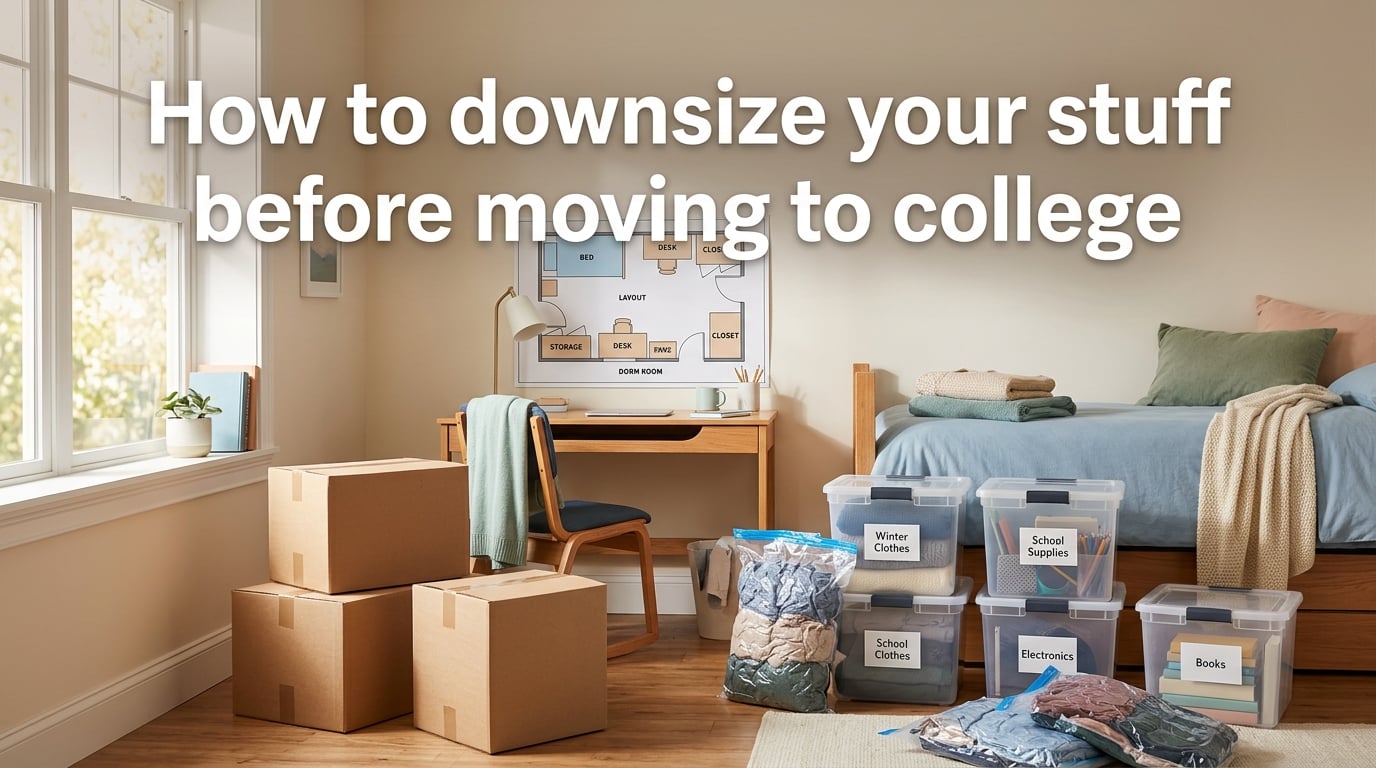
Knowing how to downsize your stuff before moving to college is one of the most important steps you can take for a smooth transition. Dorm rooms typically measure just130 to225 square feet of shared space — and that includes your roommate’s half. I learned this the hard way during my freshman year when I showed up with two full carloads and spent the first week tripping over boxes.
Downsizing isn’t about throwing everything away. It’s about being intentional so you arrive with exactly what you need, nothing more. Whether you’re an incoming freshman or a parent helping your student prepare, this guide walks you through every step of the process.
Table of Contents
How to Downsize Your Stuff Before Moving to College: The Quick3-Step Process
If you want the short version, here’s the three-week timeline that works for most students:
- Week1 — Sort everything. Walk through your room and create three piles: Keep, Donate/Sell, and Trash. Use the60-day rule: if you haven’t worn or used it in the last two months, it probably doesn’t come with you.
- Week2 — Act on your piles. Donate usable items to local charities, sell higher-value pieces on Facebook Marketplace or Poshmark, and recycle anything broken or expired. This is also when you coordinate with your roommate to avoid duplicate appliances.
- Week3 — Pack only the Keep pile. Use compression bags for clothes, pack a “first-night box” with essentials, and leave sentimental items stored safely at home.
That’s it. Three weeks, three steps, zero move-in day panic. Now let’s break down each phase in detail.
The Three-Pile Method: How to Decide What to Keep
The three-pile method is the simplest framework for downsizing before college. You sort every item into one of three categories: Keep, Donate/Sell, or Trash/Recycle.
Here’s how to make the decision on each item:
- Keep: You’ve used it in the last60 days, it fits in your dorm, and it serves a clear purpose. Clothes you actually wear, your laptop, essential toiletries — these make the cut.
- Donate/Sell: It’s in good condition but you haven’t touched it in months. Old textbooks, clothes that don’t fit, kitchen gadgets you never opened — someone else can use these.
- Trash/Recycle: It’s broken, expired, or worn out. Dried-up markers, stained clothes, outdated electronics — let them go.
The60-day rule is particularly useful for clothes. Students on Reddit report that most people actually wear just10 to15 shirts and4 to6 bottoms throughout an entire semester. Anything beyond that sits in your drawer untouched.
Category-by-Category Breakdown: What to Keep, Donate, or Toss
Here’s a quick-reference table to help you decide what to bring to college and what to leave behind:
| Category | Keep | Donate/Sell | Trash/Recycle |
|---|---|---|---|
| Clothes | 10-15 versatile tops,4-6 bottoms,1-2 jackets, comfortable shoes you actually wear | Out-of-season clothes, items that don’t fit, duplicates | Stained, torn, or worn-out items |
| Books | Current textbooks (check if digital versions exist),1-2 pleasure reads | Old textbooks (sell on Chegg, Decluttr, or Amazon Trade-In), novels you’ve finished | Damaged books, outdated editions |
| Electronics | Laptop, phone, charger, headphones, portable battery | Old tablets, unused gaming consoles, duplicate cables | Broken chargers, outdated accessories |
| Kitchen | Reusable water bottle,1-2 microwave-safe containers (if your dorm allows a microwave) | Small appliances (check meal plan coverage first), extra dishes, specialty gadgets | Chipped mugs, expired pantry items |
| Decor | 1-2 meaningful pieces, photos that fit in frames, a small plant | Bulky posters, extra throw pillows, decorative items that take up floor space | Broken or faded decor |
| Toiletries | Travel-size essentials for the first week, prescription medications | Full-size bottles (buy travel-size when you arrive), bulk items | Expired products, half-empty bottles |
One thing forum users consistently mention: campus computer labs and printers mean you don’t need a personal printer. Students who brought one almost universally report it collected dust. Same goes for bulk school supplies — wait until you see your syllabus before buying anything beyond basics.
What to Do With Items You’re Not Bringing
Once you’ve sorted your piles, you need to actually get rid of the Donate/Sell and Trash piles. Here are your best options:
Donate. Local thrift stores, Goodwill, and campus donation drives are the easiest route. Many colleges organize end-of-summer donation events specifically for incoming students. You’ll clear your space and help someone else in the process.
Sell. Facebook Marketplace, Poshmark (for clothes), Decluttr (for electronics and media), and Chegg (for textbooks) are popular platforms. Forum users report selling items1 to2 weeks before move-out nets a solid chunk of spending money for the semester. Higher-value items are generally worth listing on these platforms.
Store at home. If you have sentimental items or seasonal gear you’ll need later, ask your parents about keeping one or two labeled plastic bins in a closet or garage. This is far cheaper than renting a storage unit.
Rent a storage unit. If you’re an out-of-state student or your family needs the space, a5x5 storage unit works for most students’ overflow. A5x10 unit handles larger items like furniture. Look for climate-controlled options if you’re storing electronics or leather goods.
Gift to friends or family. Sometimes the best home for an item is with someone you know. Books, decor, and kitchen items often find new life this way.
Recycle responsibly. Electronics can go to Best Buy’s recycling program, and many municipalities accept e-waste at no charge. Don’t toss old batteries or electronics in the regular trash.
Handling Sentimental Items Without the Guilt
This is where most people get stuck. You haven’t worn that varsity jacket in years, but it represents four years of high school sports. Your childhood stuffed animal hasn’t left the shelf since middle school, but letting it go feels like erasing your past.
Here’s what actually works: keep one meaningful bin. Fill a single plastic storage tote with the items that genuinely matter — your favorite childhood photos, a graduation cap, a few awards. Everything else can be photographed and digitized.
Digital preservation is powerful. Scan old letters, photograph trophies, and save them in a cloud folder. You keep the memory without the physical clutter. As one Reddit user put it, “I kept one large plastic tub of sentimental items at home, and I’ve never regretted not bringing them to my dorm.”
Gift meaningful items to family members who’d appreciate them. Your grandmother might love your childhood quilt far more than your dorm floor would.
Smart Packing Hacks That Maximize Dorm Space
Once you’ve downsized to your Keep pile, packing it efficiently makes a huge difference. Students consistently rank vacuum/compression bags as the number one dorm-packing hack. Here’s why they work so well:
- Compression bags for clothes. Roll your clothes tightly, seal them in compression bags, and you’ll fit twice as much in half the space. This alone can reduce your clothing volume by50 to60 percent.
- Roll, don’t fold. Rolling clothes instead of folding them saves space and reduces wrinkles. It’s a simple switch that makes a real difference.
- Use vertical space. Stackable bins, over-door organizers, and hanging shelf units turn unused vertical space into storage. Dorm rooms have high ceilings for a reason.
- Pack a first-night box. Put your essentials — sheets, toiletries, phone charger, change of clothes, medications — in one clearly labeled box. You’ll thank yourself when you’re exhausted from moving and just need to sleep.
Avoid bringing full-size furniture like futons or armchairs. Forum users report these crowd the room and may actually be banned by housing policies. Stick to what your dorm bed and desk can handle.
7 Common Downsizing Mistakes to Avoid Before College
Even with the best intentions, these mistakes trip up students every year:
- Ignoring dorm restrictions. Candles, hot plates, extension cords, and space heaters are banned in most residence halls. Check your school’s housing policies before packing anything with a heating element.
- Duplicating with your roommate. Both of you don’t need a mini fridge, microwave, or TV. Coordinate through your school’s housing portal or a shared spreadsheet before move-in day.
- Overpacking kitchen gear. If you have a meal plan, you probably don’t need much beyond a water bottle and a few microwave-safe containers. Students consistently report that microwaves, kettles, and mini fridges are the most duplicated items in dorms.
- Bringing bulk school supplies. Wait until you see your syllabus. You might need a graphing calculator for one class and nothing else. Buying in advance often means buying the wrong things.
- Packing at the last minute. Last-minute packing leads to poor decisions. Three weeks out gives you time to sort thoughtfully instead of shoving everything into boxes in a panic.
- Keeping “just in case” items. If you haven’t used it in two months, the “just in case” scenario probably isn’t coming. Trust the60-day rule.
- Skipping the emotional work. Downsizing has an emotional component. Rushing through sentimental items leads to either bringing too much or feeling regret later. Give yourself time to process what these items mean to you.
Frequently Asked Questions
When should I start downsizing for college?
Start three weeks before move-in day. Week one is for sorting everything into Keep, Donate/Sell, and Trash piles. Week two is for actually donating, selling, or gifting those items. Week three is for packing only your Keep pile using space-saving techniques like compression bags.
What is the three-pile method for decluttering before a move?
The three-pile method means you sort every item you own into one of three categories: Keep (used in the last 60 days), Donate/Sell (good condition but not needed), and Trash/Recycle (broken, expired, or worn out). This simple framework makes decision-making faster and more consistent than going item by item.
How many clothes should I bring to college?
Most students actually wear about 10 to 15 shirts and 4 to 6 bottoms throughout a semester. Use the 60-day rule: if you haven’t worn it in the last two months, leave it behind. You can always swap seasonal clothes during breaks when you visit home.
What items should I not bring to college dorms?
Most residence halls ban candles, space heaters, hot plates, extension cords, and halogen lamps. Also skip personal printers (campus labs cover this), full-size furniture, bulk kitchen appliances if you have a meal plan, and anything you haven’t used in the last 60 days.
How do I avoid overpacking for college?
Start sorting three weeks early, use the 60-day rule for clothes, coordinate with your roommate to avoid duplicates, and remember that dorm rooms are 130 to 225 square feet of shared space. Students report that compression bags and rolling clothes instead of folding cut their packing volume by half.
What should I do with sentimental items when moving to college?
Keep one meaningful plastic bin at home with your most important mementos. Photograph or scan the rest so you preserve the memories digitally without the physical clutter. You can also gift sentimental items to family members who would appreciate them.
Is it worth renting a storage unit for college?
For most students, storing items at home in one or two labeled bins is the cheapest option. If your family needs the space or you’re an out-of-state student, a 5×5 storage unit handles most overflow. Look for climate-controlled options if you’re storing electronics.
Final Thoughts on Downsizing Before College
Learning how to downsize your stuff before moving to college is really about giving yourself the freedom to start fresh. You don’t need to bring everything from your childhood bedroom — and you probably shouldn’t. By following the three-week timeline, using the three-pile method, and packing smart with compression bags and vertical organizers, you’ll arrive at your dorm room ready to settle in without the chaos of overpacking.
Give yourself permission to let go of what no longer serves you. Your dorm room is small, your semester will be busy, and the less time you spend managing clutter, the more time you’ll have for everything college has to offer.