
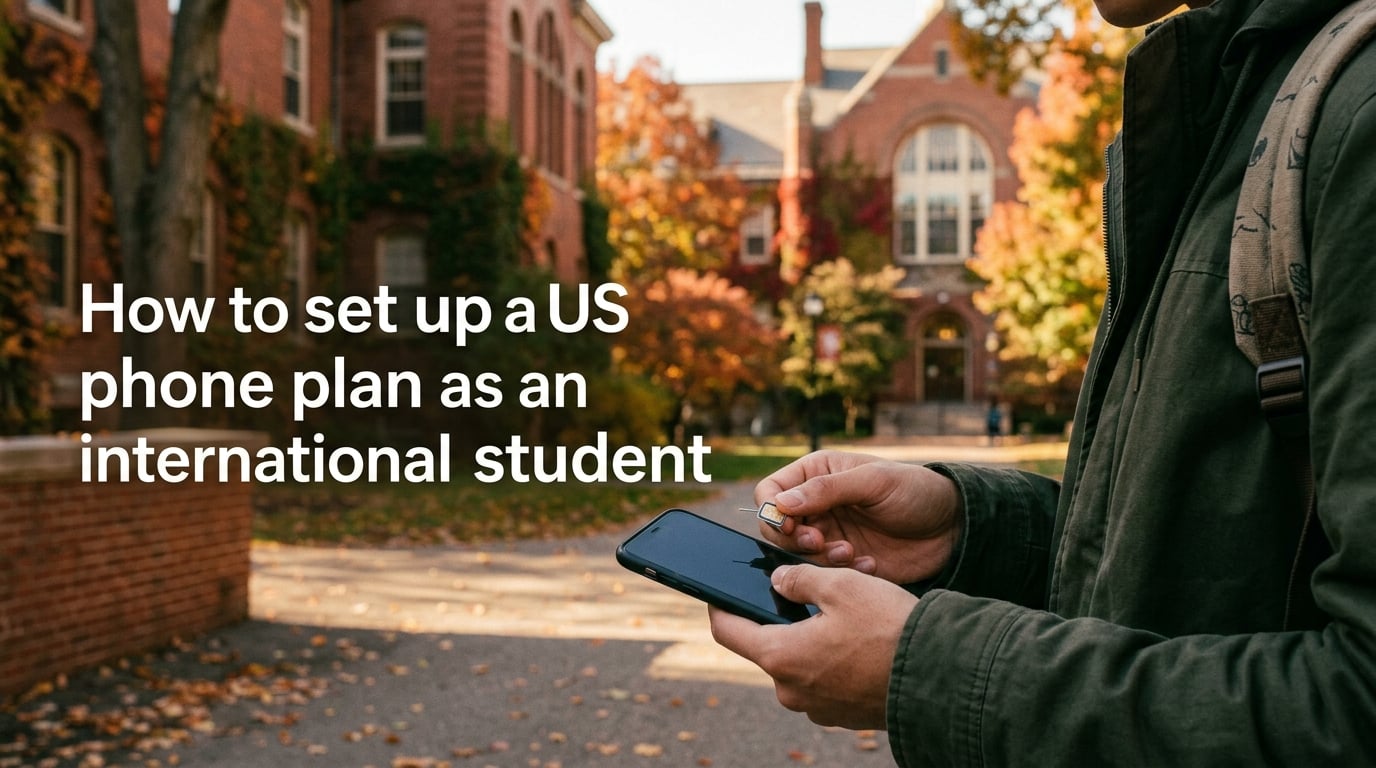
When I arrived in the US as an international student, the first thing I realized I needed — before furniture, before even opening a bank account — was a working US phone number. You can’t verify your identity for banking apps, call an Uber, or even log into your university portal without one. This guide walks you through exactly how to set up a US phone plan as an international student, from choosing the right carrier to activating your SIM card within your first week on campus.
Table of Contents
Why You Need a US Phone Number as an International Student
A US phone number isn’t a luxury — it’s a daily necessity. Without one, you’ll run into problems with nearly every service that makes life in America functional.
Banking requires a US number. Chase, Bank of America, and Wells Fargo all require a working US phone number to open an account and set up two-factor authentication (2FA). You cannot complete their online verification with an international number. This is usually the first thing that forces international students to get a US plan.
Two-factor authentication is everywhere. Your university login, student email, financial aid portal, and even campus Wi-Fi typically send verification codes via SMS to a US number. Without it, you’ll be locked out of essential academic systems.
Ride-sharing and delivery apps depend on it. Uber, Lyft, DoorDash, and Instacart all verify accounts with a US phone number. If you plan to get around campus or order groceries during your first week, you need one immediately.
Housing and DMV appointments use phone verification. Apartment applications, landlord communications, and DMV appointment confirmations are all routed through your US phone number. Some landlords even require a US number on the lease application itself.
When Should You Set Up Your Phone Plan?
Most international students should set up their US phone plan within the first three to five days of arriving in the country. While some carriers let you purchase a plan online before arrival, activating service almost always requires a US address and a US payment method — things you typically don’t have until you land.
If you’re arriving with an unlocked phone: Wait until you arrive. Purchase a prepaid SIM card or activate an eSIM once you have your campus address. This avoids activation issues and ensures your number is tied to your actual location.
If your phone is locked to a carrier in your home country: You’ll need to either unlock it before traveling (contact your home carrier) or buy an affordable unlocked phone in the US. Budget Android phones are available for under $100 at Best Buy, Walmart, or Amazon.
Quick arrival checklist:
Confirm your phone is unlocked and GSM-compatible
Have your passport, visa, and I-20 or DS-2019 ready
Know your US address (dorm, apartment, or host family address)
Bring a credit or debit card that works internationally for the first payment
How to Set Up a US Phone Plan as an International Student
Setting up a US phone plan takes about 30 minutes once you have your documents ready. Here’s the step-by-step process:
Step 1: Check your phone’s compatibility. Your phone must be unlocked and support US GSM networks (T-Mobile and AT&T bands). Most phones sold internationally in the last five years work fine. You can check compatibility on any carrier’s website by entering your phone’s IMEI number — find it by dialing *#06# on your device.
Step 2: Gather your documents. You’ll need your passport, F-1 or J-1 visa stamp, I-20 or DS-2019 form, your US address, and a payment method. A Social Security Number (SSN) is not required for prepaid plans. If a carrier asks for one at signup, choose a prepaid option instead of postpaid.
Step 3: Choose between prepaid and postpaid. For most international students, prepaid is the better choice. Prepaid plans don’t require a credit check, don’t need an SSN, and let you cancel anytime without fees. Postpaid (contract) plans typically require a US credit history, may charge a security deposit of $100 to $500, and lock you into a longer commitment.
Step 4: Pick your carrier. Compare carriers based on coverage in your area, monthly price, data allowance, and whether they include international calling. MVNOs (Mobile Virtual Network Operators) like Mint Mobile, Tello, and Visible use the same networks as T-Mobile, AT&T, and Verizon but cost significantly less.
Step 5: Activate your plan. If you’re using a physical SIM card, order it online or pick one up at a carrier store, Walmart, Target, or Best Buy. Insert it, follow the activation prompts, and your US number will be live within minutes. For eSIM, download the carrier’s app, scan the QR code, and activate — no physical card needed.
Best Prepaid Carriers for International Students
Not all carriers treat international students the same. Some require SSNs, others charge hidden fees, and a few offer genuinely student-friendly plans. Here’s how the most popular prepaid options compare:
| Carrier | Starting Price | Data | Network | SSN Required | International Calling |
|---|---|---|---|---|---|
| Mint Mobile | $15/mo (paid annually) | 5GB–Unlimited | T-Mobile | No | Add-on available |
| T-Mobile Connect | $15/mo | 5GB | T-Mobile | No | Wi-Fi calling |
| Visible | $19/mo | Unlimited | Verizon | No | Wi-Fi calling |
| Tello | $10/mo | 1GB–Unlimited | T-Mobile | No | Free to 60+ countries |
| Ultra Mobile | $10/mo | 1GB–Unlimited | T-Mobile | No | Free to 90+ countries |
| Cricket Wireless | $30/mo | 5GB–Unlimited | AT&T | No | Add-on available |
| Panda Mobile | $15/mo | Unlimited | T-Mobile | No | Included to select countries |
Our recommendation: If you call home frequently, Tello or Ultra Mobile offer the best international calling packages. For raw data value on a budget, Mint Mobile’s annual plan is hard to beat. For the simplest setup with no-commitment unlimited data, Visible is a strong choice running on Verizon’s network.
SIM Card vs eSIM: Which Should You Choose?
A physical SIM card is a small chip you insert into your phone’s SIM tray. An eSIM (embedded SIM) is a digital version that’s downloaded directly to your device. Both give you a US phone number, but they differ in important ways.
Physical SIM card pros: Works on virtually every phone, easy to swap between devices, available at retail stores with instant pickup, and universally recognized by all carriers.
eSIM pros: No shipping wait, activated instantly through an app, and you can keep your home country SIM active simultaneously on phones that support dual SIM.
Important warning: Not all eSIMs provide a US phone number. Some travel eSIMs from providers like Airalo or Holafly give you data only — no calling or texting capability. If you need a US number for banking and 2FA, confirm the plan includes voice and SMS before purchasing. Stick with carrier eSIMs (T-Mobile, Mint, Visible) for a complete service.
Money-Saving Tips for International Students
Phone bills add up fast, especially on a student budget. Here are proven ways to cut your costs:
Use Wi-Fi calling whenever possible. Most US carriers include Wi-Fi calling at no extra charge. If you spend most of your time on campus or at home with Wi-Fi, you can use a smaller data plan and save monthly.
Enable auto-pay discounts. T-Mobile, Cricket, and Visible all knock a few dollars off your monthly bill when you set up automatic payments from a US debit card or bank account.
Share a family plan. Some carriers offer group discounts. Splitting a family plan with other international students in your program can cut per-line costs by 30-50%.
Start with a lower data tier. Monitor your actual usage for the first month. Many students find they use less than 5GB of cellular data monthly because campus and home Wi-Fi handle most of their needs.
Avoid long-term commitments initially. Start with a month-to-month plan until you know your pattern. Switching carriers is easy when you’re on prepaid.
International Calling: Staying Connected with Family
Calling home from the US can get expensive if you rely on traditional carrier rates. Here’s how international students keep costs down:
Wi-Fi calling apps are your best friend. WhatsApp, FaceTime, Google Voice, and Skype let you call or video chat with family anywhere in the world for free when connected to Wi-Fi. Most international students use these daily.
Carriers with built-in international calling: Tello includes free calling to over 60 countries, and Ultra Mobile covers 90+ countries in their plans. If you make frequent calls to a specific country, these carriers can save you the hassle of juggling apps.
A VoIP option for landlines: If your family prefers landline calls, services like Google Voice or Rebtel offer low per-minute rates to landlines worldwide. Google Voice charges nothing for calls to US numbers and has competitive international rates.
Frequently Asked Questions
What is the best phone plan for international students in the USA?
Prepaid plans from Mint Mobile, Tello, Visible, and Ultra Mobile are the top choices for international students. They require no SSN, no credit check, and start as low as $10 per month. Tello and Ultra Mobile include free international calling to many countries, making them especially popular with students who call home frequently.
Can international students get a SIM card in the USA?
Yes, international students can buy a prepaid SIM card with just a passport, visa, and US address. No Social Security Number or US credit history is required for prepaid plans. SIM cards are available at carrier stores, Walmart, Target, Best Buy, or online for delivery.
Do international students need an SSN to get a phone plan?
No, prepaid plans from carriers like Mint Mobile, T-Mobile, Visible, Tello, and Cricket do not require an SSN. Only postpaid contract plans typically ask for one. If a signup form requires an SSN, switch to a prepaid option instead — you’ll get the same service without the credit check.
How much does a phone plan cost for international students in the USA?
Prepaid phone plans for international students range from $10 to $30 per month for basic service, and $15 to $50 per month for unlimited data. Budget MVNOs like Tello start at $10, while unlimited plans from Visible cost around $19. Taxes and regulatory fees typically add $3 to $8 on top of the advertised price.
Should I get a SIM card or eSIM as an international student?
A physical SIM card is the safer choice because it works on every phone and is easier to swap between devices. eSIM is more convenient if your phone supports it, but make sure the eSIM plan includes a US phone number — some travel eSIMs provide data only without voice or SMS capability.
Can I use my phone from my home country in the USA?
Yes, if your phone is unlocked and supports US GSM bands (used by T-Mobile and ATu0026amp;T). Most modern smartphones sold internationally work on US networks. Check your phone’s IMEI number on any carrier’s compatibility tool to confirm before purchasing a plan.
Conclusion
Setting up a US phone plan as an international student is one of the first things you should do after landing. With just a passport, visa, and your campus address, you can have a working US phone number within 30 minutes — no SSN, no credit history, and no long-term contract required. Start with a prepaid plan from a carrier like Mint Mobile, Tello, or Visible, and you’ll be connected to everything from your university portal to your family back home before your first class even starts.