
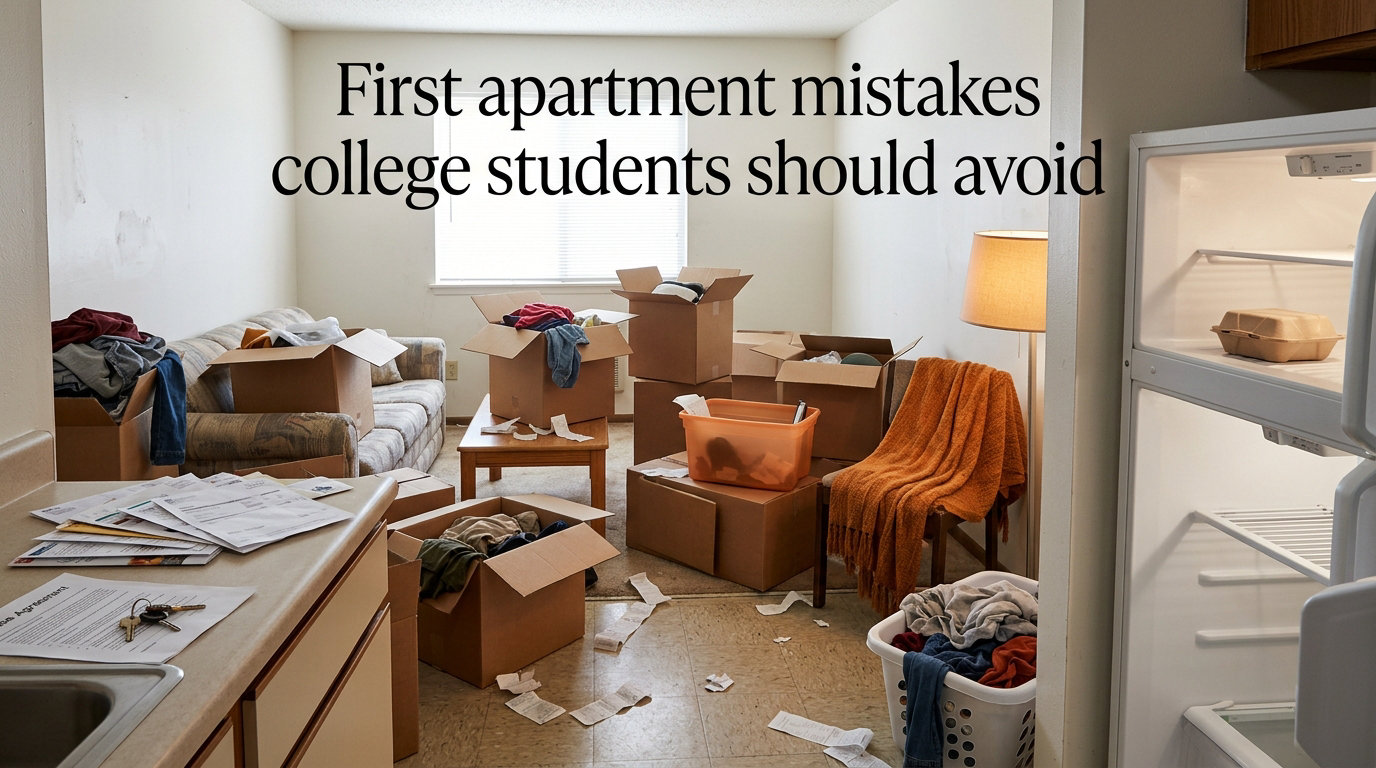
Moving into your first apartment is one of the most exciting milestones of college life, but it is also the moment when small mistakes become expensive lessons. We have talked with first-time renters, read hundreds of forum threads, and reviewed what the top advice sites publish, and one pattern keeps showing up: the same handful of first apartment mistakes trip up college students year after year.
This guide walks you through the twelve first apartment mistakes college students should avoid, plus a red-flag checklist, a move-in inspection routine, and a clear answer to the renter’s insurance question. By the end, you will know exactly what to budget for, what to photograph, what to ask the landlord, and what to read twice in your lease before you sign.
Table of Contents
The 12 First Apartment Mistakes at a Glance
If you only have a minute, here is the short list. Each mistake has its own section below with the practical steps to avoid it.
- Going over budget and forgetting total monthly costs
- Renting sight-unseen without an in-person tour
- Not reading the lease fine print
- Ignoring move-in damage and failing to document everything
- Choosing the wrong roommate, or living alone when you cannot afford it
- Skipping renter’s insurance because it seems optional
- Underestimating utility setup and monthly bills
- Paying for amenities you do not actually use
- Falling for subleasing pitfalls and summer scams
- Ignoring guarantor or cosigner requirements
- Not budgeting for groceries, transit, and everyday life costs
- Skipping the move-in cleaning and appliance check
1. Going Over Budget and Forgetting Total Monthly Costs
The single most common first apartment mistake college students make is signing a lease based on the rent number alone and ignoring everything else that lands on the monthly bill. Rent is just the starting line; utilities, internet, renter’s insurance, parking, and groceries add hundreds of dollars on top.
A reliable rule of thumb is the 30% rule: your rent should stay at or below 30% of your take-home pay (income after taxes). If you only work part-time or rely on student loans, use the 50/30/20 budget instead, which spends 50% on needs, 30% on wants, and 20% on savings or debt. Run your actual numbers before you tour anything.
Ask the leasing office for a full list of monthly costs: base rent, water/sewer/trash, electric, gas, internet, parking, pet fees, and amenity fees. One r/Apartmentliving user summed it up well after their first year: “I budgeted for rent, forgot about electric heat in winter, and ended up eating pasta for a month.” Avoid that outcome by building a 12-month spreadsheet before signing.
2. Renting Sight-Unseen Without an In-Person Tour
Virtual tours and glossy listing photos make it tempting to sign for an apartment you have never stepped inside, but most apartment hunting mistakes start here. Wide-angle lenses hide small rooms, edited photos hide stained carpets, and listings often skip the leaky faucet in the second bathroom.
Always do an in-person walk-through before signing. Test every faucet, flush every toilet, run the shower on full heat, open and close every window, flip every light switch, and check that the stove, oven, microwave, dishwasher, and laundry all work. Photograph anything that looks off and ask the landlord in writing to fix it before move-in.
If you truly cannot visit in person, send a trusted friend or family member and ask them to record a video walk-through. Treat any landlord who refuses a physical visit as a red flag, and never wire money or pay a deposit before you have a signed lease and verified ownership.
3. Not Reading the Lease Fine Print
The lease is a legally binding contract, and apartment lease mistakes usually come from skimming instead of reading. Many college students sign what their parents sign off on without understanding the clauses that affect their wallet and their freedom.
Before you sign, read these sections line by line:
- Lease term and renewal terms (12 months standard, but some are 9 or 18)
- Monthly rent, late fees, and grace period
- Security deposit amount, where it is held, and the conditions for return
- Early termination and lease break clause, including any fee
- Subleasing rules, including whether you are allowed to sublet at all
- Pet policy, guest policy, and noise rules
- Who pays for repairs and how to submit maintenance requests
- Required renter’s insurance minimums
If anything is unclear, ask for it in writing. Verbal promises from a leasing agent are notoriously hard to enforce, so an email confirmation is worth more than a friendly handshake.
4. Ignoring Move-In Damage and Failing to Document Everything
The single fastest way to lose a security deposit is to move in without documenting the apartment’s existing condition. Landlords assume any new damage is yours, and without evidence you have almost no leverage at move-out.
On move-in day, walk through the entire unit with your phone camera rolling. Photograph and video every wall, floor, ceiling, appliance, fixture, window, and closet. Pay extra attention to scuffs, scratches, stains, broken blinds, dripping faucets, and signs of pests. Note the date and time on every file, and send the photos to your landlord by email the same day so they have a timestamp.
Many leases include a move-in inspection form. Fill it out, keep a copy, and write “see attached photos” if the form does not have space. A Reddit r/Renters user learned this the hard way: they moved in, found holes in the closet walls and under the sink, and had no proof they were not responsible. Do not let that be you.
5. Choosing the Wrong Roommate or Living Alone When You Cannot Afford It
Roommate mistakes are among the most common college apartment mistakes. Picking a friend because it is convenient, picking someone you barely know because the room is open, or refusing to live with anyone at all can drain your budget or your sanity.
Before signing with a roommate, have an honest money conversation. Ask about income, spending habits, and willingness to split utilities, groceries, and shared supplies. Talk through guests, overnight stays, chores, quiet hours, and how disagreements will be handled. Put the rules in writing, even an informal shared Google Doc, so expectations are clear on day one.
Living alone sounds great until you see the math. A studio in a college town often costs 40% to 60% more than a shared two-bedroom. If your budget is tight, a vetted roommate is usually the smarter financial move, and the social support is a bonus when things go wrong.
6. Skipping Renter’s Insurance Because It Seems Optional
Renter’s insurance for college students is one of the most overlooked fixes in this whole guide. None of the top competitor articles cover it well, which is why it appears as a red flag in our own checklist. Most leases either require it or assume you have it, and a basic policy costs less than a streaming subscription per month.
A standard policy covers your personal belongings against theft, fire, smoke, water damage from burst pipes, and certain liability claims if someone is injured in your unit. If your laptop, textbooks, and bike are worth more than a few thousand dollars combined, the math makes sense on its own.
Ask your landlord for their minimum coverage requirement, then shop a few quotes online. Many insurers offer a student discount, and some student health plans or campus affiliates bundle renter’s insurance in. Carrying proof of active coverage on move-in day prevents last-minute scrambling.
7. Underestimating Utility Setup and Monthly Bills
Hidden utility costs are a recurring theme in r/personalfinance threads about first-time renting. Electric, gas, water, sewer, trash, internet, and sometimes even heat are billed separately from rent, and setup deposits can hit your account before you have moved a single box.
Plan ahead by calling each utility provider at least two weeks before move-in. Ask about setup fees, average monthly cost for the unit size, whether budget billing is available, and what the average winter and summer swings look like. Electric heat in cold climates and electric AC in hot climates can swing a bill by 60% or more between seasons.
Budget a one-time “move-in” pot of cash beyond your security deposit to cover utility activation fees, internet installation, basic cleaning supplies, and a few meals while you settle in. Treating this as a fixed cost line item instead of a surprise makes the first month far less stressful.
8. Paying for Amenities You Do Not Actually Use
Amenity fees look like a deal on paper: pool, gym, roof deck, package room, business lounge. In practice, many renters pay for amenities they visit twice a year. A doorman building in a college town can add several hundred dollars a month over a comparable walk-up across the street.
Ask yourself honestly how often you will use each amenity. If you already have a gym membership, the building gym is wasted money. If you bike to class, paying for a reserved parking spot makes no sense. If you study at the library, the rooftop lounge is decoration.
Compare the all-in monthly cost (rent plus amenity fees) to a no-frills alternative in the same neighborhood. Sometimes the cheaper building is the better deal once fees are added, and sometimes the amenity-rich building actually costs less per square foot. Run the numbers, not the photos.
9. Falling for Subleasing Pitfalls and Summer Scams
Subleasing pitfalls catch students every summer, especially when a roommate heads home and you are stuck finding a subletter fast. Scams range from fake subtenants who send fraudulent cashier’s checks to legitimate subtenants who trash the place and disappear.
Check your lease first. Some landlords allow subletting only with written approval, others ban it outright, and a few require the subtenant to apply through the same screening process you did. Subletting without permission is a lease violation that can put your deposit and your housing at risk.
If subletting is allowed, screen the subtenant the same way your landlord screened you: photo ID, proof of income or enrollment, references, and a signed sublease that spells out rent, dates, utilities, and damage responsibility. Collect a reasonable deposit, do a walk-through together at move-in and move-out, and keep your landlord in the loop.
10. Ignoring Guarantor or Cosigner Requirements
Guarantor and cosigner rules catch many college students off guard because most students have little or no credit and limited rental history. A landlord typically requires a parent, guardian, or other adult with stable income and good credit to co-sign the lease, accepting financial responsibility if you cannot pay.
Without a cosigner, your application may be denied, or you may be pushed into buildings with looser standards, which often charge higher deposits or premiums. If your family cannot cosign, ask about lease guaranty services that act as a paid stand-in cosigner, build credit with a secured card now so you qualify on your own later, or look for buildings that specialize in student housing with no-cosigner paths.
Never lie on an application or use someone else’s information. If a landlord approves you and later discovers the misrepresentation, you can be evicted and lose your deposit. Honest applications protect both you and your cosigner.
11. Not Budgeting for Groceries, Transit, and Life Costs
Rent gets all the attention, but groceries, transit, phone bills, textbooks, laundry, and weekend outings quietly eat 30% to 50% of a student’s monthly budget. Underestimating these is one of the easiest first time renter mistakes to make, and one of the hardest to undo once the semester starts.
Build a starter monthly budget the week before you move in. Estimate food at a realistic weekly amount (not the optimistic one), include a transit pass or gas and insurance for a car, add phone and streaming subscriptions, and leave room for one social outing per week. Set up a separate “sinking fund” account for predictable annual costs like a parking sticker or textbook restocks.
Aim to keep a small emergency cushion, even if it is only a few hundred dollars. Dishwashers break, car tires pop, and surprise medical bills do not wait for payday. The first month is when these surprises hit hardest, and a small cushion turns a crisis into an inconvenience.
12. Avoiding the Move-In Cleaning and Setup Checklist
Most leases do not require a deep clean before you unpack, but skipping it is a hidden mistake. Even in a recently vacated unit, prior tenants’ germs, dust, and grime settle in places you would not expect. A Reddit r/AskReddit thread put it bluntly: “Clean everything when you move in, especially the kitchen and bathroom. Disregard anything you’ve been told about it being cleaned prior to your move-in.”
Spend the first afternoon wiping down kitchen cabinets, scrubbing the bathroom tile, disinfecting the toilet and shower, vacuuming under furniture the prior tenant left behind, and washing any curtains or removable fabric. Test every smoke detector and carbon monoxide alarm the day you move in, and replace batteries if they are older than six months.
Walk the apartment with a checklist: every outlet has power, every drain empties, every door locks, every window latches, the thermostat works, the garbage disposal runs, and the breaker panel is labeled. Catching these on day one is far cheaper than catching them at move-out.
Red Flags When Renting an Apartment
Direct answer: the biggest red flags when renting an apartment are pressure to sign immediately, requests for cash-only deposits, refusals to allow an in-person tour, missing or vague lease terms, and any landlord who will not provide their name or ownership details in writing.
Other warning signs include listings with stock photos that do not match the address, pricing that is far below comparable units in the neighborhood, a leasing office that is hard to reach, and reviews that mention unreturned security deposits. Walk away if the landlord refuses to put verbal promises in writing, asks you to pay before signing, or pushes you to skip the application process.
For college students specifically, beware of “no credit check” buildings that bundle high monthly fees, mandatory add-ons, or non-refundable deposits into a low advertised rent. Cheap headline pricing often means expensive reality.
Your Move-In Checklist: What to Inspect and Photograph
This printable move-in inspection routine takes about 45 minutes and protects your security deposit when you move out.
- Walls, ceilings, and baseboards in every room, including closets
- Floors, carpet stains, and any scratches on hard surfaces
- Windows: locks, screens, seals, and condensation between panes
- Doors: hinges, knobs, deadbolts, and doorbell function
- Kitchen appliances: stove, oven, microwave, dishwasher, fridge, and garbage disposal
- Bathroom fixtures: shower pressure, hot water, toilet flush, and any leaks
- Plumbing under every sink for drips or water stains
- Electrical outlets, light switches, and any exposed wiring
- HVAC vents, thermostat, and any window AC units included
- Smoke and carbon monoxide detectors
- Outdoor areas, parking spot, mail key, and laundry access
Take timestamped photos of each item, attach them to an email to your landlord, and save the sent folder as proof. The 20 minutes you spend here can save you hundreds of dollars at move-out.
Renter’s Insurance for College Students: Why It Matters
Renter’s insurance is the single most underused tool in a college student’s renting toolkit. A basic policy bundles three protections into one low monthly bill: personal property coverage for your belongings, liability coverage if someone is hurt in your unit, and additional living expenses if the apartment becomes uninhabitable.
For a typical student, the monthly cost is modest, often under what a single takeout dinner costs, and the deductible is usually a few hundred dollars. Compare that to replacing a stolen laptop, a flooded bookshelf of textbooks, or a liability claim from a friend who slips in your hallway, and the value is obvious.
If your parents carry homeowners insurance, ask whether you are covered as a dependent living away at school. Many policies extend limited coverage to student residents, but the limits are often low. Carrying your own policy removes the ambiguity and protects everyone involved.
Frequently Asked Questions
What are common first apartment mistakes college students should avoid?
The most common first apartment mistakes college students should avoid are going over budget, renting sight-unseen, ignoring the lease fine print, failing to document move-in damage, choosing the wrong roommate, skipping renter’s insurance, underestimating utility costs, paying for unused amenities, falling for subleasing scams, overlooking guarantor requirements, ignoring life-cost budgeting, and skipping the move-in cleaning checklist.
What is the 50/30/20 rule for rent and how do college students use it?
The 50/30/20 rule splits your take-home income into three buckets: 50% for needs (rent, utilities, groceries, transit), 30% for wants (eating out, entertainment, subscriptions), and 20% for savings or debt repayment. College students with limited income can use it to confirm that rent alone stays inside the 50% needs bucket, leaving room for everything else.
What are the biggest red flags when renting an apartment?
The biggest red flags when renting an apartment are pressure to sign immediately, requests for cash-only or wire-transfer deposits, refusals to allow an in-person tour, vague or missing lease terms, landlords who will not share ownership details, listings with stock photos that do not match the address, and pricing that is dramatically below comparable units in the same neighborhood.
Do college students need renter’s insurance and is it worth it?
Yes, college students need renter’s insurance and it is almost always worth it. Basic policies cost a small monthly amount and cover theft, fire, smoke, water damage from burst pipes, and personal liability. Many leases require it, and the cost is far less than replacing a laptop, phone, or textbooks out of pocket.
What should college students look for during an apartment walk-through?
During an apartment walk-through, college students should test every faucet and shower, flush every toilet, run every appliance, check every outlet and light switch, open and close every window and door, photograph any scuffs or damage with timestamps, test smoke and carbon monoxide detectors, look for signs of pests, and ask the landlord in writing to fix any issues before signing the lease.
Final Thoughts on First Apartment Mistakes College Students Should Avoid
Walking through these first apartment mistakes college students should avoid is really about building a few good habits before you sign anything. Set a real budget, tour the unit in person, read every line of the lease, document the condition on move-in day, pick your roommates with care, and protect yourself with renter’s insurance. Each of those steps is small on its own, but together they prevent the financial stress, lost deposits, and lease headaches that derail so many first-time renters.
Start with the move-in checklist in this guide, then revisit the red-flag list before you wire any money. If you keep your eyes open and your paperwork tight, your first apartment will be the foundation for the next decade of independent living, not a semester you wish you could redo.