
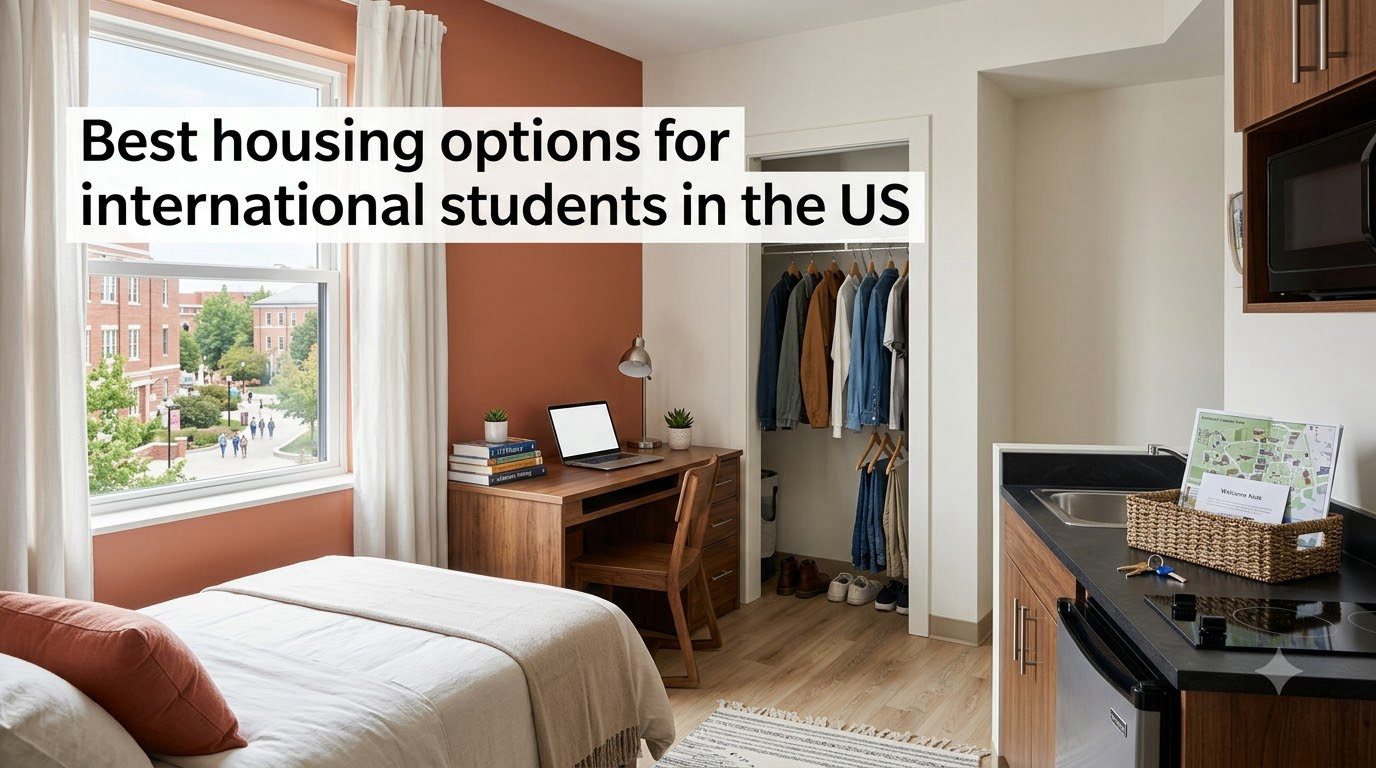
Finding the best housing options for international students in the US can feel overwhelming when you are thousands of miles away, unfamiliar with local rental laws, and unsure whether a co-signer is required. I have helped friends navigate this exact process for the last several years, and the truth is that the right housing choice depends on your visa status, budget, and how much independence you want. This guide walks through every realistic option, the documents you will need, how much it actually costs in major US cities, and how to avoid the scams that target international students.
Most international students end up choosing one of six main paths. Each comes with different costs, social experiences, and visa implications, so we will look at all of them.
Table of Contents
6 Main Housing Types for International Students at a Glance
Before diving into details, here is a quick overview of the housing types available to international students across the United States. Use this as your starting map, then read the sections below for full breakdowns.
- On-campus dorms: University-owned residence halls, usually with shared rooms, meal plans, and built-in student community.
- University apartments: On-campus apartments often reserved for upperclassmen, graduate students, and students with families.
- Off-campus apartments: Private-market studios, one-bedrooms, and larger units rented from individual landlords or property management companies.
- Shared housing: Renting a room in a house or apartment with other students, the most common setup for budget-conscious renters.
- Homestays: Living with a vetted American family who provides a room and sometimes meals, popular with younger undergraduates and language-learners.
- Greek housing: Fraternity and sorority residences, available at larger universities with active Greek life.
Purpose-built student accommodation (PBSA) is a seventh option that blends on-campus and off-campus features; it is covered in the off-campus section below.
On-Campus Housing Options (Dorms, University Apartments, Greek Housing)
On-campus housing is the easiest option for first-year international students because the university handles the application, the lease is short, and no US credit history is required. Most schools give incoming F-1 students priority placement if they apply by the housing deadline.
University Dormitories and Residence Halls
Dorms are the classic starting point. You typically share a room with one roommate, share bathrooms by floor, and buy a meal plan that covers most of your food. The advantage is community: resident advisors organize events, friends live down the hall, and you never have to navigate a US lease negotiation. The disadvantage is limited privacy and a fixed move-in window that may not match your flight arrival.
University-Managed Apartments
Many larger universities operate on-campus apartments for older undergraduates, graduate students, and students with spouses or children. These units give you a kitchen, a private bedroom, and sometimes a living room, while still letting you pay rent through your student account and skip the credit check. They are often the safest option for new PhD students who arrive without a US co-signer, and many programs explicitly recommend graduate housing for the first year.
Greek Housing (Fraternity and Sorority Houses)
Greek housing is chapter-specific housing run by fraternities and sororities. Living in a chapter house typically requires being an active member and can include meals, study rooms, and built-in social networks. It is more common at large state universities and is rarely the first choice for international students who arrive without established social ties, but it can be a strong cultural experience once you have settled in.
Off-Campus Housing Options (Apartments, Houses, Shared Housing)
Off-campus housing gives you more independence, more space, and often a lower monthly cost than a dorm. The trade-off is that you must navigate a US rental application, which usually involves credit history, a co-signer, and a 12-month lease. International students frequently underestimate how much paperwork this involves until they are mid-search.
Private Rentals and Studio Apartments
Studio and one-bedroom apartments are rented directly from landlords or through property management companies. National listing sites such as Zillow, Apartments.com, Trulia, and Rent.com let you filter by price, lease length, and move-in date, while university-specific portals often list rentals from alumni landlords. Studios in college towns tend to be the cheapest private-market option, while studios in New York and San Francisco can be among the most expensive.
Shared Housing and Finding Roommates
Shared housing means renting a bedroom in a house or apartment while sharing the kitchen, living room, and bathrooms with other students. It is the most common setup for international students on a budget, and rent is usually all-inclusive (utilities, Wi-Fi, sometimes even furniture). Finding reliable roommates before you arrive is the hard part. University Facebook groups, the subreddit for your school, and platforms like Roomsurf and Roomi are the most common tools, but you should never send money to a roommate you have only met online.
Purpose-Built Student Accommodation (PBSA)
Purpose-built student accommodation is a relatively new category of off-campus housing designed specifically for students. Buildings offer individual leases, fully furnished rooms, on-site amenities like gyms and study lounges, and sometimes shuttle service to campus. Operators include both national brands and local providers, and they typically market directly to international students because they do not require US credit history or a co-signer. PBSA is more common in larger cities and tends to cost more than a shared house but less than a private studio.
Homestays: Living with an American Family
A homestay is an arrangement where a vetted American family rents you a private bedroom in their home, often with meals and utilities included. Homestay programs are typically run by nonprofit agencies or cultural organizations that match students with screened host families. The setup is most popular with high-school exchange students, younger undergraduates, and students who want to improve their English while learning American culture firsthand. Graduate students tend to prefer more independence, but a homestay can also work as a first-month bridge while you search for a long-term apartment.
Homestays vary widely in cost and rules. Some include three meals a day and laundry; others are room-only. Always ask for a written agreement that covers curfew, kitchen access, guest policy, and how disputes are handled, and make sure the agency is accredited so you have recourse if anything goes wrong.
Documents Checklist: What You Need to Rent
Before you start contacting landlords, gather the documents most US rental applications ask for. Having everything ready in a single PDF folder saves weeks of back-and-forth once you find a place you like.
- Valid passport showing your full legal name and country of citizenship.
- F-1 or J-1 student visa stamp or change-of-status approval notice.
- I-20 form (for F-1) or DS-2019 (for J-1) issued by your university.
- Letter of admission or proof of enrollment from your school’s international student office.
- Bank statements (usually 3-6 months) showing you can cover rent and living expenses.
- Proof of income or sponsor letter, often required when there is no US credit history.
- Tax returns (Form 1040 or equivalent) if you have any US income history.
- Social Security card or ITIN if you have one, though most landlords will accept the visa instead.
- References from a previous landlord, employer, or professor.
- Renter’s insurance is often requested before move-in, especially in larger buildings.
Landlords in larger cities may also run a background and credit check. If you have no US credit, the credit check usually comes back thin rather than negative, and your visa plus proof of funds can substitute for a credit score.
Co-Signers and Guarantors: Renting Without US Credit History
If your credit history is short or nonexistent, most US landlords will require either a co-signer or a guarantor. The two terms are often used interchangeably, but they mean different things legally.
A co-signer signs the lease alongside you and is equally responsible for rent from day one. If you miss a payment, the landlord can pursue the co-signer immediately. A guarantor, by contrast, only becomes responsible if you personally default. Most landlords also require the co-signer or guarantor to be a US resident with verifiable income, which can be a hurdle if your family is abroad.
If you cannot find a qualifying co-signer, look into third-party guarantor services. Companies like Insurent, TheGuarantors, and Rhino specialize in acting as a lease guarantor for a one-time fee, typically a percentage of one year’s rent. They are accepted by many large property management companies and are often the fastest path to approval for international students with strong bank statements but no US ties.
Some landlords will waive the co-signer requirement entirely if you prepay several months of rent upfront, sign a shorter lease, or provide a larger security deposit. Always ask – the worst they can say is no.
Budgeting and Cost Comparison by City
Housing costs vary enormously across the US. A studio apartment in Manhattan is many times more expensive than a shared room in a college town. Knowing realistic numbers helps you avoid listings that look cheap but end up doubling once fees are added.
For New York City, a private studio typically rents for 2,500 to 4,000 per month in outer boroughs and 3,500 to 5,500 in Manhattan. A bedroom in a shared apartment runs 1,400 to 2,200. In Los Angeles, expect 1,800 to 2,800 for a private studio and 1,000 to 1,700 for a shared bedroom. Boston, San Francisco, and Washington DC sit in a similar high-cost band. Chicago and Atlanta drop to roughly 1,200 to 1,800 for a studio. Mid-size college towns (think State College, Ann Arbor, Madison, or College Station) usually fall between 700 and 1,200 for a shared room and 900 to 1,400 for a studio.
Beyond the base rent, budget for hidden first-month costs. Most landlords require first month’s rent, last month’s rent, and a security deposit equal to one month’s rent before move-in. In some cities, especially New York, brokers charge 12-15% of the annual rent as a fee. Application fees of 50 to 200 per adult are standard. Furniture for an unfurnished unit can run another 1,000 to 3,000 if you buy new. Renters’ insurance is usually under 20 per month but is sometimes required.
Step-by-Step: How to Find Housing From Abroad
Searching for housing from another country is harder than searching in person, but a clear process makes it manageable. Here is the workflow I have seen work for the most students.
- Start 4-6 months before arrival. On-campus housing deadlines close early, and the best off-campus listings go fast.
- Decide on a shortlist of neighborhoods. Use Google Maps to measure walking or transit distance to campus, then check transit passes and shuttle availability.
- Open a US bank account or FX card. Many landlords require ACH transfers, and FX cards let you lock in exchange rates before rent is due.
- Request a virtual tour. Reputable landlords and PBSA operators will do live video walk-throughs. Refuse listings that cannot or will not show you the actual unit.
- Read the full lease before signing. Look for lease length, early-termination clauses, subletting rules, and who pays for utilities.
- Pay small holding deposits only through verified channels. Never wire money to an individual, and never pay a full deposit before signing a lease.
- Confirm move-in logistics with your international student office; many schools run airport pickup and temporary housing programs for new arrivals.
Lease Review Checklist and How to Avoid Rental Scams
Before you sign any US lease, read it carefully and confirm you understand every clause. US leases are legal contracts, and once you sign, breaking them is expensive.
- Lease length and renewal terms: A 12-month lease is standard, but some schools run 9-month academic-year leases. Make sure the dates match your program.
- Early-termination fee: Know what you owe if you leave early. International students returning home for a family emergency need a clear exit path.
- Subletting rules: Many leases ban subletting without written approval. Check this if you plan to travel during summer break.
- Utilities and amenities: Clarify which costs are included (water, electric, internet, trash, parking) and which you pay separately.
- Maintenance responsibility: Understand who fixes what and how quickly. Document the unit’s condition on move-in day with timestamped photos.
- Renters’ insurance: Often required; confirm the minimum coverage before buying.
Rental scams specifically target international students. Common red flags include listings priced well below market, requests to wire money before signing, landlords who refuse video calls, deposits requested before you have toured the unit, and pressure to sign within hours. If a deal sounds too good to be true, it almost always is. Stick with verified platforms, your university’s off-campus housing office, and listings where you can confirm the landlord owns the property.
Frequently Asked Questions
What is the best housing for international students in the US?
The best housing depends on your priorities, but most international students start with university dorms or shared off-campus housing. Dorms offer built-in community and no credit check, while shared housing is cheaper and gives more independence.
Where do most international students live in the US?
Most international students live in on-campus dorms during their first year and then move to off-campus shared apartments or studios in their second and third years. Urban universities like NYU, Columbia, and USC have a much higher off-campus share because on-campus supply is limited.
Can international students rent an apartment in the US?
Yes. International students on F-1 or J-1 visas can legally rent any apartment in the US. The challenge is not legality but the rental application: most landlords require US credit history, proof of income, and either a US-based co-signer or a third-party guarantor.
Do international students need a co-signer to rent in the US?
Most do, because they have no US credit history. A co-signer must be a US resident with verifiable income. If no family member qualifies, services like Insurent, TheGuarantors, and Rhino act as lease guarantors for a one-time fee.
What documents do international students need to rent an apartment?
You will need a valid passport, F-1 or J-1 visa, I-20 or DS-2019 form, proof of enrollment, three to six months of bank statements, proof of income or a sponsor letter, and references. Some landlords also request a Social Security card or ITIN, although a visa alone is usually enough.
How much does student housing cost in the US?
Shared rooms run 700 to 1,400 per month in most college towns and 1,400 to 2,200 in major cities. Studios range from 900 to 1,400 in college towns to 2,500 to 5,500 in New York. Always budget an extra one to four months of rent for deposits and broker fees.
What is a homestay for international students?
A homestay is a housing arrangement where a vetted American family rents you a private room in their home, often with meals and utilities included. Homestays are most popular with younger undergraduates, exchange students, and language-learners who want cultural immersion and a supportive household.
How do international students avoid rental scams?
Refuse to wire money to individuals, never pay a deposit before touring the unit, insist on a live video walk-through, verify the landlord owns the property, and stick to reputable platforms. If a listing is priced far below market or pressures you to sign immediately, walk away.
Finding the Right Fit
The best housing options for international students in the US are the ones that match your visa status, budget, and comfort with independence. Most students do well starting in on-campus housing for the first semester, then transitioning to a shared apartment or PBSA unit once they have built a social network and learned how US leases work. Start your search early, gather your documents, line up a co-signer or third-party guarantor, and you will have a safe place to live long before you board your flight.