
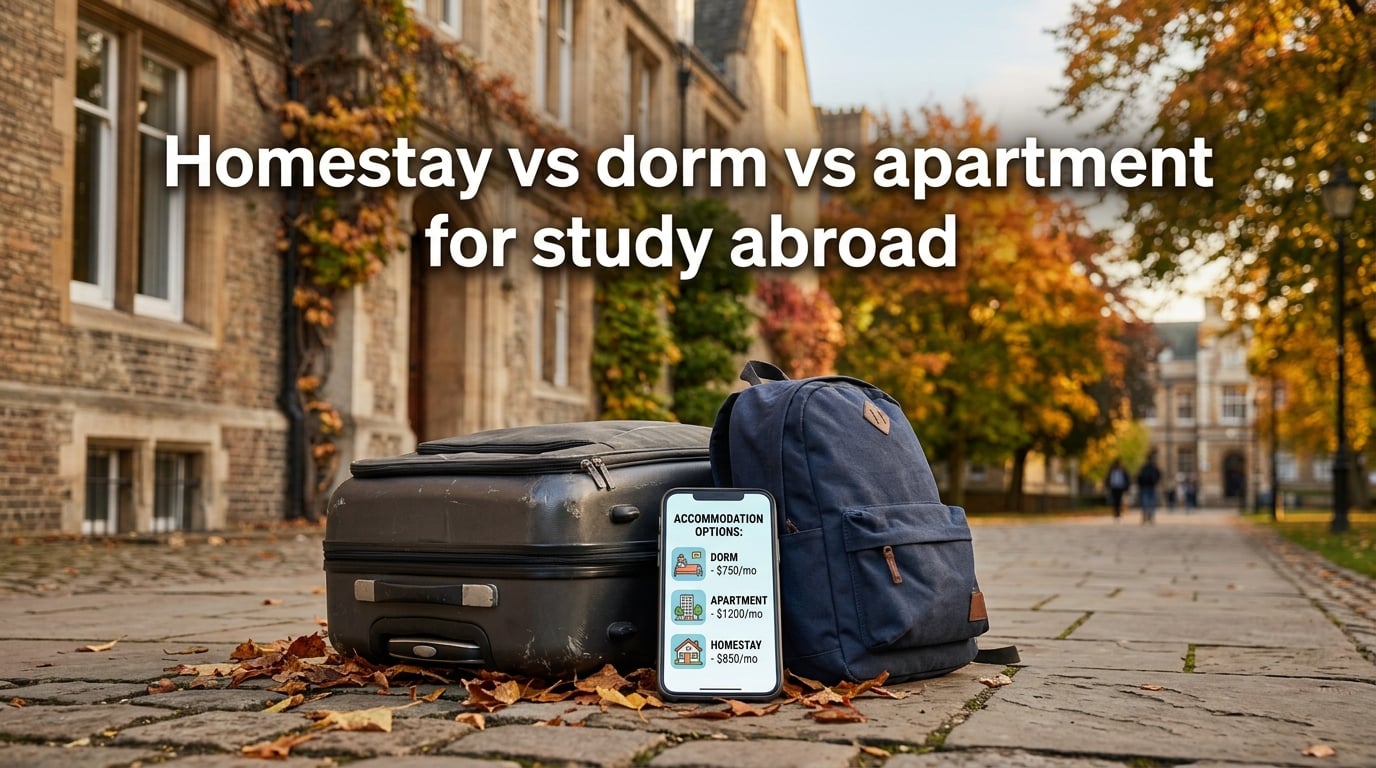
A homestay means living with a local host family who provides a room and usually meals. A dormitory (or residence hall) is university-run shared housing on or near campus. A private apartment is a self-managed rental you share with flatmates or live in alone. Each option shapes your budget, social life, language skills, and daily routine in completely different ways during your study abroad experience.
Choosing between a homestay, dorm, and apartment for study abroad is one of the most consequential decisions you’ll make before arriving in a new country. The right fit depends on your personality, your study goals, and how much independence you want. In this guide, I’ll break down each housing type honestly—drawing on real student experiences, cost data, and practical advice—to help you decide.
Table of Contents
Homestay vs Dorm vs Apartment: At a Glance
| Factor | Homestay | Dormitory | Apartment |
|---|---|---|---|
| What it is | Room in a local family’s home | University-run residence hall | Self-managed rental (solo or shared) |
| Typical cost | Moderate (meals often included) | Moderate to high | Varies widely by city |
| Meals | Usually included | Meal plan or self-catering | Self-catering |
| Privacy | Low to moderate | Low (shared rooms common) | High |
| Social life | Family-oriented | Built-in peer community | Self-directed |
| Cultural immersion | Highest | Moderate (often international peers) | Lowest |
| Independence | Low (house rules, curfews) | Moderate | Highest |
| Ideal for | Language learners, short-term, first-timers | Social students, first-year undergrads | Long-term students, older/experienced travelers |
Homestay: Living with a Host Family
A homestay places you in the home of a local family, typically in a private bedroom with shared common areas. Most homestay programs include at least breakfast and dinner, and some provide all three meals. You’ll follow household rules—think curfews, meal times, and expectations around noise and guests.
Pros of Homestay
- Daily language practice. You speak the local language at meals, during errands, and in casual conversation. Students on short-term programs report noticeable fluency gains within weeks.
- Cultural immersion you can’t get elsewhere. Holidays, family dinners, neighborhood routines—you experience daily life the way locals do.
- Meals and utilities included. This simplifies budgeting. No shopping, cooking, or utility bills to manage when you first arrive.
- Built-in support system. Your host family can help with local navigation, doctor visits, cultural confusion, and homesickness.
Cons of Homestay
- House rules feel restrictive. Curfews, meal schedules, and guest policies are common. If you value coming and going freely, this can chafe.
- Homesickness hits differently. Being surrounded by a family that isn’t yours can amplify feelings of missing home—a pain point students on Reddit mention repeatedly.
- Compatibility is unpredictable. Some host families are warm and inclusive; others treat hosting as a transaction. Students report a wide range of experiences.
- Language barrier frustration. Some hosts default to English even when you’re trying to practice, especially if your local language skills are beginner-level.
Who Should Choose a Homestay
Language learners on a semester abroad, first-time international travelers who want a safety net, and students on short-term or summer programs. If your primary goal is cultural exposure and you’re comfortable adapting to someone else’s household rhythm, a homestay delivers the richest day-to-day immersion.
Dormitory / Residence Hall: On-Campus Community
A dormitory—called a residence hall in the UK and Australia—is university-managed housing located on or very near campus. Rooms are typically shared (double or triple occupancy), though single rooms exist at some universities. Common areas, communal kitchens, and laundry facilities are standard.
Pros of Dormitory
- Instant peer community. Dorms put you alongside other students—often other international students—who are navigating the same experience. Friendships form fast.
- Walking distance to classes. No commute, no bus schedules. You roll out of bed and you’re there.
- On-site support staff. Resident advisors (RAs) and 24/7 front-desk staff handle maintenance issues, safety concerns, and roommate conflicts.
- Structured social programming. Dorm events, floor dinners, and orientation activities help you settle in—especially valuable if you’re shy or arriving alone.
Cons of Dormitory
- Limited privacy. Shared rooms, thin walls, and communal bathrooms are the norm. If you need quiet to study or decompress, this is a real issue.
- Roommate mismatch. Different sleep schedules, cleanliness standards, and noise tolerance create friction. Some students describe this as the hardest part of dorm life.
- Less cultural immersion. International dorms often feel like a bubble—you may end up socializing mostly with other exchange students rather than locals.
- Meal plan quality varies. Dorm meal plans range from excellent to barely edible, depending on the university and country.
Who Should Choose a Dorm
First-year undergraduate students, anyone who values a ready-made social circle, and students who want to be close to campus resources. If you thrive on communal energy and don’t mind sharing space, dorms make the transition abroad much smoother.
Private Apartment / Share House: Full Independence
A private apartment means signing a lease (alone or with flatmates) and managing your own household—rent, utilities, groceries, cleaning, everything. In Australia, these are often called share houses. In Spain, you might hear piso compartido. The terminology changes, but the core experience is the same: you’re on your own.
Pros of Apartment
- Total freedom. No curfews, no meal schedules, no house rules. Come and go as you please, cook what you want, host friends anytime.
- Choose your own flatmates. Unlike dorms, you pick who you live with. Many students share apartments with friends they’ve made during their first semester.
- More space and privacy. Even a shared apartment typically offers more personal space than a dorm room, with a real kitchen and living area.
- Best option for long-term stays. If you’re abroad for a full degree or multiple semesters, an apartment provides the stability and autonomy you need.
Cons of Apartment
- Hidden costs stack up fast. Security deposit, first and last month’s rent, utilities, internet, groceries, furniture (if unfurnished), transit passes—these add up to far more than the headline rent.
- Lease complications for international students. Some landlords require local guarantors, proof of income, or credit history that international students don’t have. Under-18 students often can’t sign at all.
- No built-in social network. You have to actively build your own community. Students who move into apartments alone report higher rates of isolation in the first few months.
- Scam risk. Offshore landlords, listings with no in-person viewing, and cash-only deposit requests are real red flags that international students encounter.
Who Should Choose an Apartment
Long-term degree students, experienced travelers, students who’ve already spent a semester abroad and want more independence, and anyone who prioritizes privacy and self-sufficiency. If you’re comfortable handling logistics in a foreign country, an apartment gives you the most control over your daily life.
The Real Cost: What’s Included vs What You Pay Extra
Rent is just the starting point. The true monthly cost of each housing option looks very different once you factor in what’s included and what comes out of your pocket.
| Cost Factor | Homestay | Dormitory | Apartment |
|---|---|---|---|
| Rent | Moderate | Moderate to high | Varies by city |
| Meals | Usually included | Meal plan or self-catering | You pay for all groceries |
| Utilities | Included | Usually included | You pay (electric, water, gas, internet) |
| Deposit | Varies (some have none) | Small refundable deposit typical | One to two months’ rent |
| Furniture | Furnished | Furnished | Often unfurnished |
| Transport | May be farther from campus | On campus or very close | Depends on location |
| Laundry | Often included | Coin-operated on site | You arrange (or find a laundromat) |
| Insurance | Covered by host family’s policy | University coverage typical | You need renter’s insurance |
Students on Reddit frequently mention that apartments feel cheaper on paper but cost more once you add utilities, internet, and groceries. Homestays often work out as the best value when you account for meals and bills being included—especially in expensive cities like London, Sydney, or Tokyo.
Cultural and Language Immersion: Which Housing Wins?
If language learning is a priority, a homestay is the clear frontrunner. Daily conversation with native speakers at breakfast, dinner, and in between forces you to practice in a natural, low-pressure setting. Students who choose homestays consistently report faster improvement in speaking confidence and listening comprehension.
That said, immersion quality depends heavily on the host family. Some hosts are patient, talkative, and eager to teach you. Others are busy, quiet, or default to English. The experience isn’t uniform—ask your program about the host family’s language habits before committing.
Dorms offer moderate cultural exposure, often through a mix of local and international students. You’ll pick up slang, cultural references, and social norms, but most dorm socializing happens in English (or whatever the shared language is). Apartments offer the least immersion unless you deliberately seek out local flatmates and social groups.
How to Choose: Match Your Housing to Your Personality and Goals
There’s no universal “best” option. The right housing depends on who you are and what you want from your time abroad.
Choose a homestay if you:
- Want to learn or improve a foreign language rapidly
- Are on a short-term or semester program
- Prefer having a support system close by
- Don’t mind adapting to household rules
- Are studying abroad for the first time
Choose a dorm if you:
- Want an instant social circle of fellow students
- Value being steps away from campus and student services
- Enjoy communal living and shared experiences
- Are a first-year undergraduate entering a new university
- Don’t need maximum privacy
Choose an apartment if you:
- Have already studied abroad for at least one semester
- Value privacy, quiet, and personal space highly
- Are comfortable managing logistics (leases, bills, groceries) in a foreign country
- Plan to stay for a full degree or multiple years
- Want to choose your own flatmates
Many students use a phased approach: homestay for the first semester to get oriented and build language skills, then move into an apartment or shared flat once they know the city and have a friend group. This is especially common in Spain, France, and Germany among study-abroad participants.
Country-by-Country Differences to Know
Housing norms vary dramatically depending on where you study. Here’s what to expect in popular study-abroad destinations:
United States
American dorms are the default for first-year students, often with meal plans and resident advisors. Homestays exist but are less common through university programs. Off-campus apartments require navigating lease agreements that may need a US-based guarantor.
United Kingdom
“Halls” (residence halls) are the standard for first-year students. They range from basic shared rooms to modern en-suite studios. Homestays are available through agencies but less common for university students. Private renting is typical from second year onward.
Australia
Share houses are the dominant student housing model. “College” (on-campus dorms) exist but are expensive and less common. Homestays are popular with students whose English is still developing. The rental market moves fast—start looking early.
Spain
Homestays are a popular choice for semester-abroad students, especially through programs like CIEE. Residencias (student residences) exist but vary in quality. Shared pisos (flats) are the go-to for longer-term students.
Germany
Studentenwerk (student services) offers affordable dormitory spots, but demand far exceeds supply. Many students end up in shared flats (WG—Wohngemeinschaft). Homestays are uncommon compared to other countries.
What If Your Housing Doesn’t Work Out?
It happens more often than people admit. Students on Reddit describe homestay compatibility issues, dorm roommate conflicts, and apartment lease problems as some of the most stressful parts of studying abroad. Here’s what to do:
Talk to your program coordinator first. Most study-abroad programs have a housing support team. If you’re in a homestay, they can mediate conversations with your host family or arrange a transfer to a different family. Don’t suffer in silence—programs expect some reassignments each semester.
Know your contract terms. For apartments, understand the notice period and any penalties for early termination before you sign. For homestays, ask about the switch policy during orientation—not after a crisis.
Document everything. If you’re dealing with unresponsive landlords, property damage disputes, or safety concerns, keep written records (emails, photos, dates). This protects you if you need to escalate.
Connect with other students. University international offices, student unions, and online groups (Facebook, WhatsApp, Reddit) are full of students who’ve navigated the same problems. Someone will know what to do or who to contact.
Frequently Asked Questions
What is the difference between a dorm and a homestay?
A dorm is university-managed shared housing on or near campus, typically with communal facilities and other students. A homestay means living in a private room inside a local family’s home, usually with meals included and household rules to follow.
Why do people choose homestay for study abroad?
Students choose homestays for daily language practice with native speakers, cultural immersion through family life, the convenience of included meals and utilities, and having a built-in support system in an unfamiliar country.
Which is cheaper: homestay or dorm?
It depends on the country and city, but homestays often work out cheaper overall because meals and utilities are included. Dorms may have lower base rent but require paying for meal plans, laundry, and other extras separately.
Is homestay better than dorm for language learning?
Yes, in most cases. A homestay provides daily conversation with native speakers at meals and during casual interactions, which accelerates speaking confidence and listening skills. However, some hosts default to English, so ask about the family’s language habits beforehand.
Can I switch housing after I arrive abroad?
Most study-abroad programs allow housing switches, especially from homestays. Contact your program coordinator to discuss options. For apartments, switching depends on your lease terms—check the notice period and any early-termination clauses before signing.
What type of accommodation is most popular for first-year students?
Dormitories are the most popular choice for first-year undergraduate students abroad. They offer proximity to campus, a built-in social network, and structured support through resident advisors and student services.
How much does student housing cost abroad?
Costs vary widely by country and city. As a rough range: homestays typically cost 400 to 800 per month (meals included), dorms range from 500 to 1,200, and apartments vary from 300 in affordable cities to 1,500 or more in expensive ones. Always factor in hidden costs like deposits, transport, and groceries.
Should I live in a dorm or apartment as an international student?
Choose a dorm if you want convenience, a social network, and proximity to campus—especially in your first semester. Choose an apartment if you’ve already spent time abroad, value privacy and independence, and are comfortable managing leases and bills in a foreign country.
Final Thoughts
Choosing between a homestay, dorm, and apartment for study abroad comes down to your priorities. If language immersion and cultural depth matter most, a homestay is hard to beat. If you want an instant community and campus convenience, go with a dorm. If you value independence and plan to stay long-term, an apartment gives you the most control. Many students find that the best approach is to start with a homestay or dorm for the first semester, then move into an apartment once they know the city. Whatever you choose, research your options thoroughly, ask questions before you commit, and give yourself permission to switch if it isn’t working.