
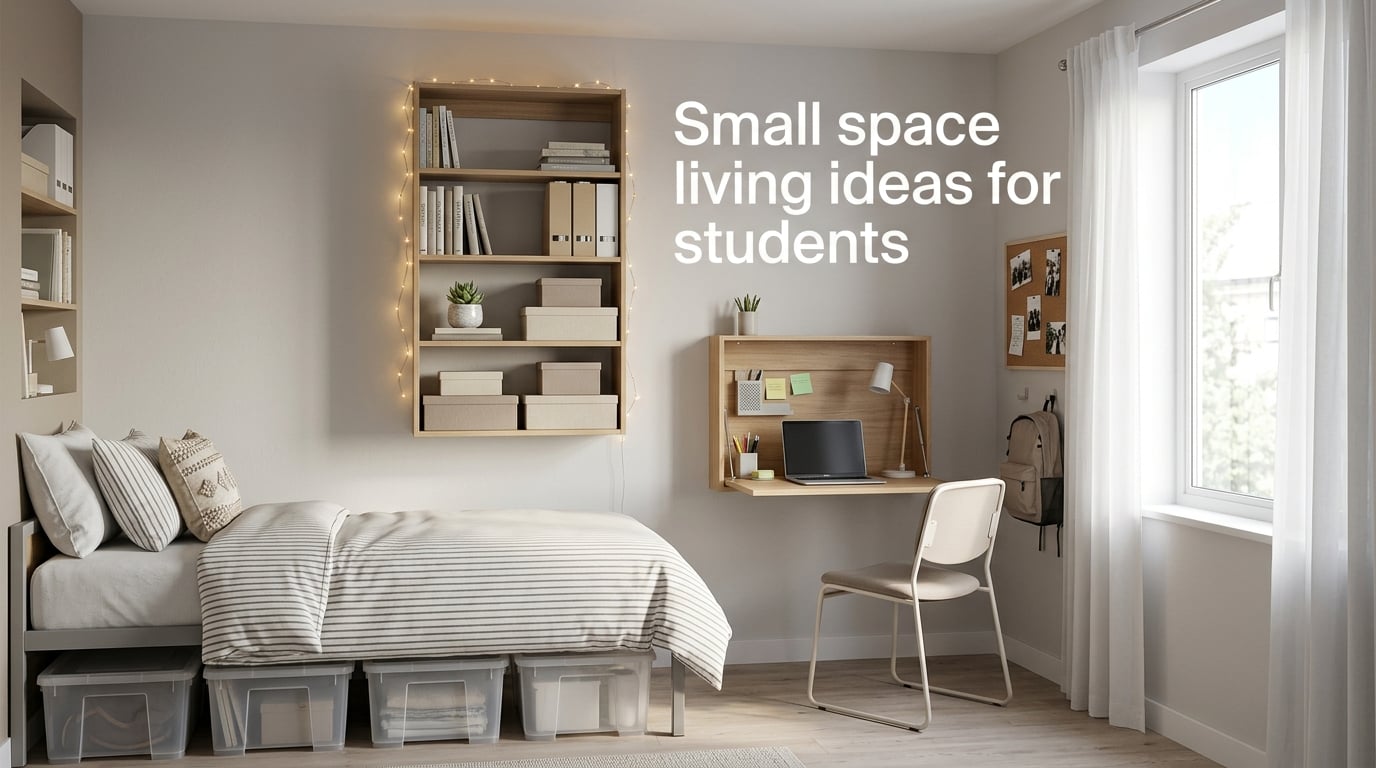
Living in a small dorm room or tiny apartment doesn’t mean you have to feel cramped all semester. After years of helping students transform their spaces, I’ve learned that the right small space living ideas for students can turn even a 10×8 foot room into a functional, comfortable home base. The key is working smarter with what you have.
College housing is expensive, and most students can’t choose their room size. But you can choose how to use every square inch of it. Whether you’re moving into a shared dorm, a studio apartment, or a cramped off-campus bedroom, these strategies will help you study better, sleep easier, and actually enjoy spending time in your space.
Table of Contents
Why Small Space Living Matters for Students
A cluttered room creates a cluttered mind. Research from the Princeton Neuroscience Institute shows that visual clutter competes for your attention, making it harder to focus on studying. When your brain is processing the mess around you, your cognitive performance drops.
For students, this translates directly to grades. A clean, organized space helps you find your notes faster, reduces morning stress when you’re rushing to class, and creates a calming environment for deep study sessions. Think of your room organization as a study tool, not just a chore.
Beyond academics, your room is your sanctuary. It’s where you decompress after tough exams, video call your family, and recharge for the next day. Making it feel spacious and organized pays dividends for your mental health throughout the semester.
The average college dorm room measures around 130 square feet shared between two students. Studio apartments for students rarely exceed 300 square feet. Working within those constraints requires planning and the right tools—but it’s absolutely doable.
Space-Saving Furniture Ideas for Student Rooms
The furniture you choose makes or breaks a small room. Standard-sized furniture designed for regular bedrooms will eat up your floor space in minutes. Instead, look for pieces built specifically for compact living.
Multifunctional Desks
A fold-down wall desk is one of the smartest investments you’ll make. These mount directly to the wall and fold flat when not in use, freeing up valuable floor space. Look for models with built-in shelving or a small corkboard on the inside panel. When the desk folds up, you suddenly have room for yoga, stretching, or just walking around without bumping into furniture.
If a wall-mounted desk isn’t possible, consider a corner desk that tucks into unused space. L-shaped desks fit perfectly in room corners and provide enough surface area for a laptop, textbooks, and a desk lamp without dominating the room. The key is measuring your corner first and choosing a desk with a depth under 24 inches so it doesn’t protrude too far into your living area.
Another option gaining popularity among students is a bed-desk combo—essentially a lap desk with a firm surface and cushion bottom that lets you work from your bed. While not ideal for long study sessions, these are perfect for quick tasks and don’t require any dedicated floor space at all.
Compact Seating Options
A full-size desk chair overwhelms a dorm room. Instead, try a folding stool or a slim-profile task chair that slides completely under your desk when you’re done studying. Some students swear by meditation cushions for floor-level studying, which can be stacked in a corner when not needed.
For hanging out with friends, floor cushions and poufs work great. They’re comfortable, inexpensive, and can be tossed into a closet or stacked when you need the floor space for something else.
Fold-Down and Convertible Pieces
A convertible futon or sleeper sofa serves double duty in studio apartments or larger dorm rooms. Use it as seating during the day and a bed at night. If you’re tight on space, a Murphy bed might be worth the investment for off-campus apartments where you can make modifications.
Nesting tables are another winner. They stack together during the day for a minimal footprint, then pull apart when you need extra surface area for group study sessions or dinner with friends.
Vertical Storage Solutions That Actually Work
When floor space is limited, think upward. Your walls are prime real estate that most students completely ignore. Vertical storage takes advantage of space you’re already paying for.
Wall-Mounted Shelving
Floating shelves above your desk, bed, or doorway hold books, decorations, and supplies without taking any floor space. Install them in rows of two or three to maximize the vertical area. Just make sure you check your dorm’s policy on wall mounting before drilling.
For dorms where drilling is off-limits, tension-rod shelving systems fit between the floor and ceiling. These adjustable units create storage columns that don’t leave a single mark on the walls. A corner shelf unit uses that awkward dead space where two walls meet—typically the most underutilized area in any dorm room.
A bookshelf turned on its side doubles as a room divider in shared spaces. Place it between your bed and your roommate’s area to create a sense of privacy while providing storage on both sides. Use the top surface for a plant, a lamp, or your alarm clock.
Over-Door Organizers
The back of your door is completely wasted space in most student rooms. Over-the-door shoe organizers aren’t just for shoes—use them to store toiletries, cleaning supplies, snacks, school supplies, and cables. Each pocket becomes a mini storage compartment.
Over-door hooks are equally essential. Hang your backpack, jacket, towel, or a small mirror without using any wall or closet space.
Hanging Systems
Hang a pegboard above your desk for organizing supplies, headphones, keys, and other small items you reach for daily. Pegboards are customizable and affordable, making them perfect for student budgets.
Adhesive wall pockets hold mail, papers, and your class schedule right where you can see them. Magnetic strips mounted on walls hold small metal items like scissors, bobby pins, and tool sets.
Under-Bed Storage Strategies
The space under your bed is the single largest storage area in most student rooms. The trick is making it accessible and organized rather than just shoving random items into the darkness.
Bed Risers for Extra Clearance
Bed risers add 3 to 8 inches of clearance under your bed frame, creating room for storage bins, drawers, and even mini-fridges. They cost almost nothing and instantly double your under-bed storage capacity. Choose risers with built-in outlets to add charging stations at the same time.
If your bed already has decent clearance, file folding your clothes instead of stacking them lets you fit significantly more into under-bed bins. This technique—popularized by organizing experts—involves folding clothes into rectangles and standing them upright like files in a drawer. You can see every item at a glance instead of digging through a pile.
Rolling Storage Drawers
Flat rolling drawers slide easily under the bed and pull out when you need something. Label each drawer by category—school supplies, clothes, electronics, toiletries—so you never have to dig through everything to find one item. Clear plastic bins work too, but rolling drawers make access much simpler.
A popular Reddit hack from r/ApartmentHacks is to use a flat rolling cart under the bed for shoes. It slides out when you’re getting dressed and rolls back into hiding when you’re done. No more tripping over sneakers scattered across the floor.
Vacuum Bags for Seasonal Items
Seasonal clothing takes up enormous closet space you can’t afford to spare. Vacuum storage bags compress bulky winter coats, sweaters, and bedding down to a fraction of their size. Store the compressed bags under your bed until the season changes. This is one of the best small space organization tips students overlook.
Closet Organization for Tiny Student Closets
Student closets are notoriously small. Many are barely deep enough for a standard hanger, and some shared dorm rooms have only one closet to split between two people. But with the right organizational tools, you can fit two to three times more clothing into the same space.
Start by decluttering before you move in. You won’t need your entire wardrobe at school—bring what fits the season and your class schedule, then swap items when you visit home. This single step saves more closet space than any organizer ever will.
Slim Velvet Hangers
Swap those bulky plastic and wire hangers for slim velvet ones. They take up about half the space and prevent clothes from slipping onto the closet floor. When you slim down your hangers, you can often fit 10 to 15 more garments on the same rod. Reddit users in r/dormrooms and r/college consistently rank slim hangers as their number one dorm hack.
Double-Rod Systems
A hanging double-rod system instantly creates two rows of hanging space from one. Use the top rod for longer items like dresses and jackets, and the bottom rod for folded pants, shirts, and skirts. These tension-mount systems don’t require any installation and can move with you when you relocate.
Door-Mounted Organizers
Mount a clear pocket organizer on the inside of your closet door for accessories, belts, scarves, socks, and underwear. This uses otherwise dead space and keeps small items visible and easy to grab when you’re getting dressed in a hurry.
Tech Setup and Cable Management
Most guides overlook this entirely, but managing your tech setup is one of the most important small space living ideas for students. Between laptops, phones, tablets, headphones, and chargers, the average student has a dozen cables competing for limited outlets and desk space.
A tangled mess of wires makes your desk feel chaotic even when everything else is tidy. Good cable management transforms your workspace from frustrating to functional—and it takes less than 30 minutes to set up properly.
Desk Charging Stations
A compact charging station or charging dock keeps all your devices powered and organized in one spot. Look for models with built-in cable management that hide the messy wires. Some even include USB-C and wireless charging pads, reducing the number of separate chargers cluttering your desk.
A desk-mounted power strip with USB ports eliminates the need for bulky adapters. Mount it to the edge of your desk with adhesive clips so it stays in place and doesn’t eat up desk surface area.
Cable Organizers
Cable clips that stick to your desk surface route cables exactly where you want them. No more fishing behind your desk for a fallen charger. Cable sleeves bundle multiple wires into a single clean tube, and velcro cable ties let you bundle and unbundle as needed.
Run cables along the back edge of your desk with adhesive cable channels. This keeps everything tidy and prevents your workspace from looking like a tangled mess.
Monitor Stands with Storage
A monitor stand or laptop riser lifts your screen to eye level (better for your neck and posture) while creating usable storage space underneath. Slide your keyboard, notebooks, or a small organizer tray under the elevated screen to reclaim desk space.
Budget-Friendly Dorm Decor Ideas
Decorating on a student budget is totally doable. You don’t need expensive furniture or designer accessories to make your room feel like home. Some of the best dorm decor costs almost nothing.
Removable Wallpaper and Wall Decals
Peel-and-stick wallpaper transforms bland dorm walls without damaging them. Use it as an accent wall behind your bed or desk to add personality. When move-out day comes, it peels off cleanly. Wall decals work the same way—add quotes, patterns, or designs that reflect your style.
Removable wallpaper for dorms is a hot topic in student forums because most housing agreements prohibit permanent changes. These products solve the problem completely.
Command Hooks and Strips
Command hooks are a student’s best friend. Hang fairy lights, picture frames, mirrors, towel racks, and organizational baskets without a single nail. The large hooks can hold up to 7.5 pounds, which is plenty for most dorm decorations. Stock up during back-to-school sales when they’re everywhere.
DIY Solutions That Save Money
Turn mason jars into pen holders. Use washi tape to decorate plain storage boxes. Hang a curtain rod above your closet or desk to create a decorative divider. Print free artwork from online sources and frame it with cheap frames from a dollar store. Pinterest and YouTube are full of DIY dorm room projects that cost under ten dollars to make.
Cork boards and pegboards make excellent DIY organizers. Buy a plain board, paint it to match your room colors, and mount it above your desk with adhesive strips. Pin your schedule, photos, and small accessories to it for an organized command center that costs almost nothing.
How to Make a Small Room Look Bigger
These visual tricks create the illusion of more space without actually changing your room’s dimensions. Interior designers use these same techniques in tiny apartments and studio lofts.
Color Strategies
Light, neutral colors make walls recede and rooms feel open. Stick to whites, creams, light grays, and soft pastels for your main surfaces—bedding, curtains, and wall decor. Add pops of color through small accent pieces like throw pillows or a desk lamp.
The 2/3 rule for living rooms is a design guideline where no single piece of furniture takes up more than two-thirds of a wall. This prevents the room from feeling crowded and leaves breathing space around each piece. Apply this principle when arranging your dorm furniture.
Mirror Placement
A large mirror placed opposite a window bounces natural light around the room and creates the illusion of depth. A full-length mirror leaning against a wall does double duty—it makes the space look larger and serves its practical purpose. Even a small mirror on your desk reflects light and opens up your visual field.
Lighting Tricks
Overhead fluorescent lighting in dorms feels harsh and institutional. Layer your lighting with a desk lamp, string lights, and a small floor lamp to create warmth and dimension. Multiple light sources at different heights make a room feel taller and more spacious than a single overhead fixture.
A warm-toned LED desk lamp with adjustable brightness serves triple duty: studying, reading, and ambient mood lighting. Clip-on lamps that attach to your bed frame or desk edge free up surface space. Smart bulbs that change color temperature throughout the day help you focus during study hours and wind down at night.
Avoid heavy, dark curtains. Sheer or light-filtering curtains let in natural light while maintaining privacy. If your dorm doesn’t allow curtain changes, lightweight tension-rod curtains can fit inside the window frame without any modifications.
Frequently Asked Questions
What are some ideas for a very small living room?
Focus on scale-appropriate furniture, vertical storage, and light colors. Use multifunctional pieces like storage ottomans and nesting tables. Mount shelves high on walls, use mirrors to create depth, and keep floor space as clear as possible. The goal is to make every piece serve at least two purposes.
What is the 2/3 rule for living rooms?
The 2/3 rule states that no single piece of furniture should take up more than two-thirds of any wall it sits against. This proportioning guideline ensures adequate breathing room around furniture and prevents the space from feeling cramped or overcrowded.
What are some good home ideas for a small space?
The best small space ideas include using vertical wall storage, choosing multifunctional furniture, installing under-bed storage solutions, using slim hangers to double closet capacity, and organizing cables with desk-mounted charging stations. Light colors and strategic mirror placement make rooms feel larger than they are.
What are some good DIY ideas for small spaces?
DIY small space solutions include making mason jar organizers for desk supplies, creating pegboard wall organizers for accessories, repurposing tension rods as closet dividers, building floating shelves from reclaimed wood, and using washi tape to customize plain storage bins. These projects typically cost under ten dollars each.
How do I maximize storage in a college dorm?
Use bed risers to add under-bed storage clearance, swap to slim velvet hangers for your closet, hang over-door organizers on every door, mount floating shelves above your desk, and use vacuum bags for off-season clothing. These five changes alone can triple your usable storage in a standard dorm room.
What colors make a small room look bigger?
Whites, creams, light grays, and soft pastels make small rooms feel open and airy. Cool tones like pale blue and mint green visually recede, creating the illusion of more depth. Use these light colors on large surfaces like bedding and curtains, then add bold accent colors sparingly through small decorative items.
Conclusion
Small space living ideas for students aren’t about sacrificing comfort—they’re about being intentional with every choice you make. The students who thrive in small spaces are the ones who plan ahead, choose multifunctional items, and stay organized throughout the semester.
Start with one or two changes from this list, like swapping your hangers or adding bed risers, and build from there. Once you see how much space you reclaim, you’ll be motivated to tackle the next area. By mid-semester, your tiny room will feel twice as functional and a whole lot more like home.
Bookmark this guide and revisit it before each move-in day. As your needs change from freshman year to senior year, these small space organization tips will help you adapt your setup without breaking the bank. Good luck this semester—you’ve got this.