
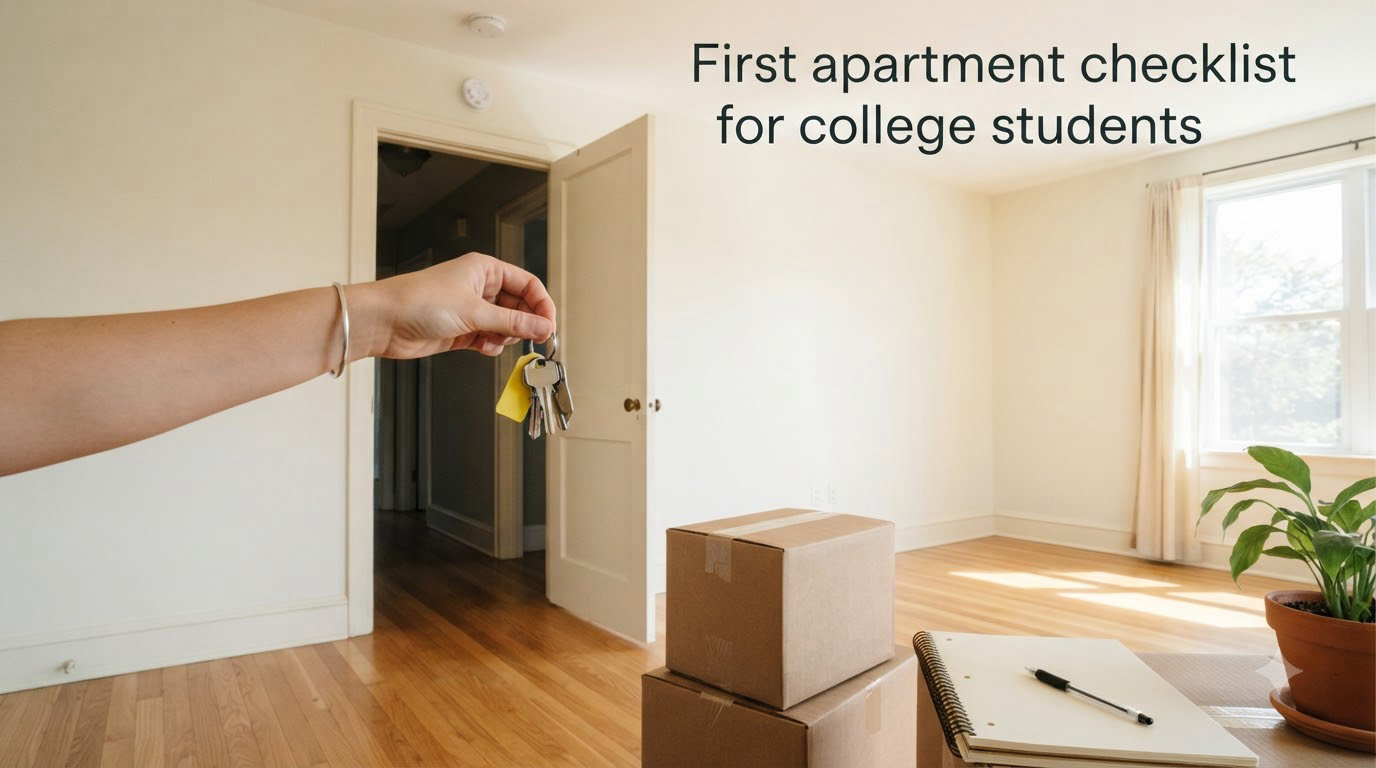
Moving into your first college apartment is exciting and overwhelming at the same time. You’re going from a tiny dorm room where everything was provided to a real apartment where you need everything from pots and pans to shower curtains. Our team put together this first apartment checklist for college students so nothing gets forgotten on move-in day.
We’ve talked to hundreds of students who’ve made this transition, and the biggest regret we hear is always the same: “I wish I had a list like this before I started shopping.” Whether you’re moving off-campus mid-semester or setting up your first place after graduation, this room-by-room guide covers what you actually need. We’ve also included budget ranges, roommate coordination tips, and a move-in day documentation checklist that protects your security deposit.
This checklist is organized by room with clear categories. We separated true day-one essentials from nice-to-haves so you can prioritize when money is tight. Bookmark this page, print it out, or save it to your phone — you’ll want it handy during your shopping trips.
Table of Contents
What You Actually Need vs. What You Think You Need
Before you fill three shopping carts at Target, take a breath. Reddit users in r/ApartmentHacks and r/college constantly warn about the same mistake: buying too much stuff you’ll never use. The truth is your first college apartment doesn’t need to look like a Pinterest board on day one.
Start with items you’ll use every single day. A bed, something to cook with, towels, and basic cleaning supplies. Everything else can wait until you’ve lived in the space for a few weeks and know what you actually need. Students who’ve been through this recommend waiting at least two weeks before buying decorative items or “nice-to-have” gadgets.
Here’s a simple framework we use: Day-One Essentials are items you need to sleep, eat, bathe, and stay safe on your very first night. First-Week Essentials are things you’ll want within the first seven days. Nice-to-Haves are items that make life more comfortable but aren’t critical. Use this framework when you’re standing in the store debating whether to buy something.
Bedroom Essentials for Your College Apartment
Your bedroom is where you’ll study, sleep, and decompress after long lecture days. Unlike a dorm, your apartment bedroom likely won’t come with a bed frame or mattress. Here’s what you need to make it functional from night one.
Furniture
- Bed frame or platform base — Metal frames are budget-friendly and easy to assemble. Look for ones with under-bed storage clearance.
- Mattress — If you’re not bringing one from your dorm, a quality twin XL or full mattress is essential. Mattress-in-a-box options ship to your door.
- Mattress topper — A memory foam topper transforms a basic mattress into something you’ll actually want to sleep on.
- Bed risers — These add 3-6 inches of under-bed storage space, which matters in small apartments.
- Nightstand or small table — Even a simple shelf works. You need a spot for your phone, water, and alarm.
- Desk and chair — A dedicated study space prevents you from doing all your homework in bed (trust us on this one).
- Dresser or storage bins — Closets in college apartments are notoriously small.
Bedding
- Two sets of sheets (one on the bed, one in the wash)
- Pillows (at least two)
- Comforter or duvet with cover
- Blanket for layering
- Mattress protector
Lighting and Organization
- Bedside lamp — Overhead apartment lighting is usually harsh and unflattering.
- Desk lamp — A good task lamp saves your eyes during late-night study sessions.
- Blackout curtains — These are a game-changer for sleep quality, especially if your bedroom faces a street or parking lot.
- Closet organizer or hanging shelves — Maximizes limited closet space.
- Laundry hamper — Get one that’s easy to carry to the laundry room.
- Full-length mirror — An over-the-door model saves wall space.
Kitchen Essentials Checklist
The kitchen is where most first-time apartment renters overspend. You don’t need a 20-piece cookware set or every gadget on the shelf. Focus on versatile items that handle multiple cooking tasks. Reddit users in r/Apartmentliving consistently recommend buying a service for four — four plates, four bowls, four glasses, and four sets of flatware. This covers you plus a guest or two without cluttering your cabinets.
Cookware
- 10-inch skillet/frying pan — The single most versatile piece of cookware you’ll own.
- 2-3 quart saucepan with lid — For pasta, soups, sauces, and boiling.
- Large stockpot (6-8 quart) — If you batch-cook or make pasta for roommates.
- Baking sheet — Sheet pan dinners are a college student’s best friend.
- 9×13 baking dish — Casseroles, brownies, and meal prep.
Dishes and Utensils
- 4 dinner plates, 4 salad plates, 4 bowls
- 4 drinking glasses and 4 coffee mugs
- 4 sets of flatware (fork, knife, spoon)
- Chef’s knife and cutting board
- Wooden spoon, spatula, tongs, ladle
- Measuring cups and spoons
- Can opener
- Colander/strainer
- Mixing bowls (set of 3)
Small Appliances
- Coffee maker or electric kettle — Saves serious money versus buying coffee out every morning.
- Toaster or toaster oven — A toaster oven does double duty for small baking jobs.
- Microwave — Check if your apartment includes one before purchasing.
Pantry and Storage Basics
- Salt, pepper, and basic spices (garlic powder, paprika, Italian seasoning)
- Cooking oil or spray
- Food storage containers (for leftovers and meal prep)
- Aluminum foil, plastic wrap, and zip-lock bags
- Paper towels
- Dish soap, sponge, and dish drying rack
Bathroom Supplies Checklist
Bathrooms in college apartments are usually small and shared. Focus on items that keep the space clean and organized. Forum users consistently list a toilet brush, plunger, and trash can as items people forget until they desperately need them. Don’t be that person running to the store at 11 PM.
- Shower curtain and rings — Measure your shower before buying. Some apartments have different rod sizes.
- Bath mat — Prevents slipping and protects the floor.
- Towels — Two bath towels, two hand towels, and a few washcloths minimum.
- Toilet brush and plunger — Buy these before you need them.
- Bathroom trash can — Small with a lid is ideal.
- Shower caddy or organizer — Keeps products off the floor and makes cleaning easier.
- Toilet paper — Bring at least one pack on move-in day. Don’t assume it’ll be there.
- Basic toiletries — Shampoo, conditioner, body wash, toothbrush, toothpaste, deodorant.
- Medicine cabinet basics — Pain relievers, cold medicine, band-aids, and any prescriptions.
- Hair dryer and styling tools — If you use them regularly.
Living Room Essentials
Your living room is the shared hangout space. Coordinate with your roommates before buying big items here — you don’t need three couches. This is the room where Facebook Marketplace and thrift stores shine. Students report finding quality sofas, coffee tables, and entertainment centers for a fraction of retail price.
Furniture
- Couch or futon — A futon doubles as guest sleeping space. Check thrift stores first.
- Coffee table or TV tray set — A surface for drinks, laptops, and snacks.
- TV stand or media console — Even a sturdy low shelf works.
- Bookshelf or storage unit — For textbooks, decor, and shared items.
- Floor lamp or table lamps — Most apartment overhead lighting is terrible.
Comfort and Entertainment
- Throw blankets and a few pillows
- Streaming device (Roku, Fire Stick, or smart TV)
- Internet router (check if your apartment has included Wi-Fi first)
- Power strip with surge protection
- Curtains or blinds (check what’s already installed)
- Area rug — makes a big difference in apartment feel and covers ugly carpet.
Laundry Supplies
If your apartment has in-unit laundry, you’re lucky. If you’re hauling clothes to a shared laundry room, you need a different setup. Either way, these items are non-negotiable.
- Laundry detergent — Pods are easiest for carrying to shared laundry rooms.
- Laundry basket or bag — Get one with handles for easy transport.
- Drying rack — Saves money on dryer costs and keeps delicates from shrinking.
- Stain remover pen or spray — For inevitable spills.
- Iron or steamer — Only if you have professional clothes or presentations. Skip this if you live in t-shirts.
- Dryer sheets — Optional but nice for reducing static.
Cleaning Supplies Checklist
Cleaning supplies are one of the most overlooked categories on a first apartment checklist for college students. You’ll need them from day one, and buying them all at once saves multiple trips to the store. We recommend a multi-surface cleaner, a dedicated bathroom cleaner, and a floor cleaning solution as your foundation.
- Multi-surface spray cleaner — One bottle handles most surfaces.
- Bathroom cleaner — For sinks, tubs, and toilets.
- Glass cleaner — For mirrors and windows.
- Vacuum cleaner — A stick vacuum works great in small apartments and stores easily.
- Mop or Swiffer — For hard floors.
- Broom and dustpan — Quick daily cleanups.
- Trash bags — Get the size that fits your kitchen trash can.
- Sponges and cleaning rags — Microfiber cloths are reusable and effective.
- Rubber gloves — Protect your hands for deep cleaning sessions.
- Disinfecting wipes — Quick wipe-downs of high-touch surfaces.
Electronics and Technology
Technology needs in an apartment go beyond what you had in the dorm. You’re now responsible for your own internet setup, and you’ll need more power outlets than you think. Extension cords and surge protectors are items that Reddit users mention in virtually every college apartment thread.
- Surge protector power strip — Get at least two: one for your desk setup and one for entertainment equipment.
- Extension cord — Apartments never have outlets where you need them.
- Wi-Fi router — Check if internet is included in rent before buying your own.
- Laptop charger and backup charger — One for your desk, one for your bag.
- Phone charging cables — Get extras. They disappear.
- Bluetooth speaker — For music while cooking or hanging out.
- Smart power strip — Cuts phantom power drain and saves on electricity.
- Desk monitor — Optional but huge for productivity if you do a lot of writing or research.
Safety and Security Checklist
Safety items rarely show up on competitor checklists, but they matter. You’re living on your own for the first time, and your apartment may not have the same security infrastructure as a dorm. Take 30 minutes on move-in day to check every window lock and deadbolt.
- Door security bar or portable lock — Adds a layer of protection, especially for ground-floor units.
- Window locks — Test every window. If locks are broken, request repairs from your landlord immediately.
- Smoke detector batteries — Check that every detector works. Replace batteries if needed.
- Fire extinguisher — A small kitchen-rated extinguisher could save your apartment.
- First aid kit — Bandages, antiseptic, pain relievers, allergy medicine.
- Flashlight — For power outages. Keep it in a known spot.
- Emergency contact list — Local police, fire department, landlord emergency line, campus security.
- Renter’s insurance — Not an item, but essential. It’s usually cheap and protects your belongings.
Budget Breakdown: What Your First College Apartment Actually Costs
Most checklists tell you what to buy but not what it’ll cost. We’ve compiled realistic price ranges for each category so you can plan your budget before hitting the stores. These ranges reflect prices at budget-friendly retailers like IKEA, Walmart, Target, and thrift stores.
Estimated Costs by Category
- Bedroom furniture and bedding: $200-500 (mattress is the biggest expense; frame, topper, sheets, and pillows add up)
- Kitchen cookware and dishes: $100-250 (a starter cookware set plus dishes and utensils)
- Kitchen appliances: $50-150 (coffee maker, toaster, microwave if not included)
- Bathroom supplies: $30-75 (shower curtain, towels, toiletries, cleaning basics)
- Living room furniture: $100-400 (couch from thrift store to budget retailer, plus coffee table and lamp)
- Cleaning supplies: $30-60 (vacuum, mop, sprays, trash bags)
- Electronics and power: $30-80 (surge protectors, extension cords, router)
- Safety items: $25-50 (fire extinguisher, first aid kit, door security bar)
- Laundry supplies: $15-30 (detergent, basket, drying rack)
Total estimated range: $580 – $1,595
Money-Saving Strategies
- Start with what you already have. If you lived in a dorm, you probably have sheets, towels, and some kitchen basics already.
- Shop thrift stores and Facebook Marketplace first. Furniture is the easiest category to find secondhand. Students report finding couches for $20-50 and coffee tables for $10-15.
- Wait for back-to-school sales. Retailers like Target, IKEA, and Amazon run major sales in July and August specifically for students moving into apartments.
- Split costs with roommates. Shared items like a couch, TV, vacuum, and kitchen supplies can be divided evenly.
- Buy in phases. Don’t try to furnish everything at once. Start with bedroom and kitchen essentials, then add living room and decorative items over the first month.
- Ask family and friends. Most people have extra dishes, towels, or small appliances they’d happily give away.
Move-In Day Checklist and Documentation
This section is the single most valuable part of this first apartment checklist for college students, and it’s something most guides skip entirely. Before you move a single box into your apartment, walk through every room with your phone camera. This documentation protects your security deposit.
Before Unpacking: The Walkthrough
- Photograph every room — Take wide shots and close-ups of any existing damage.
- Check all walls — Look for holes, scuffs, water stains, and paint issues.
- Test every outlet — Plug in a phone charger to verify each outlet works.
- Run every faucet — Check water pressure, hot water speed, and drainage.
- Flush every toilet — Make sure they flush properly and don’t run continuously.
- Test all lights and switches — Replace burned-out bulbs and report non-working switches.
- Check appliances — Run the stove, oven, dishwasher, and garbage disposal if applicable.
- Inspect windows and doors — Every lock should work. Every window should open and close smoothly.
- Look under sinks — Check for leaks, mold, or pest evidence.
- Test the thermostat — Make sure heating and cooling respond correctly.
Document Everything in Writing
Fill out your move-in condition report honestly and thoroughly. Note every scratch, stain, and dent. Get a copy for your records. Email your landlord the photos with a timestamp. This documentation is your insurance policy when you move out and want your full deposit back.
Utility Setup
- Electric account transferred to your name
- Gas account set up (if applicable)
- Internet service ordered and installation scheduled
- Renter’s insurance policy activated
- Mail forwarding set up with USPS
Roommate Coordination: Splitting Costs and Avoiding Duplicates
One of the biggest pain points students report is showing up on move-in day and discovering that every roommate bought the same items. Three microwaves, two vacuums, and zero shower curtains. A simple conversation before shopping prevents wasted money and storage headaches.
What to Discuss Before Shopping
- Make a shared spreadsheet — List all shared items and assign responsibility for each one. Who’s buying the couch? Who’s bringing dishes?
- Agree on a quality level. If one roommate wants a $300 vacuum and another wants a $40 one, find a middle ground or agree on who owns the item.
- Split costs for true shared items. The couch, TV, vacuum, and kitchen basics should be split evenly or proportional to room size.
- Keep receipts for shared purchases. When someone moves out, you need to know who paid what for fair buyouts.
- Decide on shared vs. personal cookware. Some roommates share everything. Others prefer their own dishes. Both approaches work — just agree before shopping.
Items to Assign to One Roommate
- Trash cans (one person buys all of them, gets reimbursed)
- Cleaning supplies starter kit
- Shared bathroom items (hand soap, toilet paper stock-up)
- Kitchen basics (sponge, dish soap, paper towels)
Moving Timeline: 8 Weeks Before Move-In
Starting early takes the stress out of your move. Here’s a week-by-week countdown that keeps you organized without overwhelming your schedule or budget.
8-6 Weeks Before
- Sign your lease and confirm your move-in date
- Set your total budget for apartment essentials
- Start a shared list with roommates
- Research internet providers for your area
- Begin checking Facebook Marketplace and thrift stores for furniture
5-4 Weeks Before
- Order or purchase large furniture items (bed frame, desk, couch)
- Buy bedding and towels
- Set up renter’s insurance
- Arrange utility transfers
3-2 Weeks Before
- Buy kitchen essentials, cleaning supplies, and bathroom items
- Stock up on pantry basics
- Order any online items that need shipping time
- Confirm move-in logistics with roommates
1 Week Before
- Do a final shopping trip for anything you missed
- Pack everything into labeled boxes by room
- Charge electronics and test devices
- Print or save your move-in day documentation checklist
Move-In Day
- Complete the apartment walkthrough and photo documentation FIRST
- Unload large furniture items first
- Set up the bed — you’ll want somewhere to collapse at the end of the day
- Connect internet and test it
- Stock the bathroom with essentials
- Unpack kitchen basics for the first meal
Frequently Asked Questions
What should I have on my college apartment move-in checklist?
Your college apartment move-in checklist should include bedroom essentials (bed, bedding, desk), kitchen basics (cookware, dishes, utensils), bathroom supplies (shower curtain, towels, toiletries), cleaning supplies, safety items (smoke detector batteries, first aid kit), and electronics (surge protectors, extension cords). Also bring your lease, ID, and a phone charger — you’ll need those before anything else.
What is the first thing I should move into my new apartment?
Before moving any furniture, do a complete walkthrough of your apartment. Photograph every room, test all outlets and faucets, check locks on windows and doors, and document any existing damage. This protects your security deposit. After the walkthrough, bring in your bed first — you’ll want a place to sleep no matter how the rest of unpacking goes.
What do I need for a college apartment that I wouldn’t have in a dorm?
Unlike a dorm, a college apartment requires your own furniture (bed frame, couch, desk), cookware and dishes, cleaning supplies (vacuum, mop, broom), bathroom items (shower curtain, plunger, toilet brush), safety equipment (fire extinguisher, door security bar), and you’ll need to set up your own internet and utilities. Dorms provide most of these; apartments provide almost none.
How much does it cost to furnish a college apartment from scratch?
Furnishing a college apartment from scratch typically costs between $580 and $1,595 depending on whether you buy new or secondhand. Bedroom essentials run $200-500, kitchen items $150-400, living room furniture $100-400, and everything else $80-225. Shopping at thrift stores, Facebook Marketplace, and during back-to-school sales can cut costs significantly.
What should I pack first when moving to college?
Pack kitchen and bathroom essentials first since they’re the most tedious to buy on short notice. Then pack bedding and clothing. Leave furniture for last since it’s the bulkiest and hardest to transport. Label every box by room so unpacking is organized. Your personal documents, medications, and phone charger should go in a separate bag you carry with you — not in a moving box.
Conclusion
Moving into your first college apartment is one of the biggest transitions of your college experience. Having a complete first apartment checklist for college students takes the guesswork out of shopping and packing, so you can focus on the exciting part — making your new space your own. Use this guide as your master reference, start with the essentials, coordinate with your roommates, and document everything on move-in day to protect your deposit.
Start early, shop smart, and remember: your apartment doesn’t have to be perfect on day one. Build it up over time as you figure out what you actually need. Good luck with your move.