
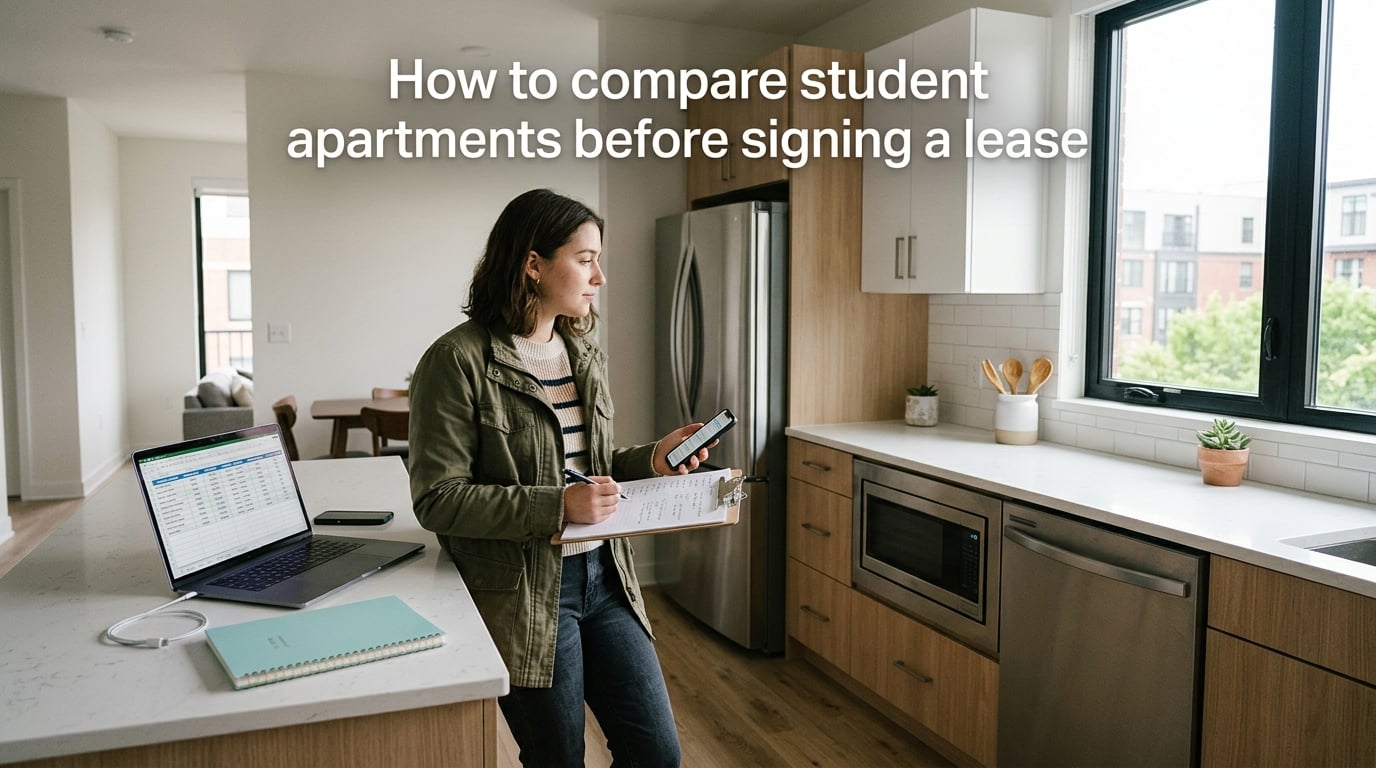
Comparing student apartments before signing a lease is the single highest-leverage thing you can do as a renter. I’ve watched classmates lose security deposits, get stuck covering a missing roommate’s rent, and discover too late that their “all-inclusive” building tacked on utilities after move-in. None of that had to happen. The whole job is to slow down, build a short side-by-side view, and let the lease terms – not the listing photos – make the decision. This guide walks through the exact framework our team uses when we help students choose between off-campus options.
In this article, you’ll get the rent-to-income rule of thumb landlords won’t tell you, a weighted scoring rubric you can copy into a spreadsheet, the lease red flags we always grep for, the inspection checklist we run on every tour, and the negotiation asks that actually move the needle. By the end, you’ll have everything you need to compare student apartments before signing a lease with the same rigor a property manager would use on you.
Table of Contents
Is signing a lease the right move for you?
A lease is a binding contract, and signing one as a college student only makes sense when you’re staying in the same city long enough to recoup the move-in costs. If you’re on a 12-month academic calendar and plan to study abroad, transfer, or graduate mid-cycle, a 12-month lease can trap you. In that case, look for sublet-friendly individual leases, a 9-month academic lease, or month-to-month rentals with a premium.
A standard lease does make sense when you have steady income (job, stipend, family support), you know your roommates, and you’ve physically toured the unit. The lease protects both sides – it locks in your rent, spells out maintenance obligations, and gives you a written record of what you agreed to. The risk isn’t the lease itself; the risk is signing one you didn’t read.
When a lease beats the alternatives
- You’re staying in the same city for the full lease term and have a stable funding source.
- You want predictable monthly housing costs instead of month-to-month rent increases.
- You need a proof-of-address document for credit cards, bank accounts, or visa paperwork.
When you should pause before signing
- Your academic plans might change mid-year (study abroad, transfer, gap semester).
- You haven’t met your roommates in person and can’t verify their reliability.
- The landlord is pushing you to sign before you’ve toured the actual unit you’ll occupy.
Start with the total cost, not the advertised rent
The headline rent is the smallest number that matters. A “950 per month” apartment can easily become 1,350 per month once utilities, parking, renter’s insurance, and required add-ons are tallied. When I sit down with a student, the first thing we do is add every line item into one monthly figure, then test whether that figure fits their actual budget.
The 30% rent-to-income rule of thumb
Most financial advisors cap housing at 30% of gross monthly income. For students, the realistic version is: total housing cost (rent + utilities + insurance + parking + internet) should not exceed 30% of your predictable monthly cash flow – including student loans, family contributions, and part-time wages.
If you’re wondering what salary you need to afford 1,500 in rent, use this shortcut: multiply the rent by 40. That gives you the recommended annual gross income (about 60k). At 30x the rent, you’re at the financial-stress line. Below 30x, you’re overextending.
Add every line item, not just rent
- Utilities – electricity, gas, water, trash, internet. Ask which are included and what the average monthly bill runs for that unit.
- Renter’s insurance – typically 15 to 30 per month but often required by the lease.
- Parking – surface, garage, reserved, or street-only. Each tier has a different monthly fee.
- Pet fees – monthly pet rent plus a one-time pet deposit. Even fish count in some buildings.
- Amenity fees – some student buildings charge for fitness, pool, or package handling.
- Trash and pest control – occasionally itemized separately from “utilities included.”
The 30/30/40 split for student budgets
If you’re building a budget from scratch, try this split: 30% needs (rent + utilities + transit + groceries), 30% academic (tuition, books, lab fees), 40% everything else. If the 30% needs bucket can’t hold your rent and utilities, the apartment is too expensive – no matter how nice the photos look.
Measure location and commute the way you actually live it
Distance from campus is one number; commute time is another. A building 0.8 miles from your lecture hall might be a 25-minute walk in winter, a 6-minute bike ride on a clear day, or a 15-minute bus ride if you catch the wrong transfer. The only way to know is to do the route yourself during the hours you’ll actually commute.
Test the commute at three times of day
- Walk or bike the route during your real class hours – 8 a.m., noon, and 5 p.m. each give a different feel.
- Take public transit during the same windows and count transfers. One-transfer routes feel easy; three-transfer commutes grind you down by week three.
- Drive the route during morning rush. Note parking cost, permit zones, and how long the lot-to-class walk actually takes.
Audit the neighborhood, not just the building
Open Google Maps and Street View the block. Walk the perimeter at night on a weekday. Look for working streetlights, sidewalk repair, and foot traffic. Then check the city’s crime map for the specific address – not just the zip code. Reddit threads for that neighborhood are often brutally honest about noise, package theft, and weekend parties.
Build a “Tuesday in mid-semester” mental test
Imagine your average Tuesday three months from now: wake up, grab coffee, walk or bus to class, attend two lectures, hit the library, come home to cook dinner, study for two hours, sleep. Which apartment makes that flow easiest? The cheapest one, or the one closest to your routines?
Compare lease terms clause by clause
The lease is where every comparison either pays off or falls apart. Two apartments with identical rent can produce wildly different years based on five clauses: lease length, individual vs joint, sublet policy, early termination, and renewal terms. Read every one. The standard lease is 12 months, but many student buildings offer 9-month academic-year leases, 6-month short terms, or month-to-month options at a premium.
Individual lease vs joint lease
An individual lease means each tenant signs a separate agreement and is responsible only for their own rent and damages. If a roommate skips out, the landlord can’t come after you for their share. A joint lease (sometimes called a “joint and several” lease) makes every tenant responsible for the full rent. One missing roommate means the rest of you cover their portion – or face eviction.
For first-time student renters with limited credit history, individual leases are almost always safer. The rent per unit is often slightly higher because the landlord carries more risk, but you don’t lose sleep over a flaky roommate.
Sublet and early-termination policy
Subletting is the ability to rent your unit to someone else while you’re away. Some student leases forbid it entirely; others allow it with landlord approval and a paperwork fee. Early termination is the escape hatch if you need to leave mid-lease. Read what it costs – typically 1 to 3 months’ rent as a penalty plus any re-letting fees.
If your plans might change, pay close attention to these two clauses. Reddit threads are packed with horror stories of students locked into 12-month leases when their study abroad or internship fell through.
Renewal, rent increases, and notice periods
Auto-renewal clauses that lock you in for another year without a 30- to 60-day opt-out window are a red flag. Look for the renewal notice period – 60 days is standard; anything shorter than 30 days is aggressive. If the lease allows the landlord to raise rent by any amount at renewal, you have no protection against a 20% jump next August.
Build a weighted scoring rubric to compare apartments side by side
This is the part most guides skip, and it’s the part that actually decides between two close options. A weighted scoring rubric turns “I kinda like A but B has better parking” into a number you can defend. I use a 10-criterion template with each criterion weighted by what matters most to the student.
The 10-criterion template
Score each apartment 1 to 5 on every criterion, multiply by the weight, and total. The highest score isn’t always the best – but it surfaces trade-offs you might otherwise miss.
- Total monthly cost (weight 15) – rent + utilities + fees + insurance + parking.
- Commute time to campus (weight 12) – weighted average across your class schedule.
- Lease flexibility (weight 12) – sublet policy, early-termination cost, lease length.
- Safety and neighborhood (weight 10) – crime data, lighting, foot traffic, reviews.
- Unit features (weight 10) – in-unit laundry, kitchen, HVAC, soundproofing, natural light.
- Building amenities (weight 8) – gym, study lounge, package room, bike storage.
- Roommate fit (weight 8) – reliability, sleep schedule, cleanliness.
- Landlord/property management reputation (weight 8) – reviews, response time, maintenance track record.
- Furnishing (weight 7) – furnished, unfurnished, or partial.
- Pets, parking, and guest policy (weight 5) – only matters if you have specific needs.
- Walkthrough condition (weight 5) – what you see when you physically tour.
How to score when trade-offs are forced
Almost no apartment wins on every criterion. The job of the rubric is to make the trade-off explicit: cheaper rent often costs an extra 20 minutes of commute time; flexible leases usually carry a premium. Once you’ve totaled each apartment, ask: “If I drop the lowest-scoring criterion, would my answer change?” That’s usually the trade-off you can’t accept.
Tour the apartment like an inspector
Bring a phone with a working camera, a small flashlight, and a notebook. Tour every unit you’ll actually live in – never sign for a “comparable” unit you haven’t seen. Show up unannounced if you can; some landlords stage model units that look nothing like the actual vacancy. The walkthrough is the single best chance to catch a problem before it costs you a deposit.
What to photograph and document
- Every wall, ceiling, and floor for stains, cracks, water damage, and missing paint chips.
- All appliances with model numbers and current condition.
- Every window – check for drafts, broken seals, and security locks.
- Bathroom fixtures – run hot and cold water and time how long it takes to get hot water.
- HVAC vents – turn on heat and AC and confirm every room responds.
- Outlets and light switches – count them per room; students always need more than they expect.
What to test while you’re inside
Flush every toilet. Run every faucet. Open every cabinet. Turn on every burner. Listen for street noise with the windows closed, then with them open. Bang on the wall – if it sounds hollow, your future neighbors will hear your late-night study sessions.
Tour at the time you’ll actually live there
Reddit users consistently warn that apartments toured in summer feel quiet but turn loud once fall semester starts. If you can, visit on a weekday evening during a typical semester week. The building’s real noise floor will show up between 9 p.m. and 1 a.m. – not at 2 p.m. on a Tuesday in July.
Spot lease red flags before you sign
Red flags aren’t subtle. Once you know what to look for, you’ll see them in seconds. The most common ones our team flags during student lease reviews fall into five buckets: payment clauses, entry rights, deposit handling, maintenance promises, and termination terms.
Red flag clauses to flag in writing
- “Tenant agrees to pay all late fees as determined by landlord.” Late fees should be a fixed dollar amount or a percentage of rent – never open-ended.
- “Landlord may enter at any time without notice.” Standard is 24-hour notice except in emergencies. Walk away from anything broader.
- “Security deposit is non-refundable.” Most states require deposits to be refundable. Non-refundable deposits are often illegal or contested.
- “Tenant responsible for all repairs under 500.” Routine maintenance and appliance repairs are typically the landlord’s job. Some wear-and-tear clauses are normal, but dollar thresholds above 100 deserve scrutiny.
- “Early termination equals full remaining lease value.” Standard early termination is 1 to 3 months’ rent, not the entire remaining lease. If they want it all, negotiate or walk.
- “No subletting under any circumstances.” Hard bans on subletting eliminate your flexibility for study abroad, internships, or a sublet semester. Push for a “with landlord approval” clause instead.
Scam red flags outside the lease
Refusal to let you tour the unit in person, demands for deposit via wire transfer or gift card, listings priced far below market, and landlords who can’t produce verifiable ownership documents are all scam indicators. If any of these show up, leave. Real landlords have nothing to hide.
Questions to ask before signing a student lease
Before signing, ask the leasing agent these questions and write down the answers. The list looks long, but each one covers a clause you’ll wish you’d read.
- What is the total monthly cost including all fees, utilities, parking, and required insurance?
- Which utilities are included, and what is the average monthly bill for this specific unit?
- What is the lease length, and is there a 9-month academic option?
- Is this an individual lease or a joint lease, and what happens if a roommate leaves?
- What is the security deposit, application fee, and any other upfront costs?
- What is the sublet policy, and is landlord approval required?
- What is the early-termination fee and notice period?
- How much notice does the landlord give before entering the unit?
- What is the maintenance response time for non-emergency issues?
- Are renters required to carry renter’s insurance, and what coverage minimum?
- What is the renewal process and rent increase history for the past three years?
- Are pets, guests, or parking restricted, and what are the fees?
Negotiate the lease before you sign it
Most students don’t negotiate because they assume the lease is take-it-or-leave-it. In reality, landlords expect negotiation on student leases, especially during the off-season. The trick is asking for things they can give without losing money.
Concessions that actually move
- One month free or half-off – common during summer or winter leasing lulls. Even a 5% rent reduction across 12 months adds up.
- Free parking or storage – landlords discount add-ons more easily than base rent.
- Earlier move-in or later move-out – if your academic calendar doesn’t match their standard lease, ask for a date shift at no cost.
- Sublet clause – even if the standard form forbids subletting, landlord-approved sublet is a frequent concession.
- Bug treatment or fresh paint guarantee in writing – if you spot issues on tour, get the fix promised in the lease, not in a verbal promise.
When to walk away
If the landlord refuses to put concessions in writing, refuses in-person tours, or pressures you to sign within 24 hours, walk. A legitimate landlord won’t lose a deal over a 24-hour cooling-off period. Your comparison work is only useful if you stay willing to say no.
Frequently Asked Questions
What are some red flags in a lease agreement?
The most common red flags are open-ended late fees, landlord entry without notice, non-refundable security deposits, tenant responsibility for all repairs over a low dollar threshold, early-termination clauses that demand the full remaining lease value, and outright bans on subletting. Scam red flags outside the lease include refusal of in-person tours, deposit demands via wire transfer or gift card, and landlords who cannot verify ownership.
Is a lease a good idea for a college student?
A lease is a good idea when you have stable funding, you know your roommates, and you plan to stay in the same city for the full term. It is a bad idea when your plans might change mid-year (study abroad, transfer, internship) or if you have not toured the actual unit. An individual lease is safer than a joint lease because you are only responsible for your own rent and damages.
What to ask before signing an apartment lease?
Ask for the total monthly cost including all utilities and fees, which utilities are included, the lease length, whether it is an individual or joint lease, the deposit and upfront costs, the sublet policy, the early-termination fee, the landlord entry notice period, maintenance response time, renter’s insurance requirements, renewal process, and any pet or parking restrictions. Write down every answer and confirm key terms in writing before signing.
What salary do I need to afford $1500 rent?
A common rule of thumb is that monthly rent should not exceed 30% of gross monthly income. To afford 1500 per month in rent, you would want a gross monthly income around 5000, which is an annual salary of roughly 60,000. For students, the realistic version is to keep total housing cost (rent plus utilities plus insurance plus parking) at or below 30% of predictable monthly cash flow from jobs, family support, and student income.
Final thoughts on comparing student apartments before signing a lease
Comparing student apartments before signing a lease comes down to three habits: build the total-cost number before you fall for the listing photos, score every shortlist option against a weighted rubric, and read the lease clauses yourself. The students who avoid bad leases aren’t the ones with the nicest buildings – they’re the ones who treated the decision like the financial commitment it is.
Take the rubric template from this guide, run your shortlist through it, and book the tours. The apartment that scores highest on the criteria that matter to you is usually the one worth signing – provided the lease clauses survive the red-flag check.