
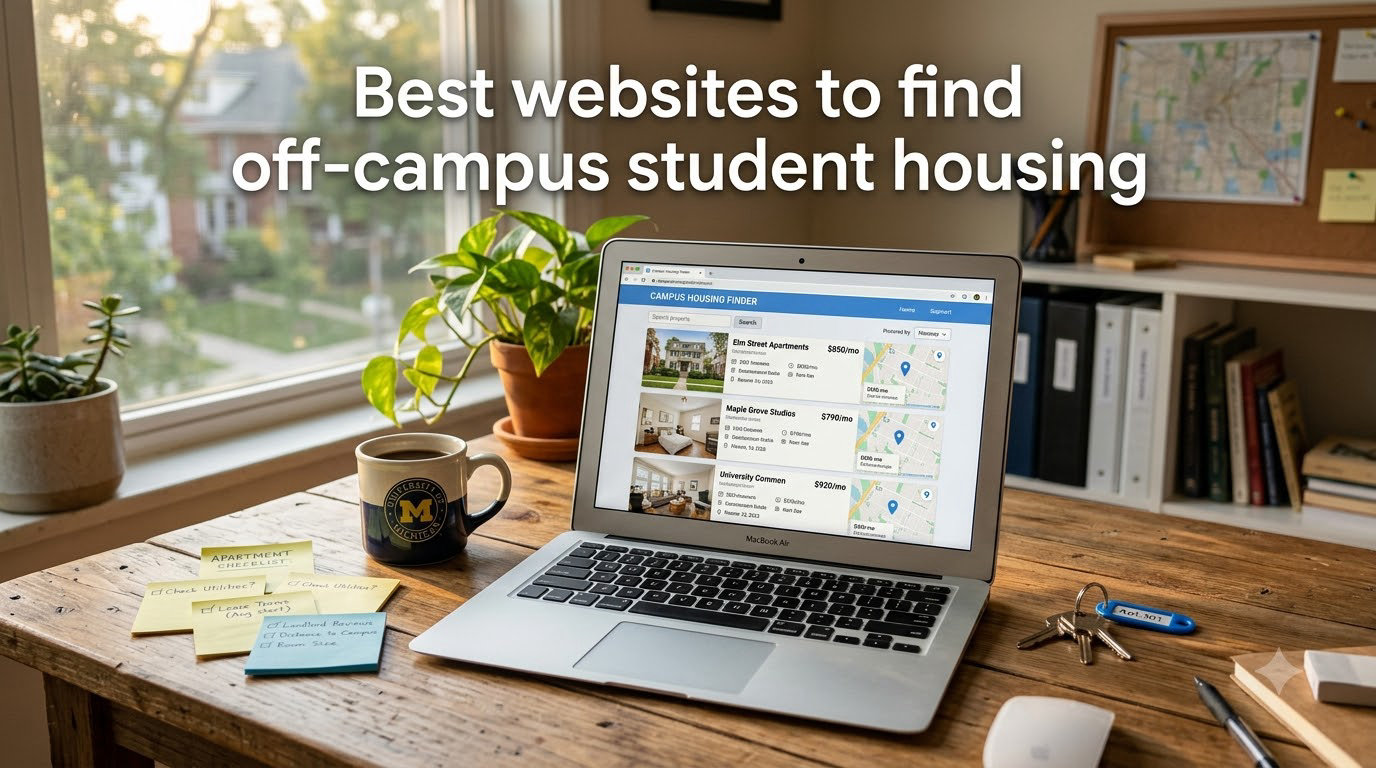
Finding the best websites to find off-campus student housing can turn a stressful search into a smooth move-in. After helping dozens of students compare platforms, I learned that layering two or three specialized sites beats relying on a single marketplace. In this guide, I break down the top platforms students use to find off-campus apartments, roommate matches, and subleases, plus how to spot scams, what to budget, and when to start your search.
Table of Contents
Quick Answer: The 7 Best Websites to Find Off-Campus Student Housing
If you only have time for a short list, here are the seven websites I recommend most for 2026 based on verified listings, student-specific filters, and proven lease outcomes:
Places4Students — best for university-vetted listings near campus
Zillow — best for verified rentals with 3D Matterport tours
Apartments.com — best for the largest inventory with school proximity filters
Uloop — best for sublets, lease transfers, and student-only listings
Roomsurf — best for finding compatible roommates by lifestyle
College Student Apartments — best for per-person pricing on shared units
Find My Place — best for verified listings with LGBTQ+ and pet-friendly filters
Keep reading for the full breakdown, a side-by-side comparison table, and answers to the questions students ask me most.
Top Student-Focused Housing Platforms Worth Your Time
Student-focused platforms build their filters around campus distance, per-person pricing, lease length, and roommate matching. These are the dedicated sites I recommend starting with.
Places4Students
Places4Students is North America’s leading off-campus housing platform, trusted by students, landlords, and universities. Listings come from vetted landlords who often partner with school housing offices, which lowers scam risk significantly. You can filter by school, lease length, and amenities like furnished units or utilities included.
Best for: first-year students and transfers who want university-screened listings. Cost: free for students to search.
Uloop
Uloop combines rental listings, sublet postings, and a roommate finder in one place. Students post listings for lease transfers, summer sublets, and rooms in shared apartments. The platform also runs university-specific sublets, so you can browse listings for your exact school.
Best for: students taking over a lease mid-year or hunting for a summer sublet. Cost: free.
Roomsurf
Roomsurf uses a swipe-style interface to match you with potential roommates based on lifestyle, major, year, and habits like cleanliness or sleep schedule. Once you match, the platform reveals contact details so you can discuss shared housing options. It is the most personality-driven roommate finder on this list.
Best for: students who already have a place lined up and need to fill a room. Cost: free.
College Rentals
College Rentals aggregates listings that are explicitly marketed to students, with filters for semester leases, furnished units, and utilities included. The site also lets landlords post by university, which is helpful when you are new to a college town.
Best for: students who want a semester-by-semester lease. Cost: free.
College Student Apartments
College Student Apartments lists per-person pricing, which is rare among rental sites. This makes it easy to compare total monthly cost when you are sharing a unit with roommates. The platform works with property managers who specialize in student housing near major universities.
Best for: roommates splitting a unit and budgeting together. Cost: free.
Find My Place
Find My Place stands out for its verification-first approach and unique filters, including LGBTQ+ friendly housing, pet-friendly units, and accessibility options. Each listing carries an FMP Score that rates the property on transparency, landlord responsiveness, and tenant reviews. This is the platform I trust most when a student asks for a safer alternative to Craigslist.
Best for: students who want verified listings with inclusive filters. Cost: free.
CribWiz
CribWiz curates student-friendly listings and includes detailed neighborhood guides with walking distances to campus, nearby grocery stores, and bus routes. The platform is smaller than the giants but offers more context per listing, which helps if you are moving to a new city.
Best for: students relocating to an unfamiliar college town. Cost: free.
General Rental Sites With Strong Student Filters
General rental marketplaces are not built just for students, but their scale and verification features make them essential for any off-campus housing search. Here is how to use them effectively as a student.
Zillow
Zillow is one of the most recognized rental platforms in the US, with a deep inventory and detailed listings. The standout feature for students is 3D Matterport tours, which let you walk through a unit remotely before scheduling an in-person visit. Zillow also surfaces price history so you can tell if a listing is fairly priced for the neighborhood.
Student tip: search by school name plus the city to surface listings landlords have tagged for student housing.
Apartments.com
Apartments.com has one of the largest rental inventories in the country and a powerful map view that shows school proximity at a glance. You can filter by apartment community, individual landlord, or building type. Listings often include verified reviews from past tenants, which adds a trust layer that pure classifieds lack.
Student tip: use the school proximity filter and check whether utilities are included in the rent.
Trulia
Trulia, owned by Zillow Group, offers a similar inventory but adds neighborhood data like crime stats, school ratings, and commute times. For students who care about the surrounding area, the neighborhood insights on Trulia are valuable when narrowing down a shortlist.
Rent.com
Rent.com specializes in connecting renters with larger apartment communities, including many that target students. The platform lets you search by pet policy, which is one of the most-requested filters on this list. Rent.com also surfaces amenities like in-unit laundry, parking, and gym access.
Realtor.com
Realtor.com pulls listings directly from multiple listing services, which often means fresher inventory than smaller aggregators. The site is more landlord-friendly than student-focused, but its depth makes it a strong backup option when you cannot find the right unit elsewhere.
Redfin
Redfin focuses primarily on home sales but has expanded its rental section. The platform is best for graduate students or upperclassmen who want to rent a house or townhouse rather than an apartment unit.
Hotpads
Hotpads uses a map-first interface that is excellent for visualizing commute times, bus stops, and bike routes to campus. The platform is popular in urban college markets and includes filters for furnished units and short-term leases.
Facebook Marketplace and Housing Groups
Facebook Marketplace and university housing groups are free, fast-moving, and full of sublets and individual landlord listings. The trade-off is verification. Anyone can post, so scam risk is higher. Stick to listings with photos of the actual unit, a verifiable landlord profile, and never wire money before seeing the place in person.
Roommate-Matching and Sublease Platforms
If you already have a place and need a roommate, or you need to take over someone else’s lease, these specialized platforms solve problems general rental sites do not.
Roomsurf for Roommate Matching
Roomsurf is the most popular roommate matching tool among college students because it factors in lifestyle compatibility, not just budget. You can filter by major, year, sleep schedule, cleanliness, and even graduation date. The swipe-style interface makes the process fast.
Sublet.com for Lease Takeovers
Sublet.com is purpose-built for short-term sublets and lease transfers. Students use it to find summer sublets, semester-only rentals, or to hand off their lease when studying abroad. The platform lets you search by school and date range, which is critical when your lease does not align with the academic calendar.
Facebook Housing Groups
Most major universities have a dedicated Facebook housing group where students post sublets, room openings, and lease transfers. Search “[University Name] housing” or “[University Name] sublet” to find yours. These groups move fast, so set up alerts and be ready to message quickly.
International Student Housing Platforms
International students often need platforms that handle currency conversion, English-speaking landlords, and no-credit-history applications. These three platforms specialize in that niche.
HousingAnywhere
HousingAnywhere lets international students book housing before arriving in a new country, with verified listings and secure payments. The platform covers the US, UK, Europe, and Australia. Many listings accept international students without a US credit history, which is a major advantage.
Uniplaces
Uniplaces targets international and exchange students with verified listings, monthly contracts, and English-speaking landlords. It is strong in European university towns and works for students who need short-term or semester-long housing.
Spotahome
Spotahome offers mid-to-long-term rentals with verified listings, video tours, and a deposit-protection guarantee. It is well-suited for international students who cannot tour in person before moving.
Comparison Table: All Platforms Side by Side
Below is a side-by-side comparison of every platform covered in this article. Use it to scan features fast and decide which sites fit your situation.
| Platform | Cost to Search | Verified Listings | Mobile App | Roommate Matching | Lease Transfer | Geographic Coverage | Pet-Friendly Filter |
|---|---|---|---|---|---|---|---|
| Places4Students | Free | Yes (university-vetted) | Yes | No | Yes | US and Canada | Yes |
| Zillow | Free | Partial | Yes | No | Limited | US-wide | Yes |
| Apartments.com | Free | Partial | Yes | No | Limited | US-wide | Yes |
| Trulia | Free | Partial | Yes | No | Limited | US-wide | Yes |
| Rent.com | Free | Partial | Yes | No | Limited | US-wide | Yes |
| Realtor.com | Free | Partial | Yes | No | Limited | US-wide | Yes |
| Redfin | Free | Partial | Yes | No | Limited | US-wide | Yes |
| Hotpads | Free | Partial | Yes | No | Yes | US urban markets | Yes |
| Uloop | Free | No | Yes | Yes | Yes | US universities | Limited |
| Roomsurf | Free | No | Yes | Yes (lifestyle match) | No | US colleges | No |
| College Rentals | Free | Partial | No | No | Yes | US colleges | Limited |
| College Student Apartments | Free | Partial | No | No | Yes | US universities | Yes |
| Find My Place | Free | Yes | Yes | No | Yes | US colleges | Yes |
| CribWiz | Free | Yes | No | No | Yes | US colleges | Yes |
| Sublet.com | Free | Partial | No | No | Yes (sublet focus) | US and Canada | Limited |
| HousingAnywhere | Free | Yes | Yes | No | Yes | Global | Yes |
| Uniplaces | Free | Yes | Yes | No | Yes | Global | Yes |
| Spotahome | Free | Yes | Yes | No | Yes | Global | Yes |
| Facebook Marketplace | Free | No | Yes | No | Yes | Global | Yes |
| Craigslist | Free | No | Yes | No | Yes | Global | Limited |
What to Look for in a Student Housing Platform
Not every rental platform is built with students in mind. Here are the features that matter most when choosing where to search.
Filters That Match Student Reality
Look for platforms that let you filter by lease length (semester versus 12-month), per-person pricing, distance to campus, furnished status, and utilities included. These filters save hours of manual searching and help you compare units on equal footing.
Verified Listings and Vetted Landlords
Verified listings mean the platform has confirmed the landlord owns the unit and the listing is real. Places4Students, Find My Place, HousingAnywhere, Uniplaces, and Spotahome all lead on verification. General sites like Zillow and Apartments.com verify listings partially, while Facebook Marketplace and Craigslist verify nothing.
Cost to Use the Platform
Every platform in this article is free for students to search. Landlords may pay listing fees, but you should never have to pay to browse. If a platform asks for a credit card to view listings, leave.
Mobile App Versus Desktop Experience
Major platforms like Zillow, Apartments.com, Trulia, Rent.com, Realtor.com, Redfin, Hotpads, Roomsurf, Uloop, Find My Place, HousingAnywhere, Uniplaces, and Spotahome all have dedicated mobile apps. Smaller student-focused platforms often work best on desktop. Use the app for quick alerts and the desktop for deep searches.
Geographic Coverage
General rental sites work in nearly every US city. Student-focused platforms tend to concentrate around major universities, so check whether your school is covered. International platforms like HousingAnywhere and Uniplaces are strongest in the UK, Europe, and Australia, and are gaining US coverage.
Roommate Matching and Lease Transfer
If you need a roommate, Roomsurf and Uloop both have built-in matching. If you need to take over a lease mid-year, Sublet.com, Uloop, College Rentals, and Facebook housing groups are the strongest options. General rental sites rarely support either use case well.
How to Avoid Rental Scams: Red Flags to Watch For
Rental scams hit students hard. According to FTC data, rental and housing scams cost Americans tens of millions of dollars annually, with students and young renters among the most common targets. Here is how to protect yourself.
Top Red Flags in Student Housing Listings
Below-market rent: if the price is dramatically lower than similar units in the area, it is probably fake.
Pressure to pay before viewing: legitimate landlords will let you tour the unit or do a video walkthrough.
Requests for wire transfers or gift cards: no real landlord accepts these payment methods.
No lease or written agreement: never send a deposit without a signed lease and verified landlord identity.
Stock photos only: listings that show only professional or reused photos are a warning sign.
Landlord outside the country: be cautious if the landlord claims to be traveling and cannot show the unit.
Steps to Verify a Listing Before Paying
Confirm the landlord owns the property through county records or a property tax lookup. Cross-reference the listing photos with a reverse image search. Search the landlord’s name and phone number online. When possible, tour the unit in person or via live video before paying any deposit. Use platforms with built-in verification like Places4Students or Find My Place to reduce risk from the start.
When to Start Your Search: Timeline and Budget Tips
Timing your search right is just as important as picking the right platform. Here is the timeline and budget framework I share with every student I advise.
Search Timeline
Start your search 2 to 3 months before the semester begins. In college towns with tight inventory (think UCLA, UC Berkeley, Boston University, NYU), competition peaks 60 days before move-in. In smaller markets, you can sometimes wait until 4 to 6 weeks out, but you will have fewer options.
Budget Beyond Rent
Rent is only one piece of the cost. Plan for utilities (electric, gas, water, internet), renters insurance, parking, and any amenity fees. Always ask whether utilities are included in the rent before signing. Some platforms, like College Student Apartments, list per-person pricing so you can split costs cleanly with roommates.
Hidden Costs to Watch For
Application fees, administrative fees, and mandatory renter’s insurance can add up fast. Some landlords charge per-person application fees, so a group of four roommates might each pay separately. Ask for a full cost breakdown in writing before committing.
Use Your University Housing Office
Most universities maintain a free off-campus housing office that maintains vetted listings and roommate boards. This is an underrated resource, especially for first-year and international students. Your school’s housing office can also flag known scam patterns in your area.
Frequently Asked Questions
What is the best website to find off-campus student housing?
Places4Students is the strongest dedicated platform for off-campus student housing, with university-vetted listings and student-specific filters. Pair it with Zillow for verified rentals with 3D tours, Apartments.com for the largest inventory, and Roomsurf for roommate matching. Layering two or three platforms gives the best coverage.
How do I find cheap off-campus housing as a college student?
Start with College Student Apartments for per-person pricing, then check Sublet.com for short-term sublets that undercut 12-month lease rates. Look slightly farther from campus where rent is lower, and use Roomsurf to find roommates so you can split a larger unit. Always factor in utilities and renters insurance when comparing total cost.
Is Places4Students a legitimate site?
Yes. Places4Students is North America’s leading off-campus housing platform, trusted by students, landlords, and institutions. Listings come from landlords who often partner with university housing offices, which adds a verification layer that general rental sites do not provide.
What is the best app for finding college roommates?
Roomsurf is the most popular roommate-matching app for college students. It uses a swipe-style interface and matches you based on lifestyle, major, year, and habits like cleanliness and sleep schedule. Uloop also offers roommate matching alongside its rental and sublet listings.
Can I find sublease options near my campus?
Yes. Sublet.com specializes in short-term sublets and lease transfers, while Uloop runs university-specific sublet boards. Most universities also have a Facebook housing group where students post summer sublets and lease takeovers. Set up alerts and be ready to message quickly because sublet listings move fast.
How can I avoid rental scams as a student?
Never wire money or pay with gift cards before touring a unit. Use platforms with built-in verification like Places4Students or Find My Place. Confirm the landlord owns the property through county records, reverse-image search the listing photos, and always get a signed lease before paying any deposit.
Conclusion Choosing the Right Platform for Your Situation
The best websites to find off-campus student housing depend on what you need most. For verified, university-vetted listings, Places4Students is my top pick. For the largest inventory and 3D tours, Zillow and Apartments.com are essential. For roommate matching, Roomsurf leads. For sublets and lease transfers, Sublet.com and Uloop are unmatched. For international students, HousingAnywhere, Uniplaces, and Spotahome offer verified listings that work without a US credit history.
Layer two or three platforms, start your search 2 to 3 months before move-in, verify every listing before paying, and use your university housing office as a free backup. With that approach, you will find the right place without falling into the common traps that trip up first-time renters.