
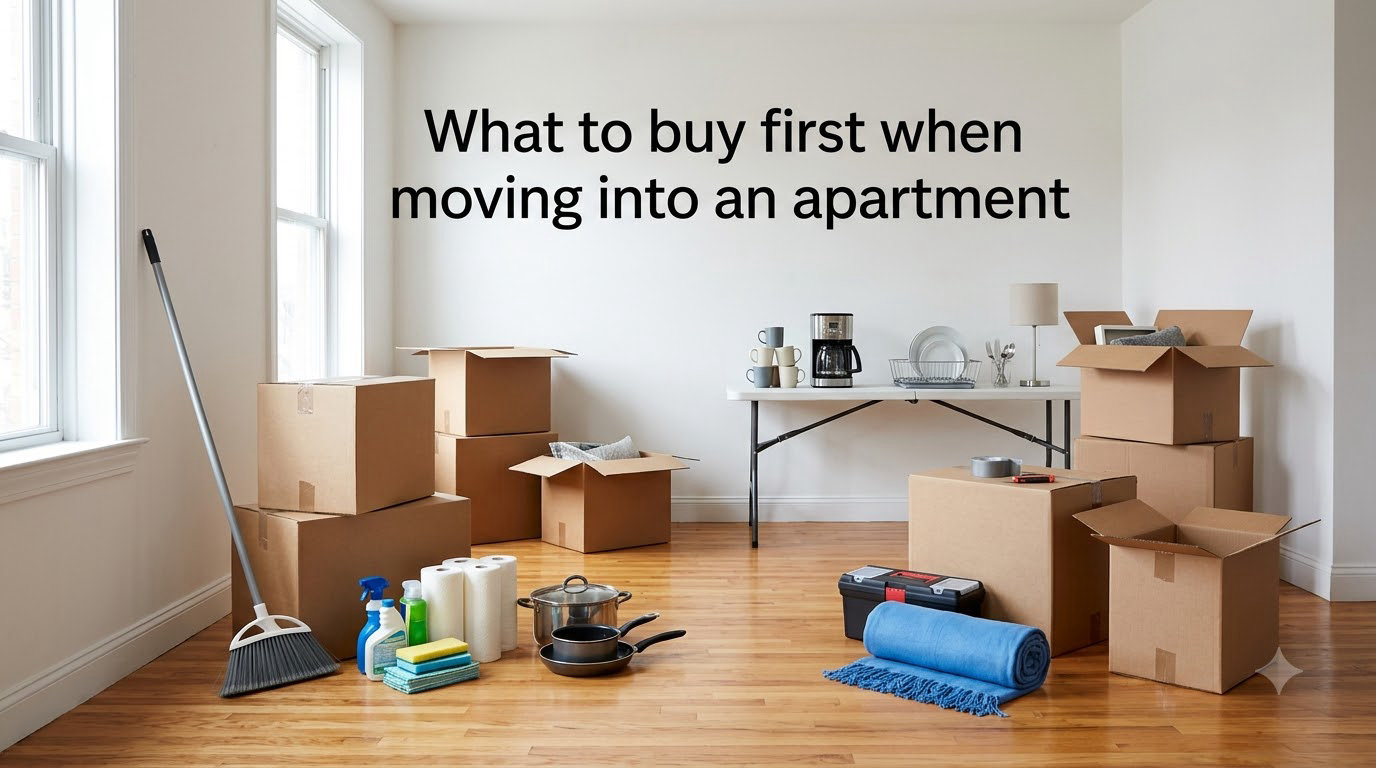
Moving into your first apartment is equal parts exciting and overwhelming. You walk through the door of an empty space and realize you need… everything. After helping dozens of students navigate this exact moment, I’ve put together the definitive guide on what to buy first when moving into an apartment so you can settle in without the stress spiral.
This guide breaks down exactly what you need, room by room, with a focus on the items that matter from day one. We’ll cover your first 48 hours survival kit, room-by-room essentials, often-forgotten items, budget strategies, and a pre-move timeline so nothing catches you off guard.
Table of Contents
Your First 48 Hours Survival Kit
The absolute essentials for your first 48 hours are toilet paper, a shower curtain with rings, bedding, basic toiletries, a phone charger, and basic cleaning supplies. These items keep you functional while you figure out the rest.
Buy these before you move in. Pack them in a clearly labeled box or bag that travels with you, not on the moving truck. You’ll thank yourself at 11pm when you need to use the bathroom or crash into bed.
- Toilet paper (at least one pack)
- Paper towels or cleaning wipes
- Shower curtain and curtain rings
- A towel and basic toiletries (soap, toothbrush, toothpaste)
- Bedding — a pillow and a blanket at minimum
- Phone charger
- Box cutter or scissors for unpacking
As one Reddit user put it: “Shower curtains and shower curtain rings. It’s human to forget one of these things right when you move in.” We’ve seen it happen more times than we can count.
Bedroom Essentials
Your bedroom is where you’ll spend roughly a third of your time in the apartment, so it deserves attention early. The good news is you don’t need much to make it livable.
Must-Have Items
- Mattress or mattress topper — If the apartment doesn’t include one, this is your single biggest purchase. A decent mattress topper can transform an old mattress for a fraction of the cost.
- Bedding set — Two sets of sheets (so you always have a clean set), a duvet or comforter, and at least two pillows.
- Hangers — Buy more than you think you need. You’ll accumulate clothes faster than you expect.
- Curtains or blinds — Privacy matters from night one. Even a temporary blackout curtain makes a difference.
- Laundry basket — Dirty clothes pile up fast without one.
Nice-to-Have (Buy Later)
Bed frame, bedside table, desk, full-length mirror, and decorative items can all wait. As Reddit users consistently advise: “Don’t buy a lot of stuff for your apt until you’ve lived in it for a few weeks.” Get the basics sorted first, then figure out what you actually want.
Bathroom Essentials
The bathroom is the room where missing essentials cause the most immediate problems. You don’t realize how important a plunger is until you desperately need one.
Must-Have Items
- Shower curtain and rings — Yes, this appears on the survival kit list too. That’s how often people forget it.
- Bath mat — Prevents slipping and protects the floor. Non-negotiable.
- Towels — At least two bath towels, two hand towels, and a few washcloths.
- Toilet brush and plunger — The “holy trinity” of apartment essentials according to Reddit includes a plunger. As one user warned: “The 1st time you meet your neighbours shouldn’t be in a panic asking if they have a plunger you can borrow.”
- Toilet paper holder — Often overlooked if the apartment doesn’t have one built in.
- Trash can with a lid — Small, with a lid. Trust us on this one.
- Basic toiletries — Hand soap, body wash, shampoo, toothbrush, toothpaste.
Nice-to-Have (Buy Later)
Bathroom shelving, a cosmetic mirror, bath scale, and decorative items can all come later once you understand the space better.
Kitchen Essentials
You don’t need a fully stocked kitchen to eat well. Reddit users recommend a minimalist approach: “You need less dishware. Maybe a 4 set of dishes, a mixing bowl, 1 frying pan, a cutting board, and a spaghetti pot, 2 cookie sheets.” That’s genuinely enough to cook most meals.
Must-Have Items
- One frying pan and one pot — These two pieces handle 80% of home cooking.
- Cutting board — Get a decent plastic or bamboo one. Avoid glass cutting boards — they dull knives.
- Knife set — You need a chef’s knife and a paring knife at minimum.
- Plates, bowls, and glasses — A set of four covers you and one guest.
- Utensils — Forks, knives, spoons, a spatula, a wooden spoon, and tongs.
- Can opener — You will need this sooner than you think.
- Food storage containers — Leftovers are your best friend when you’re busy.
- Dish soap, sponge, and dish towels — Clean as you go from day one.
- Dish drying rack — One of the most commonly forgotten kitchen items.
Nice-to-Have (Buy Later)
A coffee maker, toaster, blender, baking sheets, mixing bowls set, and specialized gadgets can all wait. Focus on what you’ll actually use daily first.
Living Room Essentials
The living room is the easiest room to leave mostly empty at first. You need far less here than you think.
Must-Have Items
- Something to sit on — A sofa, armchair, or even floor cushions. You need a place to rest that isn’t your bed.
- A lamp — Most apartments have terrible overhead lighting. A floor lamp or table lamp transforms the space.
- Power strip or extension cord — Reddit users emphasize this repeatedly: “Get some extension chords. In some units outlets are few and far between.”
Nice-to-Have (Buy Later)
A coffee table, TV stand, bookshelf, throw blankets, and rugs are all things you should buy after living in the space for a few weeks. You’ll know what fits and what you actually want once you’ve spent time there.
Cleaning Supplies
Start with the absolute basics. You can always add specialized products later once you know what surfaces you’re dealing with.
- Multi-surface cleaner spray
- Broom and dustpan (or a small vacuum if you have carpet)
- Mop or Swiffer-style tool
- Trash bags
- Disinfectant wipes
- Toilet cleaner
- Laundry detergent
- Rubber gloves
As one Reddit user wisely advised: “Bring a broom, rags, and very basic cleaning products (disinfectant, toilet cleaner, wipes) to clean up when you move in.” Your apartment will not be as clean as you expect, even if it looks fine at first glance.
Tools and Toolkit Basics
You don’t need a professional toolkit, but a few basic tools save you from scrambling when something needs fixing or assembling.
- Screwdriver set — Both Phillips and flathead. You’ll use these more than any other tool.
- Hammer — For hanging pictures and small repairs.
- Measuring tape — Essential for figuring out furniture placement.
- Step stool — Reddit’s “holy trinity” of apartment tools includes this. You’ll need it for top shelves, changing light bulbs, and hanging curtains.
- Wall hooks (Command hooks) — Hang things without damaging walls and risking your security deposit.
- Level — For hanging things straight. A phone app works in a pinch.
First Aid Kit
This is one of those things you don’t think about until you need it. A basic first aid kit should include:
- Band-aids in assorted sizes
- Antiseptic wipes or spray
- Pain relievers (paracetamol or ibuprofen)
- Antihistamines
- Tweezers
- Thermometer
- Any prescription medications you take regularly
Keep it somewhere accessible — not buried in a box you haven’t unpacked yet.
Often-Forgotten Items You Actually Need
This section is compiled from real experiences shared on Reddit, Quora, and moving forums. These are the items people consistently forget until it’s too late.
- Fire extinguisher — Reddit’s “holy trinity” for apartments includes this. It’s a safety item that could save your life and your belongings.
- Plunger — Already mentioned, but worth repeating because of how often it’s forgotten.
- Extension cords and power strips — Older apartments rarely have enough outlets in the right places.
- Dish drying rack — Surprisingly easy to forget if you’ve always had one.
- Light bulbs — Check what your apartment uses and buy spares.
- Wi-Fi router or modem setup — Reddit users warn: “Get your wifi sorted out… I spent the first week without wifi because the company had to ship the modem.” Contact your internet provider at least two weeks before moving in.
- Smoke detector batteries — Even if the apartment has detectors, the batteries may be dead.
- Key hooks or a key bowl — Losing your keys in an unpacked apartment is a special kind of frustration.
- Shower caddy or bathroom organizer — Especially important if your bathroom has limited storage.
- A basic toolkit — Already covered, but worth noting that most people don’t realize they need one until they’re trying to assemble furniture with their bare hands.
Buying Guide: Where to Shop and How to Budget
Knowing what to buy is only half the equation. Knowing where to buy it and how much to spend is what keeps you from blowing your budget in week one.
Buy New vs. Buy Secondhand
Not everything needs to be brand new. Here’s a practical breakdown:
Always buy new: Mattress, bedding, towels, toiletries, cleaning products, food storage containers, first aid supplies. Hygiene items should always be fresh.
Fine to buy secondhand: Furniture (sofa, tables, shelving), kitchenware (pots, pans, plates), lamps, curtains, and decorative items. Charity shops, Facebook Marketplace, and car boot sales are goldmines for these.
Consider buying secondhand but inspect carefully: Electrical items, upholstered furniture (check for stains or pests), and anything with moving parts.
Where to Shop (UK Student Focus)
- IKEA — The go-to for affordable furniture, kitchenware, and storage solutions. Their basics range is hard to beat on price.
- Argos — Good for small appliances, bedding, and kitchen essentials. Often has student discount deals in September.
- B&M and Home Bargains — Excellent for cleaning supplies, kitchen basics, and storage items at very low prices.
- Primark — Surprisingly good for towels, bedding, and basic homeware at budget prices.
- Charity shops — Perfect for kitchenware, books, decorative items, and sometimes furniture. Prices are unbeatable.
- Facebook Marketplace and Gumtree — Best for larger furniture pieces. Always inspect in person before buying.
- Amazon — Good for specific items you can’t find locally, especially tools, first aid kits, and tech accessories.
Estimated Budget Breakdown
Based on our research and real student experiences, here’s what you can expect to spend per room when buying a mix of new and secondhand items:
- Bedroom: £250–£400 (mattress topper, bedding, hangers, curtains)
- Kitchen: £200–£350 (cookware, utensils, dishes, cleaning supplies)
- Bathroom: £60–£120 (towels, shower curtain, toiletries, plunger)
- Living room: £150–£400 (seating, lamp, power strips)
- Cleaning and tools: £80–£150 (basic supplies and toolkit)
- First aid and safety: £30–£50
Total estimate: £770–£1,470 buying a mix of new and secondhand. Buying everything new pushes this to £1,200–£2,000. Buying primarily secondhand can bring it down to £400–£700.
Pre-Move Timeline
A timeline prevents the last-minute panic that leads to forgotten items and overspending.
4 Weeks Before Move-In
- Start collecting boxes and packing supplies
- Begin sorting and decluttering — donate or sell what you won’t bring
- Research and contact internet/broadband providers (setup can take 1-2 weeks)
- Start browsing secondhand furniture listings
2 Weeks Before Move-In
- Order or purchase your First 48 Hours Survival Kit items
- Confirm internet installation date
- Arrange utility transfers or new accounts (electricity, gas, water)
- Set up mail forwarding if moving to a new area
- Book a van or moving help if needed
Week of Move-In
- Pack a clearly labeled “First Night Box” with survival kit items
- Clean supplies ready for arrival
- Confirm move-in time with landlord or letting agent
- Charge all devices and portable batteries
Move-In Day
- Do a full walk-through before unpacking (see Move-In Inspection Checklist below)
- Set up bed first — you’ll need it tonight
- Install shower curtain and stock bathroom essentials
- Unpack kitchen basics
- Take photos of everything for your records
First Week
- Unpack room by room, starting with essentials
- Buy remaining items based on what you actually need
- Get to know the neighbourhood — locate nearest shops, pharmacy, and GP
- Meet your neighbours (not in a plunger emergency)
Move-In Inspection Checklist
This step protects your security deposit and is one of the most important things you can do on move-in day. As Reddit users advise: “While doing the initial walk-thru, take notes and pics of everything, especially any signs of wear and tear issues.”
What to Document
- Photograph every room, including walls, floors, ceilings, and windows
- Test all taps, flush toilets, and run showers to check water pressure and drainage
- Check all light switches and power outlets work
- Test the heating system, even if it’s summer
- Look for signs of damp, mould, or pest activity
- Check all locks on doors and windows
- Note any existing damage — scratches, stains, dents, or marks
- Check smoke and carbon monoxide detectors are present and working
What to Do With Your Findings
Email the photos and a written list to your landlord or letting agent within the first 48 hours. Keep a copy for yourself. This creates a timestamped record that protects you when it’s time to get your deposit back. Many landlords will try to charge for “damage” that existed before you moved in — your photos are your proof.
Frequently Asked Questions
What should I buy first when moving into an apartment?
Buy your First 48 Hours Survival Kit first: toilet paper, shower curtain with rings, bedding, basic toiletries, a phone charger, and cleaning supplies. These items make your apartment livable from night one. Everything else can wait a few days.
How much does it cost to furnish a first apartment?
A basic first apartment setup costs £770–£1,470 when buying a mix of new and secondhand items. Buying everything new typically costs £1,200–£2,000, while buying primarily secondhand can bring it down to £400–£700. The biggest costs are the mattress, bedding, and kitchen cookware.
What are the most commonly forgotten items when moving into an apartment?
The most commonly forgotten items are a plunger, shower curtain rings (people remember the curtain but forget the rings), extension cords, a dish drying rack, a fire extinguisher, light bulbs, and Wi-Fi setup. Reddit users consistently mention these as items they wished they had from day one.
Should I buy everything new for my first apartment?
No. Buy hygiene items and bedding new (mattress, towels, toiletries), but furniture, kitchenware, and decorative items are perfectly fine secondhand. Charity shops, Facebook Marketplace, and IKEA basics range offer excellent value. As experienced movers advise: live in the space for a few weeks before buying non-essential items.
What is the first thing I should move into my new apartment?
Your First Night Box should be the first thing through the door. Pack it with toilet paper, a towel, basic toiletries, bedding, phone charger, a change of clothes, and any medications. This box stays with you during the move, not on the truck, so you can settle in even if everything else arrives late.
Do I need a plunger for my first apartment?
Yes, absolutely. A plunger is one of the most essential items for any apartment, and it is one of the most commonly forgotten. As Reddit users warn, you do not want the first time you meet your neighbours to be asking to borrow their plunger. Buy one before you move in.
Final Thoughts
Knowing what to buy first when moving into an apartment comes down to prioritizing function over form. Get your survival kit sorted, set up each room with just the essentials, and resist the urge to buy everything at once. The best apartment setups come from living in the space first and buying intentionally over time.
Use the pre-move timeline to stay organized, do your move-in inspection to protect your deposit, and remember that every experienced renter started exactly where you are now. Your first apartment won’t be perfect — and that’s completely fine. It just needs to be livable, functional, and yours.