
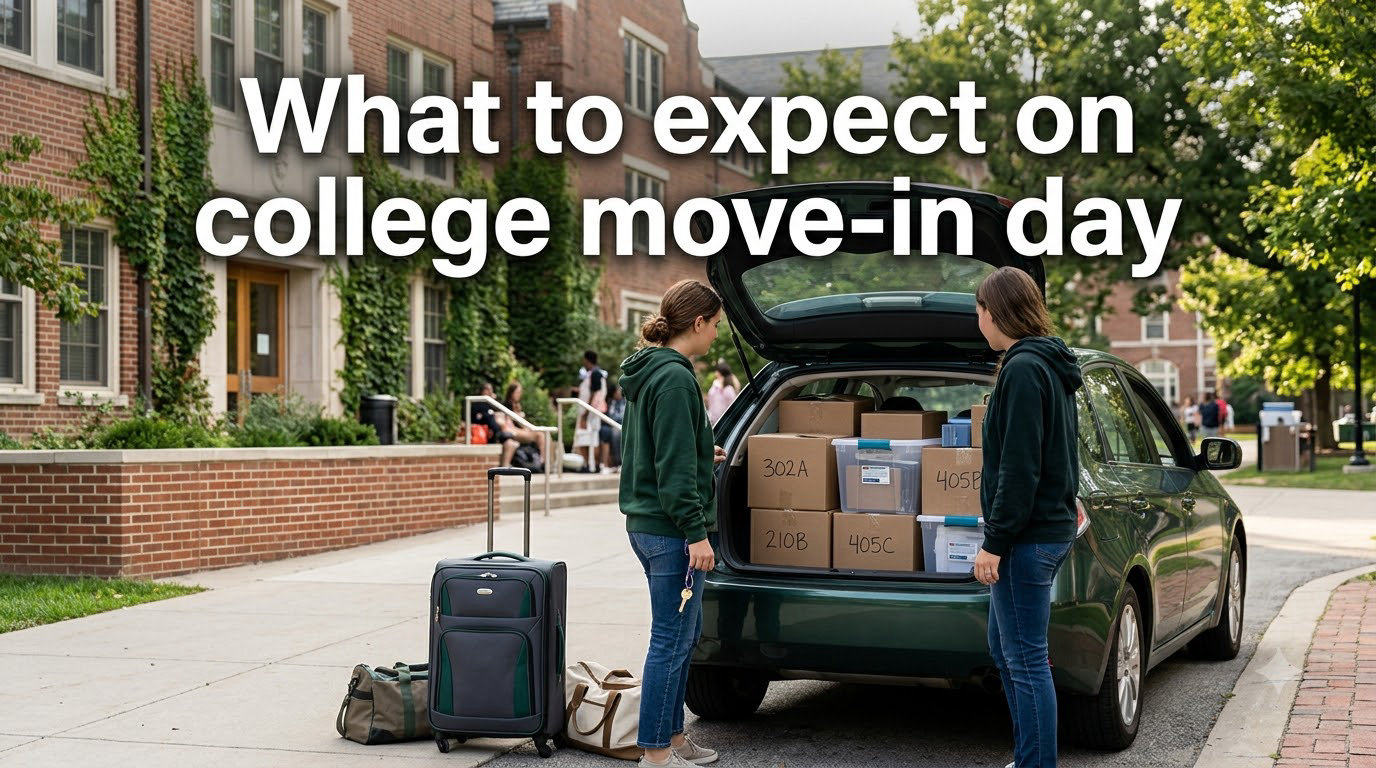
If you’re staring at suitcases, storage bins, and a long packing list, you’re probably asking one big question: what to expect on college move-in day? Here’s the short answer. Most move-in days run 3 to 5 hours from arrival to settled-in, with the actual unloading taking just 15 to 30 minutes. The rest is hauling boxes, assembling furniture, and meeting your roommate for the first time.
I’ve walked through move-in day with dozens of freshmen families, and the pattern is the same every year. Schools run move-in like a tightly orchestrated operation, with assigned arrival slots, volunteer helpers, and temporary loading zones designed to keep traffic moving. This guide walks through every stage so you know exactly what happens, when, and how to handle the curveballs.
Table of Contents
What Happens When You Arrive on College Move-In Day
The first thing that happens on college move-in day is a check-in at your residence hall lobby, where you show photo ID, confirm your housing assignment, and collect your room key or keycard. Universities assign every student a specific arrival window (often a two-hour slot) to spread out traffic, and pulling into campus during your window is the single biggest thing you can do to avoid long lines.
At the check-in table, you’ll usually receive a welcome packet with your student ID, meal plan card, parking permit, and a schedule of orientation events. A resident assistant (RA) is typically posted at the entrance to greet you, answer questions, and walk your family up to your room. Some larger schools run a curbside check-in where volunteers meet you at the car, scan your name on a tablet, and direct you straight to the unloading zone.
You’ll also be asked to sign a room condition report, a one-page checklist where you note any pre-existing damage (scuffs, stains, broken blinds) before you move anything in. Take photos of the empty room with your phone before you unpack. Schools use this report at year-end to determine whether damages are charged to you or counted as normal wear, and having timestamped photos is the easiest way to protect your security deposit.
What to bring to the check-in table
Have your photo ID, housing confirmation email, and a printed copy of your assigned arrival time in your hand. Keep them in a small folder you can grab without digging through a suitcase. If your school texted or emailed a QR code, pull it up on your phone before you reach the front of the line.
Parking and Unloading Zone Strategy
Parking is the single biggest frustration on move-in day, and the strategy is simple: use the temporary unloading zones near your building, then move your car to long-term parking before you start hauling boxes. Unloading zones are usually marked with cones, signs, or volunteers in bright shirts, and they sit right next to the residence hall entrance. You get 15 to 30 minutes in these spots before you have to relocate your car.
From the forums I read, the lesson is consistent: bring your own dolly or hand cart if you can. Schools lend them out, but the popular 4-wheel moving carts run out by mid-morning, and parents end up making 12 trips with their arms full. A cheap folding utility cart from any hardware store pays for itself the first time you wheel a mini-fridge and three storage bins in one go.
If your building has elevators, expect waits of 10 to 15 minutes during the peak window between 10 a.m. and 1 p.m. The trick is arriving either before 9 a.m. or after 2 p.m., when half the families are already settled and the second wave hasn’t hit yet. Older buildings without elevators (often historic dorms on quad-style campuses) will route you through a side stairwell with a load-in door, and volunteers will help carry mattresses up.
Unloading zone etiquette
Pull in, pop the trunk, unload fast, and move your car. Don’t leave your vehicle parked while you set up the room. Unloading zones turn into gridlock when one car blocks the next, and a frustrated family behind you means more stress for everyone. Aim for a true 20-minute exit and you’ll be a favorite among the volunteers.
How Long Does College Move-In Day Take?
Plan on move-in day taking 3 to 5 hours total, with the actual car-to-room unloading clocking in at 15 to 30 minutes and the rest going to unpacking, bed assembly, and meeting people. Early-morning arrivals can be done in 2.5 hours if you’ve prepped and packed light; late-afternoon arrivals often stretch to 6 hours when crowds and elevator waits pile up.
Here’s a realistic breakdown of how the hours split:
Check-in and lobby paperwork: 15 to 30 minutes, longer if you hit a registration line
Unloading the vehicle: 15 to 30 minutes from curb to empty trunk
Parking relocation: 5 to 15 minutes including the walk back
Hauling boxes to the room: 30 to 60 minutes with a dolly, longer without
Bedding setup, bed lofting, and basic unpacking: 45 to 90 minutes
Meeting roommate and RA: 20 to 45 minutes, often the most enjoyable part
If you don’t finish unpacking on day one, that’s completely normal. Many students leave boxes half-packed and finish setting up during the first week when classes haven’t started yet. The goal on move-in day is to get your bed made, your clothes put away, and a safe space set up so you can sleep that night.
Dorm Room Setup and Meeting Your Roommate
Once the boxes are in, the next phase is dorm room setup, which usually starts with the bed. Most dorms use extra-long twin beds, and many come with a loft kit so you can raise the frame and create floor space for a desk or futon underneath. Lofting takes 20 to 30 minutes with the included hardware and a basic screwdriver, so bring a small toolkit if your school doesn’t provide one.
Before you start unpacking, take 5 minutes to walk around the room with your roommate (if they’re there) and decide on a layout. Who gets the window side? Where does the mini-fridge go? Is the closet split or shared? Locking in these decisions early prevents passive-aggressive tension three weeks in. Surveys show the most common roommate conflict starters are temperature, lights, and noise, so talk about sleep schedules and study habits in that first meeting.
If your roommate arrives before you, don’t panic. Most schools let the first student move in freely and the second student claim whatever space is still available. Reach out via text or email a week before to align on big items like whether you’re both bringing a mini-fridge, a TV, or a rug. The students who skip this step end up with two fridges and nowhere to put them.
Suite-style vs traditional dorm differences
Suite-style dorms give you a small private bedroom and a shared living area with 2 to 4 suitemates, plus a communal kitchenette. Move-in logistics are similar, but you’ll spend more time arranging shared furniture and less time figuring out where to put your desk. Traditional dorms pack two students into a single room with no shared interior space, which is faster to set up but requires more upfront coordination about personal items and storage.
Essential Items to Bring on Move-In Day
The six items students consistently say they wish they’d packed are a small toolkit, a first aid kit, a portable fan, a dolly or folding cart, cleaning supplies, and shelf-stable snacks. These are the things that pay for themselves in the first 60 minutes. Pack them where you can reach them without unloading the entire car.
Here’s what to pack in your “open first” bag:
Toolkit: screwdriver, hammer, pliers, a small pack of screws and command strips
First aid kit: bandages, pain reliever, allergy meds, blister patches (you’ll walk more than you think)
Portable fan: most dorms don’t have air conditioning, and a clip-on fan costs very little
Power strip with surge protection: dorms typically allow only one outlet per wall, and you’ll need 6 to 8 plugs
Cleaning wipes and a roll of paper towels: rooms are cleaned between residents, but a quick wipe-down of the desk and bathroom fixtures never hurts
Snacks and water bottles: you’ll burn more calories than expected hauling boxes up stairs
For everything else (bedding, towels, decor, school supplies), load the car in reverse-unpacking order. Items you need last go in first; items you need first stay on top. This is the move-in day trick that turns a 6-hour setup into a 3-hour one.
What NOT to bring on move-in day
Skip candles, plug-in air fresheners, hot plates, and any open-coil heating appliances. They’re prohibited in nearly every residence hall for fire-safety reasons, and security may flag them during a room check. Also leave irreplaceable items (heirloom jewelry, important documents, expensive electronics) at home if possible. The first 24 hours are crowded and hectic, and the safe in your closet isn’t fully secured yet.
The Night Before College Move-In
The night before college move-in is when smooth move-ins are made, and chaotic ones are lost. Pack your car that evening, not the morning of. By 9 p.m. the night before, your vehicle should be fully loaded with the heaviest items on the bottom and your “open first” bag on top. Drive the route to campus on Google Maps at the time you’ll actually travel it, so you know whether to expect construction, traffic, or one-way streets.
Get to bed by 11 p.m. Move-in day is a 5-hour physical workout, and exhaustion sneaks up on you around hour 3. Lay out tomorrow’s outfit, charge your phone to 100%, and set three alarms (a single alarm means a single missed alarm). Drink a full bottle of water before bed; first-day nerves make people forget to hydrate and dehydration headaches show up by afternoon.
Mentally prepare for goodbyes. If you’re a parent, plan a specific time and a specific location to say your final goodbye, ideally somewhere away from the dorm so the departure feels like its own moment. If you’re the student, give yourself permission to feel every emotion at once. The mix of excitement, nerves, and grief is universal and it’s not a sign that something’s wrong.
What to Do After Unloading: Orientation and Floor Meetings
Once your room is set up, the next thing on a college move-in day schedule is an evening floor meeting led by your RA. These meetings typically run 45 to 60 minutes and cover fire safety, quiet hours, bathroom etiquette, and how to lock your door. Floor meetings are also where you’ll do your first icebreakers, learn everyone’s names (or at least the first 20%), and find out who’s in your study group for midterms.
Most schools stack orientation activities into the first week, what students call “Welcome Week” or “Week of Welcome” (WOW). Expect 2 to 4 scheduled events per day: club fairs, library tours, campus walks, free food giveaways, and convocation ceremonies. The week is designed so you meet as many people as possible before academics ramp up, so say yes to more invitations than feels comfortable, even if you’re introverted.
If your school offers early-arrival move-in for athletes, international students, or specific programs, take advantage of it. Empty dorms before the wave arrives mean quieter hallways, easier parking, and more one-on-one time with RAs who can answer questions. International students especially benefit from a quieter first day to recover from jet lag and adjust to a new country.
Family Goodbyes and Emotional Support on Move-In Day
The hardest part of move-in day is rarely the parking or the hauling. It’s the goodbye. Research on first-year college transitions shows that students who have a deliberate, planned goodbye with their family adjust faster than students who have a long, drawn-out farewell in the dorm hallway.
Here’s what works. Plan a final meal together off-campus (a favorite restaurant, a park, a coffee shop) about two hours after you’ve finished unpacking. Eat slowly. Talk about something other than the move. Then drive back to campus, take a walk through the quad, hug for as long as you need, and let the parent leave while the student stays in the room. The clean break lets both sides start the new chapter cleanly.
For parents, plan something for the drive home. A phone call with a sibling, a podcast queued up, or a stop halfway at a scenic rest area. The first hour after dropping a kid at college is full of complex emotions, and having a plan keeps those feelings from spilling onto the road.
For students, know that homesickness is normal and treatable. Most students feel a wave of it around dinner time on day 1 or 2, especially in quieter moments when the room is dark and the noise of the dorm settles down. A pre-planned call with a best friend from high school, a familiar playlist, or a comfort item from home (a pillow, a photo, a stuffed animal) goes a long way. If homesickness lasts longer than two weeks, every school has free counseling at the student health center. Reach out early.
From the parents I spoke with, the most consistent tip is this: don’t linger. The longer you stay, the harder the goodbye and the more it disrupts your student’s first social opportunities. The roommate is already navigating the room, the hallmates are inviting your student to dinner, and you’re now in the way. A clean, warm exit at the right moment is a gift.
Frequently Asked Questions
What to do on college move-in day?
The core move-in day steps are: arrive during your assigned time slot, check in at the residence hall lobby to get your key and welcome packet, unload your vehicle in a temporary 15 to 30 minute loading zone, move your car to long-term parking, haul boxes to your room using a dolly or campus cart, complete the room condition report, set up your bed and bedding first, then meet your RA at the evening floor meeting. Most of the day runs 3 to 5 hours, with the actual unloading taking just 15 to 30 minutes.
Do you stay in your dorm after move-in day?
Yes, after move-in day you stay in your dorm from that point forward. Move-in day is the official start of your residence in the building. From that night on you sleep there, eat in the dining hall, and live in your assigned room until the end of the semester (or summer, depending on your housing contract). Most schools do not allow you to leave belongings in the dorm over breaks, so check your housing calendar for approved travel windows.
How long is college move-in day?
Most college move-in days take 3 to 5 hours total, from the moment you pull into your assigned arrival window to the moment your bed is made and your boxes are put away. The actual car-to-curb unloading takes 15 to 30 minutes, then 30 to 60 minutes to haul everything to your room, then 45 to 90 minutes to set up the bed and unpack the essentials. Arriving before 9 AM often finishes in under 3 hours; arriving during the 10 AM to 1 PM peak can stretch to 6 hours.
What to bring college move-in day?
Bring a small toolkit (screwdriver, hammer, pliers), a first aid kit, a portable fan, a power strip with surge protection, cleaning wipes, snacks and water, your photo ID, a printed or digital copy of your assigned arrival time, bedding for an extra-long twin bed, towels, a laundry bag, and any decor or rugs. Pack the items you need first at the top of your car so they come out first. Leave candles, hot plates, and open-coil heaters at home, as they’re prohibited in nearly every residence hall.
How do you handle move-in day if your roommate arrives first?
If your roommate arrives before you, contact them a few days before move-in by text or email to coordinate big items like a mini-fridge, TV, and rug so you don’t double up. When you arrive, your side of the room will be empty and ready for you to set up. You’ll claim whichever desk, bed, and closet side is still unclaimed, then coordinate with your roommate on shared items. Most schools let the first student move in freely and the second student fill in the remaining space without conflict.
Conclusion
Knowing what to expect on college move-in day turns the whole experience from overwhelming to manageable. Show up during your assigned window, follow the volunteer crew through check-in, unload fast, set up the bed first, and meet your roommate before dinner. The whole day fits inside a half-afternoon, and what feels chaotic from the outside is a tight, well-rehearsed routine on the inside.
For 2026, your best move-in day prep is the night before: pack the car, charge the phone, pick out the outfit, and plan the goodbye. Walk in rested, hydrated, and ready to meet the next four years of your life.