
I have spent the last several months talking to students, resident advisors, and campus legal services staff about what actually goes wrong during the first year of renting. The same handful of issues came up again and again: a security deposit that never came back, a lease no one actually read, an unauthorized bedroom entry, or an eviction notice that turned out to be illegal. If you are renting your first apartment for the new school year, this guide covers the tenant rights every college renter should know before you sign anything, move a single box, or hand over a single dollar.
Renting for the first time feels like a foreign language. Landlords use legal shorthand like “joint and several liability” and “as-is condition” and expect you to nod along. Federal laws, state statutes, and local housing codes all layer together to create your protections, and the specifics vary dramatically by where your college is located. This guide walks through each major area of protection, what the law generally requires, and the exact steps to take when something goes wrong.
Table of Contents
Security Deposit Rights
A security deposit is your money held in trust by the landlord to cover potential damage or unpaid rent, and you have a legal right to get most of it back when you move out. Every state sets rules for how deposits are collected, stored, and returned, and these rules matter more than the size of the deposit itself.
Most states cap the maximum deposit amount (typically one or two months’ rent), require the landlord to return your deposit within a set window (often 14 to 30 days after move-out), and demand an itemized statement if any portion is withheld. Some states also pay interest on long-held deposits. The landlord’s job is to prove that any deduction is for actual damage beyond normal wear and tear, not for a fresh coat of paint or a carpet that reached the end of its natural life.
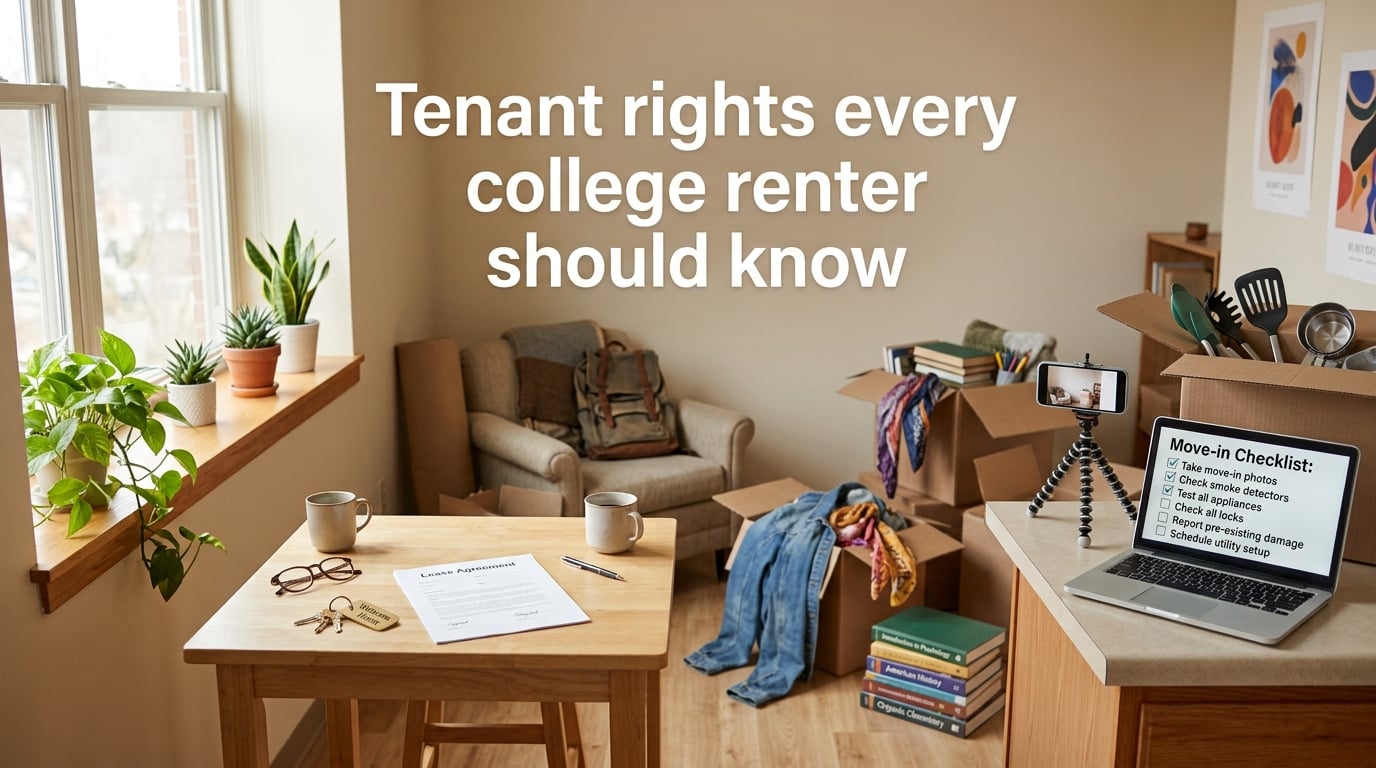
The single most important move-in habit you can develop is the move-in condition report. Walk through every room with your phone camera. Photograph the carpet, the walls, every scratch on every appliance, every sticky window, every stained tile. Take video of the counters, the tubs, the toilet flush, the oven burners. Email the photo set to your landlord the day you get the keys and keep that email thread forever. The same process in reverse at move-out gives you photographic evidence of the condition you left the unit in. In Virginia, students win roughly two-thirds of deposit disputes that go to small claims court, according to Student Legal Services at UVA, and the deciding factor is almost always documentation.
Students looking for help understanding their specific state rules can review our buying guides for state-by-state breakdowns.
What Landlords Can (and Cannot) Deduct
Allowed: Holes in walls larger than a nail, broken blinds, missing appliances, pet damage, excessive trash, professional cleaning if the unit was left filthy.
Not allowed: Normal wear and tear, faded paint, worn carpet at end of lifespan, minor scuffs, the cost of redecorating to attract the next tenant.
Lease Agreement Essentials
A lease is a binding legal contract for the entire term, usually 12 months, and reading every word before signing is the single best protective habit you can build. Most college renters skim, sign, and discover problems in February when the heating fails or in May when they suddenly need to study abroad. Here is what to actually look for in the lease agreement before your pen touches paper.
Start with the four numbers: monthly rent, security deposit amount, length of the term, and the late fee policy. Late fees vary wildly by state, with some capping them at 5 to 10 percent of rent and others allowing landlords to set any amount. The acceleration clause is a clause that says the entire remaining balance of the lease becomes due immediately if you miss a payment. If you see one, ask the landlord to remove it. Acceleration clauses are legal in many states but heavily restricted in others, and they turn a $900 mistake into a $10,000 lawsuit overnight.
The arbitration clause, which forces disputes into private arbitration instead of court, is another item worth flagging. Arbitration typically favors the party with more resources (your landlord, not you) and removes your right to a jury trial. Where state law allows, you can sometimes negotiate it out, particularly in markets with lots of vacant units. The as-is clause is the language stating that the tenant accepts the property in its current condition, which can be a major problem if the apartment has obvious habitability issues at move-in. Insist on a written list of any repairs the landlord promises to fix, with a completion date, attached to the lease.
Co-signers are almost always required for college students with no income or credit history, and the co-signer becomes legally liable if you miss a single payment. Read the co-signer section carefully. Some leases require the co-signer’s written approval for any lease modification later, which can complicate things if your parents want to help you break the lease.
Red Flags in Lease Language
“As-is” condition language that waives your right to demand repairs
Acceleration clauses that make the full remaining rent due on one missed payment
Mandatory arbitration that strips your right to a court hearing
Automatic renewal that extends the lease without your signature
Liquidated damages that charge a penalty beyond actual losses for breaking the lease
Waiver of jury trial combined with broad attorney fee provisions
The student forum on r/LegalAdvice gets at least one post a week from someone who signed a lease in August without reading and discovered a clause in December they did not bargain for. The binding answer is the same every time: a signed lease is enforceable, so read before you sign.
Eviction Protections
Eviction is a legal process, and your landlord cannot simply decide you no longer live there. Only a court order, following a formal proceeding where you have the right to be heard and to defend yourself, can lawfully remove you from your apartment. Self-help eviction tactics like changing the locks, removing your belongings, shutting off utilities, or harassing you out the door are illegal in every state.
The eviction process typically follows a clear sequence: written notice to quit or pay (usually 3 to 30 days depending on the reason and the state), filing of an unlawful detainer lawsuit if you do not resolve the issue, service of court papers, your opportunity to file an answer (often only 5 to 10 days), a court hearing, and only then a writ of possession and physical removal by a sheriff or constable. Skipping any of these steps makes the eviction legally defective, no matter what the lease says.
Tenant defenses at eviction court include: the landlord never gave proper notice, you were current on rent and the eviction is retaliatory, the unit failed a code inspection and you reported it, the landlord is discriminating against you, or the landlord accepted partial rent after serving the notice (in many states this waives the notice). Judges in housing court see these defenses regularly. Bringing copies of texts, emails, repair requests, and photos along with a one-page timeline of what happened is often the difference between an order to vacate and a dismissal.
Examples of Illegal Eviction
Changing the locks without a court order
Shutting off heat, water, or electricity to force you out
Removing doors, windows, or your belongings from the apartment
Verbally or physically threatening you to leave
Refusing to accept rent while filing an eviction
Evicting you in retaliation for reporting code violations
If any of these happen, call the police to document the incident, file a complaint with your local code enforcement office, and contact your campus Student Legal Services office the same day. Many states allow you to sue for damages, plus attorney fees, when landlords use illegal eviction tactics.
Fair Housing and Non-Discrimination
The federal Fair Housing Act protects you from discrimination based on race, color, national origin, religion, sex (including gender identity and sexual orientation since 2021), familial status, and disability. Landlords cannot refuse to rent to you, charge you higher rent, steer you to a different neighborhood, or set different terms because of any of these protected categories.
The interesting part for college renters is the categories the federal law does not list. Most states have added their own protected classes, and the ones that matter most to students are source of income, age, student status, marital status, sexual orientation, and military or veteran status. Source of income discrimination is when a landlord refuses to accept housing vouchers, Section 8, or even regular income from student loans or financial aid. As of this year, more than 20 states and dozens of major cities ban source of income discrimination, but it remains perfectly legal in many other places, including parts of Texas, Florida, and Georgia.
Disability protections also go further than most students realize. The Fair Housing Act requires landlords to allow reasonable modifications to the unit (grab bars, visual doorbells, ramps) at your expense and to make reasonable accommodations in rules and policies (waiving a no-pets rule for an assistance animal, allowing a service provider to come at a particular hour, providing a reserved accessible parking space). Documentation from a medical professional is usually enough; landlords cannot require access to your full medical records.
What Counts as Disability Discrimination in Housing
Refusing to rent because of a disability, including a mental health condition
Charging a higher deposit or pet fee for someone with an assistance animal
Refusing to make reasonable modifications like installing grab bars
Refusing to waive a “no visitors” rule for a home health aide
Refusing to assign a ground-floor unit to someone with mobility limits
Steering someone to a different building or neighborhood
If you believe you have been discriminated against, the Department of Housing and Urban Development (HUD) accepts Fair Housing complaints online and by phone. You typically have one year from the incident to file, and HUD can investigate, mediate, or refer the case to the Department of Justice. State fair housing agencies and private attorneys offer additional remedies.
Habitability and Safe Living Conditions
The implied warranty of habitability is the legal rule that your landlord is promising you a livable unit, even if your lease does not spell it out. Heat in winter, hot water, working plumbing, electricity, weatherproofing, structural safety, and freedom from pest infestations are baseline expectations in every state. A lease cannot waive this warranty, even if you signed it knowingly.
If your apartment is uninhabitable or dangerous, here is what you can do. Document the problem with photos and dated notes, send a written repair request (email or letter, not just text), and give the landlord a reasonable time to fix the issue based on severity. Reasonable time ranges from 24 to 48 hours for emergencies (no heat in winter, sewage backup, gas leak, no running water) to 14 to 30 days for non-emergencies (a broken dishwasher, peeling paint, a damaged screen). Most states give you the option to “repair and deduct” if the landlord does not act: hire a licensed professional, pay for the fix, and subtract the cost from your next rent, up to a state-set cap (often one month’s rent).
For more serious habitability failures, many states allow rent withholding, the right to put your rent into an escrow account instead of paying the landlord, until the problem is fixed. The rules around escrow are strict, so talk to legal aid or your Student Legal Services office before withholding any rent.
Code Violations That Always Trigger a Repair
No heat when the outside temperature drops below a state-set threshold
No hot water or working plumbing fixtures
Exposed wiring, missing smoke or carbon monoxide detectors
Sewage backups and standing water
Mold over a defined square footage, especially black mold
Broken locks, doors, or windows that compromise security
Maintenance and Repair Responsibilities
Maintenance requests should always be in writing, even when you call the landlord first. A phone call feels faster, but a text, email, or online portal message creates a paper trail that becomes evidence later if the repair is delayed or the dispute goes to court. State repair timelines differ, but the general rule is 30 days for non-emergency, 24 to 72 hours for urgent, and immediate response for true emergencies like fires, gas leaks, and burst pipes.
The repair and deduct remedy is worth knowing in detail. In a typical state, you must first notify the landlord in writing of the problem. You wait a “reasonable time” (often 14 to 30 days). If the landlord still does not fix it, you hire a licensed contractor, pay for the repair, and provide the receipt to the landlord along with the next rent payment minus the repair cost (often capped at one month’s rent). Some states allow this for emergencies without the waiting period. Keep every receipt.
If your landlord retaliates against you for requesting repairs, by raising rent, refusing to renew the lease, or starting an eviction, that is a separate violation. Anti-retaliation protections in most states prevent landlords from punishing tenants who report code violations, exercise legal remedies, or organize with other tenants. Retaliation is itself a defense to eviction and a basis for a damages claim.
Privacy Rights and Landlord Entry
Your landlord must give reasonable notice before entering your apartment, and reasonable usually means 24 to 48 hours written notice in most states. Entry is only allowed for specific reasons: repairs, inspections, showing the unit to prospective tenants or buyers, and emergencies. Routine visits to “check on things” or pop-in inspections are not allowed, and entering without notice can be grounds for you to change the locks, withhold rent, or even sue.
The right to quiet enjoyment is the legal promise that you can use your apartment without undue interference, and it covers much more than noise. It means your landlord cannot let maintenance workers wander in unannounced, cannot allow construction noise during quiet hours, cannot show up with prospective tenants without notice, and cannot share your personal information with neighbors or anyone else. Violations of quiet enjoyment can be defended against in court and used as grounds to break your lease in many states.
On r/TenantHelp, the most common complaint from college renters is exactly this: landlords entering with little or no notice, often with a maintenance worker who simply shows up. The legal answer is always the same: write to the landlord demanding notice for any future entry, keep a log, and call the police if the landlord enters without permission during a non-emergency.
On-Campus vs. Off-Campus Housing Rights
If you live in a college dorm or university-owned apartment, you are usually a licensee, not a tenant, which changes your legal protections in important ways. A license is permission to use the space, governed by your housing contract and the student code of conduct, while a lease creates the traditional landlord-tenant relationship. Licensees have fewer legal protections, but the university typically has its own grievance procedures and Title IX protections that fill some of the gap.
Dorm residents can almost always be removed or reassigned for conduct violations under the student handbook without going to court, but only after the university’s own disciplinary process gives you a chance to respond. Off-campus apartment residents enjoy the full landlord-tenant law of their state, and a dorm resident does not, which means an off-campus landlord needs a court order to evict you while a dorm can move you out under housing rules. Both routes give you rights, but the rules are different.
On-Campus vs Off-Campus at a Glance
| Area | On-Campus (Licensee) | Off-Campus (Tenant) |
|---|---|---|
| Eviction process | Housing office decision, then conduct process | Court order required |
| Privacy protections | Limited, plus Title IX and FERPA | State notice-of-entry laws |
| Habitability | Housing contract standards | Implied warranty of habitability |
| Discrimination | Title IX, school policies | Fair Housing Act and state law |
| Security deposit | Often non-existent or nominal | State-set rules and timelines |
| Dispute resolution | University hearing process | Court or tenant’s assertion |
For Title IX complaints and harassment in either setting, schools receiving federal funds must follow specific procedures, including an investigation, an opportunity to respond, and protections against retaliation.
Subletting, Roommates, and Joint Liability
Joint and several liability means every signer on a lease is fully responsible for the entire rent and damages, not just their share. If your roommate vanishes in October, you can be sued for the full rent they skipped and any damage they caused. This is one of the most expensive lessons college renters learn, and it shows up in r/LegalAdvice posts about leases with absent roommates almost weekly.
Subletting is one way out, but only if your lease allows it and your landlord approves the new subtenant in writing. Many leases require written consent for any subtenant, and the landlord can reasonably reject a subtenant who does not meet the original application standards. A few states (notably New York) give you a right to sublet even over the landlord’s objection, but this is the exception, not the rule.
A written roommate agreement clarifies who pays what, how shared spaces are split, how conflicts get resolved, and how to handle a roommate moving out early. It does not override the lease, but it is evidence in any dispute and a roadmap for tough conversations. Cover rent split, utility payment, overnight guests, quiet hours, cleaning duties, and a clear process for replacing a roommate who leaves.
Roommate Agreement Checklist
Rent share and due date for each roommate
Utility and internet payment split
Cleaning and chore rotation
Quiet hours and guest policy
How to handle a roommate moving out mid-lease
Process for resolving disputes (mediation, roommate meeting)
What happens if one roommate cannot pay their share
Renter’s Insurance and Breaking a Lease
Renter’s insurance costs roughly $15 to $30 per month for college students and covers your belongings against theft, fire, water damage, and liability if someone is hurt in your apartment. Landlords often require it in the lease, and many apartment complexes require proof of coverage. Even when it is not required, it is cheap protection against devastating losses, especially with laptops, textbooks, and gaming equipment typical of student rooms.
Breaking a lease is legally possible in most states if you have a qualifying reason. Active military duty orders trigger the federal Servicemembers Civil Relief Act (SCRA) protections, sexual assault, domestic violence or stalking triggers protections in many states, and uninhabitable living conditions can justify an early move. Some leases also include an early termination clause that lets you buy out of the contract for a fee, typically one to three months’ rent. Lease transfer, where you find a replacement tenant who takes over your contract, is another option if your landlord allows it.
Forum threads on r/Landlord repeatedly confirm that students try to break leases for non-qualifying reasons (transferring schools, roommate conflicts, changed majors) and discover they are still on the hook financially. Read the early termination clause before you sign, not when you need it.
What to Do When Your Landlord Violates Your Rights
When a landlord violates your rights, the order in which you respond matters. Document everything, communicate in writing, escalate through the right channels, and only then consider legal action. Here is the step-by-step process campus legal aid services use as the standard playbook.
Step 1: Document the Problem
Start a paper trail today. Photograph the issue. Save every text, email, and repair request. Note dates, times, and what was said in any phone call. A simple spreadsheet with one row per incident and columns for date, what happened, who you contacted, and what they said becomes powerful evidence if the dispute escalates.
Step 2: Communicate in Writing
Send a letter or email to your landlord describing the problem, the steps you would like taken, and a reasonable deadline. Keep the tone factual. State the law or lease provision you are relying on, if relevant. Save a copy. Many disputes resolve at this stage because landlords realize you are taking notes.
Step 3: Send a Formal Demand Letter
If the issue is not resolved, send a formal demand letter, ideally on letterhead from your Student Legal Services office or an attorney, giving the landlord a final deadline and stating that you will pursue legal remedies. Demand letters work because they signal that you are serious, not just complaining. Many state bar associations have template demand letters available.
Step 4: File a Complaint With the Right Agency
For habitability issues, file a code enforcement complaint with your city or county housing office. For discrimination, file with HUD or your state fair housing agency. For security deposit disputes, your state’s attorney general or consumer protection office often has a complaint process. For illegal eviction, call the police and document the incident.
Step 5: Pursue Legal Remedies
If the problem persists, options include small claims court (for disputes under a state-set limit, usually $5,000 to $10,000), the tenant’s assertion process in states that have one (a fast-track court process for security deposits and minor disputes), or a private attorney. Many states require landlords to pay your attorney fees if they lose, which makes hiring a lawyer more practical for renters with limited funds.
Free and low-cost legal help is more available to students than most realize. Every major university has a Student Legal Services office that handles landlord-tenant issues for free or a small fee. Legal aid societies handle housing cases for low-income renters. Law school clinics often take pro bono housing cases. State bar associations have lawyer referral services with reduced-fee consultations.
State Resources and Where to Find Your Laws
Because tenant law is mostly state law, the exact rules you live by depend on which state your college is in. The best starting point is your state legislature’s website, where the full text of every landlord-tenant statute is publicly available and free. Searching for “your state” plus “residential landlord tenant act” will usually get you to the right chapter.
Some states are widely considered tenant-friendly, with strong deposit protections, active rent control, generous repair timelines, and active enforcement. States like California, New York, Massachusetts, Vermont, Washington, Oregon, and New Jersey tend to give renters more protection than the national average. Other states, including parts of the South and Midwest, are less tenant-friendly, with weaker deposit rules, shorter repair timelines, and fewer inspection resources. Even in less friendly states, however, federal fair housing protections still apply, and most states recognize the implied warranty of habitability in some form.
For in-depth resources, the National Multifamily Housing Council publishes a 50-state survey of landlord-tenant law that breaks down security deposit caps, notice requirements, eviction timelines, and repair remedies state by state. The website for your state’s attorney general typically maintains a landlord-tenant handbook. Local law school clinics, bar associations, and tenant unions also publish local guides.
How to Find Your State’s Specific Laws
State legislature website: Search “[your state] residential landlord tenant act” to find the full statute.
State attorney general: Most publish a free landlord-tenant handbook online.
Code enforcement office: Your city or county website lists how to file a habitability complaint.
HUD regional office: HUD.gov lists the office for your state to file federal fair housing complaints.
State bar referral service: Most state bars have a reduced-fee lawyer directory.
Student Legal Services: Your campus office for free housing consultations and template letters.
Your First Move-In Checklist
Use this scannable checklist the day you move in and again the day you move out. Every step takes minutes but can save you hundreds of dollars and weeks of disputes.
Photograph every room, surface, and appliance, with timestamps enabled
Email the photo set to your landlord and keep the thread
Test every outlet, faucet, appliance, smoke detector, and HVAC setting
Note any pre-existing damage in writing within 48 hours of move-in
Read every clause in the lease before signing, especially acceleration and arbitration
Confirm the rent, deposit amount, late fee policy, and lease term in writing
Ask for a written list of any repairs the landlord promises to make
Understand renter’s insurance requirements and lock in coverage before move-in
Save your Student Legal Services contact and your local code enforcement phone number
Write down move-out notice requirements and the lease renewal date
Frequently Asked Questions
Can you get evicted from a college dorm?
Yes, dorm residents can be removed or reassigned by the housing office, but typically only after a conduct process gives you a chance to respond. Because dorm residents are usually licensees rather than tenants, the standard landlord-tenant eviction process does not apply, but the school’s housing contract and student code of conduct do. Title IX and disability accommodations still apply in dorm settings.
Can you refuse to rent to college students?
Under federal law, landlords cannot refuse to rent based on race, sex, familial status, religion, national origin, disability, or color, but student status itself is not a federal protected class. Many states and cities have added student status, source of income, and age as protected classes, which would make blanket refusal to rent to college students illegal in those jurisdictions. In states without those protections, a landlord can refuse to rent to students, but cannot use a protected category as a pretext.
Can a college student get out of a lease?
Yes, in several specific situations. Active military orders trigger SCRA protections. Domestic violence, sexual assault, and stalking trigger protections in many states. A landlord failing to provide habitable conditions is another legitimate ground. Some leases include an early termination clause that allows a buyout for a fee. Breaking a lease without one of these grounds leaves you on the hook for rent until the landlord re-rents the unit, which is why understanding the early termination clause before signing matters.
Can a 17-year-old college student rent an apartment?
A minor generally cannot enter into a binding contract, which makes it legally risky for landlords to rent to a 17-year-old. Most landlords require the lease to be co-signed by a parent or guardian if the student is under 18. Some states set a higher age of majority for housing contracts. Emancipated minors can typically sign leases on their own. The practical answer is that landlords will almost always require a parent or guardian co-signer until the student turns 18.
What rights do renters have during repairs and maintenance?
Renters have the right to prompt repairs for habitability issues, written notice before non-emergency entry, and the right to a safe and livable unit. Most states set timelines for emergency repairs at 24 to 72 hours and non-emergency repairs at 14 to 30 days. If the landlord does not act, tenants may be able to repair and deduct, withhold rent into escrow, or terminate the lease, depending on state law. Retaliation against tenants who request repairs is itself illegal.
How do I get my security deposit back as a college student?
The two most important steps are a thorough move-in condition report with photos and video, and a written request for the deposit return at move-out referencing the law in your state. Send the request to the landlord in writing and keep a copy. Most states give the landlord a window of 14 to 30 days to return the deposit with an itemized statement of any deductions. If the deposit is not returned, send a formal demand letter and, if needed, file in small claims court or through your state’s tenant’s assertion process.
Final Thoughts on Tenant Rights Every College Renter Should Know
Renting your first apartment is a major financial and legal step, and the tenant rights every college renter should know are not just legal trivia. They are the protections that keep your deposit in your pocket, your unit livable, and your housing stable through final exams and summer internships. Read your lease before you sign, document the unit before you move anything in, communicate every repair request in writing, and find your Student Legal Services office the moment something feels wrong.
The students I have talked to who came out financially whole after a year of renting all shared three habits: they read the lease, they documented everything, and they escalated through the right channels rather than just complaining. Adopt those three habits now, and the rest of the year becomes much smoother. The full list of tenant rights every college renter should know is long, but those three habits cover most of the situations you will actually face.